Heteronyms: Words Spelled the Same but Pronounced Differently

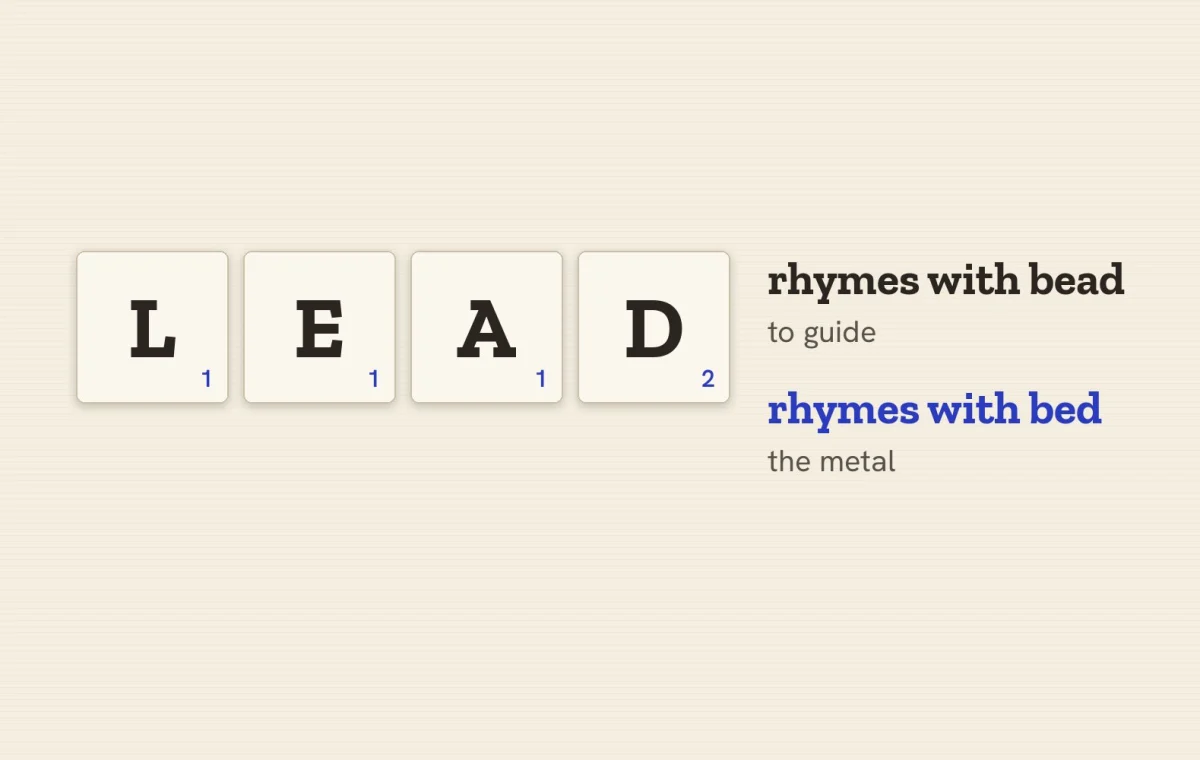
Words that are spelled the same but pronounced differently, with different meanings, are called heteronyms. Lead rhymes with bead when it means “to guide” and with bed when it is the metal; wind rhymes with pinned for moving air and with kind for turning a handle; a record is stressed on the first syllable, while to record is stressed on the second. Only the surrounding sentence tells a reader which one is meant.
The quiz below gives each word in two sentences and asks you to choose how it is said in each. It is followed by an explanation of the most productive pattern, the noun and verb pairs that differ only in stress, with a table of common examples and some notes for teachers.
Heteronym, homograph, homophone: which is which
These terms are easy to mix up because they overlap. The clearest way to separate them is to ask two questions about a pair of words: is the spelling the same, and is the pronunciation the same? The meanings are different in every case.
| Term | Same spelling? | Same sound? | Examples |
|---|---|---|---|
| Homograph | Yes | Either | bat (animal) and bat (for cricket); lead and lead |
| Homophone | Either | Yes | pair and pear; bat and bat |
| Heteronym | Yes | No | lead and lead; tear and tear |
So every heteronym is a homograph, but not every homograph is a heteronym. Homonym is the loosest of the words: it is used in everyday writing for either kind of pair, and in a stricter sense for words that share both spelling and sound. The Online Etymology Dictionary defines heteronym as a word having the same spelling as another but a different sound and meaning, and its entries for homograph and homophone set out the other two terms.
Two smaller points are worth knowing. First, some pairs in this article, such as record and record, are the same word used as a noun and as a verb, so their meanings are closely related; they are normally counted as heteronyms because both the sound and the grammatical meaning differ. Second, pairs that differ only by a capital letter, such as Polish and polish, are sometimes called capitonyms in word-play circles; in ordinary running text the capital usually gives them away.
The heteronym quiz
Read both sentences in each question, decide how the word is pronounced in each one, and choose an answer; your choice reveals the explanation and adds to your running score.
Pronunciations are given as plain respellings, with the stressed syllable in capitals where stress is the difference. They are based on the British and American transcriptions in the Cambridge Dictionary. Where British and American speech differ, the explanation says so, and in those cases neither answer is wrong in real life, even though the quiz has to mark one.
Part 1: the vowel changes
lead. (1) “The guide will lead us up the hill.” (2) “The old roof was covered with sheets of lead.”
To lead, meaning to guide or go first, rhymes with bead, and so does the noun for a dog’s lead (a mainly British use; American English usually says leash) or the lead role in a play. The soft grey metal rhymes with bed, as does the graphite “lead” in a pencil, which takes its name from the metal because graphite was once known as “black lead”.
wind. (1) “Remember to wind the clock before you go to bed.” (2) “The wind blew the door shut.”
The verb meaning to turn, coil or twist (wind a clock, a road that winds through hills) rhymes with kind. Moving air rhymes with pinned.
tear. (1) “A single tear ran down her cheek.” (2) “Try not to tear the wrapping paper.”
A drop from the eye rhymes with fear. To rip, and a rip in cloth, rhymes with bear. Note that wear and tear uses the bear sound, because it means damage.
bow. (1) “The actors came forward to take a bow.” (2) “She tied the ribbon in a neat bow.”
Bending forward in greeting or thanks rhymes with cow, and so does the front of a ship. A looped knot rhymes with go, as do the bow used to shoot arrows and the bow used to play a violin.
row. (1) “We sat in the front row.” (2) “The neighbours had a loud row about the fence.”
A line of things, and the verb for moving a boat with oars, rhyme with go. A noisy argument rhymes with cow; this sense is far more common in British English than in American English, where “fight” or “argument” is the usual word.
close. (1) “Please close the window.” (2) “The hotel is close to the station.”
The verb meaning to shut ends in a Z sound and rhymes with nose. The adjective meaning near ends in a hissing S sound and rhymes with dose. The same split appears in use: “a use” ends in S, “to use” ends in Z.
live. (1) “The concert is being broadcast live.” (2) “Where do you live now?”
The adjective and adverb (a live broadcast, a live wire) rhyme with five. The verb meaning to be alive or to reside rhymes with give.
wound. (1) “The nurse cleaned and dressed the wound.” (2) “He wound the rope around the post.”
An injury rhymes with swooned, with an “oo” sound. The past tense of wind (to turn or coil) rhymes with sound. This pair is linked to the wind question above, so a reader who knows one can work out the other.
does. (1) “Two does were grazing at the edge of the wood.” (2) “She does the crossword every morning.”
The plural of doe, a female deer or rabbit, rhymes with rose. The everyday verb rhymes with buzz.
sow. (1) “Farmers sow winter wheat in the autumn.” (2) “The sow lay in the straw with her piglets.”
To plant seed rhymes with go, and sounds exactly like sew. A female pig rhymes with cow.
bass. (1) “He sings bass in the church choir.” (2) “They caught a large bass in the lake.”
The lowest musical voice or instrument rhymes with face, and sounds like base. The fish rhymes with mass.
dove. (1) “A white dove landed on the roof.” (2) “She dove into the pool without hesitating.”
The bird rhymes with love. Dove as the past tense of dive rhymes with stove; it is common in North American English, while British English usually says dived.
sewer. (1) “The storm drains empty into the main sewer.” (2) “She is a fast sewer and finished the dress in a day.”
A drain for waste water is said “SOO-er” (in British English also “SYOO-er”, or squeezed into something close to one syllable). Someone who sews is said “SOH-er”, identical to sower, a person who sows seed. The second meaning is rare in practice, which is exactly why it trips readers up.
Part 2: the stress changes
record. (1) “She set a new national record.” (2) “Please record the meeting for anyone who is absent.”
The noun is stressed on the first syllable, “REK-ord” (in American English often “REK-erd”). The verb is stressed on the second, “ri-KORD”, and its first vowel weakens. This is the model for the whole stress-shift pattern explained below the quiz.
present. (1) “The mayor will present the prizes.” (2) “Thank you for the lovely present.”
The verb meaning to give or show formally is “pri-ZENT”. The noun meaning a gift, and the adjective meaning here or current, are “PREZ-uhnt”.
object. (1) “What is that shiny object on the shelf?” (2) “I object to the way this decision was made.”
The noun, a thing or an aim, is “OB-jekt”. The verb, to express disapproval, is “ub-JEKT”.
desert. (1) “You would never desert a friend in trouble.” (2) “Camels are well suited to life in the desert.”
The verb meaning to abandon is “di-ZURT”, which sounds exactly like dessert. A dry, barren region is “DEZ-ert”. The phrase just deserts, meaning what someone deserves, also uses the “di-ZURTS” sound, which probably explains why it is often misspelled with a double S.
content. (1) “The content of the report was never made public.” (2) “The cat looked content by the fire.”
The noun, what something contains, is “KON-tent”. The adjective meaning satisfied, and the related verb, are “kun-TENT”.
invalid. (1) “The ticket is invalid after midnight.” (2) “After the accident he lived as an invalid for many years.”
Meaning not valid or not legally acceptable, it is “in-VAL-id”. Meaning a person weakened by illness or injury, it is “IN-vuh-lid”; that use is now rather old-fashioned, and many writers avoid it when describing real people.
refuse. (1) “The refuse is collected every Thursday.” (2) “I refuse to answer that question.”
The noun meaning rubbish is “REF-yooss”, stressed on the first syllable and ending in S. The verb meaning to decline is “ri-FYOOZ”, stressed on the second and ending in Z, so this pair changes both stress and a consonant.
produce. (1) “The factory will produce five hundred bicycles a week.” (2) “The market sells fresh local produce.”
The verb is “pruh-DYOOSS” or “pruh-JOOSS” in British English (American “pruh-DOOSS”). The noun meaning farm goods is “PROD-yooss” or “PROJ-ooss” in British English and “PROH-dooss” or “PRAH-dooss” in American English; either way, the stress is on the first syllable.
minute. (1) “The train leaves in a minute.” (2) “There was a minute crack in the glass.”
Sixty seconds is “MIN-it”. The adjective meaning extremely small is “my-NYOOT” (American English often “my-NOOT”). The noun minutes, the record of a meeting, uses the “MIN-it” sound.
console. (1) “Nothing she said could console him.” (2) “The pilot checked the lights on the console.”
The verb meaning to comfort is “kun-SOHL”. The noun, a control panel or a cabinet, is “KON-sohl”.
entrance. (1) “Please use the side entrance.” (2) “The music seemed to entrance the whole audience.”
A way in is “EN-truhnss”. The verb meaning to fill with wonder is “in-TRAHNSS” (American “in-TRANSS”); it is built from trance, which is the easiest way to remember the sound.
Part 3: the ones people miss
number. (1) “Pick a number between one and ten.” (2) “My fingers grew number the longer we waited in the cold.”
The everyday word is “NUM-ber”. In the second sentence, number is the comparative of numb, “more numb”, and the B stays silent just as it does in numb: “NUM-er”.
putting. (1) “She is putting the books back on the shelf.” (2) “He spent the afternoon putting on the practice green.”
From put, meaning to place, it rhymes with footing. From putt, the gentle golf stroke, it rhymes with cutting. The spelling hides the fact that the golf word has a double T in its base form.
axes. (1) “The woodcutters sharpened their axes.” (2) “Label both axes of the graph clearly.”
The plural of axe is “AK-siz”. The plural of axis is “AK-seez”, following the same pattern as crisis and crises.
moped. (1) “He moped around the house all weekend.” (2) “She rides a moped to work.”
The past tense of mope is a single syllable, “mohpt”. The small motorbike is “MOH-ped”, two syllables; according to the Online Etymology Dictionary, the word was coined in Swedish in the early 1950s from shortened forms of the words for “motor” and “pedals”.
separate. (1) “Keep the raw meat separate from the salad.” (2) “Separate the eggs before you whisk the whites.”
The adjective ends in a weak “-it” sound: “SEP-uh-rit” or “SEP-rit”. The verb ends in a full “-ayt”: “SEP-uh-rayt”. Dozens of words ending in -ate behave like this; there is a list further down.
If you enjoyed choosing between two plausible answers, the real or fake word quiz asks a different question about unusual words: whether they exist at all.
Why so many nouns and verbs differ only in stress
Probably the largest group of English heteronyms follows one pattern. A two-syllable word works as both a noun and a verb; as a noun it is stressed on the first syllable, and as a verb on the second. So you break a record (“REK-ord”) but record a song (“ri-KORD”), and you sign a contract (“KON-trakt”) but a metal may contract in the cold (“kun-TRAKT”). The unstressed syllable usually weakens as well, which is why the first vowel of the verb record sounds like the “ri” in return.
Most of these words were borrowed from Latin or French and begin with what was originally a prefix, such as con-, ex-, im-, pro- or sub-. The pattern is strong but it is not a rule that applies to every such word. Plenty of noun and verb pairs keep the same stress in both uses (respect, control, report, support, comment), and speakers vary on some of the pairs below, especially in American English, where verbs such as protest, increase and export can also be heard with first-syllable stress (Cambridge lists both stresses for the American verbs protest and increase, and gives first-syllable stress for the American verb export). Dictionaries record those variants, so treat the table as the common pattern rather than the only correct pronunciation.
| Word | Noun (first-syllable stress) | Verb (second-syllable stress) |
|---|---|---|
| conduct | KON-dukt: good conduct | kun-DUKT: conduct an orchestra |
| conflict | KON-flikt: an armed conflict | kun-FLIKT: the reports conflict |
| contest | KON-test: a spelling contest | kun-TEST: contest the result |
| contract | KON-trakt: sign a contract | kun-TRAKT: muscles contract |
| convert | KON-vert: a recent convert | kun-VERT: convert pounds to euros |
| convict | KON-vikt: an escaped convict | kun-VIKT: convict the accused |
| digest | DY-jest: a news digest | dy-JEST: digest a meal |
| export | EK-sport: a major export | ek-SPORT: export grain |
| extract | EK-strakt: vanilla extract | ek-STRAKT: extract a tooth |
| import | IM-port: cheap imports | im-PORT: import cars |
| increase | IN-kreess: a pay increase | in-KREESS: increase the dose |
| insult | IN-sult: a personal insult | in-SULT: insult the host |
| object | OB-jekt: a heavy object | ub-JEKT: object to a plan |
| permit | PER-mit: a parking permit | per-MIT: permit entry |
| present | PREZ-uhnt: a birthday present | pri-ZENT: present the award |
| progress | PROH-gress: make progress | pruh-GRESS: talks progress |
| project | PROJ-ekt: a school project | pruh-JEKT: project an image |
| protest | PROH-test: a peaceful protest | pruh-TEST: protest the decision |
| rebel | REB-uhl: a rebel leader | ri-BEL: rebel against rules |
| record | REK-ord: a world record | ri-KORD: record a message |
| subject | SUB-jekt: a school subject | sub-JEKT: subject them to scrutiny |
| suspect | SUS-pekt: the main suspect | suh-SPEKT: suspect a trick |
| transport | TRANS-port: public transport | trans-PORT: transport goods |
Two more patterns: -ate and -ment
Many words ending in -ate have a noun or adjective that ends in a weak “-it” or “-uht” sound and a verb that ends in a full “-ayt”. You make a rough estimate (“EST-i-mit”) but estimate the cost (“EST-i-mayt”). The same split applies to advocate, alternate, approximate, deliberate, duplicate, graduate, moderate and separate (in British English the adjective alternate also moves its stress to the second syllable). A smaller group ending in -ment works the same way: the noun ends in a weak “-muhnt” and the verb in a clearer “-ment”, as in document, experiment, implement and supplement.
Which heteronyms we think cause the most trouble
The famous examples are not the hard ones. Lead, wind, tear and bow pair two meanings so far apart (a metal and a verb, moving air and a clock key) that the rest of the sentence usually settles the sound before a reader has time to hesitate. Our view is that the stress pairs in the table above give learners of English far more trouble, for three reasons that follow from the pattern itself. The spelling carries no clue at all. The two meanings are closely related, since the noun record and the verb record are the same word in two jobs, so the sentence narrows the choice less than it does for lead. And moving the stress also changes the unstressed vowel, so a wrong guess sounds wrong in two places, not one.
The pattern can also mislead when applied by rule. Our own first draft of the stress table illustrated the verb subject with “subject to scrutiny”. Checking the Cambridge Dictionary showed that subject to in that phrase is the adjective, stressed on the first syllable, so the example contradicted its own column; the table now says “subject them to scrutiny”. It is an easy slip to make, because “subject to” looks like a verb followed by its object.
So this is how we would teach the pattern: learn the default (nouns stress the first syllable, verbs the second), learn the named exceptions that keep one stress (respect, control, report, support, comment), then check the grammar of the phrase before trusting the default. We left capitonyms such as Polish and polish out of the quiz because the capital letter answers the question in writing, and we kept the pairs that differ between British and American speech, flagged, because learners meet both. We also do not give a total number of heteronyms. The 172,446-word list we use for our counts (how we check words describes it) stores spellings only, so lead the verb and lead the metal are one entry, and no count of heteronyms can be made from it.
For teachers
- Read aloud, then explain. Ask pupils to read one sentence pair from the quiz aloud before discussing meaning; the moment of hesitation is the lesson, because it shows that reading depends on understanding the sentence as well as decoding letters.
- Sort by type. Give out the words on cards and ask pupils to sort them into “the vowel changes” (lead, wind, tear, bow) and “the stress moves” (record, present, object). Then ask them to find a new example of each from the table above.
- Write the pair in one sentence. Challenge pupils to use both pronunciations in a single sentence, such as “The farmer had to produce more produce” or “The bandage was wound around the wound“.
- Link to grammar. The stress-shift table is a practical way to teach nouns and verbs: if pupils can hear which syllable is stressed, they can usually say which part of speech the word is.
- Allow for accent. Row (an argument), lead (for a dog), dove (past of dive), sewer, produce and minute vary between British and American speech, and several stress pairs vary between individual speakers. Mark the meaning, not the accent.
For a quick vocabulary warm-up on a projector, you can also try Find the Word, a 60-second challenge to type as many words as possible from one starting letter.
New to The Verbarium? Follow the reading path, with tools and printables