Real or Fake? A 40-Word Quiz on the Strangest Playable Spellings

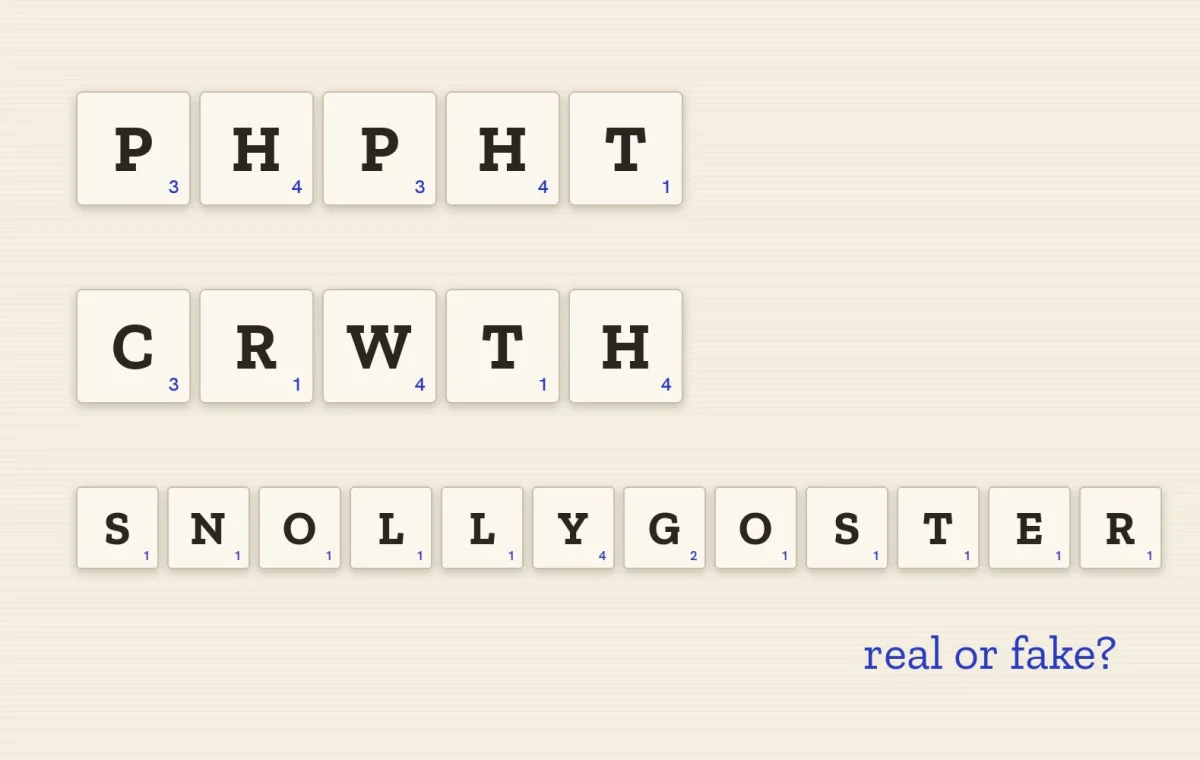
Below are 40 strange-looking spellings, split into four rounds of ten. All forty are genuine English words or close variants of them, yet only thirty are in the word list used by Find the Word, our timed word game. Read each word, decide whether you think the list contains it, and only then open the answer, which gives the meaning and, where a reliable source supports one, the origin. The ten misses are the interesting part: they show how a word-game list can hold phpht and gardyloo while leaving out emoji.
How to play along: keep a tally on paper as you go. A “valid” verdict here means one thing only: the exact lowercase spelling appears in the Find the Word list, which starts from the public-domain ENABLE word list and, after an offensive-word blocklist is removed, holds 172,446 words (the details are on how we check words). A “not valid” verdict does not mean the word is imaginary. Several of the rejected items are perfectly good English that this particular list simply does not contain.
Scoring is automatic: press Valid or Not valid for each word before opening its answer, and your running score stays at the top of the screen.
Round one: short and consonant-heavy
This round tests the instinct that a word needs vowels to count. All of these spellings are five letters or fewer, which also makes them the most useful in a 60-second round if you can trust them.
1. brr
Valid A written shiver, the noise people make when they step into the cold. The longer brrr is in the list as well, so both lengths score.
2. shhh
Not valid The written call for quiet, and a near-miss: shh with two Hs is accepted, but the list stores the sound only in that form, so the extra H pushes it outside. The older word for the same request, hush, is probably imitative too, perhaps chosen because the sound can be made very faintly.
3. cwm
Valid A Welsh word for a valley, used in geography for a steep, bowl-shaped hollow at the head of a glacial valley. In the Welsh spelling the W carries the vowel sound, roughly “koom”.
4. nth
Valid Borrowed from the mathematical use of n for an unspecified number, as in “for the nth time”. It is one of only 13 words in the game’s list with no A, E, I, O, U, Y or W at all.
5. cwtch
Not valid A much-loved Welsh-English word for a cuddle or a snug little hiding place. Wiktionary traces it through Welsh cwtsh to the same Middle English source as couch. It looks like a cousin of cwm and crwth, which is exactly why it feels safe, but the list does not include it.
6. psst
Valid The whispered call used to get someone’s attention without the whole room hearing, usually described as imitative of the sounds people make to call animals. Its plural-looking relative pssts is not in the list, so stop at four letters.
7. aglet
Valid The small plastic or metal tip on the end of a shoelace. The word came into English from French and is related to a diminutive of the word for a needle, which suits the object well.
8. crwth
Valid An old stringed instrument associated especially with Wales, a kind of lyre that was usually bowed, though it could also be plucked. Like cwm, it uses W as a vowel, and the plural crwths is accepted too.
9. phpht
Valid An exclamation of mild irritation or dismissal, written the way it sounds. Five letters, no vowels, and it still counts, which makes it a good word to remember when a P round stalls.
10. emoji
Not valid The most ordinary-looking word in this round is the one that fails. It comes from Japanese e (picture) and moji (character); the Online Etymology Dictionary credits the Japanese coinage to Shigetaka Kurita in 1999 and dates English use to 2008. Despite being everywhere in modern English it is missing from the game’s fixed list.
Round two: words for oddly specific things
These words survive because each one names something that would otherwise take a whole sentence to describe. Two impostors are hiding among them, and both are real words that simply never made it into the list.
11. bumbershoot
Valid A humorous American word for an umbrella. The usual explanation is a playful alteration of umbrella combined with the -chute of parachute, spelled “shoot”.
12. quincunx
Valid An arrangement of five things with four at the corners of a square and one in the middle, like the five spots on a die. In Latin it named a coin worth five-twelfths of a larger unit, and quincunxes and quincunxial are both accepted.
13. petrichor
Not valid The pleasant earthy smell that comes with rain after a dry spell. It sounds ancient because it is built from Greek parts (petra, stone, and ichor, the fluid in the veins of the gods), but it was coined by two Australian scientists in the 1960s and is not in the list.
14. syzygy
Valid The alignment of three celestial bodies in a straight line, such as the Sun, Earth and Moon during an eclipse. It comes from a Greek word for being yoked together, and its three Ys stand in for every vowel.
15. borborygmus
Valid The rumbling, gurgling noise of gas moving through the intestines. The Greek original was meant to imitate that sound, and the plural borborygmi also scores.
16. tintinnabulation
Valid The ringing and jingling of bells, built on the Latin tintinnabulum, a small bell. Edgar Allan Poe made it memorable in his poem “The Bells”, and at 16 letters it is the longest valid word in this quiz.
17. gardyloo
Valid The warning shout once given in Edinburgh before slops were thrown from an upstairs window into the street. It is usually traced to a mangled form of a French warning along the lines of garde à l’eau, “beware of the water”.
18. widdershins
Valid Moving anticlockwise, or against the direction of the sun, a word long associated with Scots and with bad luck. It is recorded from the 1510s and probably comes from Middle Low German weddersinnes, “against the way”. Plain anticlockwise is also accepted, if you would rather not gamble on the spelling.
19. omphaloskepsis
Valid Contemplation of one’s own navel, whether as a meditation practice or as a mocking description of self-absorption. It joins Greek omphalos (navel) and skepsis (examination).
20. ultracrepidarian
Not valid Someone who offers opinions far beyond their own expertise. It echoes the Latin saying about a shoemaker who should not judge above the sandal, and it looks every bit as dictionary-worthy as omphaloskepsis, but this list leaves it out.
Round three: bother, bluster and quick exits
This group sounds the most invented, because many of these words were coined for comic effect and have obscure origins. Watch for near-misses, because one of the fakes in this round differs from a valid entry by a single letter.
21. defenestrate
Valid To throw someone or something out of a window, from Latin fenestra, window. The noun defenestration is best known from the Defenestration of Prague in 1618, and both forms are accepted.
22. absquatulate
Valid To leave suddenly, often without paying or saying goodbye. It is probably a piece of mock-Latin from American slang of the 1830s, and the list also has absquatulated and absquatulates.
23. collywobble
Not valid The singular looks like a reasonable back-formation, but the list only holds the plural-shaped collywobbles. The word is almost always used in that plural form for a nervous, queasy stomach, which is probably why the list has no separate singular entry.
24. collywobbles
Valid Stomach ache, or the fluttery nerves that feel like one. It is often explained as a playful blend of colic and wobble, and it scores exactly as spelled here.
25. snollygoster
Valid A shrewd, unprincipled person, especially a politician who will say anything to win. It is a 19th-century Americanism, and snollygosters is accepted as well.
26. lollygag
Valid To dawdle or waste time instead of getting on with something. It is American English from the 1850s, and the variant lallygag is actually recorded a few years earlier. The list has the full set of forms for both spellings, from lollygags to lallygagging, eight entries in all.
27. kerfuffle
Valid A fuss or commotion, usually over something that did not deserve one. It grew out of the Scots curfuffle, and it remains common in informal British English.
28. mumpsimus
Not valid A stubborn attachment to a mistake, or a person who keeps making it after being corrected. The old story behind it involves an elderly cleric who misread the Latin sumpsimus for years and refused to change, and the word looks exactly like the other Latin-flavoured curiosities here, but the list does not include it.
29. flummox
Valid To baffle someone completely. It turns up by the 1830s in English and Australian slang; its origin is uncertain, though the Oxford English Dictionary has suggested a British dialect source. At seven letters it is a realistic answer to find in an F round.
30. skedaddle
Valid To run away in a hurry. It spread as American slang in the 1860s, and skedaddled, skedaddles and skedaddling are all accepted.
Round four: the long ones
Long words feel either impressively official or suspiciously made up. In this round the length tells you nothing: one rejected word is among the most famous long words in English, another is a spelling variant, and the third is not long at all.
31. flibbertigibbet
Valid A flighty, gossipy or frivolous person. Shakespeare used Flibbertigibbet as the name of a fiend in King Lear, and the 15-letter word is in the list today.
32. floccinaucinihilipilification
Not valid The act of judging something worthless, built from four Latin words that all mean roughly “of little value”. It is quoted constantly in lists of long words, but at 29 letters it is longer than any entry in the game’s list, whose longest words have 28 letters.
33. sesquipedalian
Valid Given to using long words, or simply long. It comes from the Roman poet Horace’s joke about sesquipedalia verba, “words a foot and a half long”, and the word neatly describes itself.
34. malapropism
Valid The comic misuse of a word in place of a similar-sounding one. It is named after Mrs Malaprop in Sheridan’s play The Rivals (1775), and malaprop and malapropisms are also accepted.
35. logorrhoea
Not valid This is the British spelling of a real word for excessive, rambling talk. The list is American-based and only stores logorrhea, so the extra O costs you the point; the same pattern trips people up with some other British spellings.
36. logorrhea
Valid Talk that pours out without stopping, from Greek logos (word) and the -rrhea ending meaning a flow. The related forms logorrheas and logorrheic score as well.
37. zeugma
Valid A figure of speech in which one word governs two others in different senses, as in “she lost her keys and her temper” (some grammarians call this particular type syllepsis). The name comes from a Greek word for a yoke, and zeugmas is accepted.
38. gobbledygook
Valid Pompous, jargon-filled language that is hard to understand. It was coined in 1944 by Maury Maverick, a former Texas congressman then running a wartime federal agency, in a memo banning jargon-laden official language, and the variant gobbledegook scores too.
39. selfie
Not valid Probably the most familiar word in the whole quiz, and still a miss. A photograph taken of oneself, formed from self plus the familiar -ie ending; the Online Etymology Dictionary records it by 2005 and notes claims of use from 2002. The game’s fixed list does not include it or selfies.
40. hullabaloo
Valid A noisy uproar or public fuss. It is recorded from 1762, chiefly in northern England and Scotland, and may be a rhyming doubling of hollo, a shout for attention. Unlike some of its neighbours in this quiz it is still in everyday use.
How did you score?
| Correct answers | What it suggests |
|---|---|
| 36 to 40 | You judge spellings by what the list contains, not by how they look. |
| 28 to 35 | Solid instincts, probably tripped by a near-miss such as shhh or collywobble. |
| 20 to 27 | You are trusting familiarity, which is why emoji and selfie feel safe. |
| Under 20 | Treat the strangest-looking spellings as possibilities rather than typos. |
What forty verdicts taught us about word-game lists
None of the ten misses is on the offensive-word blocklist. Each fails for the same plain reason: the spelling is not in the source list. So a “not valid” here is a statement about one file, and we would never use it to settle whether a word exists, only what this game scores.
Three things surprised us when we lined the results up. The list is generous with sounds written as words (brr, psst, shh, phpht) yet exact about their length, so shhh and pssts fail. It is inconsistent about British spelling: colour and centre pass, logorrhoea and favourite do not. And age explains only part of the gap. Emoji and selfie are missing, as you would expect of a fixed list, but so is petrichor from the 1960s, while gobbledygook from 1944 made it in.
The quiz also shows how a word-game list differs from an everyday dictionary. A general dictionary usually puts lollygag under one headword; the game’s list stores eight separate spellings for lollygag, lallygag and their forms, because a player might type any of them. It keeps regional and archaic words such as gardyloo and crwth and holds no capitals or punctuation at all. Our advice is to read any game list as a record of its compiler’s decisions, not a ruling on English, which is why we publish every verdict against the exact list the game loads, identified by a version fingerprint.
When we rechecked this quiz in September 2026, all forty verdicts held, but six origin notes (gobbledygook, gardyloo, crwth, absquatulate, mumpsimus, zeugma) had to be corrected or qualified. A verdict can be tested against a file in a second; a word history needs a source, and the popular story is often tidier than the evidence.
If the rejected items surprised you most, the words you can’t play works through familiar spellings such as email and online that fail for the same reason. The vowel-free entries in round one belong to a larger set, and the complete list of words with no vowels sorts all of them by starting letter. The British spelling trap from question 35 has its own guide to colour and color in word games.
For the stories behind borrowed words like cwm and emoji, see where our strangest words come from. When you are ready to test these under a timer, open Find the Word, or start with a practice round locked to P and see whether psst and phpht come back when you need them.
Sources
- Online Etymology Dictionary entries for emoji, selfie, hullabaloo, lollygag (and lallygag), flummox, widdershins and hush.
- Wiktionary entries for cwtch and psst; these are the only sources used for those two notes.
Updated 13 September 2026: rewritten and restructured, with every count and word verdict rechecked against the game’s word list and blocklist. Details are in the corrections log.
New to The Verbarium? Follow the reading path, with tools and printables