Where Do Our Strangest Words Come From? Fourteen Borrowings and Their Journeys

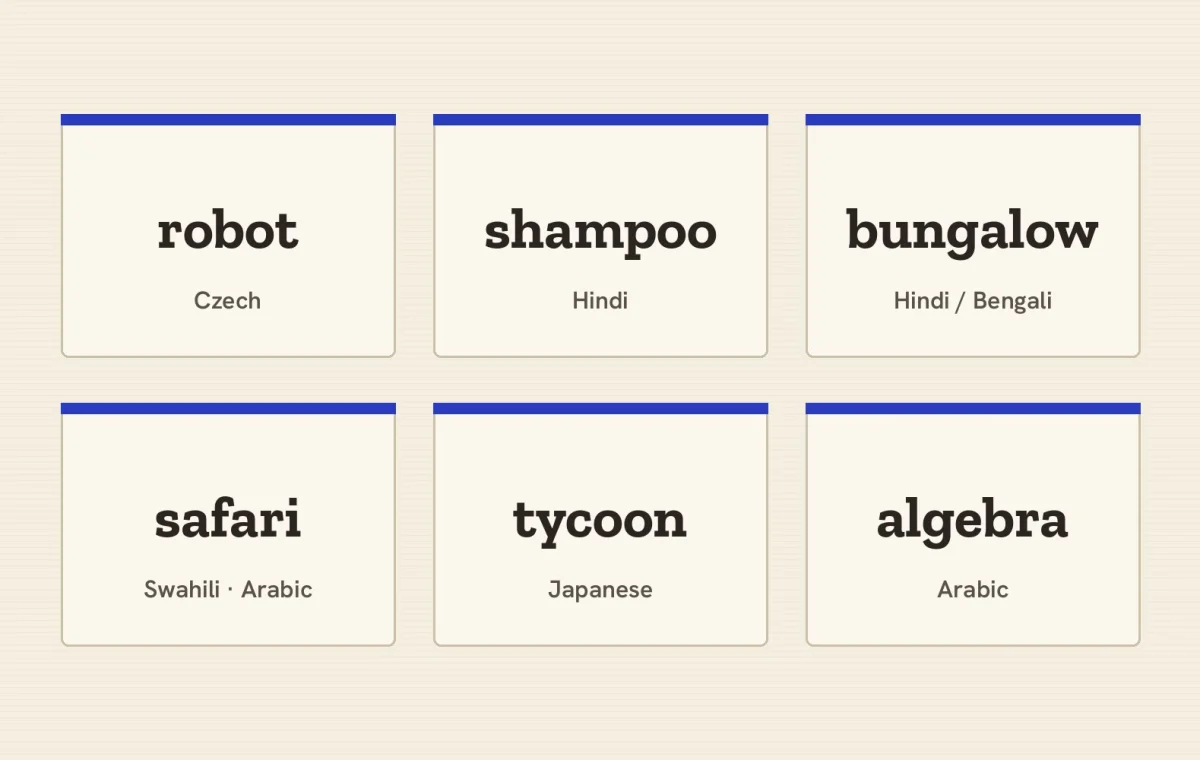
If you had to guess, which of these words came to English from a play about artificial workers, which from a Tagalog word for mountain, and which from the title of a medieval mathematics book: robot, boondocks or algebra? Most people get at least one wrong, and that is the charm of etymology. A word’s look tells you very little about where it has been.
What follows is a small cabinet of curiosities: fourteen everyday English words with well-documented and sometimes surprising histories. Each card gives the path the word took into English, a few lines on how its meaning changed along the way, and the family of forms that Find the Word accepts. Those counts come from the game’s own word list, which starts from the public-domain ENABLE list and keeps 172,446 playable words once an offensive-word blocklist is applied (how we check words explains the details), so they describe the game rather than every dictionary of English. Every card links to its entry in the Online Etymology Dictionary so you can read the full history for yourself.
The cabinet
Robot
The word comes from Czech robota, meaning forced or compulsory labour. It was put to its modern use in Karel Čapek’s play R.U.R. (1920), whose manufactured workers are called robots, and the coinage is usually credited to his brother Josef, with whom he often collaborated. English took it up in the early 1920s, with the first record in 1923. (Etymonline: robot)
The game accepts 15 entries built on it, from robots and robotic to robotize, robotry and robotization, a large family for a word barely a century old.
Shampoo
Behind shampoo is Hindi champo, an imperative of a verb meaning “press” or “knead the muscles”. When English borrowed it in the eighteenth century (the first record is from 1762) it meant to massage, and the sense of washing the hair is recorded only from about 1860. The bottle on the bathroom shelf is the last stage of a long shift in meaning. (Etymonline: shampoo)
Six forms are accepted in the game: shampoo, shampooed, shampooer, shampooers, shampooing and shampoos.
Bungalow
A bungalow was originally a low, thatched house “in the Bengal style”, which is what the Hindi source word means; English took it, in the seventeenth century, by way of Gujarati. English turned a regional description into the name of a building type, and the word now describes single-storey houses with no connection to Bengal at all. (Etymonline: bungalow)
Only two entries are accepted, bungalow and bungalows, so this is a word to remember whole rather than as the root of a family.
Safari
English borrowed safari from Swahili, where it means a journey. The Swahili word itself comes from Arabic, from a word for travel. It is a useful reminder that the language English borrowed from and the oldest known source of a word are often not the same. (Etymonline: safari)
The game accepts safari, safaris, safaried and safariing, the last two showing English happily treating the noun as a verb.
Boondocks
The source is Tagalog bundok, meaning mountain. American soldiers in the Philippines picked the word up in the early twentieth century as a name for any remote, wild place, and it spread further during the Second World War; today it means an area far from towns and cities. Despite the shared letters, boondoggle is unrelated: it is a separate American coinage of the late 1920s, first the name of a braided lanyard made by Scouts. (Etymonline: boondocks)
Both boondock and boondocks are accepted, and so are five forms of the unrelated boondoggle, from boondoggled to boondogglers.
Tycoon
Tycoon comes from Japanese taikun, “great lord”, a title that foreigners in the nineteenth century used for the shogun. In English it was first a political title before it settled into its modern meaning of a wealthy and powerful businessperson. (Etymonline: tycoon)
The accepted family is short: tycoon and tycoons. The jump from shogun to business magnate is the memorable part.
Algebra
The word comes from Arabic al-jabr, “the reuniting of broken parts”, which appeared in the title of a ninth-century treatise on equations by the mathematician al-Khwarizmi. It reached English through Medieval Latin. The same scholar’s name, in Latinised form, lies behind algorithm. (Etymonline: algebra)
Six forms are accepted, including algebraic, algebraically and algebraist. The game also accepts algorism, the older word from the same name, alongside algorithm.
Zero
Arabic ṣifr, meaning empty, became Medieval Latin zephirum, then Italian zero, and reached English through French or Italian. The same Arabic word, by a different path, gave English cipher, so the two words are relatives despite looking nothing alike. (Etymonline: zero)
The game accepts zero, zeros, zeroes, zeroed, zeroing and zeroth, and six forms of cipher as well.
Ketchup
The history here is less certain than the others, and dictionaries say so. The usual explanation connects ketchup with a Malay word for a fish sauce, possibly from a Chinese word for fish brine, although an origin in a word for curry from Tulu, a language of south-west India, has also been suggested. Early English ketchups were made from ingredients such as mushrooms or walnuts; the tomato version became the familiar one later. (Etymonline: ketchup)
Accepted entries are ketchup and ketchups, and the variant spelling catsup is accepted too, with its plural.
Alcohol
Arabic al-kuḥl was a fine powder used to darken the eyelids, the substance still called kohl. In the hands of alchemists writing in Latin, the word came to mean any fine powder, then any refined essence, including one obtained by distillation, and eventually the intoxicating spirit in wine. (Etymonline: alcohol)
The game accepts seven forms, including alcoholic, alcoholism and alcoholically, and kohl is valid as well.
Sabotage
Sabotage comes from French saboter, which is formed from sabot, a wooden shoe. A popular story says striking workers threw their clogs into machinery, but dictionaries do not confirm it; they point instead to French senses such as working clumsily or clattering about in wooden shoes. (Etymonline: sabotage)
Accepted forms are sabotage, sabotaged, sabotages and sabotaging, plus saboteur, saboteurs, sabot and sabots.
Kayak
English took the word in the eighteenth century from Danish kajak, which comes from the Greenlandic Inuit word qajaq for a small boat of sealskins stretched over a frame. English kept both the object and something close to its original name, and later extended the word to the recreational boats sold today. (Etymonline: kayak)
Seven forms are accepted, among them kayaker, kayaking and kayakings, so the list treats the borrowed noun as a verb as well.
Taboo
Taboo is usually traced to Tongan tabu, “sacred” or “forbidden”, though the word is shared across Polynesian languages (Hawaiian has kapu, Maori tapu), so the Tongan explanation of its parts may be folk etymology. It entered English through Captain James Cook’s account of his voyage to the Pacific, where he described the practice in Tonga. From a specific religious and social prohibition it widened to anything that convention forbids. (Etymonline: taboo)
The game accepts taboo, taboos, tabooed and tabooing, and the spelling tabu is also valid.
Tsunami
The Japanese word is made of tsu, harbour, and nami, wave. The name probably reflects what coastal communities saw: a wave that swept into harbours. English records it from 1896 and has used it alongside the older and misleading “tidal wave”, though these waves are caused by movements of the sea floor, not by tides. (Etymonline: tsunami)
Three entries are accepted: tsunami, tsunamis and the adjective tsunamic.
The cabinet sorted by source language
The table separates the language English borrowed from directly and any older source further back. The two columns often differ, and keeping them apart is the single most useful habit when reading an etymology. The family counts are the number of accepted entries that begin with the base word, checked against the game’s list of playable words.
| Word | Direct source | Older source | Accepted family |
|---|---|---|---|
| algebra | Medieval Latin | Arabic | 6 |
| alcohol | Medieval Latin | Arabic | 7 |
| zero | French or Italian | Arabic, via Medieval Latin | 6 |
| safari | Swahili | Arabic | 4 |
| shampoo | Hindi | 6 | |
| bungalow | Gujarati | Hindi | 2 |
| tycoon | Japanese | Chinese elements | 2 |
| tsunami | Japanese | 3 | |
| robot | Czech | 15 | |
| boondocks | Tagalog | 2 | |
| ketchup | probably Malay | probably Chinese | 2 |
| sabotage | French | 4 | |
| kayak | Danish | Greenlandic Inuit | 7 |
| taboo | probably Tongan | 4 |
Arabic appears four times, but never as the language English borrowed from directly. In each case the word passed through Latin, a European vernacular or Swahili first, which is a common route for learned vocabulary and trade words. Hindi, by contrast, supplied shampoo directly and bungalow by way of Gujarati, through contact in India, and both words changed in meaning after they arrived.
What checking the sources changed
An earlier version of this page told several of these stories more neatly than the evidence allows, and we corrected it in September 2026 after rechecking every card against the Online Etymology Dictionary (the changes are listed in our corrections log). What surprised us was the kind of mistake. No card named a wholly wrong origin; instead the routes were too short and the stories too sure.
- Missing stops. We had bungalow coming from Hindi and Urdu and kayak straight from Inuit. The dictionary puts Gujarati between Hindi and English for the first, and Danish between Greenlandic and English for the second.
- Details added on the way. Kayak had been called a single-person hunting boat, and boondocks had been given a tidy story of meaning drifting from mountain country to rural area. Neither detail is in the source, so both went.
- Confidence the source does not have. The ketchup card named a “southern Chinese” origin; the entry says only “possibly” Chinese and mentions a Tulu alternative. The Tongan explanation of taboo is flagged in the entry as possibly folk etymology, and the card on robot had Karel Čapek crediting his brother Josef, where the entry reports the attribution to Josef second-hand, so all three are now hedged.
Our conclusion is that the dangerous etymology is rarely the wrong one. It is the compressed one: a label such as “an Inuit word” that skips the languages in between, or a firm sentence where the dictionary says “possibly”, leaves a gap that a good story fills. That is why the table above keeps two source columns, and why the first two habits below matter more than the rest. It also changed how we cite: we had linked nine cards to Merriam-Webster, whose pages block the automated checks we run, so every card now links to the entry we actually read.
How to check a word’s origin yourself
A good etymology is a chain of evidence, and a few habits help you read one without being misled by a neat story. None of them needs special training, only a reliable dictionary and some patience.
- Start with a standard reference. The Online Etymology Dictionary (etymonline.com), used for every card above, and Merriam-Webster both give origins for most common words, and the Oxford English Dictionary gives the fullest histories. Popular articles and social media posts are where folk etymologies such as the clog story behind sabotage tend to circulate.
- Separate the direct source from the older ones. Write the chain down in order, as with zero: Arabic, then Medieval Latin, then Italian (perhaps with French as a further step), then English. Calling the word simply “Arabic” loses half of the history.
- Treat look-alikes with suspicion. Boondocks and boondoggle share six letters and nothing else. The same caution applies to spelling clues: many SK words do have Scandinavian roots, such as skirt from Old Norse and ski from Norwegian, but the letters alone cannot tell you which ones.
- Notice the hedges. Words such as “probably”, “perhaps” and “of uncertain origin” are information, as the ketchup entry shows. A confident story about a word whose dictionary entry is cautious is a warning sign.
- Read “first known use” as evidence, not a birthday. A date in a dictionary is the earliest written example its editors have found. Earlier uses may have been lost or may yet turn up.
Spelling history is a close cousin of this work. The reasons a word looks the way it does, from silent letters to Latin-inspired respellings, are covered in why English spelling is so weird. For a similar trip through unusual vocabulary, try the real-or-fake quiz of unusual words, which includes several borrowings, or the list of words with no vowels, where Welsh gives English cwm and crwth.
Whether a word is playable in a game is a separate question from where it came from. For the word list behind our timed game, Find the Word, how we check words explains how the list works and the words you can’t play covers the most common reasons a word is turned down.
Updated 14 September 2026: added what rechecking the sources changed, and removed the practice-round table. 13 September 2026: rewritten and restructured, with every count and word verdict rechecked against the game’s word list and blocklist. Details are in the corrections log.
New to The Verbarium? Follow the reading path, with tools and printables