Octopuses or Octopi? The Right Plural for Cactus, Data, Criteria and More

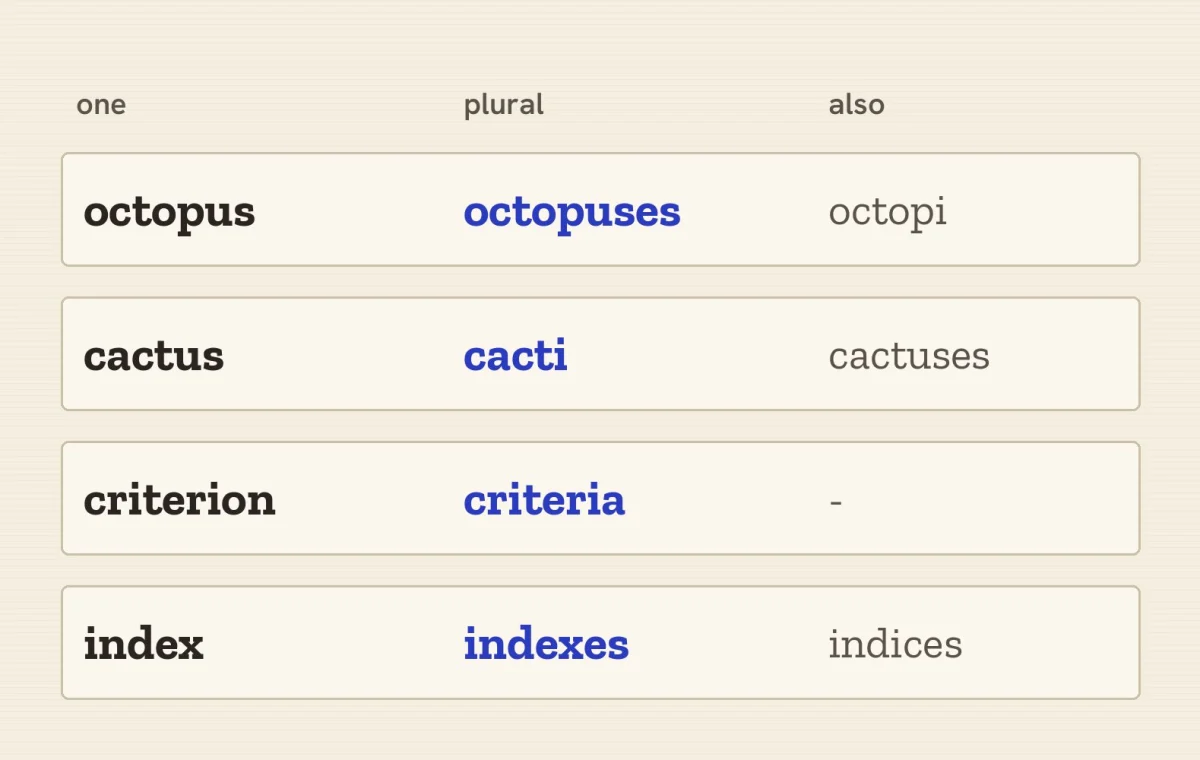
Both octopuses and octopi are recorded by dictionaries, but octopuses is the safer choice, and cacti and cactuses are both correct. Data can take a singular verb (“the data is”) or a plural one (“the data are”); both are standard. The singular is criterion and the plural criteria. Formulas and formulae, syllabuses and syllabi, and appendices and appendixes are all accepted pairs, while indices is the usual plural of index in mathematics and economics. The plural of fungus is normally fungi. Media is the plural of medium, and agenda is now an ordinary singular noun with the plural agendas.
The rest of this page takes each word in turn: what the dictionaries record, where each form is actually used, and, where the history is well documented, why the choice exists at all. For each word we also note which forms appear in the word list we use for every count on this site. It is built from the public-domain ENABLE word list and, after an offensive-word blocklist, holds 172,446 words; how we check words explains how it was put together. It contains no capitalised words and plenty of rare ones, so it shows which spellings have been recorded somewhere, not which are best.
The decision table
If you only need a form to put in a sentence, the first plural column is the one that will not draw comment in general writing. The second column is correct too, but belongs to particular settings.
| Singular | Use in general writing | Also correct | Where the other form is usual | Forms in the word list |
|---|---|---|---|---|
| octopus | octopuses | octopi | Etymonline calls octopi the common plural; octopodes, modelled on Greek, is rare | octopuses, octopi, octopodes |
| cactus | cacti | cactuses | Either; Cambridge lists cacti first | cacti, cactuses |
| datum | data (singular or plural verb) | datums (surveying sense only) | Datums for reference points in surveying and mapping | data, datums |
| criterion | criteria | criterions (rare; not listed by Cambridge) | Almost never needed | criteria, criterions |
| formula | formulas | formulae | Tends to appear in mathematics and science | formulas, formulae |
| index | indexes (of books, databases) | indices | Mathematics, science, economics and finance | indexes, indices |
| syllabus | syllabuses (UK), syllabi (US) | either | Cambridge lists syllabi first in American English | syllabuses, syllabi |
| fungus | fungi | funguses | Listed second by Cambridge; Wiktionary labels it uncommon | fungi, funguses |
| appendix | appendices (of books), appendixes (body part) | either | Cambridge’s British dictionary gives only appendixes for the body part | appendices, appendixes |
| medium | media (means of communication) | mediums | Mediums for people who claim to contact the dead | media, mediums |
| agenda | agendas | none | Agendum survives only for a single item on an agenda | agendas, agendum, agendums |
Is it octopuses or octopi?
Both are listed by the Cambridge Dictionary, which gives “plural octopuses or octopi” in its American entry. Octopuses is the form that follows normal English grammar, and no one will mark it as a mistake, so it is the better default in writing. Octopi is common (Etymonline calls it “the common plural”) and is not wrong, but it will occasionally prompt someone to object.
The objection rests on the word’s origin. According to Etymonline, octopus comes through Modern Latin from Greek oktōpous, “eight-foot”. The -us is part of the Greek word for foot, not the Latin noun ending that becomes -i, so octopi treats it as something it was not in Greek. Etymonline notes that a classically “correct” Greek plural would be octopodes and dates octopi to 1817. It allows that a name coined in Modern Latin might borrow a Latin plural, but suggests that following the grammar of living English, which gives octopuses, is probably the best policy for a common word. The same reasoning covers platypus (“flat-footed” in Greek): the word list holds both platypuses and platypi, and platypuses is the one to use.
Cacti or cactuses?
Both are correct. Cambridge lists cacti first and cactuses second in both its British and American entries. Here the Latin plural has a better claim than it does with octopus: cactus was a Latin word (borrowed from Greek kaktos) before English took it, and Etymonline records that Linnaeus applied the old name to the American plants. Either form is safe, so choose the one that sounds natural to you and keep to it.
cacti cactuses
Is data singular or plural?
It is both, and dictionaries now say so. Etymonline records data as the classical plural of datum, Latin for “a thing given”. The Cambridge Dictionary labels it an uncountable noun that takes a singular or plural verb, with a note that although it was originally a plural, it is now often used with a singular verb. Treated as a mass noun, like information, it takes is, much and little. Treated as a plural, it takes are, many and few.
The plural treatment is still common in scientific and academic writing, so follow the style of the journal, publisher or organisation you are writing for. Outside those settings, “the data is” is normal. The singular datum is rare in everyday use. In surveying and mapping, where a datum is a reference point, Wiktionary gives the plural datums, which is in the word list. The word list does not contain datas, and it is not a standard English plural.
- Mass noun: “The data is stored on a server in Frankfurt.”
- Plural: “These data are consistent with the earlier survey.”
- Avoid mixing the two: not “This data are” or “These data is”.
Criterion or criteria?
Criterion is the singular and criteria the plural. The word is Greek (kritērion, “means for judging”), and Etymonline dates criteria in English to the 1620s. Using criteria as a singular (“the main criteria is cost”) is common in speech, and the Cambridge American dictionary notes as much, but it marks that use as not standard. In careful writing, say “one criterion” and “several criteria”. The word list also contains criterions, a regular plural that Wiktionary labels rare and Cambridge does not list; criterias is absent.
Formulas or formulae?
Both are correct, and Cambridge lists formulas first. Formulae keeps the Latin plural of formula (“small form”) and tends to appear in mathematical and scientific writing: “the formulae in chapter three”. Formulas is the usual choice elsewhere, and it is the more natural plural when formula means a recipe or plan: “there are no magic formulas for success”. Whichever you pick, use it throughout a document.
Indexes or indices?
Here the meaning decides. Cambridge’s general dictionaries list both plurals for every sense, but its business English dictionary separates them. For lists at the back of books and for databases, it gives indexes, as in “the indexes to both volumes”. For systems that measure value, including economic and stock-market indicators, it gives indices, with indexes as an alternative, as in “several share indices fell”. In mathematics, where an index is an exponent or subscript, indices is the usual plural. The word list contains both forms but not the back-formed singular indice, which is sometimes written by mistake.
Syllabuses or syllabi?
Both are correct. The British Cambridge entry lists syllabuses first; the American one lists syllabi first, which probably reflects a difference in preference between the two varieties. The history is odd. Etymonline reports the explanation given in the Oxford English Dictionary: the word is ultimately a misreading of a Greek word, sittybos, in a 15th-century edition of Cicero’s letters, although Etymonline first gives a derivation from Late Latin syllabus, “list”, which corresponds to a Greek compound of syn, “with”, and lambanein, “to take”. A Latin plural for a word that probably began as a misprint is therefore a convention rather than a rule, and syllabuses is at least as defensible.
What is the plural of fungus?
Fungi is the normal plural, and Cambridge’s British entry lists funguses second, a form Wiktionary labels uncommon. Fungus is Latin for “mushroom”, so the -i plural is historically regular. The pronunciation of fungi varies more than its spelling: Cambridge gives “FUNG-guy” for both British and American English, and its American dictionary also records “FUN-jye”. The word list contains fungi and funguses.
Appendices or appendixes?
Both are correct, and it helps to split them by meaning. For sections at the end of a book or report, Cambridge accepts both, and appendices is a common choice in academic and technical documents (“see appendices B and C”). For the small organ attached to the intestine, the Cambridge British dictionary gives only appendixes. Etymonline describes appendices as the proper Latin plural, from Latin appendix, “something attached”.
Is media singular or plural?
Media is the plural of medium in the sense of a means of communication or expression: “print and broadcast media”, “works in mixed media”. When the word means newspapers, television, radio and the internet as a group, Cambridge labels the media as taking a singular or plural verb, so “the media has” and “the media have” are both standard. Mediums is the plural you need for people who claim to receive messages from the dead, for which Cambridge gives only mediums. Etymonline dates the “newspapers, radio, TV” sense of media to 1927.
Is agenda singular or plural?
In Latin, agenda was plural, “things to be done”, and Etymonline quotes Fowler giving agendum as the singular for one item. In modern English, agenda is simply a singular countable noun meaning a list of matters to discuss, which is how Cambridge defines it. Its plural is agendas: “both committees have published their agendas”. Writing “the agenda are” would now look like a mistake. Agendum and agendums are in the word list, but you are unlikely ever to need them.
The false plural trap
A handful of words that were plurals in Latin or Greek behave as singulars in English, and treating them as plurals makes a sentence sound stiff or wrong. The reverse mistake, using a true plural as if it were singular, is just as common. The table sorts the usual suspects.
| Word | Latin or Greek status | How English treats it | Example |
|---|---|---|---|
| agenda | Plural | Singular; plural agendas | “The agenda has changed twice.” |
| data | Plural | Singular or plural | “The data is incomplete.” / “The data are incomplete.” |
| media | Plural | Singular or plural when it means the press | “The media has lost interest.” / “The media have lost interest.” |
| stamina | Plural of stamen, “threads” | Singular, uncountable | “Marathon runners need stamina.” |
| trivia | Plural of trivium, “place where three roads meet” | Plural noun in Cambridge | “The trivia on the back of the card are fun.” |
| criteria | Plural | Plural; singular use is not standard | “The criteria are listed below.” |
| phenomena | Plural | Plural; the singular is phenomenon | “These phenomena are rare.” |
| bacteria | Plural | Plural; the singular is bacterium | “The bacteria are harmless.” |
A practical test is to swap in a plain English word. If information fits the sentence, data can take a singular verb. If list fits, agenda is singular. If standards or organisms fits, you need a plural verb with criteria or bacteria, and the singular is criterion or bacterium.
Check yourself
Choosing an answer below reveals the explanation and keeps a running score for the five questions.
The agenda for Monday’s meeting ___ been sent to everyone.
In modern English agenda is a singular noun meaning a list of items, so it takes has. The plural would be agendas.
Which sentence is standard in formal writing?
Criterion is the singular and criteria the plural. Singular criteria is common in speech but the Cambridge Dictionary marks it as not standard.
The fungi growing under the fallen leaves ___ breaking them down.
Fungi is the plural of fungus, so it takes a plural verb: the fungi are breaking them down.
In British school maths, the small raised numbers in x squared and y cubed are called ___.
In mathematics the plural of index is indices (American textbooks often call these numbers exponents). Indexes is the usual plural for the alphabetical lists at the back of books.
The show featured two ___ who claimed to speak to the dead.
For people who claim to contact the dead, the plural of medium is mediums. Media is the plural for channels of communication or artistic materials.
Where we land on octopi, cacti, data and criteria
The sources we checked do not agree about octopi. Cambridge lists it beside octopuses and Etymonline calls it the common plural, while Wiktionary labels it hypercorrect and reports that Fowler’s Modern English Usage calls octopuses “the only acceptable plural in English”. We write octopuses. It is the one form none of these sources objects to, and since the -us belongs to the Greek word for foot, the Latin-style ending has the weaker claim. With cactus we go the other way and write cacti: the word was Latin before English borrowed it, and Cambridge lists that form first in both its British and American entries.
For data, we use a singular verb in general writing and would not correct anyone who uses a plural one, because both are standard. The only thing we would change is a sentence that mixes the two. Criteria is the word on this page where we see no real choice. Cambridge marks singular criteria as not standard, none of our sources records it as standard, and “one criterion” costs the writer nothing.
Checking every form against our word list showed what a list can and cannot settle. It holds both plurals for all ten nouns in the decision table that have two, and for radius, focus, stadium, referendum and curriculum as well. It also holds criterions, agendums and platypi, forms few writers will ever need. The gaps are more telling: there is no datas, criterias or indice, and no virii, which Wiktionary marks as proscribed, noting that virus had no attested plural in classical Latin. So when a plural is in the list, someone recorded it; when it is missing, it deserves a second look. Neither tells you which form your readers expect. For that you need a dictionary’s usage note or the style guide you are writing to, and where those disagree, as they do over octopi, the regular English plural is the one that will not be questioned.
A rule of thumb that works
When a word has two accepted plurals, choose the regular English one (octopuses, formulas, syllabuses) for general readers, and switch to the classical form only where a field has settled on it: indices in mathematics and economics, formulae in science, and fungi almost everywhere. Keep one form throughout a document, and when a publisher or institution has a house style, it overrides all of this. For more on why English collects words from so many languages, see where our strangest words come from and why English spelling is so weird. If you want to test how many words you can recall under time pressure, you can try the one-letter word challenge.
New to The Verbarium? Follow the reading path, with tools and printables