Why English Spelling Is So Weird: From Caxton’s Eggs to Webster’s Color

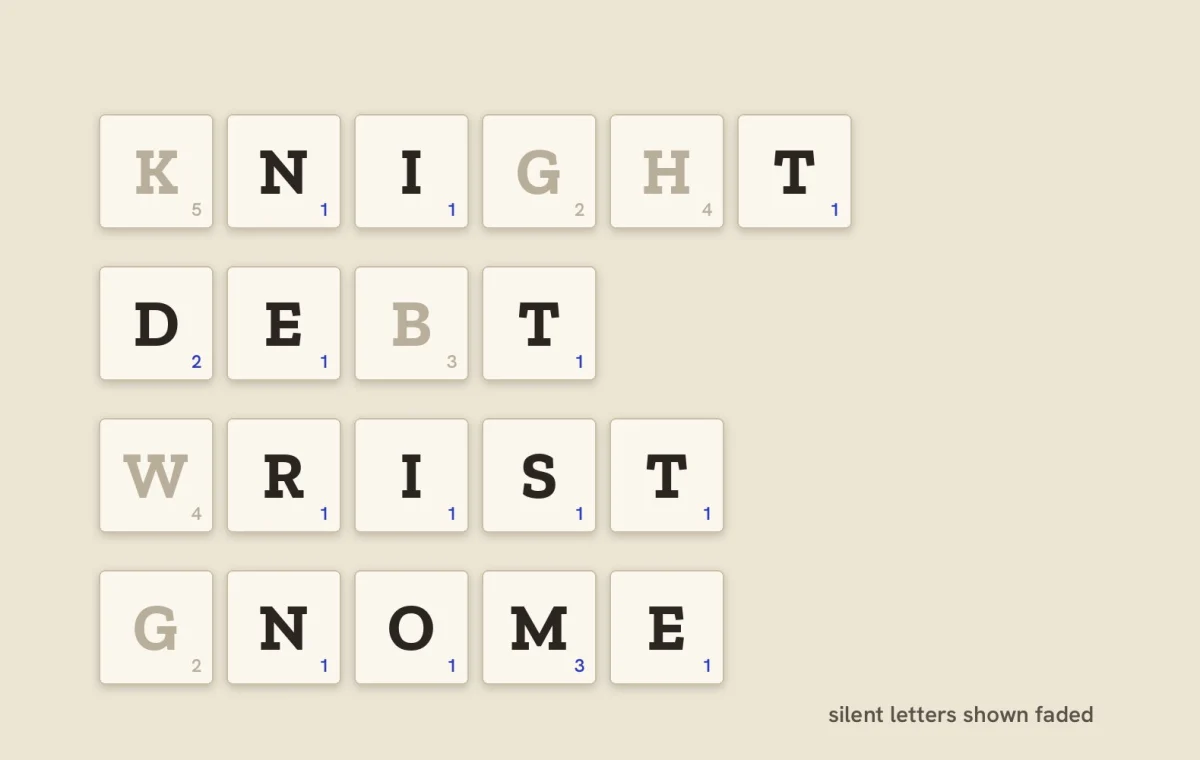
English spelling looks weird because it was fixed in stages while pronunciation kept moving: the silent K in knight, the B in debt and the many sounds of ough each record a separate episode, from French-trained scribes to Renaissance scholars and dictionary makers.
In 1476 William Caxton set up a printing press at Westminster, the first in England. He had already printed English books abroad, in Bruges, and he came home to a practical problem that no amount of type could solve: English did not have one agreed way of writing itself. Years later, in the prologue to his translation Eneydos (1490), he told a story that shows the difficulty neatly. Some merchants, delayed on a voyage, went ashore, and one of them asked a woman for “egges”. She replied that she could speak no French. Only when another of the company asked for “eyren” did she understand that they wanted eggs.
Caxton’s point was that English varied so much from place to place that a printer could hardly choose words, let alone spellings, that every reader would recognise. Modern spelling grew out of that uncertainty. It was never designed in one sitting; it was laid down over centuries by scribes, printers, scholars and dictionary makers, each working with inherited habits and each changing them a little.
This essay follows that history in order, pausing on the letters that trouble readers most: the silent consonants at the front of words such as knee, write and gnaw, the inserted B in debt, and the famously unruly ough. Where it helps, it also counts how often each pattern appears in the word list behind our word game, Find the Word (those counts describe that list, not the whole of English), and it ends with where we stand on how spelling should be taught and judged.
A timeline of how the spelling was laid down
The periods below overlap, and none of them ended neatly. The dates are the conventional ones found in standard histories of the language, and they are best read as landmarks rather than boundaries.
| Period or event | Approximate date | What it left in the spelling |
|---|---|---|
| Old English | c. 450 to c. 1100–1150 | A Latin alphabet with extra letters such as thorn (þ) and ash (æ); spellings that were broadly phonetic, so the K in cniht (knight) was spoken |
| Norman Conquest | 1066 onwards | French-trained scribes brought French habits, such as qu for the old cw (cwen became queen) and ou for a long U sound (hus became hous, later house) |
| Printing arrives in England | 1476 | Caxton and the printers who followed him spread particular forms widely, while still carrying much of the variation of manuscript writing |
| Great Vowel Shift | broadly 15th to 17th centuries | The long vowels changed their sounds, but many spellings kept the older vowel letters |
| Latin-inspired respellings | chiefly c. 1400 to c. 1600 | Scribes and scholars added letters to show Latin ancestry: B in debt and doubt, P in receipt, C in indict |
| Samuel Johnson’s Dictionary of the English Language | 1755 | A widely consulted authority that recorded established spellings rather than overhauling them |
| Noah Webster’s An American Dictionary of the English Language | 1828 | Promoted simpler American forms such as color, center and defense |
When the letters matched the sounds
Old English was written with the Roman alphabet that missionaries and churchmen brought to Britain, supplemented by a few letters for sounds Latin did not have. Thorn (þ) and eth (ð) stood for the sounds now written th, and ash (æ) for a vowel close to the one in modern cat. By the standards of what came later, the system was fairly faithful to speech. Scribes wrote what they heard in their own dialect, which is why Old English texts from different regions can look quite different from one another.
Many of the spellings that now look perverse were once straightforward. The Old English ancestor of knight was cniht, and both the initial consonant and the middle sound represented by h were pronounced; that middle sound was a breathy consonant related to the one at the end of Scots loch (after a vowel like i it was probably closer to the sound in German ich). The ancestor of write was wrītan, with a W that was really sounded before the R. When later English stopped pronouncing these sounds, the written forms had already become familiar, and they stayed.
French scribes and a second set of habits
After 1066, French became the language of the court, of much administration and of a great deal of polite writing. English continued to be spoken by most of the population, but the people trained to write it were often schooled in French conventions, and they applied those conventions to English words. The old cw of cwen was replaced by the French qu, giving queen. A long U sound, which Old English had written with a simple u as in hus, came to be written ou, the French way, which is why we have house and mouse.
The same centuries brought a great many French words into English, so the language ended up with two layers of writing habits side by side: native words respelled on French lines, and borrowings that kept their French look. Many of the “exceptions” learners meet today come from this overlap.
Printing spread spellings but did not settle them
It is tempting to say that the printing press froze English spelling. The reality was slower and messier. Caxton and his successors did make certain forms travel much further and appear much more consistently than hand copying ever could. But early printed books still show plenty of variation, sometimes within a single page, and spellings continued to compete for generations. Standardisation was a gradual process running through the sixteenth and seventeenth centuries, shaped by authors, schoolmasters, printers and readers together.
What printing did change was the cost of variation. Once a form had been set in type and copied many times over, it became the version readers expected to see. That made spelling increasingly resistant to later changes in pronunciation, which is one reason the gap between speech and writing widened rather than closed.
The vowels moved and the letters stayed
Between late Middle English and early modern English, the long vowels of the language shifted in a connected series of changes that the Danish linguist Otto Jespersen named the Great Vowel Shift. In Chaucer’s English, the vowel in bite was close to the one now heard in beet, the vowel in house was close to the one in goose, and the vowel in meet was nearer to that of modern mate. Over the following centuries these sounds were pushed into new positions, and several became the diphthongs heard today.
Spelling did not follow. The letters in bite, house, name and meet reflect roughly where the vowels were before the shift, which is one reason English vowel letters have such different values from the same letters in French, Italian or Spanish. The shift is not, however, a universal excuse. It explains a large share of the mismatch in long vowels, but consonant loss, borrowing, regional variation and deliberate respelling all followed their own histories.
OUGH: one spelling, several histories
No sequence shows the gap between speech and writing more plainly than ough. In though it ends in a plain vowel; in through the vowel is different; in rough and tough it ends with an F sound; in cough the vowel changes again; and in bough it rhymes with cow. These words once shared a consonant written with gh, the same breathy sound that knight used to have, and they lost or changed it in different ways in different places. The written gh stayed while speech went its separate ways; though, for instance, was sometimes pronounced with a final F sound between about 1300 and 1750, and still is in some dialects.
The game’s dictionary contains 237 entries with ough somewhere inside them, and 25 that end with it. Most of the larger number are families built on a few roots, so rough brings rougher, roughest and roughly with it. The 25 endings include some less familiar forms alongside the everyday ones:
although borough bough breakthrough chough clough cough dough enough furlough hiccough interborough lough plough rough slough sough sourdough thorough though through tough trough unrough wherethrough
The wider gh pattern appears in 1,548 entries. Spelling variants sit in the list too: plough and plow are both accepted, as are hiccough and thru. How the site handles pairs like these is covered in the guide to color and colour in word games.
Silent first letters: KN, WR, GN and the Greek clusters
Silent letters at the start of a word deserve a section of their own, because they hide the letter a word is filed under. Knee sounds as if it begins with N, write with R and gnat with N again. There are two quite different histories behind these openings, and it helps to keep them apart.
The native group is kn, wr and gn. In Old English these consonants were pronounced: cnāwan (know), wrītan (write) and gnagan (gnaw) began with two sounded consonants. Later, at different times for different clusters, the first consonant fell silent in standard speech (the W of wr roughly between 1450 and 1700, the K of kn by about 1750), but by then the written forms were well established and the letters stayed on the page.
The second group is learned vocabulary built from Greek: ps, pn, pt and mn. English speakers do not normally pronounce the first consonant at the start of psychology, pneumonia, pterodactyl or mnemonic, but the spellings keep the Greek clusters. The hidden consonant reappears when the same Greek element sits inside a word: the P is heard in apnoea, in helicopter (whose second half comes from the Greek word for wing, as in pterodactyl) and the M is heard in amnesia.
| Opening | All entries | Entries of 3 to 5 letters | Examples |
|---|---|---|---|
| KN | 225 | 35 | knee, knife, knot, know |
| WR | 199 | 27 | wrap, wreck, wrist, wrong |
| GN | 66 | 13 | gnash, gnat, gnaw, gnome, gnu |
| PS | 327 | 10 | psalm, pseud, psych |
| PN | 30 | 0 | pneuma, pneumonia |
| PT | 43 | 0 | ptarmigan, ptosis, pterosaur |
| MN | 3 | 0 | mnemonic, mnemonics, mnemonically |
The counts above come from the Find the Word word list: the public-domain ENABLE list with an offensive-word blocklist removed, leaving 172,446 playable words. How we check words sets out how that list is built and filtered. The figures count written clusters rather than pronunciations, so they include inflections and derived forms. What they show clearly is that the native clusters are rich in short everyday words, while the Greek clusters are large but made almost entirely of long technical terms.
The practical lesson is about where a word is filed. A dictionary, an index or an alphabetical list puts knee under K and write under W, however they sound, so anyone searching by ear starts in the wrong place. The pages on words that start with K and words that start with W treat kn and wr as groups of their own. The explorer below is set to K: compare the KN row with the vowel openings to see how large the silent-K section is, then switch to W or G for the WR and GN words.
Letter explorer
Shows every two-letter opening for the letter, how many accepted words start with it, and the short words behind each one.
Debt, doubt and the scholars’ letters
The silent B in debt belongs to a completely different story from the K in knight. English took the word from French around 1300, and it was written without a B, in forms such as dette. From about 1400, scribes and later scholars who admired Latin wanted the English spelling to display the word’s Latin ancestor, debitum, so they added the B. Nobody began pronouncing it. The same impulse gave doubt its B (after Latin dubitare, between the fourteenth and sixteenth centuries), gave receipt its P (after Latin recepta, from about 1500) and gave indict its C (around 1600).
These additions are visible evidence of an attitude rather than of a sound. Their authors believed spelling should show where a word came from, and in many cases the related words still carry the letter audibly: debit, dubious and reception. Some of the scholarly guesses were wrong. The S in island was added in the sixteenth century by association with isle, which does come from Latin (through French), but island itself descends from an Old English word, igland, that never had an S.
It follows that a silent letter cannot be read at face value. A letter may preserve a sound English once had, as in knight, or it may be a later decoration that was never spoken in English at all, as in debt. The only way to tell is to look at the history of the individual word, which is the approach taken in our collection of stories behind strange words.
Dictionaries on both sides of the Atlantic
By the eighteenth century, most words had a dominant printed spelling, but there was no single authority to consult. Samuel Johnson’s Dictionary of the English Language, published in 1755, filled that gap for many readers. Johnson did not set out to reform spelling. In his preface he presented himself as recording the established usage of good writers, accepting its irregularities rather than imposing a new system, and his dictionary became a reference that helped fix many of the forms British readers still use.
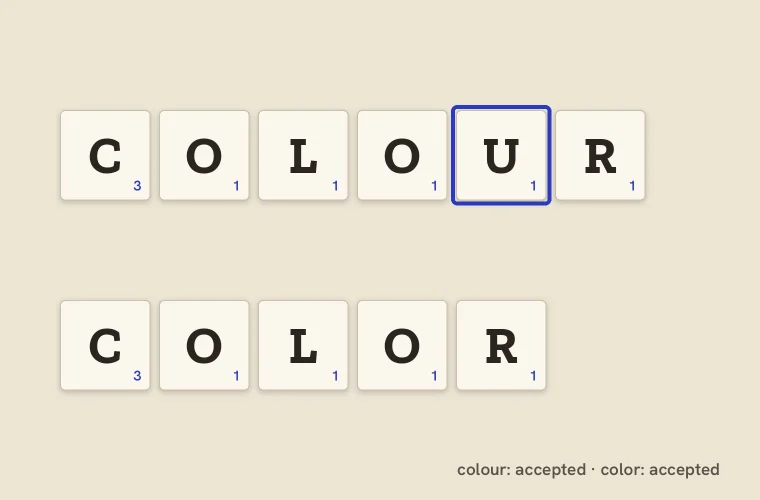
In the United States, Noah Webster took a more interventionist view. His American Dictionary of the English Language of 1828 promoted shorter spellings, most of them already in use, that he considered more rational and more American, among them color for colour, center for centre and defense for defence. Many of his choices became standard in American English; others he proposed did not catch on. The result is the transatlantic split that still sends writers to check whether a page expects honour or honor. The game accepts both spellings of all of those pairs.
What the word list still carries from scribes, scholars and Webster
Histories of spelling usually stop at the dictionaries. We wanted to know how much of each episode survives in ordinary vocabulary, so we counted it in the same word list. The scribes’ and printers’ forms are the largest inheritance: 1,548 entries still carry the old gh, and 490 begin with the written clusters kn, wr or gn. The scholars’ Latin letters are a smaller but stubborn legacy: entries built on debt, doubt and receipt alone number 42, from debtor to undoubtedly, each keeping a letter added to show ancestry rather than any English sound.
Webster’s reform is the easiest to see, because this American-built list still holds both sides of it. We found 44 words accepted with both -or and -our, from ardor and ardour to vigor and vigour, and center and centre or defense and defence pass too. What surprised us is where the split reappears. Many longer derivatives exist only in their American form: colorful, favorite and neighborhood are in the list, while colourful, favourite and neighbourhood are not, with a few exceptions such as honourable and labourer. That describes one reference rather than English, but it shows how a spelling can be standard in one country and still missing from a respected list compiled in another.
Where we land on teaching and judging spelling
English spelling is irregular as a guide to pronunciation, but it is far from random. Its irregularities fall into the families this essay has followed: a lost consonant, a French scribal habit, a vowel that moved or a scholar with an opinion. That is why we would teach spelling by those families rather than as a list of exceptions. A letter that was once spoken (knight) and a letter a scholar added (debt) behave differently, and knowing which is which lets a learner predict a related word instead of memorising each one.
The system also keeps related words looking related even when their sounds diverge. Sign and signature, bomb and bombard, muscle and muscular, and heal and health all share written material that a purely phonetic spelling would pull apart. For that reason we do not think wholesale reform is worth its cost. Reformers may be right that irregularity is expensive, but any reform has to decide whose accent to follow and what to do when pronunciation changes again, and those questions have so far proved harder to settle than the spelling itself.
On judging spelling, we would be stricter about consistency and more relaxed about convention. Colour and color are both standard, and marking either one wrong judges where a writer learned English, not whether they can spell; our own list accepts both. Mixing the two in one document is a fairer thing to correct. And the history argues for some humility about “correct” forms in general. The S in island was added in the sixteenth century by association with isle, although the word itself never had one, and that historical mistake is now the only spelling anyone would accept.
The same quirks are the reason the hard parts of the alphabet are hard, a theme taken further in the reference on the hard letters Q, X, Z and J. If you want to see how quickly the kn and wr words come to mind against the clock, a round of Find the Word is a quick test.
Sources and further reading
- William Caxton, prologue to Eneydos (1490), the source of the “egges” and “eyren” story.
- Samuel Johnson, A Dictionary of the English Language (1755), especially the preface.
- Noah Webster, An American Dictionary of the English Language (1828).
- David Crystal, Spell It Out: The Singular Story of English Spelling (Profile Books, 2012).
- Simon Horobin, Does Spelling Matter? (Oxford University Press, 2013).
- Albert C. Baugh and Thomas Cable, A History of the English Language (Routledge, several editions).
- Online Etymology Dictionary entries for knight, kn-, wr-, Q, debt, doubt, receipt, indict, island, though and mnemonic.
Updated 14 September 2026: added our counts of what the list keeps from Caxton, Johnson and Webster, and our view on teaching and judging spelling; the practice-round table was removed. 13 September 2026: rewritten and restructured, with every count and word verdict rechecked against the game’s word list and blocklist. The former article on silent letters was merged into this essay. Details are in the corrections log.
New to The Verbarium? Follow the reading path, with tools and printables