Words That Start With W: Common Lists, WH and WR, and Five Myths Tested

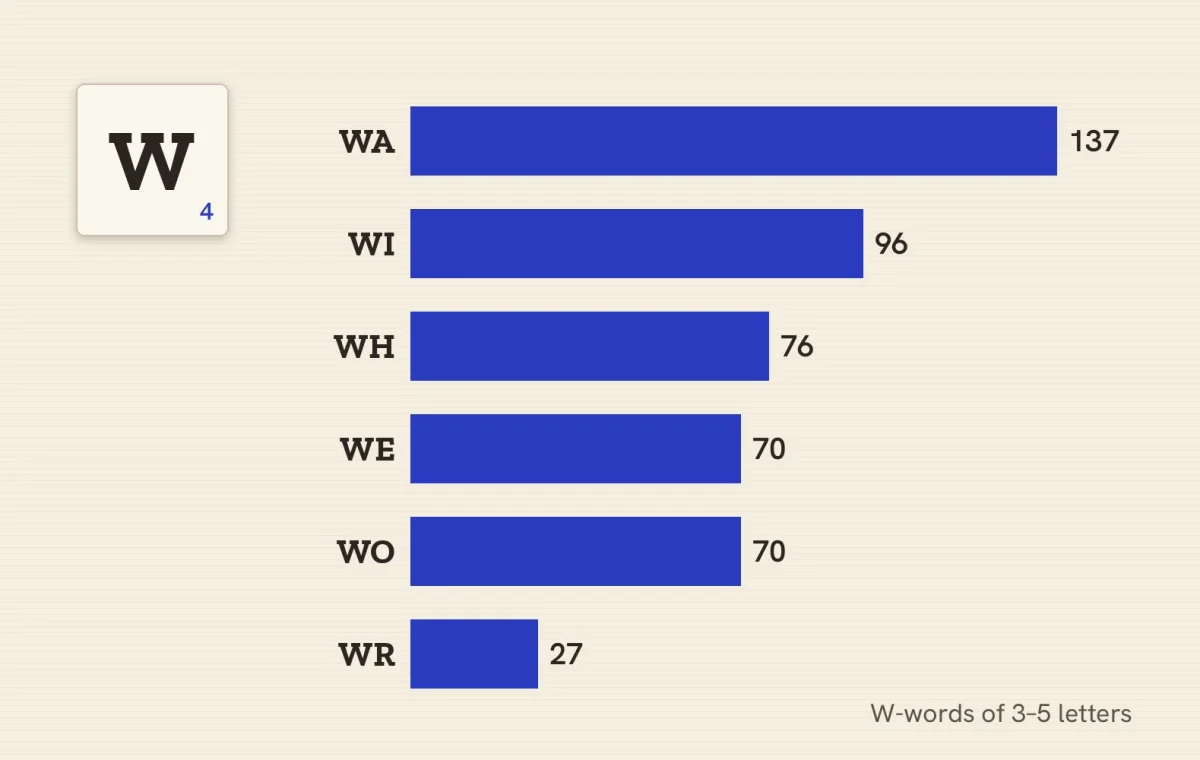
There are 3,684 words that start with W in the word list we use, the list behind our word game: 172,446 words from the public-domain ENABLE list, with offensive words removed (see how we check words). That makes W the 19th of 26 letters, about 2.1% of the list, ahead of V (2,729) and K (1,710). It is richer in short words than that suggests: 495 W words have three to five letters, and its 36 three-letter words match the number for C. The most useful short ones are the everyday core of English: who, why, way, was, what, when, with, word, work and world.
Common words that start with W, chosen by hand as everyday or genuinely useful words rather than ranked by frequency. Meanings are given for the less familiar ones, nothing offensive is included, and every word is in the list.
3 letters: who, why, way, was, war, web, wet, win, won, wax, wig, wit, woe, wok, wow, wee (small, in Scottish, Irish and northern English use), wry (dryly humorous)
4 letters: walk, wall, want, warm, wary, wash, wave, weak, wear, week, well, west, what, when, whim, wide, wife, wild, will, wind, wine, wing, wise, wish, with, wolf, wood, wool, word, work, wrap, waft (to float gently through the air), wily (sly, cunning), whey (the liquid left after milk curdles in cheesemaking), weir (a dam across a river that controls its flow), writ (a written order from a court)
5 letters: watch, waste, water, weigh, weird, whale, wheat, wheel, where, which, while, white, whole, whose, woman, world, worry, worth, would, wound, wreck, wrist, write, wrong, wince (to flinch), wield (to handle a tool or weapon with skill)
Longer and more interesting: weather, welcome, whisper, whistle, window, winter, wizard, wonder, wrinkle, wanderlust (a strong longing to travel), wistful (full of longing), wherewithal (the means to do something), woebegone (miserable-looking), winsome (charming), wainscot (wooden panelling on the lower part of a wall), widdershins (anticlockwise; archaic)
The rest of this page tests five beliefs about W words that sound reasonable, each checked against the same word list:
- Myth 1: WH- is where most W words live.
- Myth 2: W belongs with the hard letters, alongside Q, X and Z.
- Myth 3: After a W you will always find a vowel or an H.
- Myth 4: Any common ending can be added to a W word.
- Myth 5: If a W word is in everyday use, the game will accept it.
Each myth below is set against the same word list, with the counts recomputed for this page. The counts describe that list, not English in general. In our game, Find the Word, you have up to sixty seconds to type as many words as possible beginning with a given letter, so each myth also shapes how players approach a W round.
Myth: WH- is where most W words live
The WH words are the most conspicuous W words in everyday English: what, when, where, which, who, why. They are so frequent in ordinary sentences that it is natural to assume they make up the bulk of the section. The word list says otherwise. WH is only the third-largest opening, with 599 words, or 16.3% of the W section.
| Opening | All W words | Share | 3 to 5 letters | 3 letters |
|---|---|---|---|---|
| WA | 1,007 | 27.3% | 137 | 12 |
| WI | 770 | 20.9% | 96 | 5 |
| WH | 599 | 16.3% | 76 | 3 |
| WO | 573 | 15.6% | 70 | 7 |
| WE | 493 | 13.4% | 70 | 5 |
| WR | 199 | 5.4% | 27 | 1 |
| WY | 24 | 0.7% | 15 | 2 |
| WU | 19 | 0.5% | 4 | 1 |
| All W | 3,684 | 100% | 495 | 36 |
WA is the real bulk of the letter, holding more than a quarter of all W words and 137 of the 495 short ones. The gap is similar among short words, where WH supplies 76, fewer than WA or WI. WH is still well worth visiting, and its short words include whale, wharf, wheat, wheel, whim, whip, whisk, white and whole as well as the question words. It is simply one opening among five large ones rather than the centre of gravity.
The spelling itself has an interesting past. In Old English these words were written with the letters the other way round, so what began as hwæt; the WH order became standard in Middle English spelling. Etymonline’s entry for wh- adds that the new spelling was widespread in some places by the 14th century but did not become the usual form until after about 1400, and that it was also attached to words that never had an HW sound, such as whole, from Old English hal. The broader story of how such conventions settled is told in why English spelling is so weird.
Frequency in play backs this up. The game serves W in about 2.4% of rounds, around one in 42, the same share as N and U and more than V, K or any of the rare letters. It is an ordinary letter to meet, and an ordinary letter to prepare for; the details of how letters are drawn are in Adventure mode, tested.
Myth: W belongs with the hard letters
W does feel awkward to start with, and it sits near the bottom of the alphabet by total size. Only seven letters (X, Z, Y, Q, J, K and V) begin fewer words. But total size is a misleading measure for a timed game, because every accepted word counts once and short words are the quickest to think of and type. Once the count is limited to words of three to five letters, W moves well clear of the letters it is usually grouped with.
| Letter | All words | 3 to 5 letters | 3 letters |
|---|---|---|---|
| X | 134 | 15 | 1 |
| Q | 822 | 69 | 2 |
| Z | 532 | 94 | 12 |
| J | 1,368 | 240 | 22 |
| V | 2,729 | 255 | 21 |
| K | 1,710 | 350 | 27 |
| N | 4,378 | 336 | 34 |
| C | 16,215 | 925 | 36 |
| W | 3,684 | 495 | 36 |
W has more words of three to five letters than N, which begins almost 700 more words overall, and it has more three-letter words than N while matching C, a letter with more than four times as many words in total. Its 495 short words are more than seven times the supply for Q and more than thirty times the supply for X. The familiar three-letter core alone is generous, and every word in this row is accepted.
wad wag war was wax way web wed wee wet who why wig win wit woe wok won woo wow wry wye
The other fourteen three-letter W words in the list are rarer: wan (pale), wae (a Scots form of woe), wap (a blow), wat (a Buddhist temple in Southeast Asia), waw (an Arabic letter, and an obsolete word for a wave), wen (a cyst on the skin), wha (a spelling of what that imitates pronunciation), wis (surely; archaic or dialect), wiz (a very clever or skilled person), wos (a spelling of was that imitates speech), wot (archaic: to know), wud (dialect: mad), wyn (the Old English letter wynn) and wab, which has no English entry in Wiktionary, the dictionary we checked.
So W is not scarce in the way the genuinely hard letters Q, X, Z and J are. A more likely reason a W round feels slow is staying inside WA, which keeps producing easy answers, instead of moving on to the other openings. You can test that for yourself in a W practice round by noting how many different opening pairs your words used.
Myth: after a W comes a vowel or an H
Most W words do follow that pattern: 3,461 of the 3,684 have A, E, I, O, U or H in second place. The remaining 223 words, about 6% of the section, belong to two consonant openings that are easy to overlook. WR has 199 words and WY has 24. Neither is a mere curiosity, and WY in particular is far richer in short words than its total suggests.
WR is the silent-W group, and that silence is exactly why it gets missed: write, wrong, wrist and wreck are heard as R words and stored that way in memory. It has 27 words of five letters or fewer, of which one has three letters, three have four and the other 23 have five. Here is the complete short set.
wrack wrang wrap wraps wrapt wrath wreak wreck wren wrens wrest wrick wried wrier wries wring wrist writ write writs wrong wrote wroth wrung wry wryer wryly
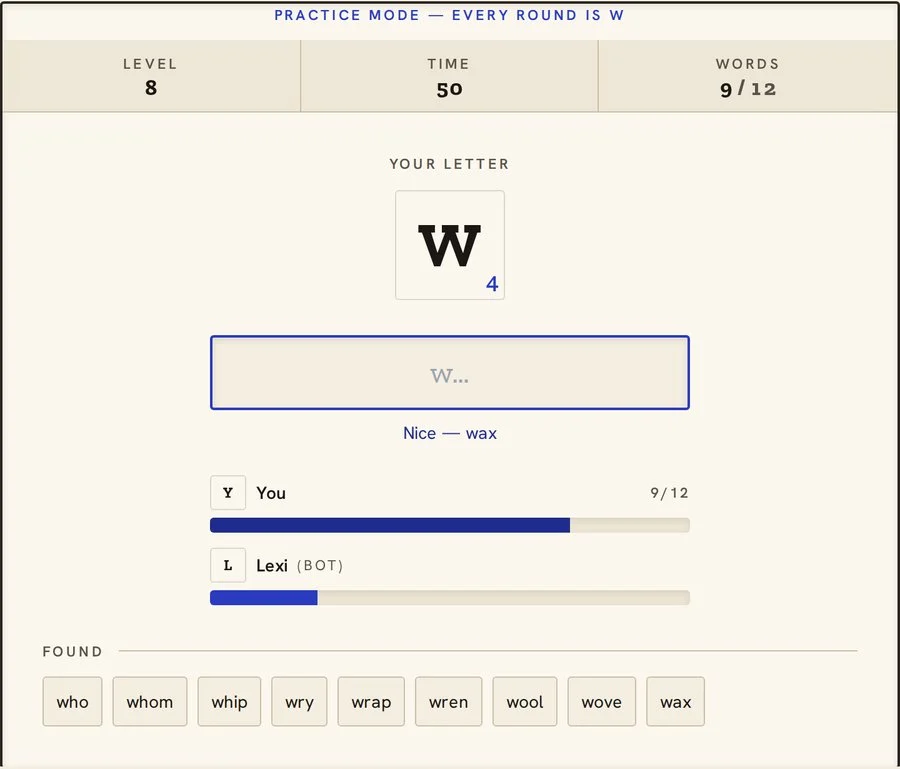
WY is smaller but unusually compact. Fifteen of its 24 words have five letters or fewer, including the three-letter wye and wyn. The full short list is wych, wye, wyes, wyle, wyled, wyles, wyn, wynd, wynds, wynn, wynns, wyns, wyte, wyted and wytes. Note that wry is not one of them: its Y is a vowel sound, but in spelling it begins WR. WU, at 19 words and only four short ones (wud, wurst, wuss, wussy), is the thinnest of the vowel openings and is best left until last.
Myth: any common ending can be added
Once a W word appears, extending it feels like free points: walk, then walks, walked, walking. That habit is sound, but it rests on the assumption that the list contains every regular form, and it does not. Forms are included only where the dictionary records them, and the irregular verbs among W words need special care because the obvious ending produces a spelling that does not exist.
| Root | Accepted | Refused |
|---|---|---|
| walk | walks, walked, walker, walkers, walking, walkings, walkable | none of the obvious forms |
| work | works, worked, worker, workers, working, workings, workable | none of the obvious forms |
| whisk | whisks, whisked, whisker, whiskers, whisking | whiskings |
| wrap | wraps, wrapped, wrapt, wrapper, wrappers, wrapping, wrappings | wraped |
| write | writes, writer, writers, writing, writings, wrote, written | writed, writting |
| weep | weeps, weeping, wept | weeped |
| wear | wore, worn | weared |
Two lessons come out of the table. First, a plural of an -ing form is a gamble: walkings and workings are accepted while whiskings is not. Second, the irregular families are where the extra words hide, because wrote, written, wept, wore and worn all begin with W but none can be produced by adding a suffix. The prefix and suffix worksheet practises the spelling changes, such as the doubled P in wrapped, that trip up the mechanical approach.
Myth: everyday W words are always accepted
The W section contains plenty of recent-feeling vocabulary, so it is tempting to assume that anything you might say at work or at home will score. The word list is fixed, though, and several very common computing and lifestyle words are missing while others of a similar age are present. Checking each spelling one by one gives the following split.
| Accepted | Not in the list |
|---|---|
| workout, workouts | website, websites |
| workstation | workflow, workaround |
| wireless | wifi, wiki |
| windsurf | webcam, webinar, weblog, webpage |
| weirdo, weekend | wannabe, wetsuit, whiteboard |
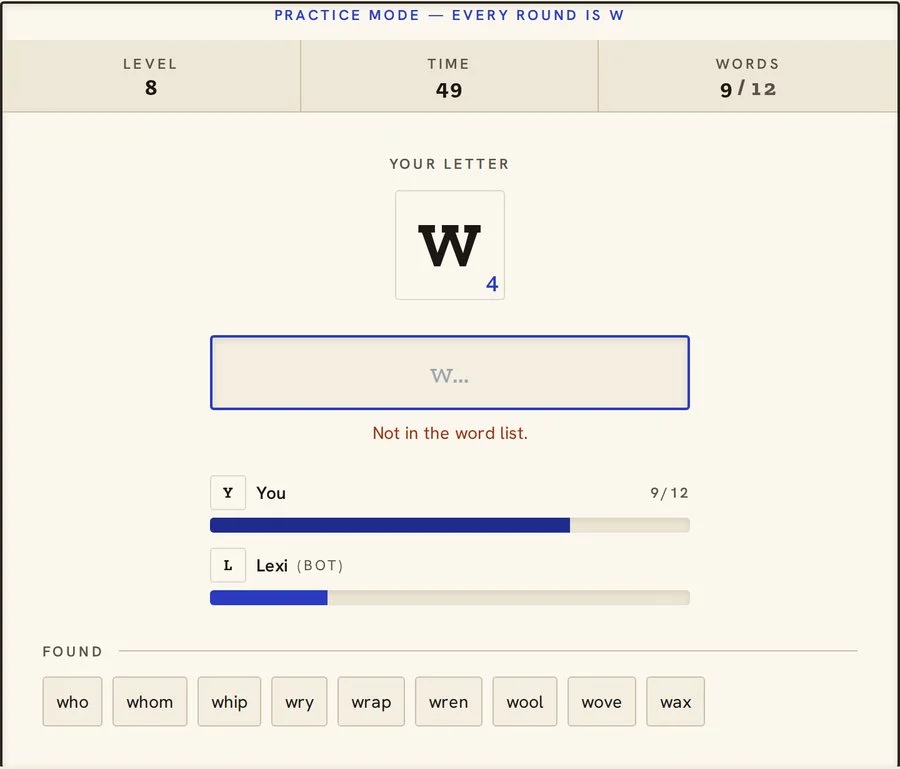
There is no reliable rule hidden here: workout is in and workflow is out, web and webbing are in but every web- compound above is out. The practical response is to type the older, shorter word first and treat the newer compound as a bonus if it happens to score. Why good words end up refused is explained in the words you can’t play, and the same kind of check is applied to other letters in the map of K words and the V drills.
What W sounds like, and why the spelling misleads
The WH myth has a partner in pronunciation. Most speakers in England, Australia and much of North America now say which and witch, or whine and wine, the same way. Linguists call this the wine–whine merger. Scottish and Irish English, along with some older and regional American speech, still keep the two sounds apart, with a breathier sound for WH. For writers who have the merger, that is probably one reason whether/weather and which/witch are such common spelling mistakes: nothing in the sound signals the H.
W is also silent more often than it looks. It is written but not pronounced at the start of write, wrong and every other WR word, and in the middle of two, sword and answer. In who, whom, whose and whole the W is silent and the word begins with an H sound. The history of those silent letters is covered in why English spelling is so weird. In a W round, the practical point is the reverse of the spelling problem: words that start with a sound other than W still live under W, so the WR and WHO groups only come to mind if you look for them deliberately.
Some of those silences can be dated. Etymonline’s entry for wr- says the W of write and its relatives stopped being pronounced between about 1450 and 1700, except in dialects, although the spelling stayed. The letter itself is a late arrival: according to Etymonline’s entry for W, Old English first wrote the sound as UU and then with a runic letter called wynn, until Norman scribes brought in W, a joined double U, in the 11th century; wynn had disappeared by about 1300. The old letter survives in the word list as wyn and wynn, and Wiktionary records wen as an obsolete form of its name.
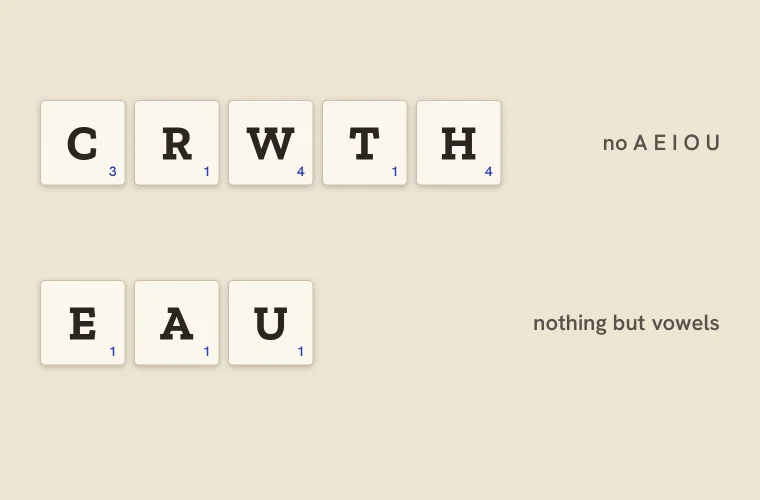
W can even be a vowel. In Welsh the letter often stands for a vowel sound, and two Welsh words in the list show it: cwm, a bowl-shaped valley head carved by a glacier, and crwth, an old stringed instrument associated with Wales. Wiktionary files both under English terms with a vocalic W. With their plurals, they are the only four words in the list that contain a W and none of A, E, I, O, U or Y. Neither starts with W, but they are a neat footnote to myth 3: sometimes the W is the vowel.
Where we land on W
WH looks like the heart of the letter, because what, when and which are everywhere in ordinary English. In the list it is third. The question words are frequent in sentences, but there are only so many of them, while WA quietly holds more than a quarter of the section. That gap between how often words are used and how many words there are is, in our view, the most useful thing the W count shows, and it applies well beyond this letter.
For anyone learning or teaching English spelling, we would spend the time on the two places where W and sound part company: the WH words that many speakers pronounce like plain W (which and witch, whether and weather, whine and wine) and the silent-W words that sound like R (wrap, wring, wrist, wrote). We think those pairs matter more to a speller than any rare W word, and they are a short list to learn.
We also think the refused words deserve a fair reading. Wifi, website and webcam are ordinary English, and their absence says nothing against them. The game checks a fixed, public-domain list that we have not patched with newer words, and we publish every count against exactly that list, so any figure on this page can be checked against what the game accepts.
The five myths at a glance
| Myth | What the word list shows |
|---|---|
| WH- is where most W words live | WH has 599 of 3,684 W words (16.3%), third behind WA (1,007) and WI (770). |
| W belongs with the hard letters | W has 495 words of three to five letters and 36 of three letters: more short words than N, and as many three-letter words as C. |
| After a W comes a vowel or H | 223 W words begin WR or WY, including 42 of five letters or fewer. |
| Any common ending can be added | Forms are listed individually: walkings is accepted, whiskings, writed and weeped are not. |
| Everyday W words are always accepted | Workout, wireless and weirdo score; website, wifi, webcam and wannabe do not. |
Check the W figures yourself
Every count in the myths above can be reproduced with the explorer below. It is set to W and lists each opening with its accepted words.
Letter explorer
Shows every two-letter opening for the letter, how many accepted words start with it, and the short words behind each one.
Updated 14 September 2026: added a direct answer and lists of common W words with meanings, more of the history of WH, WR and the letter W itself, two screenshots from a test round and our own view of what the counts show; the five myths and their figures are unchanged. The previous update, on 13 September 2026, rewrote the page and rechecked every count and word verdict against the game’s word list and blocklist. Details are in the corrections log.
New to The Verbarium? Follow the reading path, with tools and printables