Words That Start With K: Common Lists, Silent K and a Map of the Letter

There are 1,710 words that start with K in the word list we use, which is the list behind our word game: 172,446 words from the public-domain ENABLE list, with offensive words removed (see how we check words). That makes K the 21st of 26 letters, just under 1% of the list, ahead of only J, Q, Y, Z and X. The total undersells it. K has 350 words of three to five letters, more than N, E or O, and the short ones most people actually use are key, kid, kit, kin, keep, kind, king, kick, knee, knit, knot and know.
Familiar words that start with K, for spelling lists, homework and word games. We picked them by hand as everyday or genuinely handy words, so this is a selection rather than a frequency ranking; meanings are given for the less familiar ones, and every word is in the list.
3 letters: kid, kit, key, keg, kin, ken (range of knowledge or sight), kip (British informal: a sleep or nap)
4 letters: kick, kind, king, kiss, kite, kiwi, keen, keep, kept, kale, kelp, kiln, kilt, knee, knew, knit, knob, knot, know, kerb (British spelling of curb), kith (friends and acquaintances)
5 letters: kayak, kebab, khaki, kiosk, knack, knead, kneel, knife, knock, known, koala, krill (tiny sea crustaceans), kudos (praise, credit), klutz (a clumsy person)
6 letters: karate, kettle, kidney, kitten, knight, knives, kernel, kindle, kitsch (art or decor in overdone, sentimental taste), kowtow (to bow low; to grovel), kibosh (as in put the kibosh on: to stop something)
Longer: kitchen, kingdom, knuckle, knowledge, kangaroo, keyboard, kerfuffle (a commotion or fuss), kaleidoscope
Where K words cluster
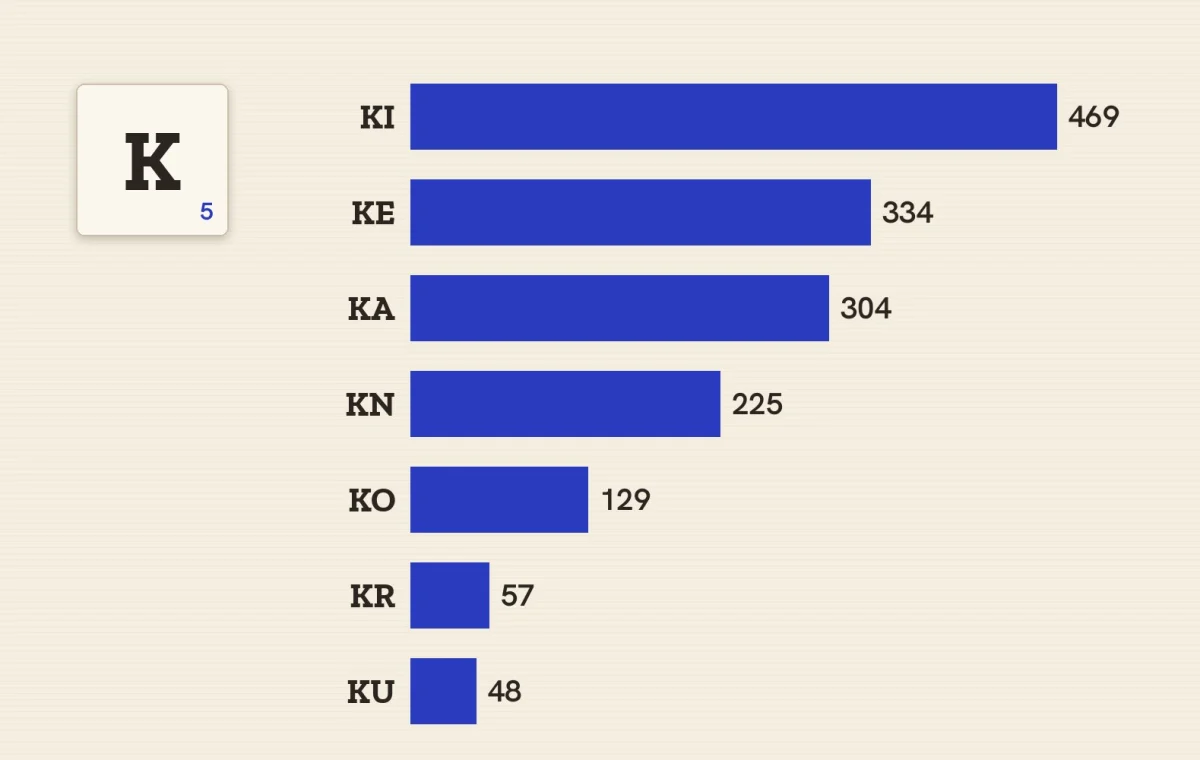
The letter K tends to bring silent-K curiosities such as knight and knuckle to mind. The chart below draws the section as it really sits in the word list: all 1,710 K words, split by the letter that comes second, with a darker inner bar for the 350 words of three to five letters.
Reading the map
Three long bars dominate the top of the chart. KI, KE and KA together hold 1,106 words, and among the short words they hold 213 of 350, which is 60.9% of everything a player is likely to type in a hurry. Notice that the order changes once length is taken into account: KA is only the third-largest opening overall, but with 73 short words it edges past KI’s 72 and KE’s 68.
Add KO and KU and the five vowel openings account for 1,283 of the 1,710 K words (75.0%) and 269 of the 350 short ones (76.9%). The remaining quarter is spread across eight consonant pairs, and those eight behave very differently from each other. KN is large, KH and KY are small but surprisingly short-heavy, and KW barely registers at all.
Inflected forms such as kites and kited count as separate entries, because the list stores them that way. The same list, and the same counting rules, sit behind every figure on this page.
Why the map is lopsided
Much of the shape is spelling history. Old English usually wrote the K sound with C, so cyning and cnawan are the ancestors of king and know. After the Norman Conquest, new scribal habits restricted C and expanded the use of K, which became common in English spelling from the 13th century; one likely reason is that in French C before E or I stood for an S sound, so K was the clearer way to mark the K sound before those vowels and before N. Before A, O and U the older C spelling usually stayed, which is why English has cat, cold and cut rather than K spellings for those sounds.
Etymonline’s entry for K notes that in words taken from Arabic, Hebrew, Turkish, Japanese, Hawaiian and other languages, K now stands for a range of sounds, while older borrowings often followed traditional English spelling and took a C instead. The result is that many native words sit in KI, KE and KN, while a good share of KA, KO and KU is borrowed vocabulary: kayak, kiosk (from Turkish through French), karma, koala, kudzu. KH is almost entirely made of loanwords too, khaki from Urdu being the familiar one. For a player this may matter because many of those borrowings are less familiar, and so probably harder to call up on demand, so the KA and KO bars look friendlier on a chart than they may feel under pressure. The wider story of how English collected its spellings is told in why English spelling is so weird.
KN: a long bar with no three-letter words
KN is the fourth-largest opening, with 225 words, and it is the pair most people remember first. Its short supply is thinner than the length of its bar suggests: 35 words of three to five letters and not a single three-letter word. Here is the complete short set.
knack knap knaps knar knars knaur knave knead knee kneed kneel knees knell knelt knew knife knish knit knits knob knobs knock knoll knop knops knosp knot knots knout know known knows knur knurl knurs
Because the K is silent in the familiar members of this group, the words are often stored in memory as N sounds. Knee, knew, knit, knob, knot and know are four-letter words most players know well, yet they tend to surface late in a round because the ear does not connect them with K. Saying “silent K” to yourself once, early, is a cheap way to bring the whole family forward.
The silence is younger than the spelling. Etymonline’s entry for kn- says the K was fully sounded in Old and Middle English, when these words were written with CN (cneo for knee, cniht for knight, cnawan for know), and that it faded over about a century until standard pronunciation reduced it to a plain N by 1750. The same entry says the sound survives in most of the related Germanic languages; the entries for knee and knight list cousins such as German Knie and Knecht. English kept the old spelling after the sound went, which turns the KN section, 225 words and 13.2% of the whole letter, into a spelling trap for anyone who writes by ear.
KO: a short bar with six three-letter words
KO has only 129 words in total, barely more than half the size of KN, but 41 of them are short and six have three letters: koa, kob, koi, kop, kor and kos. Its familiar members include koala, koan, kohl, kook, kopek and koto. Set side by side with KN, it is the clearest example on the chart that the total length of a bar and its usefulness in the last ten seconds are two separate measurements.
The thin bars: KH, KU, KY, KR and KL
Below the five big openings, the chart breaks into short stubs. Each is small enough to show in full, and together they add 57 short words. The table lists every word of three to five letters in each group, with the most recognisable ones picked out in the right-hand column.
| Opening | All / short | Every word of 3 to 5 letters | Easiest to recall |
|---|---|---|---|
| KH | 45 / 16 | khadi, khaf, khafs, khaki, khan, khans, khaph, khat, khats, kheda, khet, kheth, khets, khi, khis, khoum | khaki, khan |
| KU | 48 / 15 | kudo, kudos, kudu, kudus, kudzu, kue, kues, kugel, kukri, kulak, kumys, kurta, kuru, kurus, kusso | kudos, kudu, kudzu, kurta |
| KY | 42 / 12 | kyack, kyak, kyaks, kyar, kyars, kyat, kyats, kylix, kyrie, kyte, kytes, kythe | kyat |
| KR | 57 / 10 | kraal, kraft, krait, kreep, krill, kris, krona, krone, kroon, krubi | krill, krona, krone |
| KL | 40 / 4 | klong, kloof, kluge, klutz | klutz |
KH and KY are worth a second look. KH has more short words than KR (16 against 10) even though KR is the larger opening, and more than a third of KH’s words are five letters or fewer. KY has no three-letter word, but its twelve short entries make up over a quarter of the group.
The faint bars: KB, KV and KW
At the foot of the chart are three openings with 18 words between them. KB consists of exactly two words, kbar and kbars, a unit of pressure. KV has eleven, of which only kvas and kvass are short; the rest are their plurals kvases and kvasses and the kvetch family. KW has five words in total (kwacha, kwanza, kwanzas, kwashiorkor, kwashiorkors) and none is shorter than six letters, which is why it has no blue bar at all.
These are real openings and they do score, but they reward players who already know the words. Searching for them from scratch in a sixty-second round is rarely a good use of time while any of the vowel openings are unexplored.
All 27 three-letter K words
Only six openings contribute to the three-letter set, and four of them (KA, KE, KI and KO) supply 25 of the 27 words. None of the consonant pairs KB, KL, KN, KR, KV, KW or KY has a three-letter word. If you want to drill these against the other difficult letters, the three-letter words quiz covers them in self-test form.
| Opening | Count | Words |
|---|---|---|
| KA | 6 | kab, kae, kaf, kas, kat, kay |
| KE | 7 | kea, kef, keg, ken, kep, kex, key |
| KH | 1 | khi |
| KI | 6 | kid, kif, kin, kip, kir, kit |
| KO | 6 | koa, kob, koi, kop, kor, kos |
| KU | 1 | kue |
The everyday ones are keg, key, kid, kin, kip, kit and koi. The rest are names of letters (kaf in Arabic, khi for the Greek chi), animals and plants (kea, a New Zealand parrot; kob, an African antelope; koa, a Hawaiian tree), a drink (kir, crème de cassis topped with white wine) or older and regional words such as kop, a South African word for a hill.
Newer words on and off the map
The dictionary is fixed, so a word’s familiarity says little about whether it will score. Among K words the split is unpredictable, and it is worth checking a spelling before relying on it. Both columns below were tested against the list.
| Accepted | Not in the list |
|---|---|
| keto, karaoke, kimchi, kiwi | kombucha, kawaii, kratom, kpop |
| keyboard, keyword, kilobyte, kickboxing | keylogger, kibibyte, ketos |
The gap between keto (in) and ketos (out) is a reminder that plurals are listed individually rather than generated. More on why good English words can still be refused is in the words you can’t play, and K is compared with Q, X, Z and J in the hard letters guide.
What the count changed in our view of K
By total, K looks like one of the rare letters. The count shows something the total hides: how compact it is. One K word in five (20.5%) has three to five letters, against 7.8% across the whole list, and that is why K ends up with more short words than N, E or O (336, 333 and 332) even though each of those letters begins roughly two and a half to four times as many words. If someone asks for “a list of K words”, the honest answer is that the useful part of the letter is unusually large for its size.
That also shapes what we would tell someone to learn. For spelling, the words worth drilling are the KN family, because the sound gives no clue: knack, knead, knelt, knoll, knuckle and knowledge are the ones we would put on a list. For vocabulary, kith, ken, kowtow, kitsch and kudos earn a place in ordinary writing. The three-letter oddities such as kab, kor and kos are real entries, but we would learn them only for word games.
When we merged the thin pages for Q, X, Z and J into a single guide in September 2026, K did not go the same way, and we think that is right: thirteen opening pairs, a silent-letter family with its own history and 350 short words give it enough to stand alone. Every figure here was recounted each time our offensive-word blocklist was extended during that month’s audit; none of the K counts changed at the final recount, because none of the newly blocked words began with K.
For Find the Word players: using the map against the clock
K is one of the less frequent letters in play. The game serves it in about 1.2% of rounds, around one in 82, so the payoff from learning its map comes less often than for S or C, but when K does appear the short words cluster tightly enough to prepare in a single sitting. How letter frequency and the bot deadline interact is covered in Adventure mode, tested.
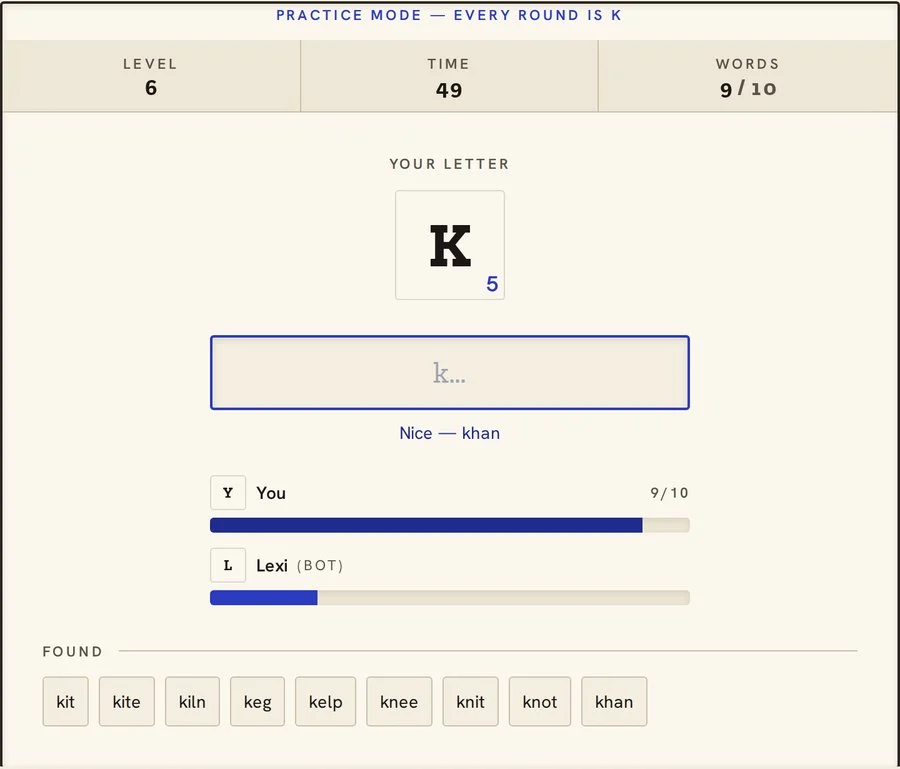
Explore the K map yourself
The explorer below is set to K. Pick an opening to see every accepted word of three to five letters behind it, or switch letters to compare K with any other part of the alphabet.
Letter explorer
Shows every two-letter opening for the letter, how many accepted words start with it, and the short words behind each one.
A learning ladder for K
Read from the top of the chart downwards, the openings make a natural study order. Each rung adds the next pairs and shows how much of the short K vocabulary you have then covered. The second rung is a sensible first target, since it covers more than four in five short K words, and the ladder is easy to test in a K practice round of Find the Word once you have worked through a step.
| Rung | Openings to learn | Short words added | Short K words covered | Three-letter words covered |
|---|---|---|---|---|
| 1 | KI, KA, KE | 213 | 213 of 350 (60.9%) | 19 of 27 |
| 2 | add KO, KN | 76 | 289 of 350 (82.6%) | 25 of 27 |
| 3 | add KH, KU | 31 | 320 of 350 (91.4%) | 27 of 27 |
| 4 | add KY, KR | 22 | 342 of 350 (97.7%) | 27 of 27 |
| 5 | add KL, KB, KV | 8 | 350 of 350 (100%) | 27 of 27 |
Updated 14 September 2026: added a direct answer and word lists with meanings for readers who arrived looking for K words, the history of the silent K in KN words, and our own reading of the counts; the chart, tables and ladder are unchanged. The previous update, on 13 September 2026, rewrote the page and rechecked every count and word verdict against the game’s word list and blocklist. Details are in the corrections log.
New to The Verbarium? Follow the reading path, with tools and printables