Three-Letter Words for Timed Word Games: A Self-Test for the Nine Narrowest Letters

Cover the answers, read each prompt, write down every three-letter word you can for that letter, and only then open the answer box to mark yourself.
This quiz covers the nine letters with the fewest three-letter words in the game’s dictionary: X, Q, Z, U, I, V, J, K and Y. Between them they have 145 playable three-letter words, out of 961 in the whole list, and every answer below was checked against the list the game uses: the ENABLE word list, which is in the public domain, less an offensive-word blocklist, for 172,446 playable words (how we check words explains the method). The counts describe that list, not English as a whole. Use paper or a blank note, give yourself about a minute per letter, and count only words you wrote before opening the box. Some accepted words are rare or dialectal, so the answer boxes also suggest a smaller starter set worth learning first.
Running it on paper or with a class: read each prompt aloud, allow one minute per letter and have everyone write in silence. Swap sheets and mark from the answer box, counting only exact spellings, then turn each score into a share of that letter’s set and find it in the scoring table. Agree beforehand which words count. For a mixed class we would accept only the first two columns of the everyday or list words table, so nobody is rewarded for memorising zoa. If you prefer a screen, the box under each letter checks typed answers against the game’s list, and the final round is scored automatically.
Printable: Download all nine lists (PDF, one page). Every accepted three-letter word for X, Q, Z, U, I, V, J, K and Y on one page.
Round 1: X and Q
X has one three-letter word
Write the only three-letter word in the dictionary that begins with X. If you know a two-letter X word from other games, it will not help here, because the game needs at least three letters.
Show the X answer
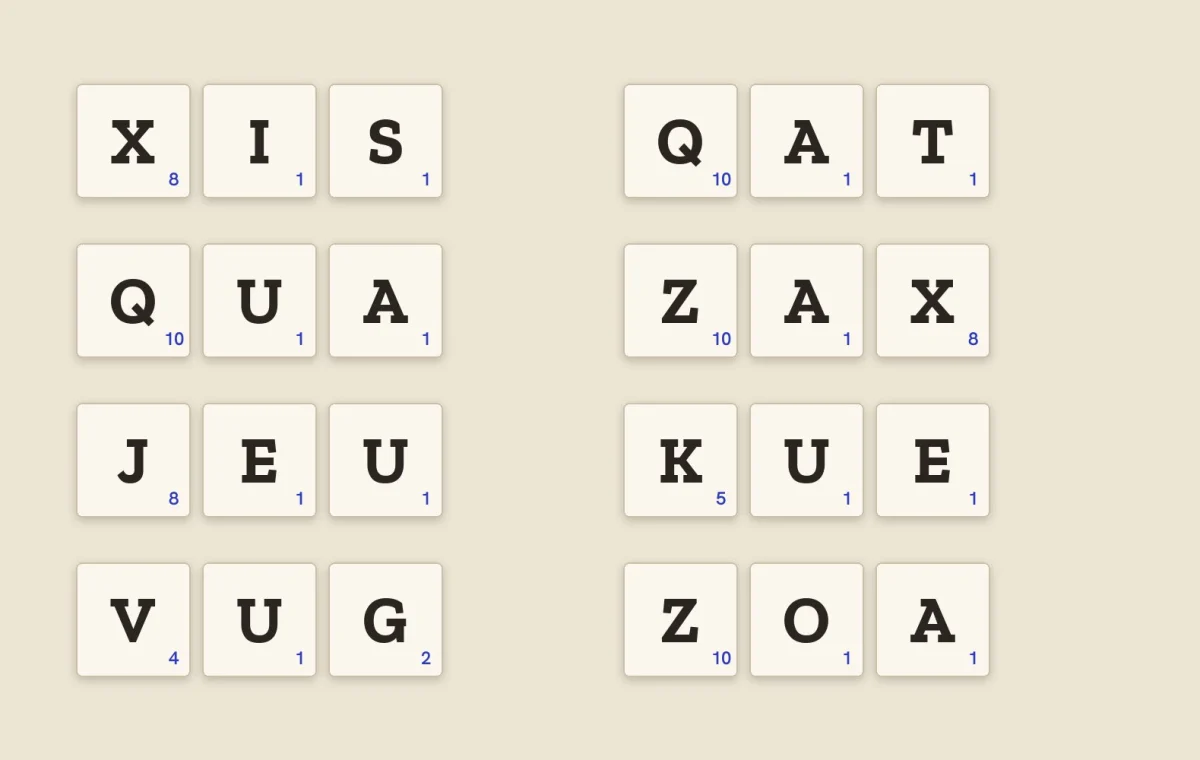
xis
That is the complete set. After typing it in a real round, the other short X words all begin with XE or XY, such as xenon, xerox and xylem. You can rehearse the whole sequence in a practice round locked to X.
Q has two three-letter words
Write both three-letter Q words. One of them does not need a U after the Q, and the other begins with QU in the usual way. Afterwards, a practice round locked to Q is a good test.
Show the Q answers
qat qua
Both are worth memorising outright, since they are the entire category. Qis is not in the dictionary, and qi is too short for the game.
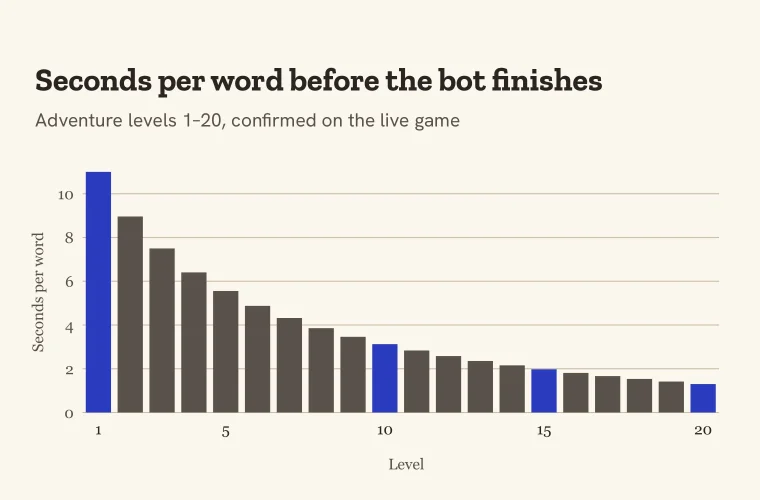
How much time you will have for these words depends on the mode. In Adventure the round ends when the bot finishes, which on higher levels leaves under two seconds per word, so these three-letter answers have to come instantly. Our live pace tests set out what each level demands.
Round 2: Z
Z has twelve three-letter words
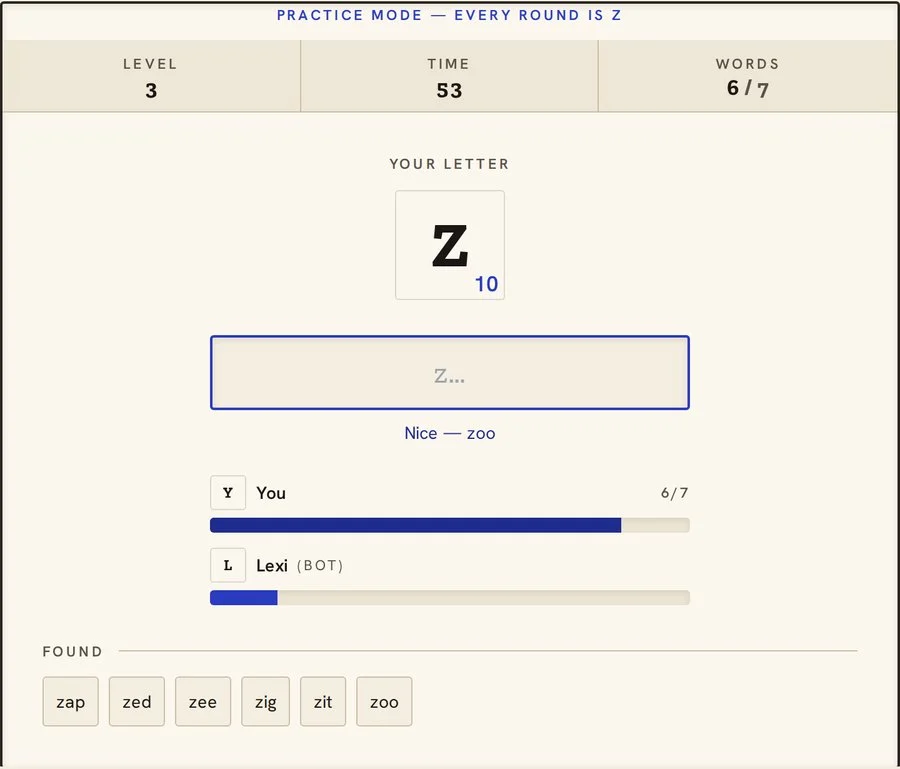
Write as many of the twelve three-letter Z words as you can. If you stall, open the hint before the answers and try again, or take a practice round locked to Z once you have marked yourself.
Hint: how the Z words are spread
Three begin with ZA, three with ZE, four with ZI and two with ZO. No three-letter Z word starts with any other pair.
Show the Z answers
zag zap zax zed zee zek zig zin zip zit zoa zoo
A practical starter set is zap, zed, zip, zit and zoo, which are familiar and hard to confuse with each other. Add zag, zig and zee next.
Round 3: U and I
U has fifteen three-letter words
Write the U words. This set is spread thinly across many second letters, so a quick pass through UG, UM, UP, UR and US is a sensible way to search.
Show the U answers
udo ugh uke ulu umm ump uns upo ups urb urd urn use uta uts
Start with ugh, uke, ump, ups, urn and use. The rest are less familiar and can wait until those six come back to you without effort.
I has nineteen three-letter words
Write the I words. Four of them begin with IC and three with IN, and the remainder are scattered across other second letters.
Show the I answers
ice ich ick icy ids iff ifs ilk ill imp ink inn ins ion ire irk ism its ivy
Most of these are everyday words, which makes I one of the easier sets to learn completely. Ich, ick and iff are the least obvious of the set, so give them extra attention.
Round 4: V and J
V has twenty-one three-letter words
Write the V words. Eight of them start with VA, so begin there, then move through VE, VI, VO and VU.
Show the V answers
vac van var vas vat vau vav vaw vee veg vet vex via vie vig vim vis voe vow vox vug
A starter set of van, vat, vet, vex, via, vie, vim and vow covers four different second letters. For more on V, try the drills on the words that start with V page.
J has twenty-two three-letter words
Write the J words. They are split fairly evenly between JA, JE, JI, JO and JU, so do not stop after the first pair that produces answers.
Show the J answers
jab jag jam jar jaw jay jee jet jeu jib jig jin job joe jog jot jow joy jug jun jus jut
Twelve familiar words make a strong base: jab, jam, jar, jaw, jet, jig, job, jog, jot, joy, jug and jut. The others can be added later.
Round 5: K and Y
K has twenty-seven three-letter words
Write the K words. Most begin with KA, KE, KI or KO, and there is one each under KH and KU, which are easy to overlook.
Show the K answers
kab kae kaf kas kat kay kea kef keg ken kep kex key khi kid kif kin kip kir kit koa kob koi kop kor kos kue
Begin with keg, ken, key, kid, kin, kip, kit and koi. The words that start with K guide shows how the longer K words are distributed.
Y has twenty-six three-letter words
Write the Y words. Seven each begin with YA, YE and YO, with two under YI and three under YU, so a five-pair sweep will find all of them.
Show the Y answers
yah yak yam yap yar yaw yay yea yeh yen yep yes yet yew yin yip yob yod yok yom yon you yow yuk yum yup
A good first set is yak, yam, yap, yaw, yes, yet, yew, you and yum. Several informal words such as yep and yup are accepted, so they are worth including.
Round 6: valid or not?
Decide whether each of these three-letter words is in the game’s dictionary before opening it. Some of them look like ordinary words and some look invented, so trust the list rather than your instinct.
zen
Not valid It is not in the list, so a Z round cannot lean on it.
zek
Valid It is one of the twelve three-letter Z words.
qis
Not valid The only three-letter Q words are qat and qua.
uni
Not valid It does not appear in the dictionary as a word.
kue
Valid It is the only three-letter K word starting KU.
vin
Not valid V words starting VI are via, vie, vig, vim and vis.
umm
Valid Along with ump, it is one of two three-letter UM words.
If the traps catch you out, the words you can’t play page explains many familiar rejections, and the hard letters Q, X, Z and J reference goes beyond three letters for the toughest starts.
Everyday words or list words?
Being in a word-game list is not the same as being a word people use. For a teacher, a crossword solver or a learner of English, the better question is which of these 145 words are worth knowing outside a game. The table sorts them into three columns. The sorting is our judgement for an adult reader of English, not a dictionary label, and readers in different countries will draw some lines differently: Wiktionary marks zed as the name of the letter chiefly in Commonwealth countries and Ireland, and zee as chiefly American.
| Letter | Everyday words | Informal, regional, formal or mostly in set phrases | Rare list words |
|---|---|---|---|
| X | none | none | xis (1) |
| Q | none | qua (1) | qat (1) |
| Z | zap, zip, zit, zoo (4) | zag, zed, zee, zig (4) | zax, zek, zin, zoa (4) |
| U | ugh, ups, urn, use (4) | uke, umm, ump, uns (4) | udo, ulu, upo, urb, urd, uta, uts (7) |
| I | ice, icy, ill, imp, ink, inn, ion, ire, irk, its, ivy (11) | ick, ids, ifs, ilk, ins, ism (6) | ich, iff (2) |
| V | van, vat, vet, vex, via, vie, vow (7) | vac, vee, veg, vim, vox (5) | var, vas, vau, vav, vaw, vig, vis, voe, vug (9) |
| J | jab, jam, jar, jaw, jay, jet, jig, job, jog, jot, joy, jug, jut (13) | jag, jib, joe (3) | jee, jeu, jin, jow, jun, jus (6) |
| K | keg, key, kid, kin, kit (5) | ken, kip, kir, koi (4) | kab, kae, kaf, kas, kat, kay, kea, kef, kep, kex, khi, kif, koa, kob, kop, kor, kos, kue (18) |
| Y | yak, yam, yap, yay, yen, yes, yet, yew, you, yum (10) | yah, yaw, yea, yep, yin, yip, yob, yon, yow, yuk, yup (11) | yar, yeh, yod, yok, yom (5) |
The sorting changes our advice. On the raw count K looks like the richest of the nine letters, with 27 three-letter words, yet only five of them are everyday words and 18 are rare list words. J has five fewer entries but thirteen everyday words, and I has eleven. The letter that looks strongest in a count is the weakest for a vocabulary lesson, so in a classroom we would teach K last. The game reverses that order, because every listed word scores the same, and there the rare K words are exactly what is worth learning. X and Q have no everyday three-letter word at all; a class can skip them, while a player should learn them first, since xis, qat and qua are the whole set. In Find the Word these nine letters together come up in about one round in eight (12.7%, worked out from the game’s letter weights), which is why a few minutes on them repays itself.
If you also play Scrabble
These answers transfer to Scrabble only in part, because the two games draw their lines in different places. The biggest difference is length. NASPA’s page for NWL2020, the word list for competitive play in the United States and Canada, gives 107 two-letter words, and qi, za, xi, xu, jo and ka, all on these narrow letters, are among them. None can score here, because this game needs three letters. Scrabble lists also change between editions: the Wikipedia article on the Official Scrabble Players Dictionary says qi and za were added in the fourth edition (2005) and zen in the sixth (2018), while zen is not in this game’s list at all.
So a Scrabble habit is not a safe bet here: two-letter words never count, and recent additions may be missing. The reverse is not guaranteed either. We have checked every word on this page against the game’s list only, not against any Scrabble dictionary, so confirm a word in the edition your group uses before relying on it.
A learning order
The order below puts the smallest, most valuable sets first. It is an editorial suggestion based on how few alternatives each letter offers, not a ranking of how common the words are.
| Step | Letters | What to learn | Three-letter words in the set |
|---|---|---|---|
| 1 | X, Q | xis, qat, qua (the complete sets) | 3 |
| 2 | Z | zap, zed, zip, zit, zoo, then the rest | 12 |
| 3 | U, I | The everyday words first, then the full lists | 34 |
| 4 | V, J | The starter sets in the answer boxes | 43 |
| 5 | K, Y | The starter sets, then the unfamiliar words | 53 |
Once a set comes back reliably on paper, test it under pressure in a real round of Find the Word, and use the word recall training routine to check a week later whether the words have stayed with you.
Scoring yourself
Work out, for each letter, what share of its three-letter words you wrote down before opening the answers, then find the matching row. The bands are a rough guide for deciding what to practise next.
| Share recalled for a letter | What it suggests | What to do next |
|---|---|---|
| X or Q missed | The quickest possible gain is still available | Learn xis, qat and qua today; they are the whole category |
| Under a quarter | This letter is likely to stall a timed round | Learn the starter set only and retest in a few days |
| A quarter to a half | You have a start but probably search only one or two pairs | Use the second-letter hints and sweep every pair next time |
| Half to three quarters | A dependable opening set for this letter | Add the unfamiliar words a few at a time |
| Over three quarters | The set is close to complete | Move on to four- and five-letter words for this letter |
Updated 14 September 2026: added a table sorting all 145 words into everyday, informal and rare words, instructions for running the test on paper, and a screenshot from a test round on Z. The Scrabble section now cites its sources, and Scrabble verdicts we could not confirm from a published source were removed. Updated 13 September 2026: rewritten and restructured, with every count and word verdict rechecked against the game’s word list and blocklist. An offensive entry that the game now blocks was removed from the Y answers. Details are in the corrections log.
New to The Verbarium? Follow the reading path, with tools and printables