Word Games for the Classroom That Need Only a Board and a Timer

Six word games work with nothing more than a board, a marker and a timer: a one-letter word race (list words starting with a given letter), word ladders (change one letter at a time to turn one word into another), a category grid (fill a grid of letters and topics), hidden words (find words inside a long word), a prefix and suffix relay (teams build words on a shared ending or beginning) and a silent-letter sort. Each takes two to fifteen minutes, suits a whole class or small groups, and needs no printing. The rules, timings and ready-to-use examples for all six are below.
Every example answer below has been checked against the word list we use for every count on this site, which is based on the public-domain ENABLE list and holds 172,446 words once offensive words are removed; how we check words explains how it was prepared. The list contains no capitalised words and includes many rare ones, so pupils will sometimes find a genuine word that is not in our answer keys. Keep a dictionary handy to settle those, and treat names as a house rule you decide in advance.
| Game | Ages | Time | Best for |
|---|---|---|---|
| One-letter word race | 7+ | 3 to 5 min | Starting a lesson, quick recall |
| Word ladders | 8+ | 5 to 10 min | Spelling patterns, careful reading |
| Category grid | 7+ | 8 to 12 min | Topic vocabulary, teamwork |
| Hidden words | 7+ | 5 to 10 min | Seeing parts inside long words |
| Prefix and suffix relay | 9+ | 5 to 8 min | Word building, active break |
| Silent-letter sort | 7 to 11 | 10 to 15 min | Spelling awareness, discussion |
1. One-letter word race
This is the fastest game to set up and the easiest to repeat. Write one letter on the board, start the timer, and everyone lists as many words beginning with that letter as they can. It works as a settling activity at the start of a lesson because the whole class can begin within ten seconds.
- Ages
- 7 and up
- Time
- 1 to 2 minutes of writing, 3 minutes of checking
- Group size
- Individuals, pairs or the whole class
- Practises
- Vocabulary recall, spelling under light time pressure
- You need
- Board, timer, scrap paper
- Write a single letter on the board.
- Set the timer for 60 or 90 seconds. Pupils write words of three letters or more that begin with that letter.
- When time is up, pairs swap lists and cross out misspellings and repeats.
- Each correct word scores one point; a word nobody else in the room wrote scores two.
- Collect a few of the rarest words on the board and talk about their meanings.
For mixed abilities: give pupils who need support a longer timer or let them work in pairs with one writer, and ask confident spellers to count only words of five letters or more. You can also let a group choose between two letters, one easy and one hard.
The letter you choose makes a big difference. In the word list, S begins 1,452 words of three to five letters, while C, B, P and T each begin between 845 and 925. At the thin end, V begins 255 short words, J 240, Z 94, Q 69 and X only 15. For a first go, use S, B, C, P or T; save K, V and W for groups who have played before, and avoid X, Q and Z unless the aim is a laugh.
Sample answers for B, T and K (common words only)
B: bag bat bed bee bin box boy bus bake ball band bank bark bear bell bike bird boat bone book boot bowl bread brick brown brush build
T: tap ten tie tin toe top toy tub tag tail take talk tall tank team tent test time tiny toad tool town tree trip true turn table tiger toast
K: keg key kid kit keen keep kept kick kind king kiss kite knee knit knot know kettle kitten kitchen koala
2. Word ladders
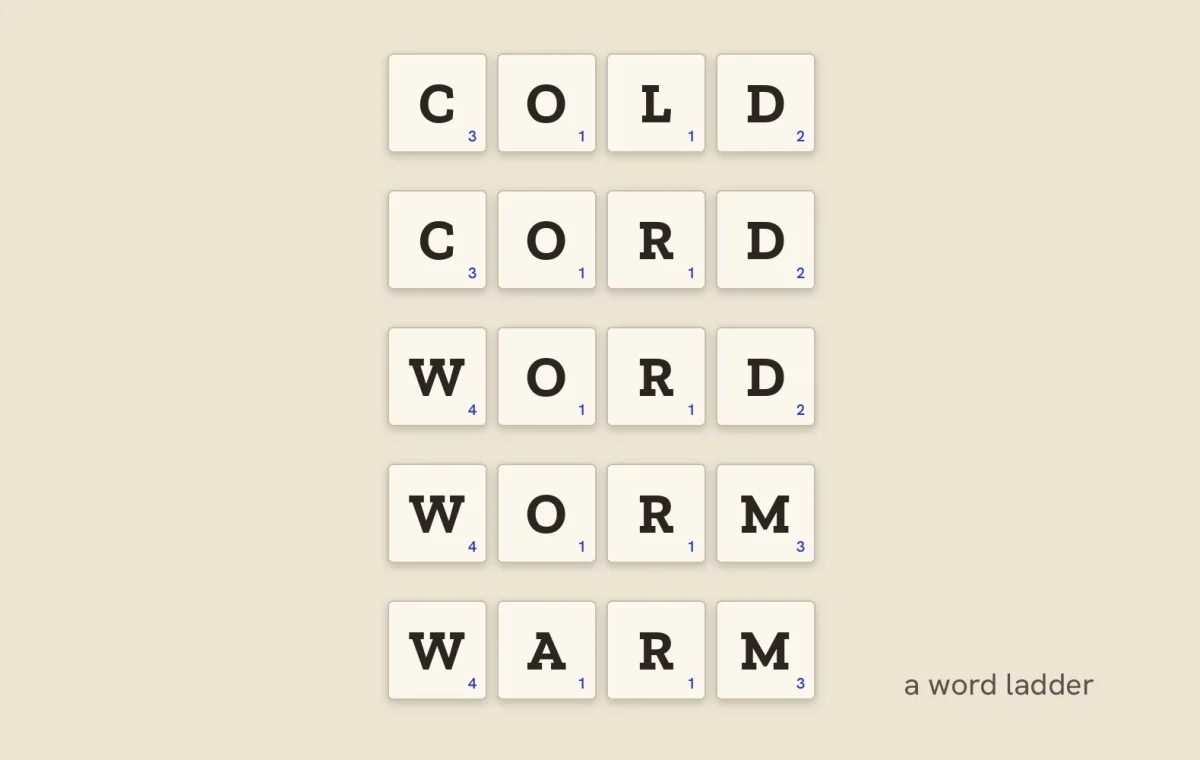
A word ladder turns one word into another by changing a single letter at a time, and every step on the way must be a real word. Pupils have to read each word letter by letter, which makes it a good fit for spelling lessons. Four-letter words are the most comfortable size: three-letter ladders are too easy, and five-letter ones often need obscure words.
- Ages
- 8 and up
- Time
- 5 to 10 minutes
- Group size
- Pairs or small groups; whole class for a demonstration
- Practises
- Letter-by-letter spelling, vowel and consonant patterns, persistence
- You need
- Board, timer
- Write a start word at the top of the board and a target word at the bottom, with a row of blank lines between.
- Pupils change exactly one letter per step, keeping the other letters in the same order.
- Every step must be a real word that the group agrees on (or that a dictionary confirms).
- The first pair to reach the target wins a point; a pair that reaches it in the fewest steps wins a bonus point.
- Finish by writing the shortest answer on the board and checking each step aloud.
For mixed abilities: give support groups the ladder with one or two middle words already filled in, or show the number of steps needed. Stretch groups can try to make a ladder of their own for another group to solve.
The ladders below were computed from the word list as the shortest possible paths using only everyday words. Pupils may find other ladders of the same length, and those are equally correct.
| Puzzle | Steps | Level |
|---|---|---|
| FIVE to NINE | 2 | Warm-up |
| COLD to WARM | 4 | Standard |
| GIVE to TAKE | 4 | Standard (several answers) |
| HARD to EASY | 5 | Harder |
Answers: word ladders
FIVE to NINE: five, fine, nine.
COLD to WARM: cold, cord, word, worm, warm. Another four-step answer is cold, cord, card, ward, warm.
GIVE to TAKE: give, live, like, lake, take. Also correct: give, gave, cave, cake, take; give, gave, wave, wake, take; give, gave, game, tame, take.
HARD to EASY: hard, card, care, case, ease, easy; or hard, card, cart, cast, east, easy. It can be done in four steps (hard, hart, hast, east, easy), but hart (a male deer) and hast (an old form of “have”, as in “thou hast”) are unusual enough to make a good discussion point.
3. Category grid
Draw a grid with letters across the top and categories down the side. Teams try to fill every square with a word that fits both the letter and the category. Because it can be tied to a topic (science words, food, places around school), it doubles as a vocabulary review.
- Ages
- 7 and up
- Time
- 5 to 8 minutes of play, 4 minutes of scoring
- Group size
- Teams of three or four
- Practises
- Topic vocabulary, spelling, discussion within a team
- You need
- Board, timer; each team copies the grid onto paper
- Draw a grid of five letters across and four or five categories down.
- Teams copy the grid and fill in as many squares as they can before the timer ends.
- Go through the grid one row at a time, with each team reading its answers.
- A correct answer scores one point; an answer no other team gave scores two.
- Challenge any doubtful answer to the class and let the dictionary decide.
For mixed abilities: let support teams choose any three letters in each row instead of all five, or allow a picture with a label for younger pupils. For confident groups, add a category such as “adjectives” or “words with a double letter”, or require every answer to have at least five letters.
| Category | B | C | M | S | T |
|---|---|---|---|---|---|
| An animal | bear | cat | mouse | snake | tiger |
| A food | bread | carrot | melon | soup | toast |
| Found in a house | bed | chair | mirror | sofa | table |
| An action word | bake | climb | march | sing | throw |
| A colour | blue | cream | magenta | silver | tan |
Letters with plenty of words (B, C, M, S, T, P) keep the game moving. If you include categories such as countries or cities, decide in advance whether capitalised names count, since a word-game list will not contain them.
4. Hidden words in a long word
Write one long word on the board. Pupils find shorter words hidden inside it, using letters that sit next to each other in the same order. Most children are surprised by how many words a familiar word contains, and the game draws attention to the parts that longer words are built from.
- Ages
- 7 and up
- Time
- 3 to 5 minutes per word
- Group size
- Individuals or pairs, reviewed as a class
- Practises
- Visual scanning of spellings, recognising word parts
- You need
- Board, timer
- Write a long word in large capitals and leave space around it.
- Pupils find words of three letters or more made from neighbouring letters, left to right.
- After the timer, a volunteer underlines each hidden word on the board.
- One point per hidden word; the longest hidden word found earns a bonus point.
For mixed abilities: tell support groups how many hidden words there are, or give them the first letter of each. As a stretch, switch to the harder version: make words from any of the letters in any order, using each letter no more often than it appears in the long word.
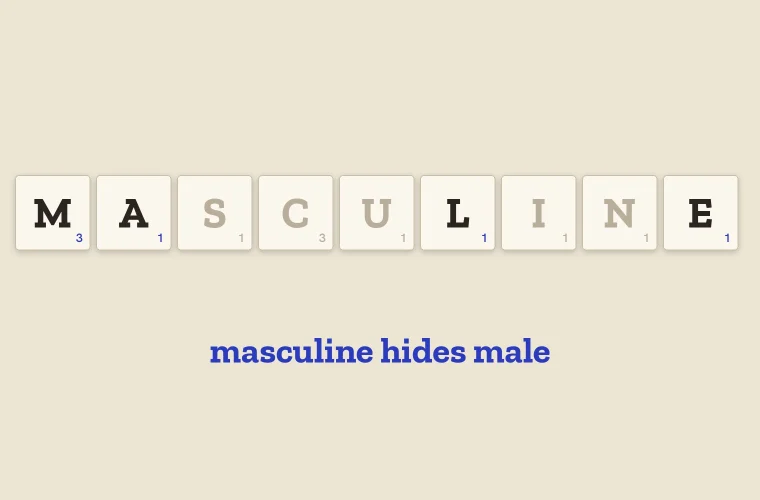
GRANDMOTHER · SCARECROW
Answers: hidden words in GRANDMOTHER
Common words hidden in grandmother: grand, gran, ran, and, mother, moth, other, the and her. The word list also contains a few rare ones (such as rand), which are fair game if a pupil can show them in a dictionary.
Answers: hidden words in SCARECROW
Common words hidden in scarecrow: scare, scar, car, care, are, crow and row.
Answers: harder version, any letters from SCARECROW
Six letters: arrows coarse scarce soccer
Five letters: acres arose arrow cower crews crows races roars score screw swear swore worse
Four letters: acre care case core crew crow race rare rear roar rose scar soar sore wear wore
Three letters: ace arc are awe car cow ear era oar ore owe raw row saw sea sew sow war was
5. Prefix and suffix relay
This is the most active game of the six, and useful when a class needs to move. Teams line up facing the board, each with a column headed by a word beginning or ending such as un- or -ful. One pupil at a time runs up, writes a word that uses it, and hands the marker to the next person in line.
- Ages
- 9 and up
- Time
- 2 minutes per round, three rounds
- Group size
- Teams of four to six
- Practises
- Word building, the meaning of common prefixes and suffixes, spelling changes when an ending is added
- You need
- Board divided into one column per team, one marker per team, timer
- Write the same prefix or suffix at the top of every team’s column.
- On “go”, the first pupil in each line writes one word using it, then passes the marker back.
- Nobody may repeat a word already in their team’s column.
- When the timer stops, check each column together; every correct, correctly spelled word scores a point.
- Change the prefix or suffix for the next round.
For mixed abilities: allow a teammate to whisper help, or write a short list of root words (help, kind, care, use, happy) at the side of the board for anyone who gets stuck. Stretch the round by requiring words that take both a prefix and a suffix, such as unhelpful.
Each set below contains words from the list that pupils are likely to know. When checking, look out for the spelling changes (happy becomes happiness and happily). The prefix and suffix worksheet covers those rules if you want a follow-up activity.
Answer bank: prefixes
un-: unhappy unkind unfair untidy unzip unwrap unpack unable unsafe unusual
re-: redo reread rewrite replay refill reheat rebuild return
dis-: disagree dislike disappear dishonest disobey discover
mis-: misspell mislead mistake misplace misbehave
Answer bank: suffixes
-ful: helpful careful hopeful painful playful thankful useful
-less: helpless careless hopeless painless useless fearless homeless
-ness: kindness sadness darkness fitness illness happiness
-ly: quickly slowly sadly kindly happily loudly
6. Silent-letter sort
Write a jumbled set of words on the board and draw columns headed silent K, silent W, silent B and so on. Pupils say each word aloud, decide which letter is silent, and sort it into the right column. The game suits a slower, discussion-based part of a lesson, and it gives a natural opening for talking about why English spelling keeps letters it no longer pronounces.
- Ages
- 7 to 11
- Time
- 10 to 15 minutes
- Group size
- Pairs, then whole-class checking
- Practises
- Spelling of common silent-letter words, listening carefully to pronunciation
- You need
- Board, timer
- Draw four to six column headings on the board, one per silent letter.
- Write 16 to 24 words in a jumbled list underneath.
- Pairs copy the headings and sort every word, saying each one aloud first.
- Check as a class: a volunteer places each word and the class agrees or challenges.
- Finish by asking pairs to add one more word of their own to any column.
For mixed abilities: start support pairs with only two columns (silent K and silent W work well), or underline the silent letter in the first word of each group. For confident pupils, mix in a few words where the letter is sounded, such as kitten, number and winter, and add a “no silent letter” column.
Pronunciation varies between accents, so pick words where the letter is silent for almost everyone. The sets below avoid known disagreements; for example, some speakers sound the L in calm and palm, and many American speakers do not sound the H in herb, so those words are left out. For background on how these spellings arose, see why English spelling is so weird.
| Silent letter | Example words |
|---|---|
| K | knee, knife, knit, knob, knock, knot, know, knuckle |
| W | wrap, wren, wreck, wrist, write, wrong, answer, sword, two |
| B | lamb, limb, climb, comb, crumb, thumb, tomb, debt, doubt |
| L | half, talk, walk, chalk, could, should, would |
| T | castle, listen, whistle, fasten |
| G | gnat, gnaw, gnome, sign, design, foreign |
| H | hour, honest, honour, ghost, rhyme |
A ready-mixed board set of 20 words
thumb write knot half castle wrist comb knee listen walk wreck lamb know chalk whistle climb sword knock could fasten
Sorted: silent K (knot, knee, know, knock); silent W (write, wrist, wreck, sword); silent B (thumb, comb, lamb, climb); silent L (half, walk, chalk, could); silent T (castle, listen, whistle, fasten).
Why the games are built this way, and what we have not tested
We wrote these six versions ourselves, and each choice on the page came from one constraint: a teacher should be able to start with nothing prepared except a letter or a word on the board. That rules out cards, printed grids and anything that needs a word list in the teacher’s hand, which is why every game ships with its answer key inside the article instead.
The examples were picked from counts, not from memory. For the letter race we looked at words of three to five letters, because those are the words younger pupils can actually produce, and that is where B climbs to third place behind S and C even though it is only eighth across the whole list. For the ladders we measured how easy it is to take a single step at each length: a three-letter word in the list has about 16 one-letter-change neighbours on average, a four-letter word about 11, and a five-letter word under 6, with 743 five-letter words (8.7%) having no neighbour at all. Three-letter ladders fall out almost by accident, and five-letter ones soon run into dead ends, so four letters is where we set the puzzles. For the silent-letter sort, accent-dependent words stayed out because a sorting game needs one right column per word.
The scoring follows the same thinking. A bonus for a word nobody else wrote is there so that a pupil who knows unusual words can beat one who simply writes common words fastest, and the “decide disputes the same way every time” rule exists because a word-game list contains rare words that no teacher can be expected to know.
The limits are real. We have not run these games with a class, so the ages and timings in the summary table are our estimates from the difficulty of the material, not observations. Our answer keys come from a list that excludes names and includes obscure words, so they will miss some answers pupils give and contain a few they never would. Treat the page as a set of checked examples with untested timings, and adjust after the first round.
Running the games smoothly
A visible countdown helps more than any rule. Most classroom boards can show a timer, but a kitchen timer or a phone placed where everyone can see it works just as well. Keep rounds short enough that pupils want another one, and announce the scoring before the timer starts so there are no arguments afterwards.
Decide on disputed words the same way every time. A shared dictionary is the simplest referee, and a quick “does anyone know what it means?” turns an argument into a vocabulary moment. For games scored on unique answers, ask teams to read their words out in turn and cross off any word another team also has, so that the whole class hears every answer.
If a pupil enjoys the letter race and wants to play at home, our free online word game uses the same idea: one starting letter, a short time limit, and every word checked automatically.
New to The Verbarium? Follow the reading path, with tools and printables