Kangaroo Words: Words That Hide Their Own Synonym

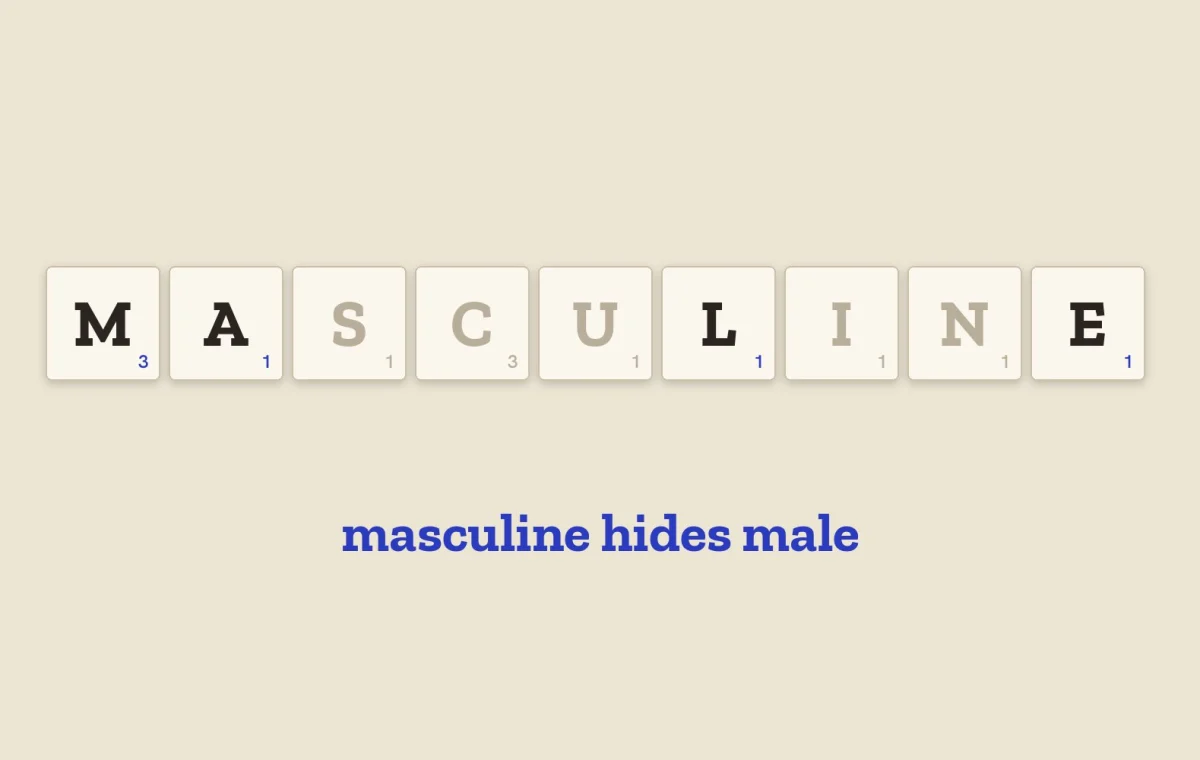
A kangaroo word is a word that contains one of its own synonyms, with the letters of the hidden word appearing in the right order but not necessarily side by side. Masculine hides male (masculine), deceased hides dead, and respite hides rest. The smaller word tucked inside is called the joey, after the young kangaroo carried in its mother’s pouch.
The term belongs to recreational word play rather than to linguistics, so general dictionaries such as the Cambridge Dictionary do not define it. It does have an established following among puzzle writers: Wikipedia’s article on kangaroo words, which cites Dave Morice’s The Dictionary of Wordplay, describes the same idea, in a slightly looser form that also admits closely related words as joeys, and notes that compilers set the rules differently. Some insist that the joey’s letters must be split up rather than sitting in one block, and some reject pairs that come from the same root, such as act in action. The same article mentions related coinages: a “twin kangaroo” holds two joeys, and an “anti-kangaroo” hides its own opposite, as animosity hides amity.
How the examples on this page were chosen
Kangaroo words are easy to get slightly wrong, either because the letters are out of order or because the two words are related rather than synonymous. Every pair below passed three checks. A script confirmed that the joey’s letters appear in order inside the longer word. Both words are in the list we use for every count on this site, which starts from the public-domain ENABLE word list and holds 172,446 words once an offensive-word blocklist is removed; how we check words describes it. Finally, we compared the definitions in the Cambridge Dictionary, turning to Wiktionary where Cambridge did not record the relevant sense, and kept a pair only when one word is defined by the other or the two definitions match closely enough that each could replace the other in at least one ordinary sentence. Pairs in which one word is only a kind of the other went to the caveats further down. We also left out pairs in which the joey sits as a single unbroken block, such as alone and lone, because those are the least surprising.
The meaning test matters more than it first appears. In the game’s word list, the letters M, A, L, E appear in that order inside 1,506 other words, and R, E, S, T inside 2,791, including marmalade and interest, which have nothing to do with men or with resting. Finding the letters is easy; finding them inside a word with the same meaning is what makes a kangaroo word.
Fourteen kangaroo words, with the joey highlighted
masculine
Joey: male. Wiktionary gives “of or pertaining to the male sex; biologically male” as a sense of masculine. Cambridge defines masculine mainly by characteristics traditionally linked with men, so the everyday overlap is narrower than the dictionary sense.
encourage
Joey: urge. Wiktionary defines one sense of encourage as “to spur on, strongly recommend”, and Cambridge defines urge as “to encourage someone strongly to do something”. The joey is split around a single A.
fabrication
Joey: fiction. A fabrication is an invented story presented as true, and calling a claim “pure fiction” says exactly the same thing.
blossom
Joey: bloom. As nouns both mean a flower, and as verbs both mean to open into flower; the double S is the only thing standing between them.
destruction
Joey: ruin. A town reduced to destruction and a town reduced to ruin are in the same state, and the four letters are spread across most of the word.
evacuate
Joey: vacate. Wiktionary’s first sense of evacuate is “to leave or withdraw from”, which matches Cambridge’s “to leave a room, building, chair, etc.” for vacate, although evacuating usually implies danger. The joey is six of the eight letters.
exhilarate
Joey: elate. Both verbs mean to make someone very happy or excited; they are often met as the adjectives exhilarated and elated.
perambulate
Joey: amble. To perambulate is to walk or stroll about, usually at leisure, which is also what it means to amble along a riverside path.
rapscallion
Joey: rascal. Wiktionary defines a rapscallion as “a rascal, scamp, rogue, or scoundrel”, and Cambridge’s definitions of the two words are almost word for word the same, so this is one of the most exact matches on the page.
deceased
Joey: dead. Cambridge defines deceased simply as “dead”, and it is the usual word in formal and official writing, and the joey’s two Ds sit at the very start and end of the word.
contaminate
Joey: taint. Wiktionary defines the verb taint as “to contaminate or corrupt (something)”, so tainting a water supply and contaminating it are the same act.
rotund
Joey: round. Rotund means rounded or plump, and a single T is all that separates the joey’s first two letters from the last three.
curtail
Joey: cut. To curtail spending is to cut it back, and both words can describe shortening a visit or a speech as well.
salvage
Joey: save. To salvage something is to save it from loss or destruction, whether that is cargo from a wreck or a meeting that is going badly.
Popular examples that need a caveat
A few pairs appear in almost every list of kangaroo words but are looser than the ones above. Chicken hides hen (chicken), but a hen is specifically a female chicken, so the words are not interchangeable: a rooster is a chicken but not a hen. Precipitation hides rain, yet rain is only one kind of precipitation, alongside snow, sleet and hail. Rambunctious hides raucous, and the two do overlap, since one dictionary sense of raucous is boisterous and disorderly, but the first sense of raucous in the Cambridge Dictionary is “loud and unpleasant”, which rambunctious (“full of energy and difficult to control”) does not mean.
Three pairs that could have joined the list above fail for the same kind of reason. Splotch hides spot (splotch), but both Cambridge and Wiktionary define a splotch as a spot or mark with an irregular shape, which makes it one kind of spot. Instructor hides tutor (instructor), yet Cambridge describes an instructor as someone who teaches a practical skill and a tutor as a teacher who works privately or with small groups: two kinds of teacher rather than one. Barren hides bare (barren), but Cambridge defines barren land as unable to produce plants and bare as not covered by anything, so barren ground is usually bare while bare ground need not be barren.
Spelling can also decide the matter. The British spelling utilise contains use (utilise), but the American spelling utilize has no S, so the joey disappears. Both spellings are in the word list, which makes this a case where a kangaroo word exists in one variety of English and not the other.
Examples we rejected from other lists
Our tests run in a fixed order: the letters must appear in sequence, both words must be in the word list, the meanings must be interchangeable rather than merely related, and the joey must not sit in one unbroken block. Applied to the examples given by Wikipedia and the open Wiktionary appendix of kangaroo words, those tests remove more than you might expect.
- Wrong order. Wikipedia gives borough carrying burgh and junction carrying join, while noting the letters are out of their usual order. By our first test they are not kangaroo words at all: the R of borough comes before its U.
- Not in the list. Advertisement hiding ad fails our second test, because the list has no words under three letters. As a short form of the same word (Cambridge calls ad “informal for an advertisement”), it would also fail the stricter same-root rule.
- Related, not synonyms. The Wiktionary appendix lists community hiding county and city, but the Cambridge Dictionary defines a community as people and a county as a political division. It lists container hiding tin and can, which are kinds of container, the same fault as chicken and hen, and deteriorate hiding rot and die, where Cambridge’s “to become worse” is broader than rot (“to decay”) and is not what die means.
- One block. Inflammable and flammable really are synonyms, which is a useful fact in its own right, but the joey sits there in plain view.
The closest call was chocolate and cocoa. Cambridge defines cocoa as the powder used to make chocolate, which fails, but it also gives both words a drink sense (chocolate as “a hot drink made from milk or water, powdered chocolate, and sugar”, cocoa as “a sweet chocolate drink that is made with cocoa powder”), so the pair passes in that one sense. We left it off the main list because it works only through a secondary meaning.
We also got three wrong ourselves. Our first draft of this page listed instructor and tutor and splotch and spot among the kangaroo words, and used barren and bare in the puzzle; checking the definitions moved all three to the caveats above. As for the name, we like it because it builds the meaning test into the picture: a joey is carried by its own kind. Without that test the idea is just letter hunting, and 1,506 other words in the list contain M, A, L, E in order.
Find the joey
Each word below hides a synonym of itself, with its letters in order. The clue gives a rough meaning and the length of the joey. Try to find it before you open the answer; writing the long word out and crossing off letters is the most reliable method.
1. respite (a joey of 4 letters meaning a pause from effort)
respite hides rest. A respite is a short period of rest or relief, as in a respite from the rain.
2. indolent (4 letters, meaning not working or lazy)
indolent hides idle. Both describe someone who avoids activity or effort.
3. illuminated (3 letters, meaning lighted up)
illuminated hides lit. An illuminated sign and a lit sign are the same thing, and each letter of the joey is separated from the next.
4. observe (3 letters, meaning to notice with the eyes)
observe hides see. To observe something is to see or notice it, and the second E is the final letter of the word.
5. wriggle (6 letters, meaning to move with small, quick movements)
wriggle hides wiggle. Cambridge defines both words by small, quick movements of the body. Remove the R and the kangaroo word becomes its own joey, which makes this a particularly neat pair.
6. appropriate (3 letters, meaning suitable)
appropriate hides apt. An apt remark is an appropriate one, and the T is waiting almost at the end of the word.
7. separate (4 letters, meaning to divide or move apart)
separate hides part. As verbs, both mean to divide or move apart, as when a crowd parts or separates to let someone through.
8. gigantic (5 letters, meaning extremely large)
gigantic hides giant. Used as an adjective, a giant wave and a gigantic wave are equally huge. The two words are related, so stricter compilers would exclude this pair.
How to find kangaroo words yourself
The easiest starting point is a long word with a short, common synonym. Write the long word down, then look for the synonym’s first letter, then its second letter somewhere after that, and so on; if you run out of word before you run out of letters, it is not a kangaroo word. Formal or Latin-derived words are good hunting grounds because English so often has a short everyday word for the same idea, which is why pairs like deceased and dead or perambulate and amble turn up.
Then apply the meaning test honestly. If you can only connect the two words through a chain of associations, or one is merely a kind of the other, the pair belongs with the near misses. If you follow the stricter rule about related roots, check each pair’s origins in an etymological dictionary before counting it. If hunting letters inside words appeals to you, the same habit of rearranging and reading letters drives anagram families and palindromes, and you might also enjoy a quick game of Find the Word, where you race to type words from a single starting letter.
New to The Verbarium? Follow the reading path, with tools and printables