Anagram Families: The Letter Sets That Spell the Most Words

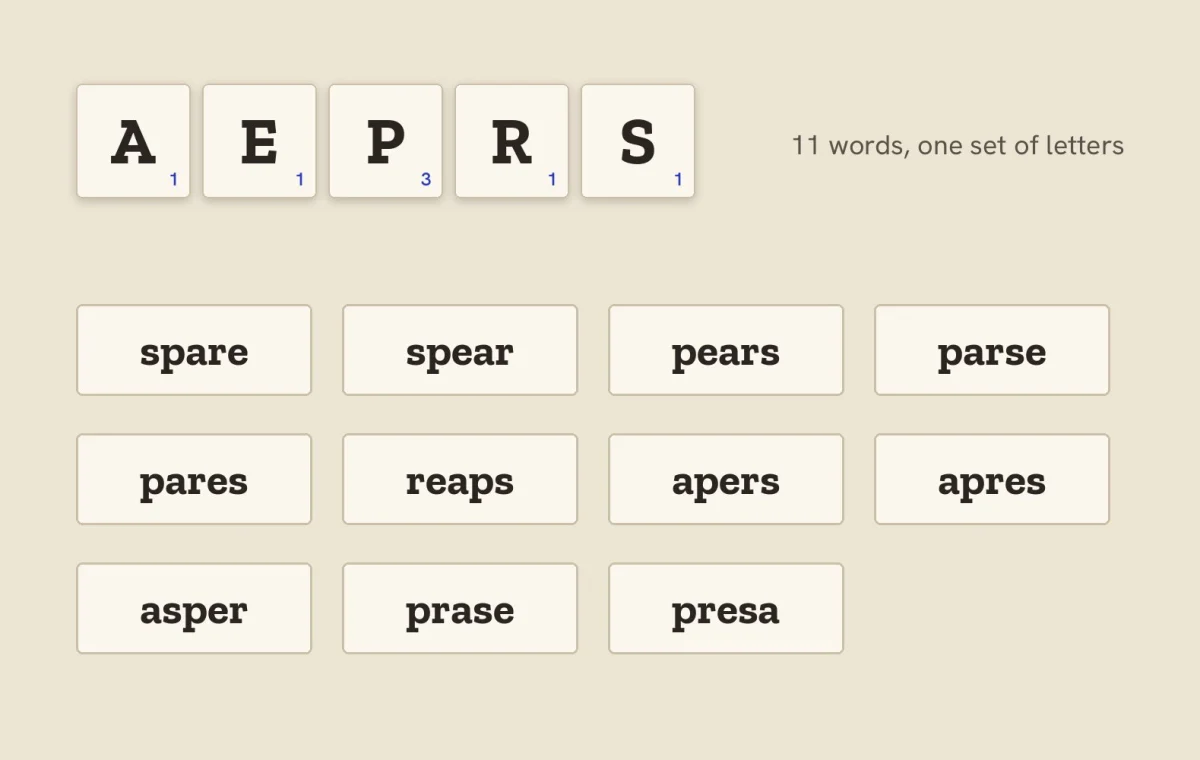
Some sets of letters are unusually generous. Shuffle A, E, P, R and S and you get eleven different playable words, from everyday ones such as spare, spear and parse to specialist entries such as prase and presa. Other sets of five letters spell exactly one word and refuse to be rearranged at all. This page ranks the biggest anagram families in the game’s word list for four, five, six and seven letters, explains why the same few letters keep turning up at the top, and finishes with five puzzles you can try before revealing the answers.
How the families were counted: every word was reduced to its letters in alphabetical order (so stop and pots both become OPST), and words sharing the same sorted letters were grouped together. The source is the Find the Word list: the public-domain ENABLE word list with an offensive-word blocklist removed, 172,446 playable words in all (how we check words explains it), so the rankings describe that list rather than English generally. Every playable word is counted. When we extended that blocklist during our September 2026 audit, one vulgar member left the AERS family, so the set below now has six words and AILR holds second place on its own.
Four-letter families
Among the 3,862 four-letter words in the list, just over half (52%) have at least one anagram partner. That is the highest rate of any length in the list. Short words are packed densely into the small number of possible letter combinations, so a four-letter word is more likely than a longer one to share its letters with a neighbour. The largest family has eight members, built on the letters of east and seat.
| Rank | Letters | Words | Family |
|---|---|---|---|
| 1 | AEST | 8 | ates, east, eats, etas, sate, seat, seta, teas |
| 2 | AILR | 7 | aril, lair, lari, liar, lira, rail, rial |
| =3 | AERS | 6 | ares, ears, eras, rase, sear, sera |
| =3 | ASTW | 6 | staw, swat, taws, twas, wast, wats |
| =3 | OPST | 6 | opts, post, pots, spot, stop, tops |
| =3 | OSTW | 6 | stow, swot, tows, twos, wost, wots |
| =7 | AEHT | 5 | eath, haet, hate, heat, thae |
| =7 | AELT | 5 | late, tael, tale, teal, tela |
| =7 | AELV | 5 | lave, leva, vale, veal, vela |
The OPST family is the most useful of these to remember, because all six members are ordinary English and every one of them is easy to type under pressure. AILR is the surprise of the table: it contains no S at all, yet takes second place on its own with seven words thanks to borrowed currency and botanical terms such as lari, lira, rial and aril.
Five-letter families
Five letters is where the families get large. Of 8,582 five-letter words, 44% share their letters with at least one other entry, and two sets reach ten words or more. The AEPRS family of eleven is the joint largest group at any length in the list, level only with the six-letter AELRST set further down.
| Rank | Letters | Words | Family |
|---|---|---|---|
| 1 | AEPRS | 11 | apers, apres, asper, pares, parse, pears, prase, presa, reaps, spare, spear |
| 2 | AELST | 10 | least, setal, slate, stale, steal, stela, taels, tales, teals, tesla |
| =3 | AELPS | 8 | lapse, leaps, pales, peals, pleas, salep, sepal, spale |
| =3 | AELRS | 8 | arles, earls, lares, laser, lears, rales, reals, seral |
| =3 | EIPRS | 8 | peris, piers, pries, prise, ripes, speir, spier, spire |
| =6 | ACERT | 7 | caret, carte, cater, crate, react, recta, trace |
| =6 | AELPT | 7 | leapt, lepta, palet, petal, plate, pleat, tepal |
| =6 | ABEST | 7 | abets, baste, bates, beast, beats, betas, tabes |
Notice how many of these families are made from a four-letter base plus S. AELPS, AELRS and ABEST each contain several plurals and third-person verb forms (leaps, earls, beats) sitting beside words where the S is part of the root (lapse, laser, beast). ACERT and AELPT are the exceptions, and they are worth knowing precisely because none of their seven members relies on an added S.
Six-letter families
With six letters the share of words that have a partner falls to 36% of 15,182, but the leading families stay large because sets drawn from the commonest letters still have plenty of real words to collide with. The top of the table is an eleven-word group that reads like a spelling test.
| Rank | Letters | Words | Family |
|---|---|---|---|
| 1 | AELRST | 11 | alerts, alters, artels, estral, laster, ratels, salter, slater, staler, stelar, talers |
| =2 | ACEPRS | 9 | capers, crapes, escarp, pacers, parsec, recaps, scrape, secpar, spacer |
| =2 | AELPST | 9 | palest, palets, pastel, petals, plates, pleats, septal, staple, tepals |
| =2 | EINRST | 9 | estrin, inerts, insert, inters, niters, nitres, sinter, triens, trines |
| =5 | ACERST | 8 | carets, cartes, caster, caters, crates, reacts, recast, traces |
| =5 | AEPRSS | 8 | aspers, parses, passer, prases, repass, spares, sparse, spears |
| =5 | EENRST | 8 | enters, nester, renest, rentes, resent, tenser, ternes, treens |
| =8 | ACENRT | 7 | canter, carnet, centra, nectar, recant, tanrec, trance |
| =8 | ADEILR | 7 | ariled, derail, dialer, laired, railed, redial, relaid |
EINRST shows the list’s habit of accepting both British and American spellings, since niters and nitres are counted as separate words. ACENRT and ADEILR are the largest six-letter families without an S, and both are made mostly of common verbs and nouns, which makes them better practice material than the top-ranked set.
Seven-letter families
Only 28% of the 23,060 seven-letter words have an anagram partner, and the largest family has nine members. The letters at the top, A, E, I, N, R, S and T, are among the most frequent in the whole list, which is no coincidence.
| Rank | Letters | Words | Family |
|---|---|---|---|
| 1 | AEINRST | 9 | anestri, antsier, nastier, ratines, retains, retinas, retsina, stainer, stearin |
| 2 | AEGINRS | 8 | earings, erasing, gainers, reagins, regains, reginas, searing, seringa |
| =3 | ADEIRST | 7 | aridest, astride, diaster, disrate, staider, tardies, tirades |
| =3 | AEILNST | 7 | elastin, entails, nailset, salient, saltine, slainte, tenails |
| =3 | AEIRSTT | 7 | artiest, artiste, attires, iratest, ratites, striate, tastier |
| =3 | EEIMPRS | 7 | empires, emprise, epimers, imprese, premies, premise, spireme |
| =3 | EIPRSST | 7 | esprits, persist, priests, spriest, sprites, stirpes, stripes |
| =3 | EORSSTU | 7 | estrous, oestrus, ousters, sourest, souters, stoures, tussore |
No seven-letter family without an S has more than five members. Ten sets reach five, among them cheater, hectare, recheat, reteach and teacher. For comparison, the leading eight-letter set reaches seven words (angriest, astringe, ganister, gantries, granites, ingrates, rangiest), and beyond that the families shrink quickly as long words become too specific to be rearranged.
Why these letters win
Two forces explain almost every row in the tables. The first is plain letter frequency. Across the whole list, E makes up about 11.5% of all letters, S about 9.5%, I 9.0%, A 7.6%, R 7.1%, and N and T just under 7% each. A set built from those letters has many more real words to collide with than one built from B, K or W, so its chances of producing several anagrams are far higher. Taking the fifty largest seven-letter families (with ties broken alphabetically), all fifty contain E and 42 contain S.
The second force is the S ending. English adds S to make plurals and third-person verbs, so a single four-letter base such as tale or teal generates a new five-letter word that shares letters with every other S form in the group. The effect shows up clearly when words ending in S are compared with the rest:
| Length | Words ending in S with an anagram | Other words with an anagram |
|---|---|---|
| 4 letters | 67% | 49% |
| 5 letters | 53% | 40% |
| 6 letters | 43% | 33% |
| 7 letters | 34% | 25% |
A third factor is the balance of vowels and consonants. Five-letter sets with exactly two vowels can be arranged into many pronounceable shapes, and they dominate the big families: of the 85 five-letter families with five or more members, 78 have two vowels, five have one and two have three. Sets with no vowel or four vowels never produce more than two words. Finally, the list’s acceptance of variant spellings (niters and nitres, apres alongside spare) and of obscure technical terms pads out several families that would look smaller in an ordinary desk dictionary.
Big families versus useful ones
The tables rank families by size, and size mostly measures how many rare words the list accepts. To see how much of each family is ordinary English, we looked up every member in wordfreq, a public frequency list built from Wikipedia, subtitles, news, books and web text up to about 2021, and treated a word as everyday if it appears at least once per million words. The results changed our view of the leaderboard.
- The record holders are mostly padding. Only three of the eleven AEPRS words clear that bar (pears, spare, spear), with parse just below it. The six-letter AELRST family, level with it on eleven, has two (alerts, alters). The seven-letter leader AEINRST has one, retains, and the seven-word EORSSTU set has none.
- The families worth admiring are smaller. OPST has five everyday words out of six, and sets such as EILV (evil, live, veil, vile), EIMT (emit, item, mite, time) and EIRST (rites, tiers, tires, tries) clear the bar with every member. No six- or seven-letter family of four or more words manages that.
- Longer can be better. The eight-letter AEGILNRT set, with altering, integral, relating and triangle, holds more everyday words than any seven-letter family, even though it is smaller than the leaders.
If you want to judge a family yourself, three signs usually mark an artefact of a word-game list rather than a real curiosity: a Latin or technical plural (recta, lepta), two spellings of one word counted separately (niters, nitres), and a member you could not use in a sentence without looking it up (anestri, tanrec). A frequency list helps but has a blind spot: it does not separate names from words, so tesla scores as if it were common vocabulary. Our own pick for the most satisfying family is ACEEHRT, where cheater, hectare and teacher share letters without sharing anything else.
Families in a timed round
In our game, Find the Word, every answer must begin with the letter you are dealt, so what helps is a family that clusters under one letter: dealt S, the AELST set gives setal, slate, stale, steal and stela. If you recognise words like these but cannot produce them on demand, word recall training is aimed at that gap.
Practice: five families to rebuild
Each puzzle below gives a set of letters and the number of playable words it makes. Try to write the family down before opening the answer. The first two are gentle; the last three include one or two entries that few people would find without help, which is normal and part of the exercise. Some of the rarer members also appear in the real-or-fake word quiz.
Puzzle 1: O, P, S, T (6 words)
opts, post, pots, spot, stop, tops. All six are common, so a full score here is a fair target before moving on to the longer sets.
Puzzle 2: A, C, E, R, T (7 words)
caret, carte, cater, crate, react, recta, trace. Carte is a fencing position and recta is an anatomical plural; the other five are everyday words.
Puzzle 3: A, E, L, P, S, T (9 words)
palest, palets, pastel, petals, plates, pleats, septal, staple, tepals. Tepals are the petal-like parts of flowers such as tulips, and septal relates to a septum.
Puzzle 4: E, I, N, R, S, T (9 words)
estrin, inerts, insert, inters, niters, nitres, sinter, triens, trines. Insert, inters and sinter are the members most people find; the spelling pair niters and nitres counts twice.
Puzzle 5: A, E, G, I, N, R, S (8 words)
earings, erasing, gainers, reagins, regains, reginas, searing, seringa. Erasing, gainers, regains and searing are the familiar four; seringa is a Brazilian rubber tree.
New to The Verbarium? Follow the reading path, with tools and printables