Prefix and Suffix Worksheet: Word Families That Stay in Your Round

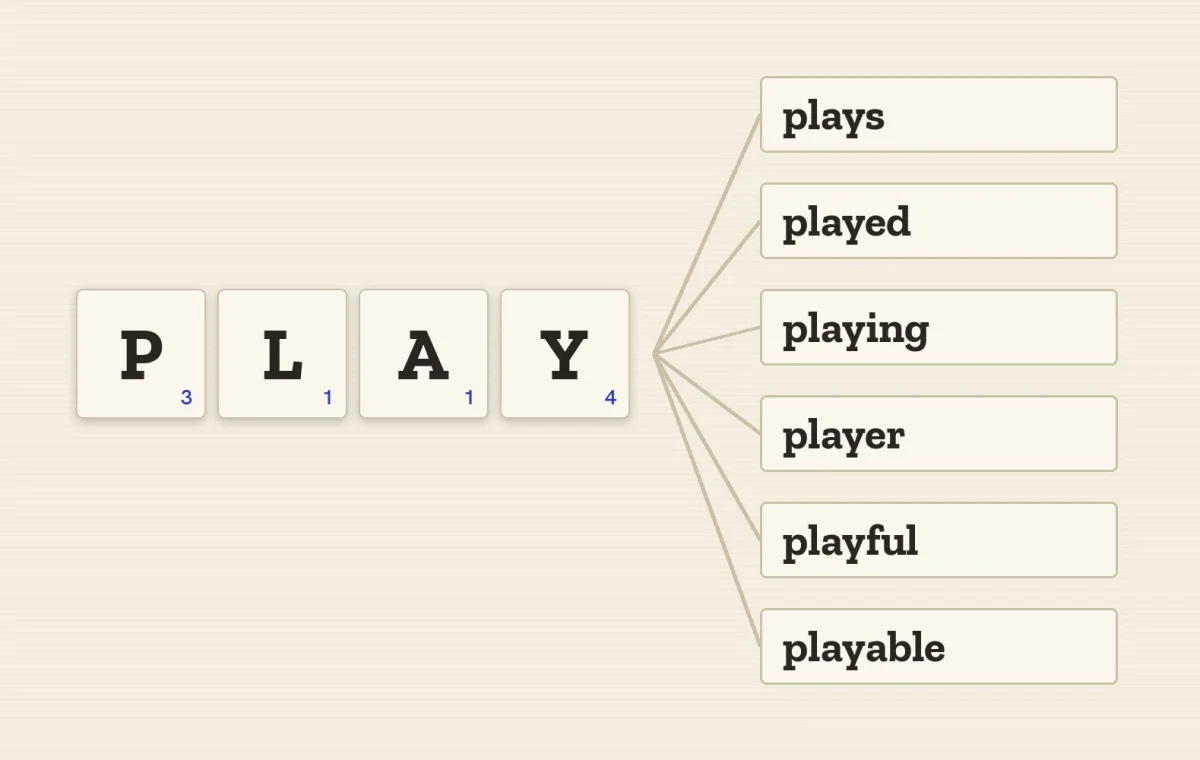
When the game serves the letter P, the single word play can become nine accepted answers without the first letter ever changing. Every form in the row below was checked against the game’s word list, and each one scores separately in a P round.
play plays played playing player players playful playfully playable
Replay is in the list too, but it cannot help in that round because the prefix turns it into an R word. That split is the idea behind this worksheet. Endings usually keep a word inside the round you are playing, while beginnings usually push it into another one, so the useful habit is a quick family check on endings and a mental note for prefixes. Everything below, from the spelling rules to the answer key, also works as a paper worksheet for a class that has never seen the game.
How to use this worksheet
Work through Parts 1 to 4 once, reading the examples aloud if that helps them stick. Then print or copy the card, set a timer, and try the practice roots without looking back. Give each root twenty seconds, write only forms you can spell with confidence, and open the answer key only when every root has been attempted.
Every count on this page was produced by a script run over the game’s word list, 172,446 words taken from the public-domain ENABLE list after an offensive-word blocklist is removed, as described in how we check words. The counts measure exact spellings. A match such as care and career shows up as a base plus -er even though the two words are unrelated in meaning, so treat the numbers as a guide to which checks cover the most ground, not as a grammar lesson.
Part 1: the four family checks
After typing a familiar base word, run these checks in order. Each should take a few seconds at most, and if a form does not come to mind straight away, move on to a new root rather than forcing it.
- Add S or ES. This is the most productive check by a wide margin: walk, walks; teach, teaches; box, boxes.
- Add ED and ING. Regular verbs give two more answers: paint, painted, painting; jump, jumped, jumping.
- Add ER and ERS. Many verbs have a person or thing form: painter, painters; walker, walkers; trainer, trainers.
- Try one familiar derivative. Only now reach for -ful, -less, -ly, -ness, -able or -ment, and only for words you already know: careful, careless; kindly, kindness; movement; readable.
| Ending added directly | Base words with a matching longer entry |
|---|---|
| -s | 48,117 |
| -ing | 6,526 |
| -es | 6,024 |
| -ed | 5,963 |
| -ly | 4,447 |
| -er | 2,585 |
| -ness | 2,259 |
| -able | 635 |
| -less | 627 |
| -ment | 453 |
| -ful | 297 |
The order of the checks follows the table. There are 4,957 base words for which the base, the -s form, the -ed form and the -ing form are all listed, and 1,642 of those also have both -er and -ers. That six-word shape, as in paint, paints, painted, painting, painter, painters, is the most reliable family to rehearse. The rarer endings in the lower half of the table are worth trying only when the finished word is one you would use in conversation.
Part 2: spelling-change rules
Direct attachment misses thousands of ordinary forms, because English often adjusts the end of the base before adding an ending. The table lists the changes that come up most in a timed round, with a count of base words in the list that fit each pattern.
| Rule | Examples | Bases matching | Watch for |
|---|---|---|---|
| Drop final E before -ing | hope, hoping; make, making; write, writing | 4,728 | E usually stays before a consonant: hopeful, movement |
| Final E takes just -d | hope, hoped; love, loved; bake, baked | 4,934 | Do not write a second E |
| Consonant + Y becomes -ies | study, studies; carry, carries | 4,753 | Includes noun plurals as well as verbs |
| Consonant + Y becomes -ied | study, studied; hurry, hurried | 423 | The Y stays before -ing: studying, hurrying |
| Consonant + Y becomes -ier, -iest | happy, happier, happiest | 1,241 and 1,137 | Mostly adjectives |
| Vowel + Y keeps the Y | play, played; enjoy, enjoyed | 126 (with -ed) | plaied is not listed |
| Double the final consonant | stop, stopped, stopping; plan, planned, planning; run, runner | 1,094 (-ing), 1,053 (-ed), 494 (-er) | Depends on stress and vowel sound, so rely on words you know |
| IE becomes Y before -ing | die, dying; lie, lying; tie, tying; vie, vying | 28 | tieing is also listed |
The three rules behind most families
Doubling a final consonant. Cambridge’s English Grammar Today gives the rule this way: a word ending in a single vowel and a single consonant doubles that consonant before a suffix beginning with a vowel, as in hopped, slimming and wetter. In longer words the consonant doubles only when the last syllable is stressed, so admitting and preferred double while visiting and entered do not, and it does not double after two written vowels (meeting) or two written consonants (lifted). The same page notes that British spelling doubles L in some unstressed endings, as in travelled, where American spelling usually has one L. The game accepts both: 130 words in the list take -ed with one L and with two.
We tested the one-syllable version of the rule against the list, and it holds far better than the raw numbers first suggest. Among one-syllable words ending in one vowel and one consonant other than W, X or Y, 456 have doubled -ed and -ing forms in the list (a letter-matching count, so a few of those belong to other words). Another 154 seem to have undoubled forms, which looked like a long list of exceptions. It is not one: for 152 of the 154, the undoubled forms can be explained by a different word ending in silent E, the way hoped and hoping belong to hope rather than hop. Only bus and friz remain, and Cambridge already flags buses and busses as irregular. Words ending in W, X or Y never double: 117 one-syllable words of that shape have an -ing form, and none of them doubles (snowing, boxing, playing).
Dropping a silent E. The E usually goes before a suffix that begins with a vowel (hoping, famous, notable) and stays before one that begins with a consonant (hopeless, excitement), with a handful of exceptions such as argument and truly. Cambridge adds that words ending in -ee, -ye or -oe keep the E before -ing (agreeing, seeing), and that dyeing and singeing keep it so they differ from dying and singing. Our count backs the main rule strongly: outside the -ee, -ye and -oe group, only 32 words ending in E have an -ing form that keeps the E, and 20 of those have the dropped form as well (both ageing and aging are listed). One pattern the short rule misses: before -able, words ending in -ce or -ge mostly keep their E. The list has 33 such forms, including noticeable, changeable and manageable, against five spellings without the E.
Changing Y to I. After a consonant, Y becomes I before most suffixes (happily, business, replied), but it stays before -ing (studying) and in a few one-syllable words (shyness, dryness). After a vowel, Y normally stays (buyer, destroys), with daily, paid and said as the common exceptions. The list agrees: 408 consonant-plus-Y words have a -ying form, and the few -iing spellings that exist, such as skiing and taxiing, come from words ending in I. The 126 vowel-plus-Y words with an -ed form all keep the Y. One warning for teachers: the list also contains payed, so the game will not catch a pupil who writes it, even though Cambridge’s page of common verb-ending mistakes says to write paid.
Where we land: we would teach doubling with the silent-E pairs side by side, hop and hope, plan and plane, star and stare, because our count shows that an undoubled look-alike is almost always the other word, not a broken rule. All three rules hold well in the list once look-alike words are set aside. Doubling in longer words is the one part that depends on stress rather than spelling, so we would teach it last.
The doubling rule is the one most likely to cause a slip under pressure. Both hoping and hopping are valid, but they belong to different base words, so typing the wrong one is still a scoring answer that happens to be a different word. The same is true of planed and planned. For spelling habits that go deeper than suffixes, why English spelling is so weird explains how many of these patterns formed.
Part 3: prefixes belong to other rounds
Prefixes are productive in the list. A script found 4,222 base words that also appear with re-, 3,076 with un-, 1,648 with over-, 1,240 with out-, 1,113 with pre-, 1,093 with mis- and 1,078 with dis-. Almost all of them start with a different letter from their base, so the PLAY family scatters across five rounds.
| Round | Listed forms |
|---|---|
| P | play, plays, played, playing, player, players, playful, playfully, playable |
| R | replay, replays, replayed, replaying |
| M | misplay, misplays, misplayed, misplaying |
| O | overplay, overplays, overplayed, overplaying, outplay, outplays, outplayed, outplaying |
| U | underplay, underplays, underplayed, underplaying |
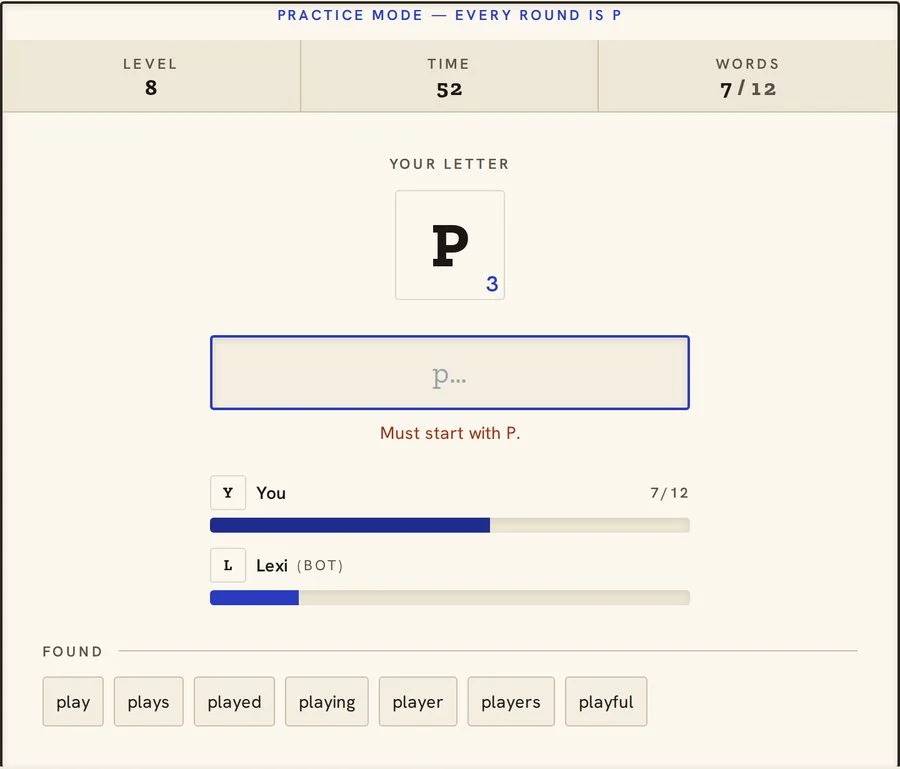
A useful habit is to park any prefixed word that surfaces during the wrong round. If replay comes to mind while you are working on P, set it aside as an R answer for later rather than typing it. Rounds built on awkward letters benefit most from this, and the guide to Q, X, Z and J shows how thin some of those rounds are to begin with.
Part 4: forms that look right and fail
A mechanical checklist produces some convincing strings that the game will not accept, and a few that it accepts for the wrong reason. These are the patterns to keep in mind.
- Irregular past forms
- The list has break, breaks, breaking, breaker, breakers but not breaked. The real past tense broke cannot be reached by adding letters, so the checklist has to give way to what you know.
- Invented prefixed forms
- Rebreak is not listed. Unbreakable is, but it scores in a U round, not a B round.
- False families
- Stoped, planed and hops are valid, but they come from stope, plane and hop. They count, yet they are not the forms of stop, plan and hope that the rules above produce.
- Rare but listed
- Some generated forms exist but are specialised or regional. If you would not recognise a word in a sentence, it is a poor use of seconds, and the guide to words you can’t play covers the reasons common-looking forms are sometimes missing.
Print this card
Printable: Download the prefix and suffix card (PDF, one page). The four family checks and the spelling-change rules on one page.
Copy the table below onto an index card or print this section. It is designed to be read in the few seconds between answers, so it keeps only the order of checks and the four spelling changes worth remembering.
| Step | Check | Quick reminder |
|---|---|---|
| 1 | S / ES | boxes, teaches, carries |
| 2 | ED / ING | drop E: hoping; double: stopping; keep Y: studying |
| 3 | ER / ERS | painter, runner, carrier |
| 4 | One derivative | -ful, -less, -ly, -ness, -able, -ment, only if familiar |
| Park | Prefixes | re-, un-, over-, out-, mis-, dis-: save for their own round |
Keeping the card beside you for a week of rounds is a simple form of the retrieval practice described in word recall training. Once the order feels automatic, put it away and test yourself in Find the Word, or open a P round and see how much of the PLAY family you can reach.
Practice roots
Allow twenty seconds per root. Write every form you can think of that starts with the same letter as the root, uses no prefix, and belongs to the root’s own family. Each root was chosen to exercise a different rule from Part 2.
- BAKE: a final E root, so watch the -ing form.
- HURRY: a consonant plus Y root.
- SHOP: a short root that doubles its final consonant.
- TEACH: a root that needs -es, plus one irregular past form.
- JUMP: a direct-attachment root with an adjective family.
- TIE: an IE root with two accepted -ing spellings.
Write your answers on paper before opening any of the answers below. The keys list the main family forms found in the word list for each root, leaving out rare extras such as hurriednesses, teachably and jumpinesses; compounds such as bakeshop or shoplift are left out because they are new words rather than forms of the root.
Answer key
BAKE (8 forms)
bake, bakes, baked, baking, bakings, baker, bakers, bakery. The plural bakeries is listed as well if you reached that far, which makes nine. The key point is that baking drops the E while baked adds only a D.
HURRY (8 forms)
hurry, hurries, hurried, hurrying, hurrier, hurriers, hurriedly, hurriedness. The Y becomes I before -es, -ed and -er but stays before -ing, which is why hurrying keeps its Y.
SHOP (7 forms)
shop, shops, shopped, shopping, shoppings, shopper, shoppers. The list also contains shoppe, which is a separate spelling of the noun rather than a suffix form, so count it only as a bonus.
TEACH (9 forms)
teach, teaches, teaching, teachings, teacher, teachers, teacherly, teachable, and the irregular past taught, which also scores in a T round. There is no teached, so the past form has to come from memory.
JUMP (11 forms)
jump, jumps, jumped, jumping, jumper, jumpers, jumpy, jumpier, jumpiest, jumpily, jumpiness. The adjective jumpy opens a second small family, so it is worth checking the -y form of any short verb you already know.
TIE (5 forms)
tie, ties, tied, tying, tieing. Both -ing spellings are listed, so a quick typist can take both. The list also contains tier, tiers and tieless, but tier usually means a row or level, so count those three as bonus answers rather than core family forms.
Rule check for a class
This short exercise needs no game and no timer. Pupils join each base and suffix, then name the rule they used. It is short enough to use as a starter before the practice roots.
- make + ing
- stop + ed
- happy + ness
- enjoy + ment
- begin + er
- visit + ed
- notice + able
- carry + ing
- hope + ful
- dye + ing
Rule check answers
1 making (drop E before a vowel suffix). 2 stopped (one vowel, one consonant: double). 3 happiness (consonant plus Y becomes I). 4 enjoyment (vowel plus Y keeps Y). 5 beginner (stress on the last syllable: double). 6 visited (stress on the first syllable: no doubling). 7 noticeable (E stays after C before -able). 8 carrying (Y stays before -ing). 9 hopeful (E stays before a consonant suffix). 10 dyeing (E stays, so it differs from dying). All ten answers are in the game’s word list.
Updated 14 September 2026: added the three spelling rules in full with a cited source and our counts from the word list, a rule check for classroom use, and a screenshot from a test round on P. Updated 13 September 2026: rewritten and restructured, with every count and word verdict rechecked against the game’s word list and blocklist. Details are in the corrections log.
New to The Verbarium? Follow the reading path, with tools and printables