Silent First Letters: 893 Hidden Openings Counted

The most useful silent letter in a starting-letter game is not the B in debt.
It is the K in knee.
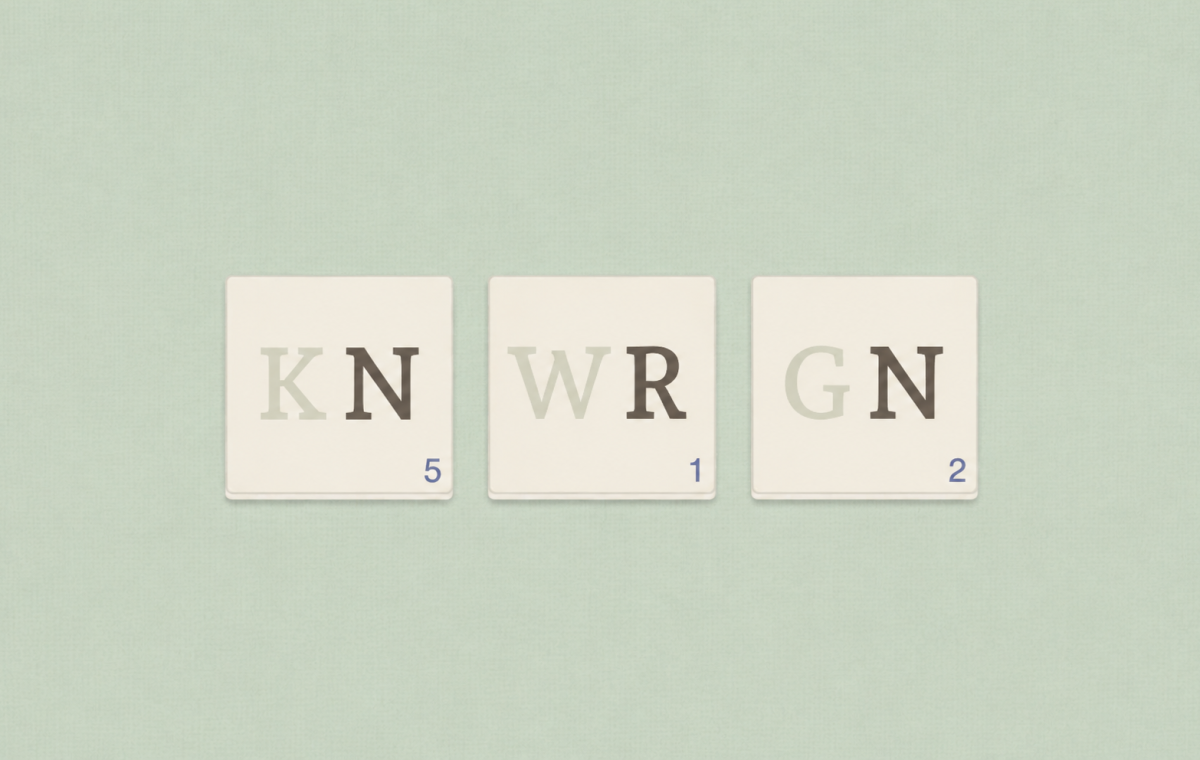
A silent letter inside a word may make the spelling difficult, but it does not hide the letter required by the round. A silent letter at the beginning creates a different problem: the word sounds as though it belongs somewhere else.
Knee, knife and know sound like N-words.
Write, wrist and wrong sound like R-words.
Gnat, gnaw and gnu sound like N-words.
Find the Word classifies all of them by the letter the player cannot hear.
That makes silent openings more than a spelling curiosity. They are searchable parts of the dictionary that players can overlook during a timed round.
Seven openings, 893 dictionary entries
I searched Find the Word English Dictionary v1.0 for seven exact opening patterns commonly associated with an unpronounced first consonant in modern English:
KN-WR-GN-PS-PN-PT-MN-
The results were:
| Opening | All entries | Entries of 3–5 letters |
|---|---|---|
| KN- | 225 | 35 |
| WR- | 199 | 27 |
| GN- | 66 | 13 |
| PS- | 327 | 10 |
| PN- | 30 | 0 |
| PT- | 43 | 0 |
| MN- | 3 | 0 |
| Total | 893 | 85 |
These are spelling counts, not automatic pronunciation labels.
A silent letter is written but not pronounced, but the dictionary file contains no audio or phonetic transcription. I selected the seven patterns using established modern pronunciations, then counted their exact spellings in the uploaded file.
Even within one written cluster, exceptions can occur. The raw PS- group includes pshaw and psst, which do not behave like the silent P in psych or psalm.
The counting method for the game’s dictionary is explained on the site’s How We Check Words page.
K rounds: check KN- before leaving K
The dictionary contains 1,715 K-words. Of those, 225 begin with KN-.
Among the 354 K-words containing three to five letters, 35 begin with that cluster:
knack, knap, knaps, knar, knars, knaur, knave, knead, knee, kneed, kneel, knees, knell, knelt, knew, knife, knish, knit, knits, knob, knobs, knock, knoll, knop, knops, knosp, knot, knots, knout, know, known, knows, knur, knurl, knurs
That means almost one in ten short K-words begins with a K the player does not hear.
The cluster becomes easier to search when divided by its third letter:
KNA-
knack, knap, knaps, knar, knars, knaur, knave
KNE-
knead, knee, kneed, kneel, knees, knell, knelt, knew
KNI-
knife, knish, knit, knits
KNO-
knob, knobs, knock, knoll, knop, knops, knosp, knot, knots, knout, know, known, knows
KNU-
knur, knurl, knurs
The initial K in familiar words such as knife, knight and know was pronounced in earlier English. The consonant cluster later simplified, while the spelling retained the K.
For a player, the history explains the mismatch but the route is more important:
When K slows down, search KN-A, KN-E, KN-I, KN-O and KN-U deliberately.
I would not attempt to memorise all 225 KN-entries. The 35 short forms already provide a substantial K-round resource.
W rounds: WR- is a separate search lane
The dictionary contains 199 WR- entries, including 27 of three to five letters:
wrack, wrang, wrap, wraps, wrapt, wrath, wreak, wreck, wren, wrens, wrest, wrick, wried, wrier, wries, wring, wrist, writ, write, writs, wrong, wrote, wroth, wrung, wry, wryer, wryly
They form six practical routes:
WRA-
wrack, wrang, wrap, wraps, wrapt, wrath
WRE-
wreak, wreck, wren, wrens, wrest
WRI-
wrick, wried, wrier, wries, wring, wrist, writ, write, writs
WRO-
wrong, wrote, wroth
WRU-
wrung
WRY-
wry, wryer, wryly
The W in words such as wrap and write was once pronounced. The spoken cluster later simplified, leaving modern English with an R sound while the spelling retained W.
That history creates a recall problem. A player searching by sound may mentally place write beside right under R.
The game does not.
During a W round, I treat WR- as its own lane rather than waiting for individual words to appear randomly.
The most immediately useful branch is WRI- because it contains several familiar short entries:
wring, wrist, writ, write, writs
G rounds: GN- is small enough to learn as a complete map
The dictionary contains 66 words beginning with GN-.
Only 13 contain three to five letters:
gnar, gnarl, gnarr, gnars, gnash, gnat, gnats, gnaw, gnawn, gnaws, gnome, gnu, gnus
Unlike the larger K and W groups, GN- does not need an elaborate search system.
It can be divided into six roots:
- gnar-
- gnash
- gnat
- gnaw
- gnome
- gnu
The initial G in inherited words such as gnaw and gnat was formerly pronounced before the cluster simplified. Not every GN-word necessarily reached English through the same historical route, so the shared spelling should not be treated as proof of one origin.
For gameplay, that disagreement does not matter. Gnaw and gnome both belong in a G round.
The cluster accounts for only about 2% of the dictionary’s short G-words, but five familiar anchors can recover most of its practical value:
gnash, gnat, gnaw, gnome, gnu
P has the largest hidden group and the weakest short pool
The dictionary contains:
- 327
PS-entries; - 30
PN-entries; - 43
PT-entries.
Together they produce 400 P-words.
That is more than the KN-, WR- or GN- totals. Yet only ten contain five letters or fewer, and all ten begin with PS-:
psalm, pseud, pshaw, psi, psis, psoae, psoai, psoas, psst, psych
The raw spelling list needs a pronunciation correction.
Pshaw and psst are not useful examples of the same silent-P pattern as psalm or psych. The clearly relevant short group is:
psalm, pseud, psi, psis, psoae, psoai, psoas, psych
The larger PS- section contains connected families such as:
- psych-
- pseud-
- psalm-
- psori-
- psycho-
The P is silent in familiar English pronunciations of words such as psychology and psalm. Merriam-Webster identifies the same silent-P pattern in several Greek-derived openings.
The family is therefore real and playable. It is simply less useful for quick answers than KN- or WR-.
A 327-word total sounds generous. A ten-word short pool tells the player what those words are likely to cost under a timer.
PN- and PT- are recognition routes, not emergency routes
None of the 30 PN- entries or 43 PT- entries contains fewer than six letters.
The PN- group is concentrated around technical and medical vocabulary:
pneuma, pneumatic, pneumonia, pneumonic, pneumonitis, pneumothorax
Standard English pronunciation of pneumonia begins with N rather than P.
The PT- group includes:
ptarmigan, pteranodon, pterodactyl, pteropod, pterosaur, ptosis, ptomaine, ptyalin
Cambridge records pterodactyl with an opening T sound and no pronounced P.
These clusters can help a prepared player, especially when a technical word is already familiar. They should not be presented as equal alternatives to knee, write or gnat.
In Find the Word, every accepted answer contributes the same immediate progress. A six- or twelve-letter medical term is not automatically more valuable than a short ordinary word.
My P-round order is therefore:
- Ordinary familiar P-words.
- Short PS-forms.
- Longer PS- families already known.
- PN- and PT- only when a complete word arrives without reconstruction.
The dictionary contains hundreds of silent-P spellings. Most are not emergency answers.
MN- gives M one root, not a family strategy
The complete MN- section contains only:
mnemonic, mnemonically, mnemonics
There are no short entries.
Mnemonic is pronounced with an initial N sound in standard English. Merriam-Webster notes that the spelling preserves the initial consonant cluster associated with its Greek and Latin history, although English pronunciation does not voice both letters.
This is useful knowledge, but not a productive M-round system.
Once mnemonic is known, the other two forms can follow. Beyond that one root, the cluster gives the player nowhere else to go in this dictionary.
MN- belongs on a prepared-word card, not in the same strategic tier as KN-.
Why internal silent letters are a different problem
This article counts silent openings because they affect the first letter required by the game.
Words such as:
debt, thumb, walk, listen, island, receipt
raise important spelling and historical questions, but their silent letters do not conceal the round letter.
Debt still sounds like a D-word.
Thumb still sounds like a T-word.
Walk still sounds like a W-word.
They may cause spelling errors after recall, but they do not cause the word to be mentally filed under a different opening letter.
The broader history of those spellings belongs in Why English Spelling Is So Weird, where lost sounds and later scholarly additions can be distinguished properly.
For this page, the editorial boundary is deliberate:
A silent opening changes where a player searches. An internal silent letter changes how the answer must be spelled.
Both matter, but they require different help.
Silent-opening routing card
Use this sequence only when the corresponding round letter appears.
K
Go directly to:
KNA- → KNE- → KNI- → KNO- → KNU-
The short pool contains 35 entries, making this the highest-value route on the page.
W
Search:
WRA- → WRE- → WRI- → WRO- → WRU- → WRY-
The WRI- branch is the strongest familiar group.
G
Run the compact anchors:
gnash → gnat → gnaw → gnome → gnu
Then check known plurals and forms.
P
Use:
PS- first
Treat PN- and PT- as longer technical branches, not automatic rescue routes.
M
Use the single prepared family:
mnemonic → mnemonics → mnemonically
Then leave MN- and return to ordinary M vocabulary.
Any other starting letter
Do not search these seven clusters.
Their value comes from narrowing the correct round, not from becoming a general catalogue of silent letters.