How to Choose a Starting Word for Wordle-Style Games

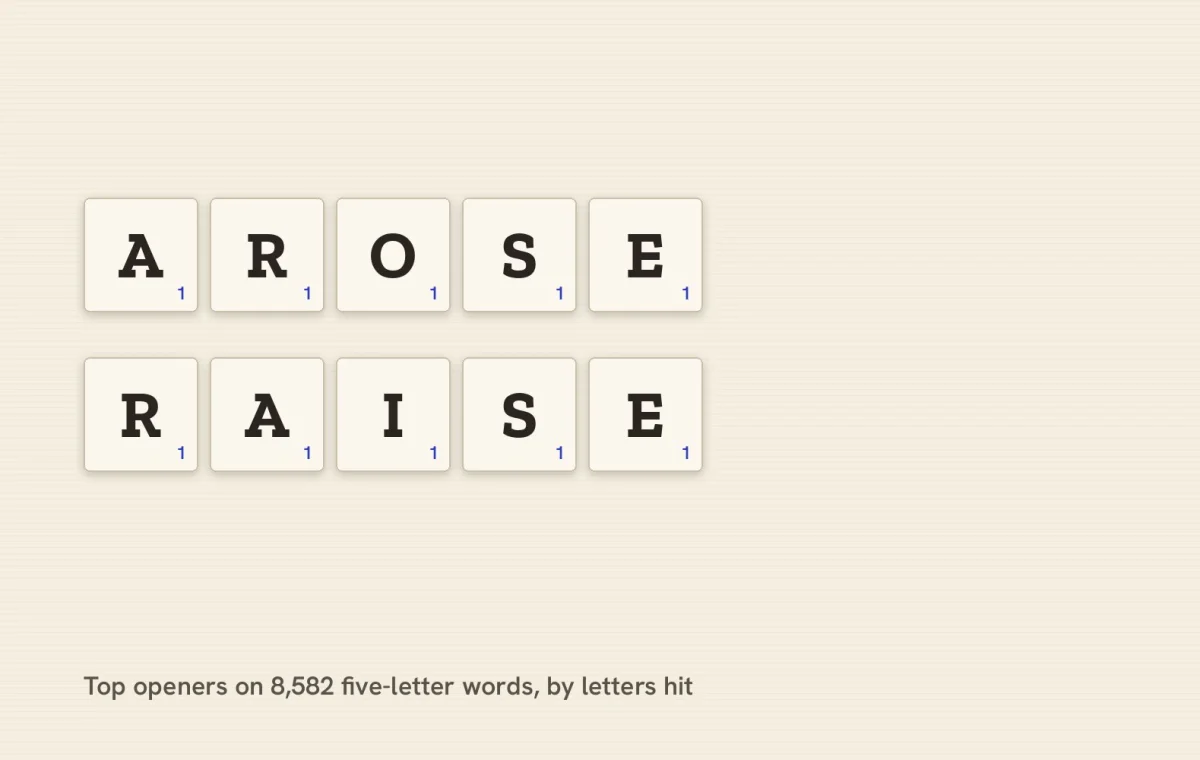
On a general list of 8,582 five-letter English words, the starting words that touch the most letters of the answer are arose, arise and raise: each shares, on average, 1.9 of its letters with a randomly chosen word, against 1.3 for a typical word. If your game never uses plural answers, irate, later and alert move to the front and raise stays in the top ten. The best follow-up to arose is unlit. These are ranks on our list, not on Wordle’s own curated answers, which we have not scored.
The shortlist
| Opener | Letters of the answer hit, on average | Green tiles expected | Rank, all 8,582 words | Rank without -S words | Note |
|---|---|---|---|---|---|
| arose | 1.92 | 0.36 | 1 | 7 | Best coverage; poor positions |
| raise | 1.91 | 0.46 | 3 | 9 | Same letters as arise and serai; best positions of the four |
| stare | 1.87 | 0.40 | 15 | 38 | Swaps O and I for T and L |
| tares | 1.87 | 0.84 | 16 | excluded | Same letters as stare; 4th for greens because of the final S |
| slate | 1.81 | 0.46 | 34 | 132 | Holds up on both lists |
| irate | 1.69 | 0.37 | 247 | 4 | Top familiar word once plurals go |
| later | 1.66 | 0.53 | 353 | 14 | Best positions among the no-plural leaders |
| crane | 1.54 | 0.42 | 978 | 113 | C and N are uncommon on this list |
| adieu | 1.50 | 0.35 | 1,225 | 227 | Four vowels; U and D are weak letters |
The two scores answer two different questions. The first is the average number of the opener’s letters that turn out to be in the answer, green or yellow, taken over every word in the list; it rewards common letters wherever they sit. The second is the average number of green tiles, which rewards letters in their usual positions. A word can do well on one and badly on the other, and the section on plurals explains why the two disagree so sharply.
The spread matters more than the exact order. The gap between first and tenth by coverage is 0.04 of a letter, and the top 100 words all sit within 0.16 of each other, while the median word scores 1.34 and the worst, jumpy, 0.65. Any word near the top of the table is a fine opener; what the ranking really tells you is which familiar words to avoid.
The three things a good opener does
It tests common letters. Across the 8,582 words, S appears in 46.2 per cent, E in 45.0, A in 40.6, R in 31.0, O in 29.3, I in 28.2, L in 25.2, T in 24.2 and N in 21.4. Then comes a drop: U 18.4, D 18.2, C 15.9, Y 15.3, P 14.7, M 14.2, H 13.3. Every word in the top twenty by coverage is built from the first nine letters and nothing else. Z, X and J each appear in about two per cent of words and Q in under one per cent, and our guide to the hard letters Q, X, Z and J shows how few five-letter words they have.
It uses five different letters. A repeated letter tests only four, and 2,946 of the 8,582 words (34.3 per cent) repeat one, so the ranking only considers the 5,636 that do not. Words with no repeated letter are called isograms, and our article on the longest isograms in English follows the idea to its limit.
It puts letters where they usually sit. Position changes everything. S starts 12.2 per cent of the words and ends 31.1 per cent of them, but sits second in only 0.7 per cent. A is the most common second letter (17.2 per cent), E the most common fourth (19.7 per cent), and Y is a fifth letter or almost nothing. The table below shows the picture for the thirteen letters that matter.
| Letter | 1st | 2nd | 3rd | 4th | 5th | In word |
|---|---|---|---|---|---|---|
| S | 12.2 | 0.7 | 3.9 | 4.1 | 31.1 | 46.2 |
| E | 2.2 | 12.3 | 6.6 | 19.7 | 10.8 | 45.0 |
| A | 5.8 | 17.2 | 9.9 | 7.7 | 4.1 | 40.6 |
| R | 4.9 | 7.5 | 9.1 | 5.3 | 6.1 | 31.0 |
| O | 2.1 | 15.4 | 7.8 | 5.3 | 2.6 | 29.3 |
| I | 1.4 | 11.2 | 8.6 | 6.7 | 1.7 | 28.2 |
| L | 4.7 | 5.9 | 6.8 | 6.2 | 4.0 | 25.2 |
| T | 6.3 | 1.9 | 5.1 | 7.2 | 5.6 | 24.2 |
| N | 2.3 | 2.8 | 7.3 | 6.0 | 4.2 | 21.4 |
| U | 1.4 | 9.1 | 5.1 | 3.0 | 0.3 | 18.4 |
| D | 5.3 | 0.7 | 3.2 | 3.5 | 6.8 | 18.2 |
| Y | 1.1 | 1.9 | 1.4 | 0.7 | 10.4 | 15.3 |
| C | 7.7 | 1.4 | 3.1 | 3.3 | 1.1 | 15.9 |
The initial-letter column is the reason so many strong openers start with S, C, B, P or T, and our article on which letters start the most English words shows the same pattern across the whole list. The fourth and fifth columns explain the other half: an opener ending in E or S is standing where the answer’s E or S most often stands.
Why plurals change the answer
2,668 of the 8,582 words, 31.1 per cent, end in S, and most of them are plurals. That single fact drives both rankings. It is why S is the most common letter overall, and why the words that score best for green tiles are all of the shape consonant, A or O, R or N, E, S: cares (0.85 greens), bares, pares, tares, cores, canes, dares, mares. Their letters are not the most common letters; their positions are the most common positions.
Many games choose answers that are not plurals, so we removed every word ending in S and scored the remaining 5,914 again. S falls from the most common letter (46.2 per cent) to the ninth (21.9 per cent), behind E 48.5, A 41.8, R 33.9, O 30.3, I 30.0, L 26.1, T 25.7 and N 22.8. The new leaders by coverage are ariel, oater and orate at 1.80, then irate, retia and terai; arose, arise and raise drop to seventh, eighth and ninth at 1.76, and the family of alert, alter, later and ratel follows at 1.76. In fifth position E and Y take over (15.7 and 15.1 per cent), then D, R and T, so the best words for greens become saner, sated, cared and sired. Several of the new leaders are obscure (ariel is a gazelle, oater a cowboy film, retia a plural of rete), and a game with a stricter guess list may not accept them, which is why the shortlist above names irate and later instead.
How the famous openers rank
Three favourites, raise, stare and slate, deserve their reputation on this list: third, fifteenth and thirty-fourth of 5,636 by coverage, and still ninth, thirty-eighth and 132nd once plurals are gone. Two others do not. The opener adieu ranks 1,225th: its four vowels sound thorough, but U (18.4 per cent) and D (18.2) are the weakest letters in it, and it leaves out R, S, T, L and N. When it is played against every word in the list it hits exactly one letter 44.6 per cent of the time and three or more only 10.2 per cent of the time; arose hits one letter 25.8 per cent of the time and three or more 24.7 per cent. The opener crane ranks 978th, because C (15.9 per cent) and N (21.4) are middling here; it climbs to 113th without plurals, and it may well do better again on a curated list of common words, which we cannot measure.
| Opener | Answers sharing no letter with it (all 8,582) | Hits exactly one letter | Hits three or more | Rank by coverage |
|---|---|---|---|---|
| arose | 406 (4.7%) | 25.8% | 24.7% | 1 |
| raise | 412 (4.8%) | 27.5% | 25.2% | 3 |
| slate | 568 (6.6%) | 30.5% | 21.7% | 34 |
| stare | 572 (6.7%) | 28.7% | 25.0% | 15 |
| adieu | 670 (7.8%) | 44.6% | 10.2% | 1,225 |
| crane | 1,025 (11.9%) | 37.6% | 14.0% | 978 |
What we did not expect was how little separates the good openers from each other and how much separates them from the famous vowel-heavy ones. Nine letters (A, E, I, O, R, S, L, T, N) make up the entire top twenty by coverage, and the difference between choosing arose and choosing slate is a tenth of a letter per game. The difference between slate and adieu is three times that, and adieu leaves 65 per cent more candidates alive after an all-grey result (670 against 406).
The second word
A second opener should test the most common letters the first one missed, so the method is greedy: take the highest-scoring word that shares no letter with the first. After arose that word is unlit, covering U, N, L, I and T; the pair tests A, E, I, O, R, S, L, T, N and U, the same nine letters named above plus U, and on average 3.1 of the answer’s letters are among them. Exactly one word in the 8,582, pygmy, shares no letter with either. After raise the greedy choice is clout, which leaves nymph and pygmy untouched. For the no-plural list the best pair among familiar words is irate then sonly, which leaves eight words, all containing U and H, such as chuck, chump and humph. The very best pair by raw coverage is notes and urial, but urial (a wild sheep) is not a word most people can play with confidence, and it beats arose plus unlit by less than a thousandth of a letter.
Four questions players ask
Vowel-heavy or consonant-heavy?
Three vowels is the ceiling. Of the 8,582 words, 59.0 per cent contain exactly two vowel letters (counting A, E, I, O and U, so the two Es of geese count twice), 31.1 per cent contain one, 9.3 per cent contain three, and only 21 contain four. So an opener with three vowels (arose, raise) already covers more vowels than 90 per cent of answers have, and a fourth vowel is a wasted slot, which is what sinks adieu and audio (2,682nd). A consonant-heavy opener is only worth it when the consonants are R, S, L, T or N; crane and train (1,656th) spend slots on C and N. The 36 five-letter words with no A, E, I, O or U at all, such as nymph and pygmy, are covered in words with no vowels.
When should I stop eliminating letters and start guessing?
Count candidates, not guesses. An all-grey arose still leaves 406 words on this list, far too many to guess among, so a second word of five new letters is almost always right in that case; after arose and unlit are both grey, one word remains. A first guess with two or three yellows or greens is different: the survivors are usually a few dozen, and a guess that uses what you know will both test new letters and have a chance of winning. The practical rule is to keep eliminating while you can still name more candidates than you have guesses left, and to start guessing the moment you cannot.
Does hard mode change the choice?
Yes. Wikipedia’s article on Wordle describes the option as one that “requires players to use any revealed green or yellow letters in subsequent guesses”. That rules out an elimination word such as unlit once the opener has hit anything, so position matters more from the first guess: a yellow you must reuse is worth less than a green you can leave in place. On this list that argues for raise or later over arose, which is 3,468th for green tiles, and for tares or lares if plurals are allowed.
Are these the best openers for Wordle itself?
No, and nobody can say that from a general list. The same Wikipedia article says that “each day’s answer is drawn from a curated list of 2,309 words”, that the original list was cut down to “about 2,000 more familiar words”, and that the game “now follows American spelling conventions”. Our list has 8,582 five-letter words, including rare ones such as serai and stoae and every plural, and some openers other people recommend (soare, salet) are not in it at all. The letter shares of a curated pool of familiar words will differ, so treat these ranks as a description of English five-letter words in general, and the method, not the exact order, as the part that carries over.
Rank any word list yourself
The ranking is ten lines of Python. Put a word list in words.txt, one word per line (a game’s own guess list, if you can find one, or any dictionary file), and run this; it prints the ten best openers by coverage. On our list the first line is arose 1.921. To exclude plurals, add and not w.strip().endswith("s") to the first filter; to rank by green tiles instead, count letters by position rather than once per word.
from collections import Counter
words = [w.strip().lower() for w in open("words.txt") if len(w.strip()) == 5 and w.strip().isalpha()]
n = len(words)
share = Counter()
for w in words:
    share.update(set(w))          # count each letter once per word
score = {w: sum(share[c] / n for c in w) for w in words if len(set(w)) == 5}
for w in sorted(score, key=score.get, reverse=True)[:10]:
    print(w, round(score[w], 3))
How we computed this
The word list is a 172,446-word list built from the public-domain ENABLE word list with offensive words removed; how we check words describes it. It has no capitalised words, nothing under three letters, rare and archaic words alongside common ones, and both British and American spellings where ENABLE has them. From it we took the 8,582 five-letter words and, for each letter, counted the share of words containing it at least once and the share with it in each of the five positions. Every word with five different letters was then scored twice: by the sum of its letters’ overall shares (the “letters hit” column) and by the sum of its letters’ shares in their own positions (the “green tiles” column). We repeated everything with the 2,668 words ending in S removed, found the greedy second word for each leading opener, and counted how many words share no letter with each opener and pair. The scripts and their full output are saved so the figures can be reproduced, and the snippet above was run as printed.
The main limit is the one already named: a dictionary-style list weights every word equally, whereas a game’s answer pool is chosen by people and leans towards familiar words, so letter shares there will differ. A second limit is that both scores are averages over a single guess; they say nothing about how well a word splits the remaining candidates on later turns, which is a harder computation and depends entirely on the answer list. Within those limits, the findings that should travel are these: nine letters do nearly all the work, three vowels are enough, a repeated letter is a wasted slot, and the plural S is either your best friend or a wasted fifth square depending on the game you are playing. If you enjoy the letter-frequency side of this, our free word game asks you to find words from one starting letter against a sixty-second clock.
New to The Verbarium? Follow the reading path, with tools and printables