Words Without Vowels: All 114, the 7-Letter Ones, and Words With No Y

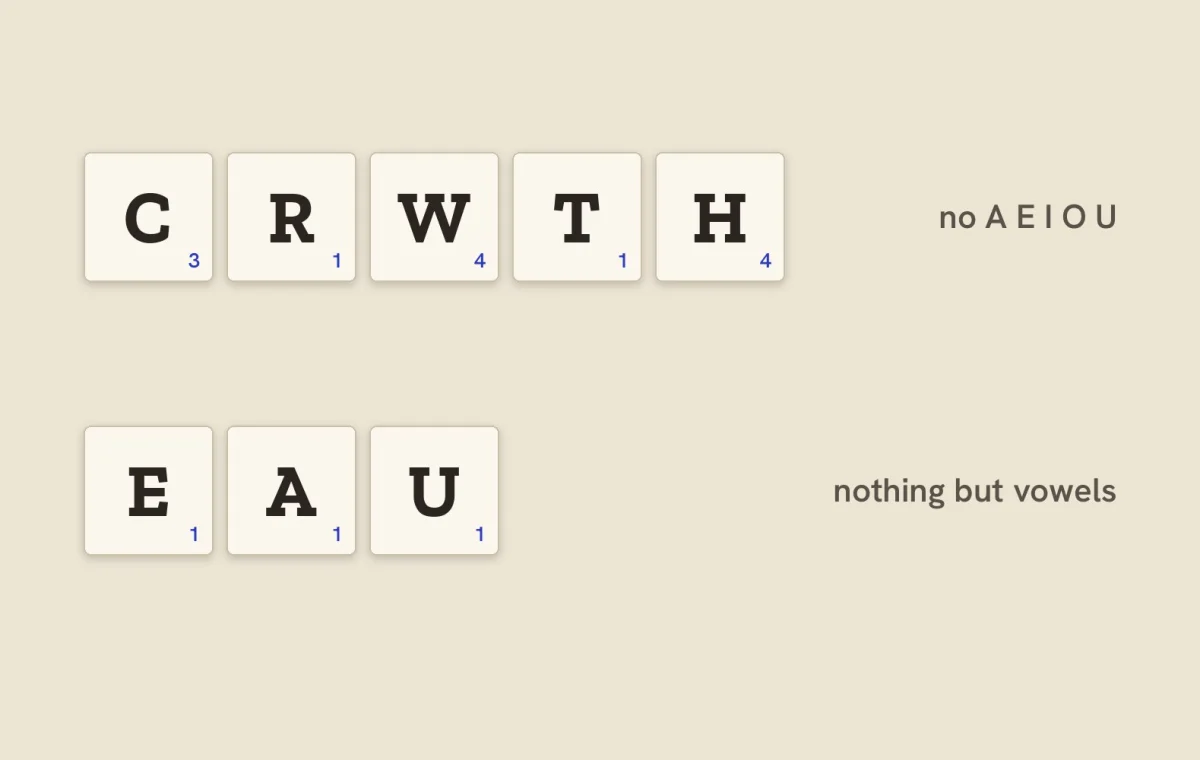
Words with no vowels are real, but almost all of them lean on Y. Gym, myth, lynx and rhythm contain no A, E, I, O or U, and the longest such words have seven letters: rhythms, glycyls and tsktsks. If Y counts as a vowel too, the list shrinks to a handful of sounds and borrowings: hmm, brr, shh, psst, tsk, nth and the Welsh words cwm and crwth. We counted every case in a 172,446-word list: 114 words have no A, E, I, O or U, and only 17 have no Y either.
The list is the public-domain ENABLE word list with an offensive-word blocklist removed (how we check words explains it and gives a version fingerprint). It holds lowercase words of three or more letters, including rare and technical ones, so the figures describe that list rather than every English dictionary. Vowels here are written letters, not sounds.
| Question | Answer from the word list |
|---|---|
| Words with no A, E, I, O or U | 114 (28 of three letters, 26 of four, 36 of five, 21 of six, 3 of seven) |
| Longest words without vowels | 7 letters: glycyls, rhythms, tsktsks |
| Words with no A, E, I, O, U or Y | 17, listed in full below |
| Longest word without vowels or Y | tsktsks (7 letters); the longest that is not a written sound is crwths (6) |
| Words with no A, E, I, O, U, Y or W | 13, nearly all written sounds such as hmm and psst |
| Words with no consonants | 1: eau (the list has no words shorter than three letters) |
| How many contain Y | 97 of the 114 |
| Most common starting letter | S, with 25 words |
Is Y a vowel? The answer changes the list
A search for “words without vowels” can mean two different things. The usual school answer is that the vowels are A, E, I, O and U, “and sometimes Y”. Under the first reading, gym and myth have no vowels. Under the second, they plainly do, because the Y in each stands for a sound that I could equally spell. The letter has worked this way for a long time: Latin borrowed Y to write Greek loanwords, and in modern English it still stands for a vowel in Greek-derived words such as system, while it is a consonant at the start of year (Wikipedia: Y).
The two definitions give very different lists, which is why answers found online disagree:
- No A, E, I, O or U: 114 words, from cry and gym to rhythms.
- No A, E, I, O, U or Y: 17 words. Thirteen are sounds or abbreviation-like forms, and four are the Welsh borrowings cwm and crwth with their plurals.
- No A, E, I, O, U, Y or W: 13 words, because the Welsh pair use W as a vowel.
Where we land: for spelling questions we count only A, E, I, O and U, because that rule gives one fixed answer anyone can check. But we would never tell someone that rhythm has no vowel. It has two vowel sounds and no vowel letters, and the Y carries the first of them. If you need a word that has no vowel of any kind, written or spoken, the honest candidates are interjections such as hmm, shh and psst, and even those are debatable, as the section on syllables explains.
All 114 words without vowels, by length
These are every playable word with no A, E, I, O or U. Short words dominate, and more than half of the three-letter group (15 of 28) is a consonant or two followed by Y, the pattern of cry, sky and why.
Three letters (28)
brr bys cry cwm dry fly fry gym hmm hyp nth pht ply pry pyx shh shy sky sly spy sty syn thy try tsk why wry wyn
Alongside the everyday words sit pyx, a small container used in church services, and wyn, one spelling of the name of an Old English letter. Nth is the only one that is neither a sound, a Y word nor a Welsh word.
Four letters (26)
brrr byrl cwms cyst drys gyms hymn hyps lynx myth pfft psst rynd scry spry sync syph tsks typp typy whys wych wynd wynn wyns xyst
Hymn, lynx, myth and sync are the familiar core. Wynd is a Scots word for a narrow alley between houses, xyst is a covered walkway in classical architecture, typp is a textile term, and drys is a plural noun for people who oppose alcohol.
Five letters (36)
byrls crwth crypt cysts dryly flyby ghyll glyph gypsy hymns lymph lynch myrrh myths mythy nymph phpht psych pygmy rynds shyly slyly stymy sylph synch syncs synth syphs thymy tryst typps wryly wynds wynns xylyl xysts
Five letters is the largest group. Crypt, glyph, lymph, myrrh, nymph and tryst are all ordinary vocabulary, which makes this the length to know if you want no-vowel words that people will recognise. Ghyll is a northern English word for a ravine, and crwth is an old stringed instrument associated with Wales.
Six letters (21)
crwths crypts flybys flysch ghylls glycyl glyphs lymphs myrrhs nymphs psychs rhythm spryly sylphs sylphy synchs synths syzygy trysts tsktsk xylyls
Rhythm and syzygy are the famous ones. Flysch is a geological term for a kind of sedimentary rock, glycyl and xylyl are chemistry terms, and most of the rest are plurals of shorter words above.
Seven letters (3)
glycyls rhythms tsktsks
These are the only 7-letter words without vowels in the list, and no longer one exists in it. Rhythms is often quoted as the longest English word without a vowel letter; in this list it shares the record with a chemistry plural and the doubled, pluralised form of tsk. By starting letter the whole category runs S 25, T 12, W 11, P 10, C and G 9 each, B, F, H and M 5 each, L, R and X 4 each, and D and N 3 each. No word without vowels begins with A, E, I, J, K, O, Q, U, V, Y or Z.
Words with no vowels and no Y
Take Y away and 17 words remain. This is the list most people are after when they ask for “words without vowels or Y”, and it falls into three clear groups.
| Group | Words | How they are said |
|---|---|---|
| Sounds written down | brr, brrr, hmm, pfft, phpht, pht, psst, shh, tsk, tsks, tsktsk, tsktsks | Mostly held consonants: hmm is a hummed M and shh a hiss; tsk stands for a click of the tongue |
| Abbreviation-like | nth | “enth”, the letter N plus the ending of fourth or tenth |
| Welsh borrowings | cwm, cwms, crwth, crwths | The W is a vowel: cwm is said like “koom”, crwth like “krooth” |
Only the first group and nth survive if W is also treated as a vowel, which leaves 13. The longest word with no vowels and no Y is tsktsks, and the longest that is not a written sound is crwths. Several spellings people expect to find here are missing from the list: grr, zzz and the Welsh cwtch are not in it, and hm and sh are too short to be included.
Why these words exist
All but 114 of the 172,446 words in the list contain at least one of A, E, I, O and U, so each word on this page is an exception with a reason behind it. Four reasons cover them all.
Y doing a vowel’s job
This accounts for 97 of the 114 words. Some are Greek in origin, where Y stands in for the Greek letter upsilon: myth goes back to Greek mythos (Etymonline: myth) and rhythm to Greek rhuthmós through Latin (Wiktionary: rhythm). Others are short words ending in Y, such as dry, fly and sky. The two letters have long overlapped: by Middle English, scribes used Y and I interchangeably in many words (Wikipedia: Y).
Sounds turned into spellings
Interjections such as hmm, shh, psst and pfft record noises that are not built around a vowel in the first place. They are spelled to suggest the sound, so there is no settled form, and variants multiply: the list has both brr and brrr, and both pht and phpht.
Shortenings and abbreviation-like forms
Nth is the letter N used as a number, plus the ordinal ending -th. Sync is a shortened form of synchronization, recorded from 1929, with synch as an alternative spelling (Etymonline: sync). Synth is a clipping of synthesizer (Wiktionary: synth) and psych began as short for psychology (Etymonline: psych); in both, the vowel letters were in the part that was cut off.
Welsh loans
In Welsh, W and Y are vowel letters alongside A, E, I, O and U (Wikipedia: Welsh orthography). When English borrows a Welsh word without changing its spelling, the result looks vowel-free to an English reader. Cwm, a valley head carved by a glacier, and crwth, the old stringed instrument, are the two in this list. English spelling’s habit of keeping borrowed forms intact is covered in why English spelling is so weird.
Are there words without syllables?
Not really. Every word said aloud takes at least one syllable, and people searching for “words without syllables” usually seem to want words without vowel letters, which are the lists above. What does exist is a syllable without a vowel sound. In many pronunciations the second syllable of rhythm is just a drawn-out M (Wiktionary gives [ˈɹɪð.m̩], with the mark under the m showing that it forms a syllable on its own), and hmm is a single syllable carried entirely by the M.
A few sounds sit at the edge. Shh can be held as a pure hiss, and tsk is really a click made with the tongue against the teeth, although it is also read aloud as “tisk”. Linguists describe sounds like these as syllabic consonants but note that it is not certain how to define a syllable in such cases (Wikipedia: syllabic consonant). We would not call any of them a word without a syllable. The safer statement is that a handful of English words, all interjections, contain no vowel sound at all.
What our count showed
The category is smaller than its reputation. The 114 words are about one in every 1,500 words in the list, and the number overstates the variety: 40 of the 114 are simply an -s or -ly form of another word on this page, such as myths, cwms or shyly. Take away the Y words and the plurals, and what is left of “words with no vowels” is a few noises, one mathematical ordinal and two Welsh nouns.
We also wanted to know which of these words anyone actually uses, so we looked each one up in wordfreq, a public frequency list built from Wikipedia, film subtitles, news, books and web text up to about 2021. Thirty-five of the 114 appear at least once per million words, and 31 do not register at all. The seven-letter record is the clearest example: rhythms is common, while glycyls and tsktsks do not appear in the frequency list. So when someone asks for the longest word without vowels, we think rhythms is the useful answer and the other two are artefacts of a list built to accept rare words. A frequency list has its own blind spot, though. It does not separate names from words, which is probably why wynn, a name as well as an Old English letter, clears the once-per-million mark.
The Y-free group is the most revealing part of the count. Of the 13 words with no A, E, I, O, U, Y or W, twelve are interjections and their forms. Nth is the only ordinary word among them, and it gets there by borrowing a letter name. Our practical advice follows from that: if a puzzle or quiz asks for a word with no vowels and no Y, nth, cwm and crwth are the answers that do not depend on accepting a noise as a word.
The opposite: words that are almost all vowels
Only one playable word is made entirely of vowel letters: eau, the French word for water that English uses in phrases such as eau de cologne. That answers the “word without consonants” question for this list, with one caveat about Y again. If Y counts as a vowel, aye, eye, yay, yea and you join it, but the Y at the start of yay, yea and you is a consonant sound, so only aye and eye have a fair claim. The one-letter words a and I would also qualify, but the list holds nothing shorter than three letters.
A further 263 words contain exactly one consonant: 180 of three letters, 62 of four and 21 of five, and none longer. The 21 five-letter words are the vowel-heaviest in the list.
aalii adieu aecia aerie aioli aquae areae audio aurae aurei cooee eerie looie louie miaou oidia oorie ourie queue uraei zoeae
Most are Latin plurals from science (aecia, areae, zoeae) or unusual spellings. The ones in everyday use are adieu, aerie, aioli, audio, eerie and queue, and queue is the neatest of them, since four of its five letters are vowels that are not all pronounced.
| Starting letter | Familiar four-letter words with three vowels |
|---|---|
| A | aeon, aero, aide, aloe, aqua, area, aria, aura, auto |
| B, C, L | beau, ciao, lieu, luau |
| E | ease, eave, euro |
| I | idea, iota |
| O | oboe, oleo, olio, ooze, ouzo |
| Q | quai |
| U | urea, uvea |
Counting total vowels rather than proportion gives a different winner. Ethylenediaminetetraacetate and its plural contain 13 vowel letters each, more than any other word in the list, but at 27 and 28 letters they are far from vowel-heavy in proportion.
Questions and answers
What is a word with no vowels that everyone knows?
Rhythm, myth, gym, sky and lynx if Y is allowed. If it is not, hmm and shh are the best-known, and nth is the only one that is not a sound or a Welsh word.
Which word contains all five vowels in alphabetical order?
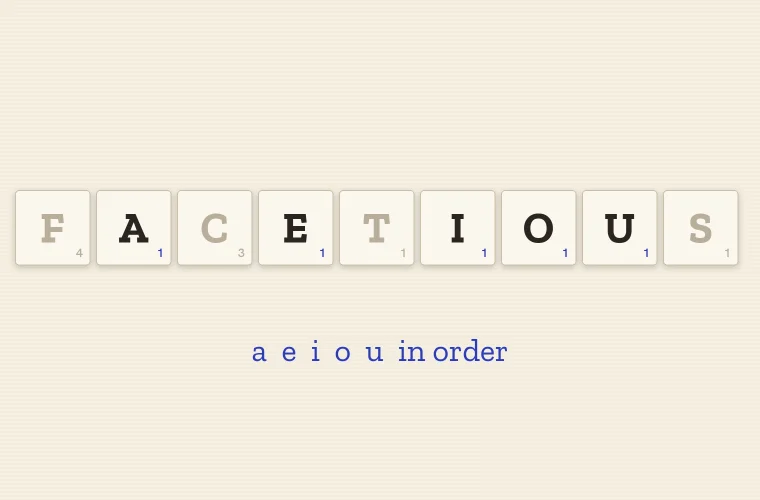
Six words in the list have A, E, I, O and U as their only vowel letters, once each and in order: arsenious, facetious, abstemious and abstentious, plus the adverbs facetiously and abstemiously, which add a Y at the end. An earlier version of this page said there were four; we had missed the two adverbs, and the fix is recorded in our corrections log. More records of this kind are in words with all five vowels.
What is the shortest word with all five vowels?
Seven letters, and the list has three: eulogia, miaoued and sequoia. Only sequoia is a word most people know.
Are these words real, or just word-list entries?
Both kinds are here. Every word on this page is in the list, but many are rare. If a spelling like phpht looks invented, the real-or-fake quiz of unusual words tests forty similar cases, and the frequency check above is a quick way to separate the words people use from the ones that mainly live in dictionaries. If you want to try recalling a few under time pressure, Find the Word accepts every word on this page.
Updated 13 September 2026: rewritten and restructured, with every count and word verdict rechecked against the word list and blocklist. The former article on vowel-heavy words was merged into this page. Details are in the corrections log.
New to The Verbarium? Follow the reading path, with tools and printables