The Words You Can’t Play: Answers to the Rejections Players Ask About

When Find the Word turns down a word you were sure of, the reason is almost always one of these:
- The exact spelling is not in the word list. Everyday words such as email and online are missing, however common they are.
- You closed up a phrase or dropped an apostrophe. Sometimes that happens to produce a stored word (cant, hotdog), and often it does not (dont, icecream).
- The word is shorter than three letters. Two-letter favourites from other games, such as qi and za, never count here.
- It starts with the wrong letter, or you already played it. A valid word still scores only once, and only in its own letter’s round.
- It is on the offensive-word blocklist. A small number of words that exist in the underlying list are switched off in the game.
The questions below take the kinds of rejection players tend to query and show which similar spellings pass and which fail. Every verdict was checked against the game’s own list, which starts from the public-domain ENABLE word list and removes an offensive-word blocklist to leave 172,446 playable words (how we check words describes it), and the tables are deliberately mixed so you can see that no simple category decides the outcome.
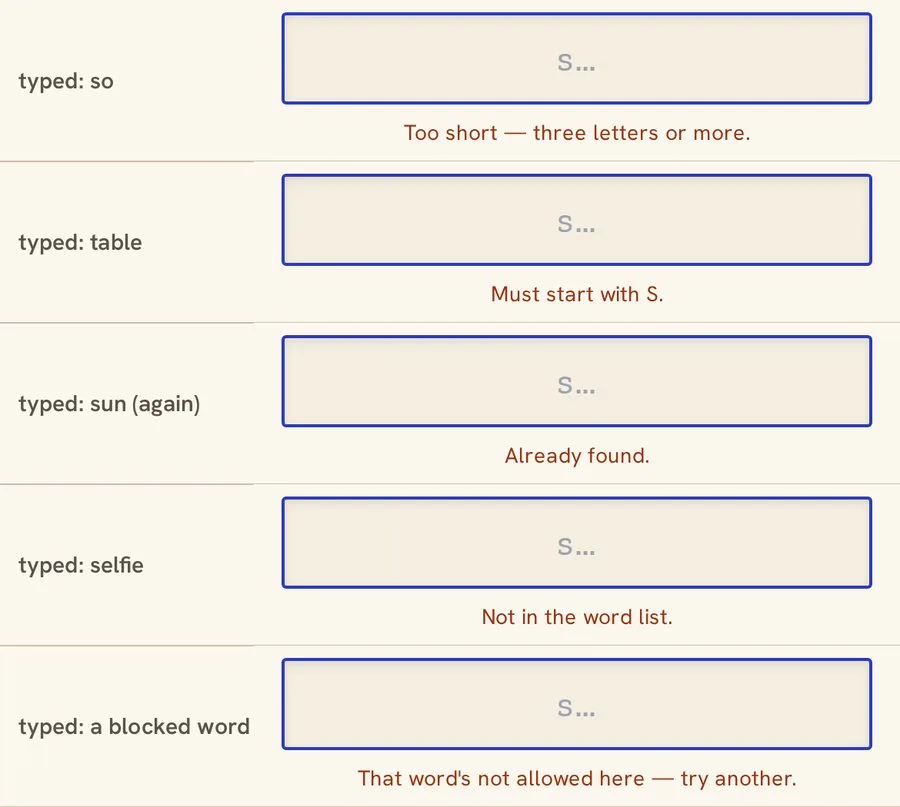
Each message points to a different cause, so it is worth reading rather than just retyping. “Not in the word list” means the exact spelling is missing, while “That word’s not allowed here” means the spelling is on the blocklist, which is checked first, so the message can appear even for a blocked spelling that is not in the word list. More on how rounds are timed and scored is in Adventure mode, tested.
Want to test a specific spelling? The checker below runs the same rules as the game, in the same order, against the same word list and blocklist, and suggests an accepted form when there is one.
Is this word in our list?
Checks the same fixed word list every count on this site comes from, and the offensive-word blocklist. The list (about 450 KB) loads the first time you check a word.
Why do word games reject capitals, apostrophes, accents and abbreviations?
Because a word-game list is a list of plain letter strings, and anything that is not a plain letter has no place in it. The list behind Find the Word, like the ENABLE list it comes from, holds only lowercase entries made of the letters a to z: no capitals, spaces, hyphens, apostrophes, numbers or accented characters. Proper nouns, contractions and hyphenated compounds are left out by design. Spellcheckers work on the same principle, comparing what you typed with the entries in their own dictionary, which is why a real but unlisted word gets flagged there too.
We think that is the right rule for a game, odd verdicts and all. Once capitals count, someone has to decide whether polish and Polish are different words and which names should score. A list of lowercase strings avoids those arguments, and the same spelling gets the same answer for every player.
Abbreviations fail for the same reason. Tv, dvd, atm, asap and diy are all rejected. The exceptions are acronyms that turned into ordinary lowercase words: laser (1960, from “light amplification by stimulated emission of radiation”), radar (1941, from “radio detecting and ranging”) and scuba (1952, from “self-contained underwater breathing apparatus”) are all accepted, along with sonar, snafu and awol.
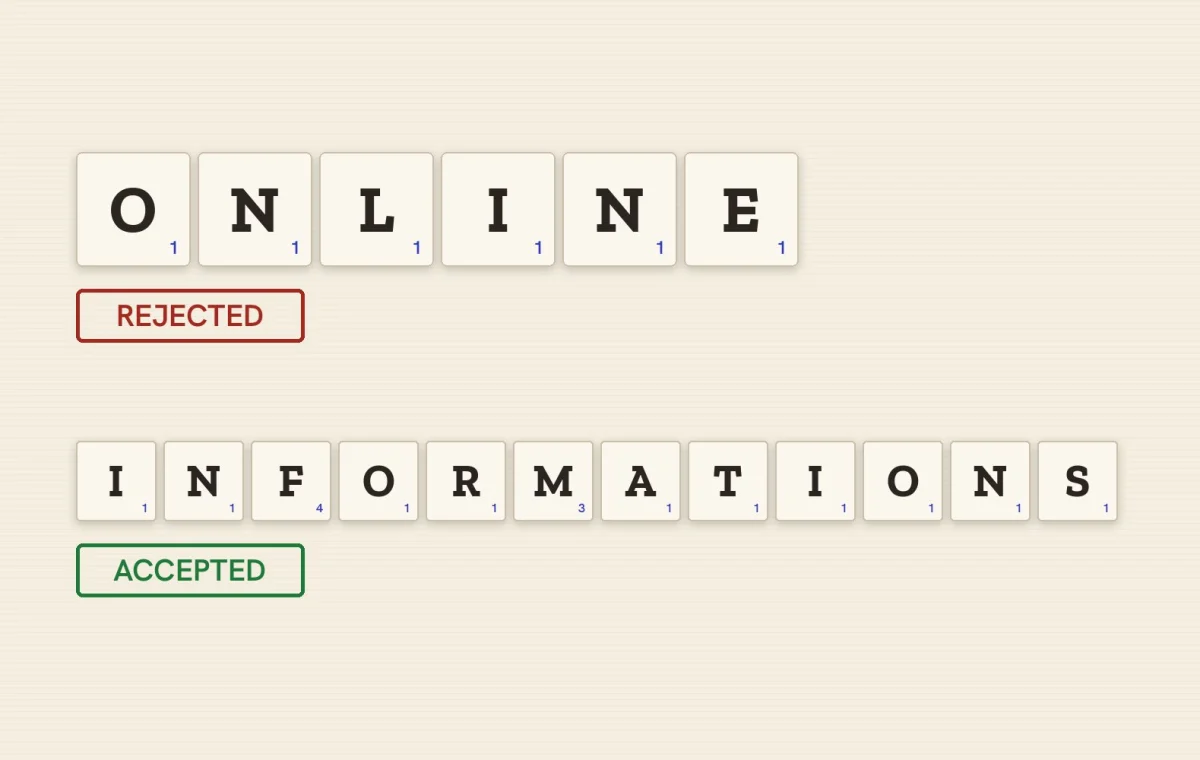
Why was ONLINE rejected when it is an everyday word?
The game’s word list is a fixed snapshot, and a good deal of recent and internet-era vocabulary never made it in. So online, email, website and blog are all missing, even though no editor would question them. At the same time, older computing words such as software, modem and download are accepted.
| Accepted | Rejected |
|---|---|
| computer, software, hardware, laptop | online, offline, website, internet |
| download, upload, password | email, blog, podcast, login |
| modem, fax, faxed | emoji, selfie, hashtag, wifi |
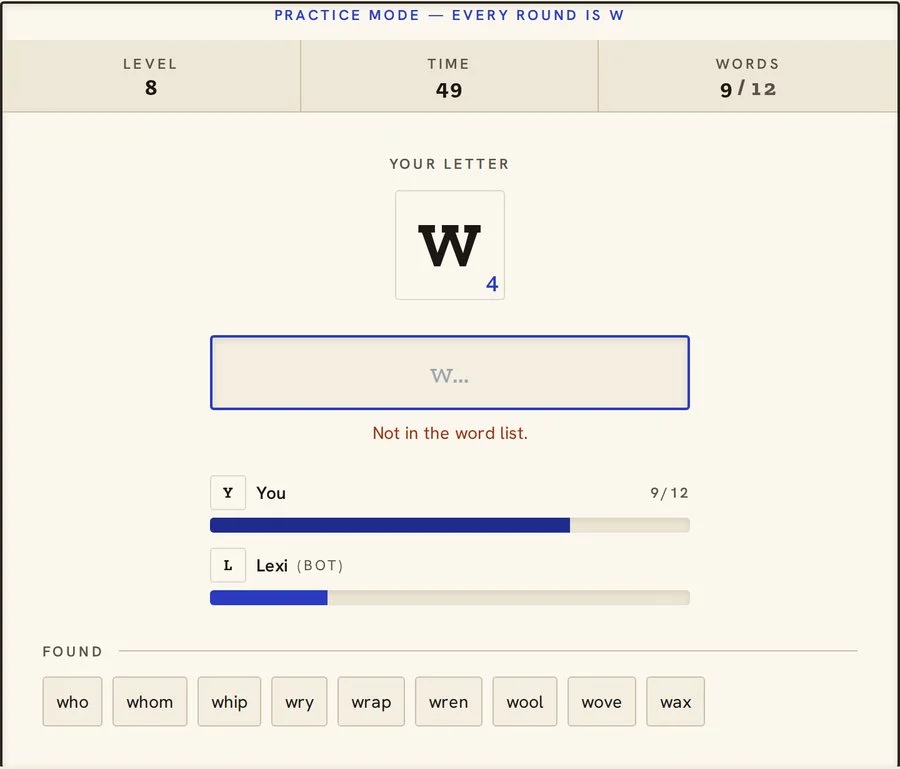
This does not mean the rejected words are wrong or informal. It means the game compares your letters with a stored list, and these spellings are not in it. If you want to see how unpredictable that can be, the real-or-fake quiz puts emoji and selfie next to words like syzygy and phpht that do score.
Why does CANT score but DONT does not?
Before it checks anything, the game deletes every character that is not a letter from A to Z. In a live test, typing can’t with the apostrophe scored as cant, and typing cant straight afterwards was turned away as “Already found”. Hyphens go the same way: co-op scored as coop. When you enter cant, it is accepted because cant is a separate English word (hypocritical or specialised talk), not because the game is reading it as can’t. Most other contractions have no such lucky twin, so they simply fail.
| Typed | Result | Why |
|---|---|---|
| cant | Valid | A word in its own right |
| wont | Valid | Means habit or custom |
| its, lets, shell, well | Valid | Ordinary words without the apostrophe |
| dont, isnt, didnt | Not valid | No matching word exists |
| thats, youre, theyre | Not valid | No matching word exists |
| aint, oclock | Not valid | Not stored in the list |
A useful habit is to ask whether the unpunctuated spelling means something by itself. If it does, it has a chance; if it only exists as a squashed contraction, move on to another word before the clock eats your round.
Why was ICECREAM rejected when HOTDOG worked?
Closing up a two-word phrase only works when the list happens to store the joined form. Hotdog is there, along with hotdogs, but icecream is not, and neither are hyphenated expressions typed without their hyphens, such as xray, selfesteem and motherinlaw. There is no rule you can apply in advance, which is frustrating but honest.
| Accepted | Rejected |
|---|---|
| hotdog, weekend, teenager | icecream, wellbeing, daycare |
| anyone, someone, everyday | noone, alot, healthcare |
| cannot, alright, nonetheless | xray, selfesteem, motherinlaw |
Two familiar spelling slips in this group behave differently. Alright is accepted even though many style guides dislike it, while alot, which has never been a standard written form, is not in the list.
Aren’t brand names banned?
There is no brand filter. Some words that began as trade names have become ordinary nouns and appear in the list, while others never made it in. Xerox is accepted, along with xeroxed, xeroxes and xeroxing, yet kleenex and jacuzzi are rejected.
| Accepted | Rejected |
|---|---|
| xerox, thermos, zipper | kleenex, jacuzzi, velcro |
| escalator, trampoline, aspirin | frisbee, bandaid, dumpster |
| jeep | google, lego, hoover |
Can I play the names of places and people?
Only when the same letters also form an ordinary lowercase word. The game cannot tell whether you meant the country or the porcelain when you type china, and it does not need to, because china is stored as a common noun. The same is true of turkey, jersey, japan (a glossy lacquer) and first names such as frank, mark and jack.
Names with no everyday meaning fail. London, France, Everest and Shakespeare are all rejected, and capitalising them makes no difference because the game converts what you type to lower case before checking it. One surprise in the other direction is paris, which is in the list, so treat that one as a lucky exception rather than a sign that cities are allowed.
Why were INFORMATIONS and FURNITURES accepted?
Because the list stores them. Plurals such as advices, equipments, furnitures, informations and luggages look wrong in modern edited prose, where those nouns are normally uncountable, but word-game lists tend to include rare, older or specialised forms. A game list decides what scores; it is not a style guide.
| Accepted | Rejected |
|---|---|
| informations, furnitures, equipments | sheeps, childs |
| advices, luggages | datas, criterias |
| fishes, deers, mouses | mooses |
Do I need the accent on CAFÉ or FIANCÉ?
No, and on this game the accent actively hurts. The game deletes any character outside plain A to Z, so when we typed café with the accent in a live round, it was checked as caf and rejected with “Not in the word list”, while cafe without it scored at once. Leave accents off. Every accented borrowing we checked is accepted in its unaccented form: cafe, cliche, creme, decor, eclair, entree, facade, fiance, fiancee, jalapeno, naive, naivete, pinata, protege, resume, senor and soiree. That is a good record, but it covers only the words checked here, so it is not a promise about every borrowed word.
Why the game strips characters instead of refusing them
The game removes everything outside a to z rather than refusing the entry, and we think that is the better of the two options: phone keyboards can add a capital or an apostrophe without being asked, and a correct word should not fail for a character the player never meant to type. The cost is the accent case, where café loses a letter and fails. We got this wrong ourselves at first. Earlier versions of this page said accents made no difference and that an apostrophe could never be entered; testing the live game showed both answers were wrong, and they were corrected on 13 September 2026. The how-to-play text on the play page now states the rule, with café as its example. The practical advice is short: type plain letters and nothing else.
Why won’t the game take OK, QI or ZA?
Find the Word requires at least three letters, so every two-letter word is out regardless of which dictionary lists it. That catches players who come from board games where short words such as qi, za and xi are standard. Ok fails for the same reason, although its longer spelling okay is accepted.
Word lists also change over time, and games do not all update together. When Merriam-Webster published the sixth edition of the Official Scrabble Players Dictionary in 2018, ok, ew and zen were among the additions. Find the Word uses a fixed list, so okay scores here while ok, ew and zen do not.
If short words are your strength, the best move is to shift that knowledge up a letter. The three-letter words quiz covers the shortest answers the game does accept, and the guide to Q, X, Z and J lists what is left for the letters where two-letter habits hurt most.
Is COLOUR accepted, or only COLOR?
Both are accepted, and so are many other British and American pairs, including centre and center, grey and gray, and plough and plow. The pattern is not complete, though: favorite is accepted while favourite is not. The full set of pairs is covered in colour or color in word games.
Will a word that fails here fail in other games too?
Often, but not always. Every word game checks against its own fixed list and its own length rule, so the same spelling can pass in one and fail in another. Some broad principles are common, though: proper nouns, abbreviations and hyphenated forms are excluded in most of the games below, and a word missing from a game’s list is simply not a word for that game, however common it is in speech.
| Game | Shortest word allowed | What decides a word |
|---|---|---|
| Find the Word | 3 letters | A fixed ENABLE-based list, minus an offensive-word blocklist |
| Scrabble | 2 letters | An official dictionary chosen for the game or tournament, updated in new editions |
| Boggle | 3 letters in the classic game | A standard English dictionary agreed by the players; the rules exclude proper nouns, abbreviations, contractions and hyphenated words |
| Wordle | Exactly 5 letters | A curated list of answers, plus a larger list of words accepted as guesses |
That last row explains a common Wordle frustration: a word can be accepted as a guess without ever being eligible as an answer. The same logic applies here in reverse. A word being real, or even common, does not put it on a particular game’s list, which is why the checker at the top of this page is more reliable than instinct.
The word is in the dictionary, so why was it still rejected?
There are three likely explanations. The first is that the word does not begin with the round’s letter, which is easy to miss when you are typing fast. The second is that you had already played it in the same round, since each word can score only once.
The third is the blocklist. The game switches off a small set of offensive words, covering 281 entries of the underlying word list that other games may use. The blocklist file itself holds 411 spellings; the other 130 are spellings the word list never contained. We do not reprint blocked words in our articles, and they are rejected in every round and every mode.
Where we drew the blocklist line
Slurs and strong vulgar or explicit words are blocked. Mild everyday words, damn for example, are deliberately left playable, because we do not think a word you would hear in ordinary conversation needs to be refused. The harder calls are words whose main senses are innocent but which can be used as slurs in some contexts, such as spade (the digging tool) and paddy (a rice field). We left those playable too. Blocking them would tell a player that a garden tool is offensive, and a game that rejects innocent words teaches the wrong lesson about language.
The line has moved, and we would rather say so. During our September 2026 audit we extended the blocklist three times after finding slurs and explicit forms the original list had missed, and after each change we recounted every figure on the site. One older article had even listed a blocked word as playable; that is in the corrections log. If you think an inoffensive word has been caught by mistake, or an offensive one is still getting through, use the contact details at the end of this page.
Which words get rejected most often?
We do not know, and we would rather say so than guess. The examples on this page were chosen because they illustrate each type of rejection clearly, not because they come from records of what players typed. Any ranking of “most rejected words” would need real submission data, which this page does not use.
What you can do is test your own weak spots. A practice round locked to C, for example, is a quick way to find out whether cant, cafe and cliche come to mind when you need them.
What should I do if I think a verdict is wrong?
First check the spelling you actually typed, then the round letter, then whether you played the word earlier. If all three look right, the explanation of how we check words describes exactly which list the game uses and how entries are compared. If you still believe the game has made a mistake, send the word and the round letter through the contact page and it will be looked at against the list.
Sources
- Online Etymology Dictionary entries for laser, radar and scuba (dates and expansions of the acronyms).
Updated 13 September 2026: rewritten and restructured, with every count and word verdict rechecked against the game’s word list and blocklist. Corrected the answers about accents and apostrophes after testing the live game. Details are in the corrections log.
New to The Verbarium? Follow the reading path, with tools and printables