How to Win Timed Word Games: Bank, Sweep and Close in Sixty Seconds

The letter comes up, the clock starts at sixty, and for a second or two nothing arrives. You know hundreds of words, but none of them is on the tip of your tongue, and the first thing you think of is a long word you are not sure how to spell. This playbook is about what to do in that moment and in the rest of the round. It applies to any game where you race a timer to list words, from Boggle-style grids to a one-letter race on a classroom whiteboard, and we tested it on our own game, Find the Word, where you are given one starting letter and up to a minute to type as many valid words of three or more letters as you can.
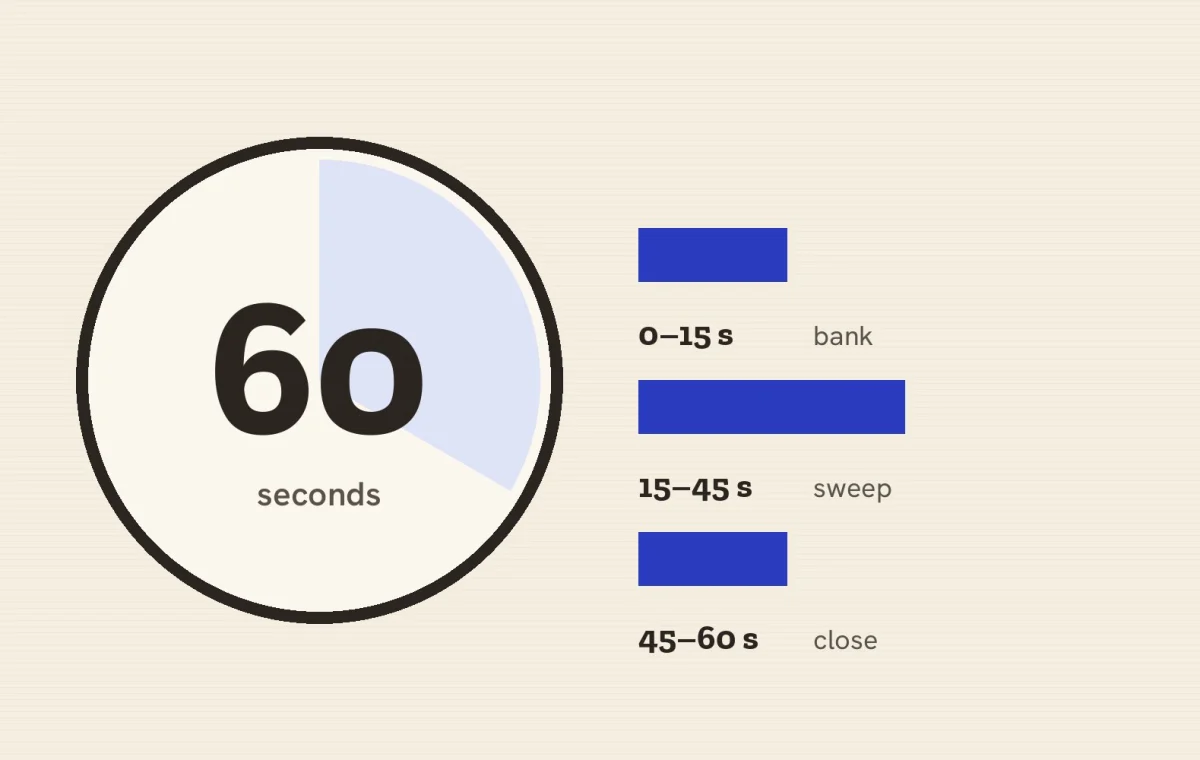
The plan has three phases: bank, sweep and close. Type the words that need no thought first, search in a structured way in the middle, and start no new gambles at the end. Each phase has a different job, and the right way to carry out that job depends heavily on the letter you have been dealt. So after explaining the phases, the second half of this page walks through three illustrative rounds, one for a broad letter, one for a very narrow letter and one for a letter in between. Each comes with a practice link that locks the game to that letter, so you can try the same start yourself.
Why one rhythm does not fit every letter
The letters are not equally generous. In the Find the Word list, which is the public-domain ENABLE word list less an offensive-word blocklist, 172,446 words in all (the method is described on how we check words), S has 1,452 words of three to five letters, K has 350 and X has just 15. S therefore offers nearly a hundred times as many short answers as X before memory or typing speed even comes into it.
Those numbers change what can go wrong. Under S the risk is drift: you find one productive cluster and stay in it long after it has dried up. Under X the risk is the opposite, because you can waste precious seconds searching for openings that do not exist. A letter like K sits in the middle, with enough short words to keep going but few enough that a wasted opening costs you. The plan below stays the same in outline, but the way you run each phase shifts with the pool.
First, check which clock you are racing
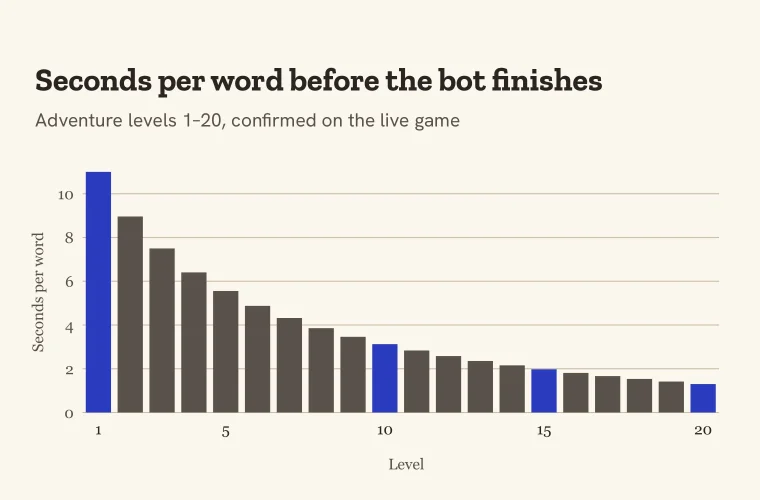
Before planning how to spend a round, find out what actually ends it, because it is not always the clock you can see. The timings on this page assume a full sixty-second round, which is what you get in 1v1 Live. Adventure mode is different, and we only confirmed how different by running the live game with a test script. There, the round ends when Lexi the bot finishes, and the bot finishes well before the minute is up: at 55 seconds on level 1, 43.75 seconds on level 10 and 31.25 seconds on level 20, while the word target climbs from five to twenty-four. The full results, level by level, are in Adventure mode, tested.
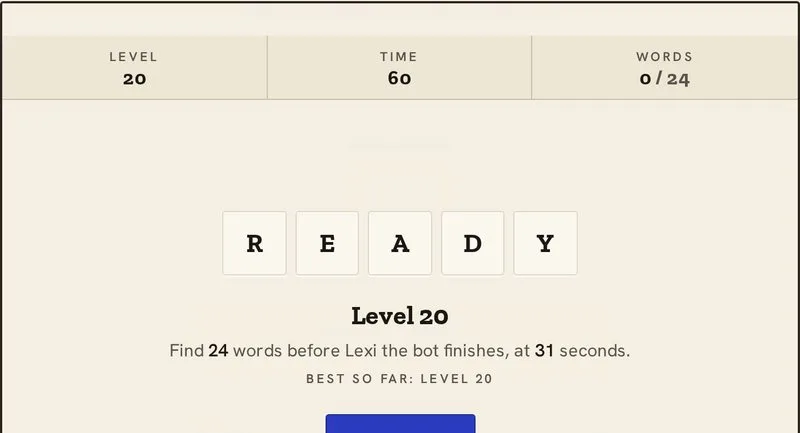
We got this wrong the first time. The original version of this playbook assumed every Find the Word round lasted sixty seconds, and so did the game’s own start screen, which promised the same minute on every level. Only the scripted test runs showed that the bot ends Adventure rounds early. We rewrote the timing advice, changed the start screen to show the real deadline and recorded both on the corrections page. The lesson carries to any timed game: read what ends a round before deciding how to spend it.
So in Adventure, stretch the three phases over the bot’s time rather than the clock’s. Spend roughly the first quarter of that time banking, the middle half sweeping and the last quarter closing. On level 10 that means banking until about 11 seconds, sweeping until about 33 and closing by 44. On the highest levels there is barely time for a sweep at all, and the bank phase has to carry most of the round, which is why preparation before you play matters more the higher you climb.
Check your own level here before planning a round:
Adventure level calculator
Phase one: bank what you already know (roughly 0 to 15 seconds)
The first phase is for words that need no thought at all. In a game where every accepted word counts toward the total, a three-letter word you type instantly is worth more to you than a nine-letter word you have to reconstruct letter by letter. Open with the short, familiar words that come to you without searching, and type them quickly.
The best way to make this phase reliable is to prepare it before you play. For the narrow letters, a handful of short words is enough to guarantee you never start a round empty-handed. The three-letter words quiz is built for exactly that, and the letters most likely to stall you are covered in more depth on the hard letters Q, X, Z and J page.
Resist the temptation to start with a clever long word. If it arrives complete and you are confident of its spelling, type it. If you find yourself assembling it, park it and keep banking. The half-finished word will still be there in phase two, and by then you will have a few answers on the board.
Phase two: sweep by second letter and by family (roughly 15 to 45 seconds)
Once the obvious words are in, “think of another word” stops being a useful instruction. The sweep replaces it with a smaller, concrete one: change the second letter. If you have been typing words that start SA, move to SE, then SH, then ST. Each new starting pair gives your memory a fresh cue, and it guards against the easy habit of circling one cluster that has already given what it can.
The second tool in this phase is the word family. When a word you already know is on the board, check its direct forms. The game accepts 4,957 words to which s, ed and ing can each be added directly, with no spelling change, to make another accepted word (a rough letter-matching count: it leaves out families with a spelling change, such as bake, bakes, baked, baking, and does not check that the forms are really related), which makes this a productive habit. It only works for forms you actually know, though. Break, breaks and breaking are all accepted, but breaked is not, because the past tense is broke. The prefix and suffix worksheet covers the spelling changes that make families harder, such as doubled consonants and dropped letters.
How you sweep depends on the letter. Under a broad letter you can move through many starting pairs and still have more to visit. Under a narrow letter, sweeping the whole alphabet is a waste of time, because most second letters lead nowhere, so you jump straight to the few pairs that exist.
Phase three: close with certainties (roughly 45 to 60 seconds)
In the last quarter of the round, the value of a hesitant word drops sharply. A long word that you almost remember with ten seconds left is usually a word you will not finish. Use this phase for short words you skipped earlier, for family forms of words already on the board, and for any starting pair you noticed but did not open.
A useful rule of thumb is that nothing new and uncertain gets started after the 45-second mark unless it arrives whole. Keep a mental note of the word that nearly came, and look it up afterwards. That note is the most valuable thing to take into your next practice session, which is the subject of the word recall training routine.
When you race a person instead of a clock
In 1v1 Live, the head-to-head mode of Find the Word, both players get the same letter for three 60-second rounds, and whoever finds more words takes each round. To see exactly what a player can see, we ran a test match between two automated browser sessions on 14 September. The answer is less than you might expect: your own words, and a single number for your opponent.
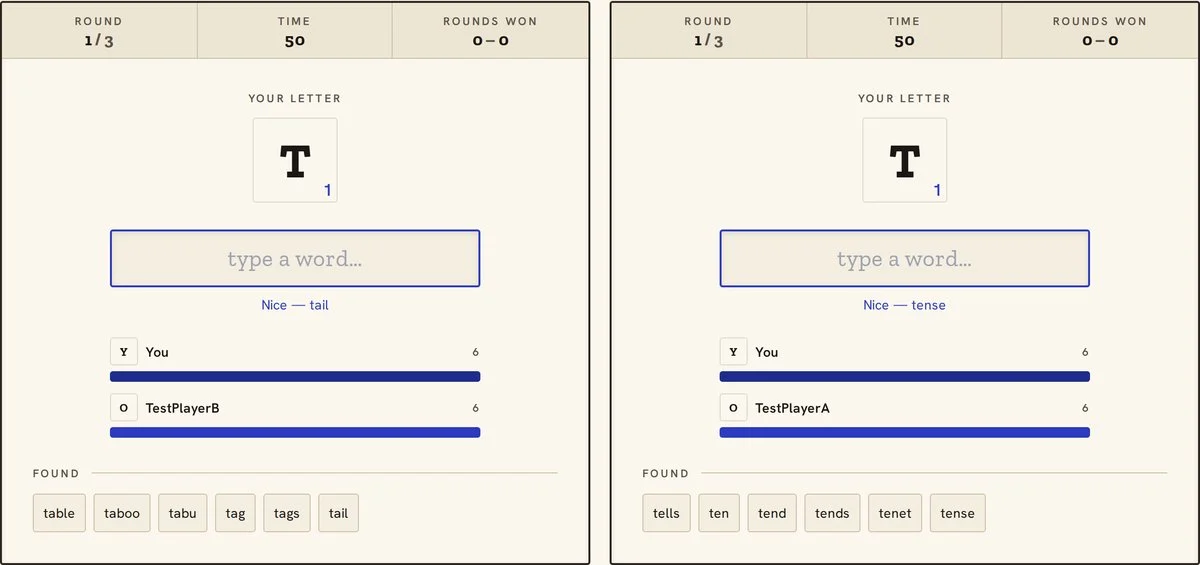
That settles two questions of strategy, and here is where we land on both. First, an opponent’s lead early in the round is no reason to change your search: you cannot tell which openings their words came from, so the count measures pace and nothing more, and abandoning a productive sweep to chase it costs you. Second, the close matters more than it does against a bot. A tied round goes to nobody, so when the counts are level in the last seconds, one certain three-letter word is worth more than any long word still being assembled. This is our reading of the rules, not a result measured on human players. Games that cross out words both players found pull the other way, as the Boggle section below explains.
The three rounds below are illustrations, not records of real games. Every word in them was checked against the list of words the game accepts, but the timings and word lists were built on paper to show how the plan adapts to different letters. Your own words will differ, and that is expected.
Illustrative round one: S, a broad letter
S is the most generous starting letter in the dictionary, with 1,452 playable words of three to five letters spread across 17 different second letters. The problem under S is almost never a shortage of answers. It is spending twenty seconds in SA and SE while ST, SH, SL, SN and SW sit untouched. To rehearse it, open a practice round locked to S.
| Phase | Illustrative time | Words typed | What the player is doing |
|---|---|---|---|
| Bank | 0 to 15s | sad, sat, saw, say, sea, set, sit, six, sky, sun, son, spy | Typing short words that need no search at all |
| Sweep | 15 to 30s | star, stop, step, stem, ship, shop, shot, slip, slow, slap, snow, snap | Moving deliberately to ST, SH, SL and SN once the vowel pairs slow down |
| Sweep | 30 to 45s | sing, sings, singer, singing, stamp, stamps, stamped | Expanding two words already on the board into their families |
| Close | 45 to 60s | swim, swan, skip, skin, scan, scar | Opening SW, SK and SC with short, certain words only |
The point of this illustration is the order of the starting pairs rather than the particular words. By the middle of the round the player has visited eleven different openings, and the family step adds several answers without any new vocabulary at all. The last phase does not try anything ambitious; it simply opens pairs that were skipped earlier.
Illustrative round two: X, a narrow letter
X is the other extreme. There is exactly one three-letter X word in the dictionary, xis, and only 15 words of three to five letters in total. All of those short words start with XE, XI or XY. Longer X words exist (134 X entries in all), but many are technical terms. A sensible X round therefore depends on preparation, because there is very little to discover under pressure.
| Phase | Illustrative time | Words typed | What the player is doing |
|---|---|---|---|
| Bank | 0 to 15s | xis, xerox, xenon, xylem | Typing the prepared short set, starting with the only three-letter word |
| Sweep | 15 to 45s | xeroxed, xeroxes, xeroxing, xenons, xylems, xylophone, xylophones | Skipping the alphabet scan, going straight to XE and XY, and adding forms of words already typed |
| Close | 45 to 60s | xebec, xyst | Adding two less familiar short words that were learned in advance |
Notice how little of this round involves searching. The bank phase is entirely prepared material, and the sweep does not test XA, XO or XU at all, because no short words live there. A player who has never looked at the X list will struggle to reach even a few answers, which is why the hard letters are worth a few minutes of study before they turn up in a real round. Once you have learned the short X words, test them in a practice round locked to X.
Illustrative round three: K, a letter in the middle
K has 350 playable words of three to five letters. Most of them sit under KA, KI and KE, with KO and KN some way behind and a thin scattering elsewhere. That is enough to keep a round moving, but a player who only thinks of KI words will run dry quickly, and the KN words are easy to forget because the K is silent when spoken.
| Phase | Illustrative time | Words typed | What the player is doing |
|---|---|---|---|
| Bank | 0 to 15s | kit, kid, key, keg, kin, kind, king, kiss, kite | Short, familiar words from the two biggest openings |
| Sweep | 15 to 30s | knee, knew, knit, knot, know, knob | Switching to KN, which is easy to overlook because it sounds like N |
| Sweep | 30 to 45s | kicks, kicked, kicking, kits, keys, kings | Adding family forms of words already on the board |
| Close | 45 to 60s | kale, kelp, keep, kilt, koala | Picking up KA, KE and KO words that came to mind earlier |
The middle letters reward a mix of both approaches. There are enough words to sweep, but the useful starting pairs are few enough that a player can learn them in advance. The words that start with K page breaks the openings down in detail if K is a letter that regularly slows you down, and a practice round locked to K lets you try the sweep for yourself.
Reviewing a round afterwards
The number of words you reach tells you how the round went, but the list itself tells you why. After a round, group your words by their first two letters. Gaps usually jump out immediately: a B round with plenty of BA and BE words and nothing under BO or BU, or an S round that never reached ST. That observation is more useful than a general resolution to learn more words, because it gives you something specific to do next time.
Keep the review honest by testing recall rather than recognition. Reading the words you missed makes them feel familiar, but the game asks you to produce them from nothing. Close the list and try to write them out before deciding that a gap has been fixed.
Using the plan in other timed word games
The three phases are not specific to one game, but the balance between them shifts with each game’s rules.
Boggle replaces the single letter with a grid of letter cubes and scores by length. The current Hasbro rules sheet for Boggle Classic (UK edition) times a round with a 90-second sand timer and describes three-minute rounds as the traditional game. It scores one point for a three- or four-letter word, two for five letters, three for six, five for seven and eleven for eight or more, and any word on more than one player’s list is crossed off every list. Both rules push the close in the opposite direction from Find the Word. An eight-letter word is worth as much as eleven three-letter words, and a common short word is the one most likely to be cancelled, so we would still bank short words first, because they are quick to spot, but spend the final stretch hunting for one long word nobody else will have. The rules sheet makes the same point, telling players to look for unusual words that others might miss. Sweeping still works, only the prefixes come from paths across the grid rather than from a second letter you choose, and the sheet gives credit for both the singular and the plural of a noun, so the family step pays there too.
Categories games, where one letter must answer a list of prompts such as “a fruit” or “a city” before the timer ends, reward the bank phase most of all. Fill every prompt that has an instant answer first, then sweep the blanks by trying second letters in turn, exactly as in a single-letter round. A partly remembered answer in one category should be left until the end, because it costs the time of two easy ones.
Classroom word races on paper, one letter and one minute, follow Find the Word most closely. The review step described above works especially well there, because pupils can group their lists by first two letters and see at a glance which openings nobody reached.
Questions about the plan
Should I ever start with a long word?
Only if it arrives complete and you are sure of its spelling. Each accepted word counts once, so a long word that takes ten seconds to assemble costs you the several short words you could have typed in the same time.
Are the phase timings fixed?
No. They are a starting point. Under a narrow letter like X the bank phase may be almost the whole round, while under S the sweep can easily stretch past 45 seconds. What matters is the order: certain words first, structured searching in the middle, and no new gambles at the end.
Do these timings work in Adventure mode?
Only on the earliest levels. In Adventure the bot sets the deadline, and it finishes sooner as you climb, so scale the phases to the bot’s finishing time shown on the start screen. Our live pace tests found that typing one word every three seconds clears level 10 but not level 11.
Do the example rounds show real results?
No. They are illustrations assembled from the dictionary to show how the plan adapts, and they were not played. Every word in them is accepted by the game, but your own lists will look different, and the word totals are not targets.
What is the quickest way to improve on hard letters?
Learn the short words for the narrowest letters before you need them. For X and Q the complete three-letter sets are only xis, qat and qua, and a few minutes with the three-letter quiz will give you a dependable start for Z, J, K and V as well.
Updated 14 September 2026: the Boggle section now follows the current Hasbro rules sheet, which uses a 90-second timer and treats three-minute rounds as the traditional option; the page previously gave three minutes as the standard. Added a section on head-to-head rounds, based on a test match on the live game. Updated 13 September 2026: rewritten and restructured, with every count and word verdict rechecked against the game’s word list and blocklist. Corrected the timing advice for Adventure mode, where the bot ends the round before sixty seconds. Details are in the corrections log.
New to The Verbarium? Follow the reading path, with tools and printables