Find the Word Adventure Mode, Tested: The Real Deadline at Every Level

Find the Word looks like a sixty-second game. The timer starts at 60, and the rules say you have a minute. In Adventure mode that is not quite true, and the difference decides almost every round past the first few levels. To pin it down, we read the game’s code, then ran the live game in a browser with a test script that typed valid words at fixed speeds and recorded when each level was won or lost. This page reports what those tests showed, with screenshots from the runs, so you can plan for the deadline you actually face.
A note on method, because it matters for how to read the results: the tests were automated. A script does not hesitate, forget a word or mistype one, so the results show what the rules demand, not how a person will feel meeting those demands. How to build the speed is covered in our guides to winning timed word games and word recall training.
The real deadline is the bot
An Adventure round ends in one of three ways. You reach the word target and clear the level. The 60-second clock runs out. Or Lexi, the bot whose progress bar fills up under yours, finishes first. The third one is the one that matters, because Lexi always finishes before the clock does. On level 1 the bot needs 55 seconds. Every level after that takes a second and a quarter off, down to a floor of 30 seconds, which the game never actually reaches because level 20 stops at 31.25 seconds.
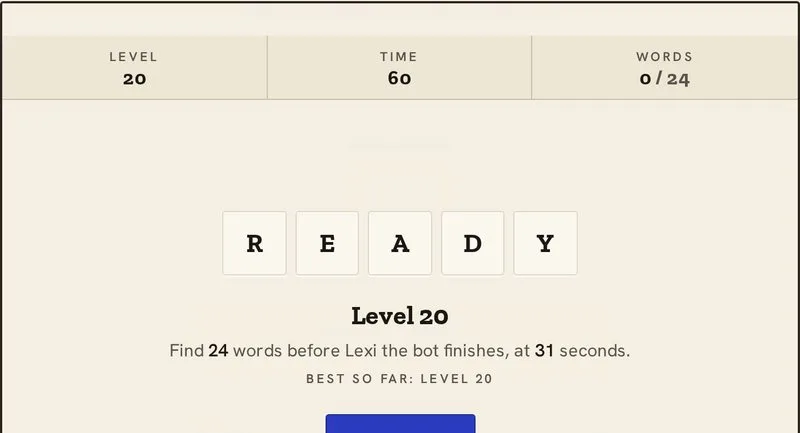
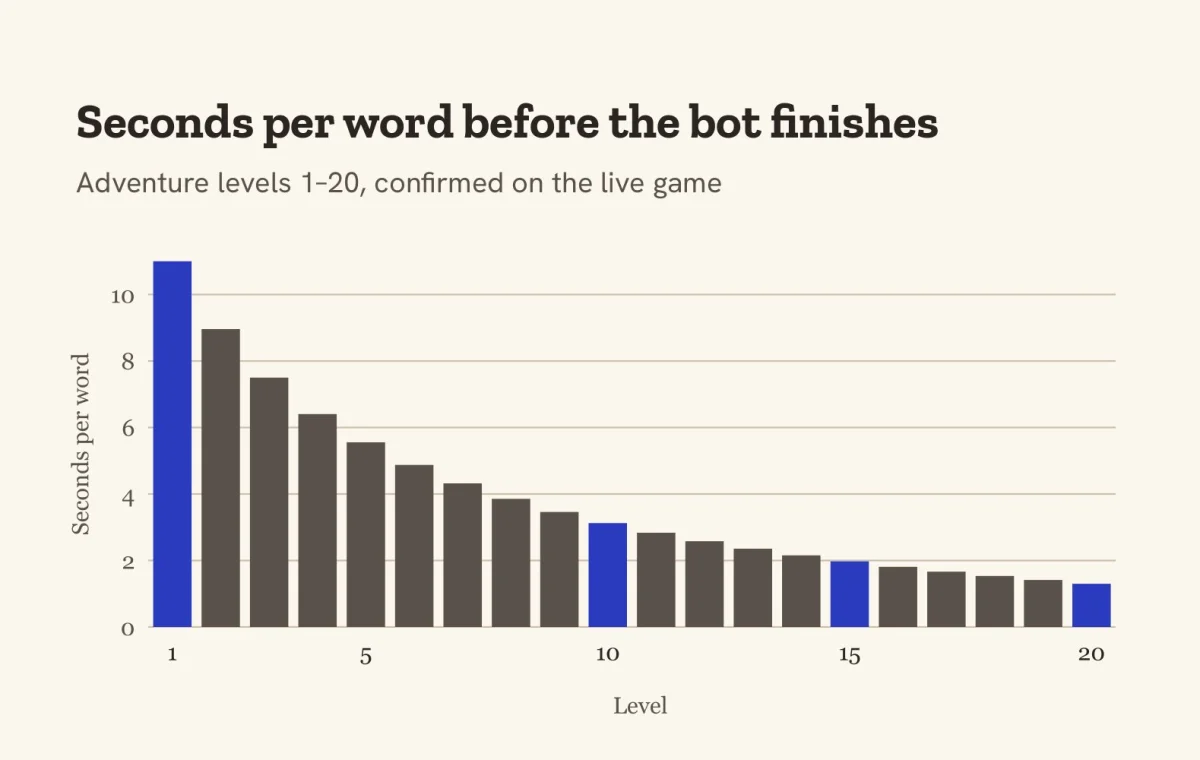
At the same time, the target rises by one word per level: five words on level 1, fourteen on level 10, twenty-four on level 20. Put the two together and the time you have for each word shrinks quickly. On level 1 you can spend eleven seconds per word and still win. On level 20 you have about 1.3 seconds per word, including the time it takes to type it and press Enter. The clock at the top of the screen still counts down from 60, which can make a round feel less urgent than it is.
We changed the start screen after testing. It used to say “Find 24 words in 60 seconds” on every level. It now shows the bot’s actual finishing time for the level you are about to play, because the old wording described a deadline that never applies.
What each of the 20 levels demands
The table lists, for every level, the number of words you need, the moment the bot finishes, and the average time that leaves per word. These figures come straight from the formulas in the game, and the pace tests below confirm them on the live site.
| Level | Words needed | Bot finishes at | Time per word |
|---|---|---|---|
| 1 | 5 | 55 s | 11.0 s |
| 2 | 6 | 53.75 s | 9.0 s |
| 3 | 7 | 52.5 s | 7.5 s |
| 4 | 8 | 51.25 s | 6.4 s |
| 5 | 9 | 50 s | 5.6 s |
| 6 | 10 | 48.75 s | 4.9 s |
| 7 | 11 | 47.5 s | 4.3 s |
| 8 | 12 | 46.25 s | 3.9 s |
| 9 | 13 | 45 s | 3.5 s |
| 10 | 14 | 43.75 s | 3.1 s |
| 11 | 15 | 42.5 s | 2.8 s |
| 12 | 16 | 41.25 s | 2.6 s |
| 13 | 17 | 40 s | 2.4 s |
| 14 | 18 | 38.75 s | 2.2 s |
| 15 | 19 | 37.5 s | 2.0 s |
| 16 | 20 | 36.25 s | 1.8 s |
| 17 | 21 | 35 s | 1.7 s |
| 18 | 22 | 33.75 s | 1.5 s |
| 19 | 23 | 32.5 s | 1.4 s |
| 20 | 24 | 31.25 s | 1.3 s |
Two stretches stand out. Through level 7 there are more than four seconds per word, which is enough to think, reject an idea and try another. From level 13 onwards the average drops below two and a half seconds, and there is no time for a word you are not sure of. By then, the only practical way to win is to go into the round with a set of short words already in mind, which is what the three-letter word self-test is for.
To see your own numbers, pick your level below and enter the pace you think you can keep up. The calculator uses the same formulas the game uses, which the pace tests that follow confirmed on the live site.
Adventure level calculator
Printable: Download the level table (PDF, one page). All 20 levels with targets, bot deadlines and time per word.
The pace tests
To check the table against the real game rather than trust the formulas, the test script opened the live play page, set the level, locked the letter to S with a practice link, and submitted one valid word at a fixed interval from the moment the round started. For each speed we picked the last level the rules say it should clear and the first level it should lose, and ran both.
| One word every | Level | Requirement | Result on the live game |
|---|---|---|---|
| 3 s | 10 | 14 words by 43.75 s | Cleared (14 words, 42.1 s) |
| 3 s | 11 | 15 words by 42.5 s | Lost to the bot (14 words, 42.5 s) |
| 2 s | 14 | 18 words by 38.75 s | Cleared (18 words, 36.1 s) |
| 2 s | 15 | 19 words by 37.5 s | Lost to the bot (18 words, 37.5 s) |
| 1.5 s | 18 | 22 words by 33.75 s | Cleared (22 words, 33.2 s) |
| 1.5 s | 19 | 23 words by 32.5 s | Lost to the bot (21 words, 32.6 s) |
| 1.25 s | 20 | 24 words by 31.25 s | Cleared (24 words, 30.1 s) |
All seven results matched the prediction. Typing a word every three seconds clears level 10 and loses level 11 one word short. A word every two seconds gets you to level 14. Even a steady word every second and a half fails on level 19, and only a word every 1.25 seconds cleared level 20, with about a second to spare. In a second test with no words typed after the first, the bot won level 20 at 31.4 seconds, in line with its 31.25-second finishing time plus the page’s reaction delay.
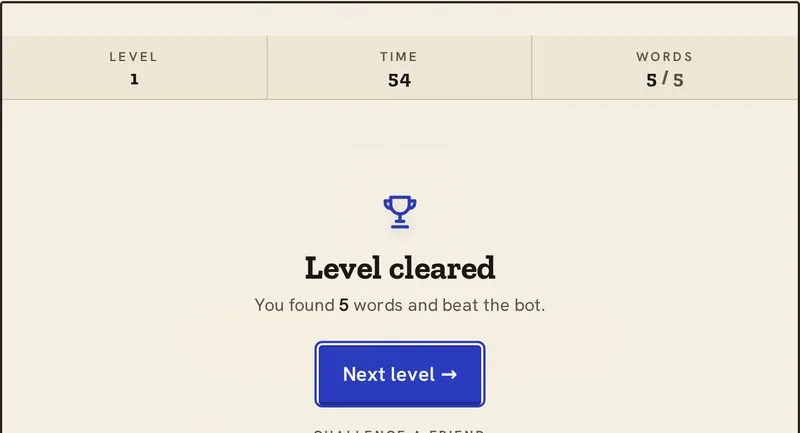
Reaching the target ends the round at once, even with time on the clock, and moves you up a level.
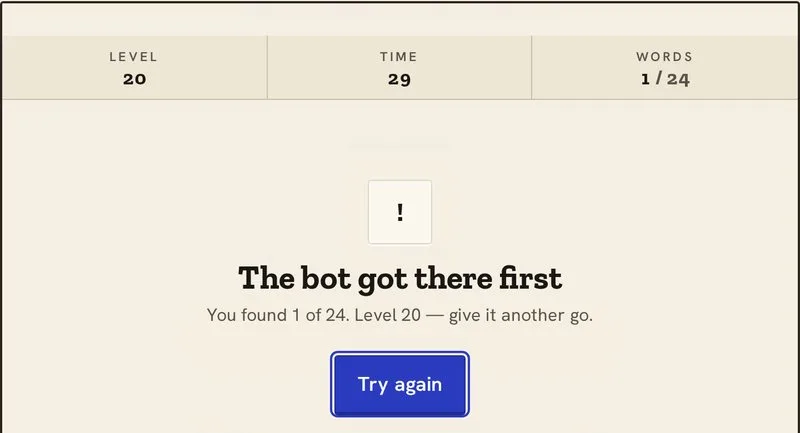
Here the clock still showed 29 seconds. Losing keeps you on the same level for another try.
One practical consequence: a steady rhythm matters more than bursts. The script wins because it never stalls, and a player who types three words quickly and then pauses for eight seconds has used the same time as one who types a word every 2.75 seconds. Practising a single letter until the first ten words come without searching is the most direct way to close that gap.
How often each letter comes up
Letters are not served at random with equal odds. The game uses fixed weights that favour common starting letters, and it never serves the same letter twice in a row. We worked out the long-run frequencies exactly from those weights and that no-repeat rule, and a simulation of two million draws agreed with them to within random variation.
| Letter | Share of rounds | How often |
|---|---|---|
| S | 9.9% | about 1 in 10 |
| C | 9.0% | about 1 in 11 |
| P | 8.4% | about 1 in 12 |
| A | 5.8% | about 1 in 17 |
| R | 5.8% | about 1 in 17 |
| D | 5.8% | about 1 in 17 |
| M | 5.3% | about 1 in 19 |
| B | 5.2% | about 1 in 19 |
| T | 5.2% | about 1 in 19 |
| E | 4.1% | about 1 in 24 |
| F | 4.1% | about 1 in 24 |
| I | 4.1% | about 1 in 24 |
| O | 3.6% | about 1 in 28 |
| H | 3.6% | about 1 in 28 |
| G | 3.6% | about 1 in 28 |
| L | 3.0% | about 1 in 33 |
| N | 2.4% | about 1 in 42 |
| U | 2.4% | about 1 in 42 |
| W | 2.4% | about 1 in 42 |
| V | 1.8% | about 1 in 55 |
| K | 1.2% | about 1 in 82 |
| Q | 0.6% | about 1 in 163 |
| X | 0.6% | about 1 in 163 |
| Z | 0.6% | about 1 in 163 |
| J | 0.6% | about 1 in 163 |
| Y | 0.6% | about 1 in 163 |
S, C and P between them account for more than a quarter of all rounds. Q, X, Z, J and Y each come up about once in every 163 rounds. That changes how to spend practice time. If you want to climb Adventure levels, the common letters decide most of your results, and preparing S, C, P, A, R and D pays off far more often than preparing X. The hard letters guide is still worth knowing, because when X does appear on a high level there are only fifteen short answers to find, but it is a once-in-a-long-while problem.
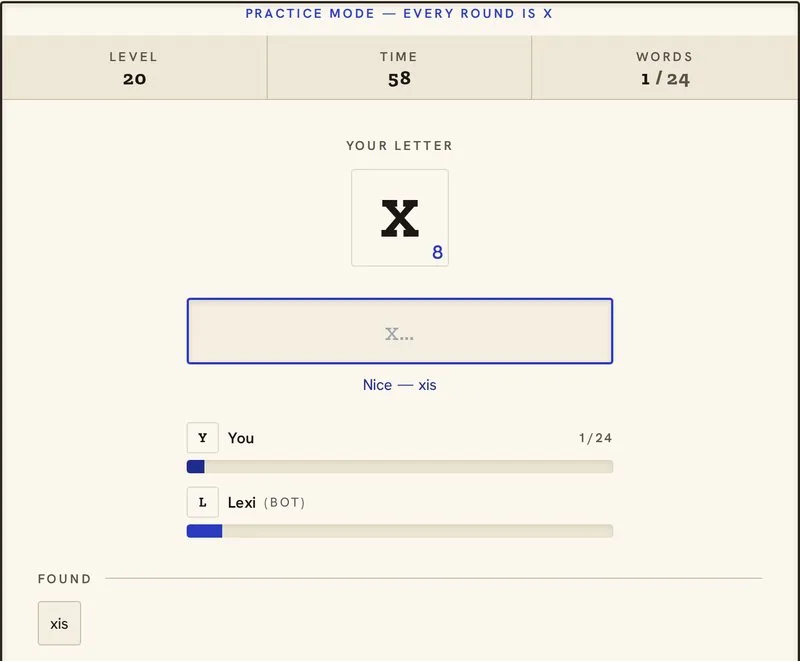
If you want to practise a letter anyway, add it to the address: /play/?letter=s serves S every round, and the page shows a “Practice mode” label so you know it is not random. Progress you make in practice mode counts toward your Adventure level like any other round.
What the game says when it rejects a word
Every word you enter is checked in a fixed order, and each check has its own message. We entered one example of each during the test runs.
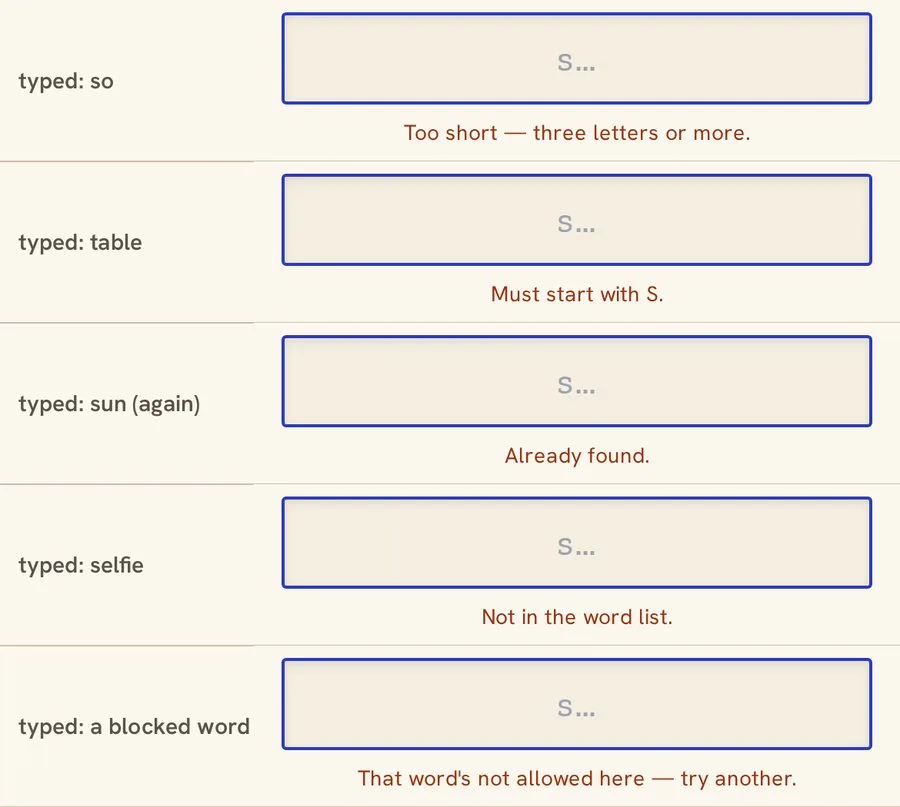
- Too short — three letters or more.
- Anything under three letters, including two-letter words that other games accept.
- Must start with S.
- The word does not begin with the round’s letter.
- Already found.
- You have already scored this exact word in this round.
- That word’s not allowed here — try another.
- The spelling is on the game’s offensive-word blocklist. The blocklist is checked before the word list, and 281 of its spellings are words the underlying list would otherwise accept.
- Not in the word list.
- The exact spelling is not in the dictionary described on how we check words.
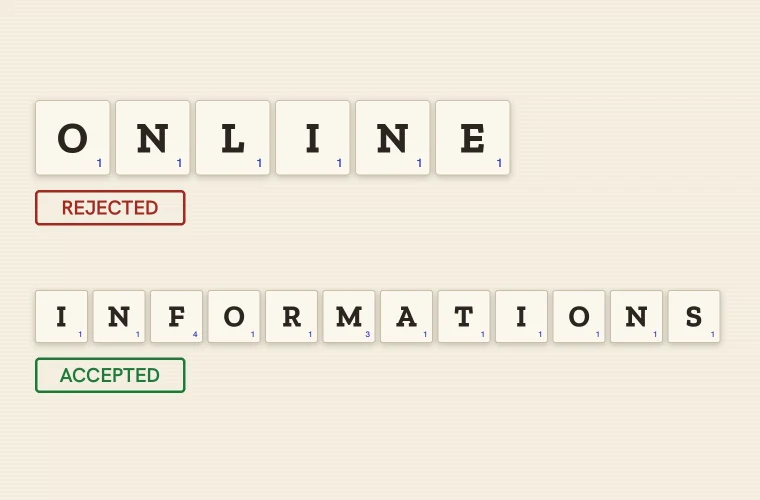
Two details are easy to miss. Rejected words cost nothing but time: there is no penalty and the input clears straight away. And the game strips everything that is not a letter before checking, so typing don’t is read as dont, and capital letters make no difference. Our FAQ on words you can’t play explains which common spellings fail and why.
How 1v1 Live differs
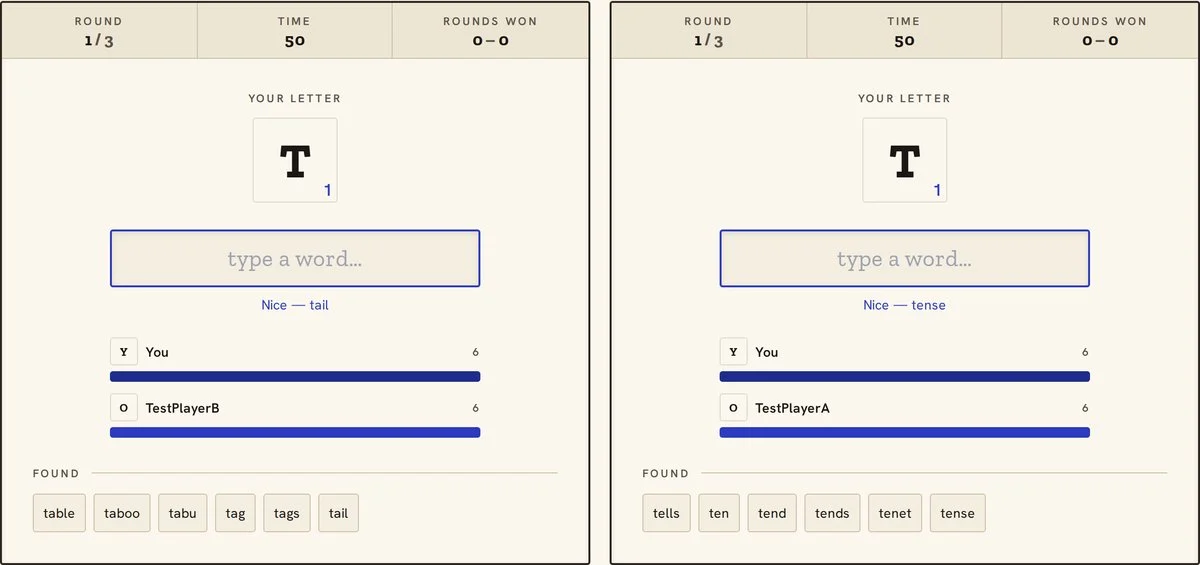
1v1 Live has no bot. Two players join a room through a share link or a six-character code, both press Ready, and the match runs for three rounds of a full 60 seconds each. Both players get the same letter in each round, drawn with the same weights as Adventure and never repeating the previous letter. Whoever finds more words wins the round; a tied round gives nobody a point, and the match can end in a draw.
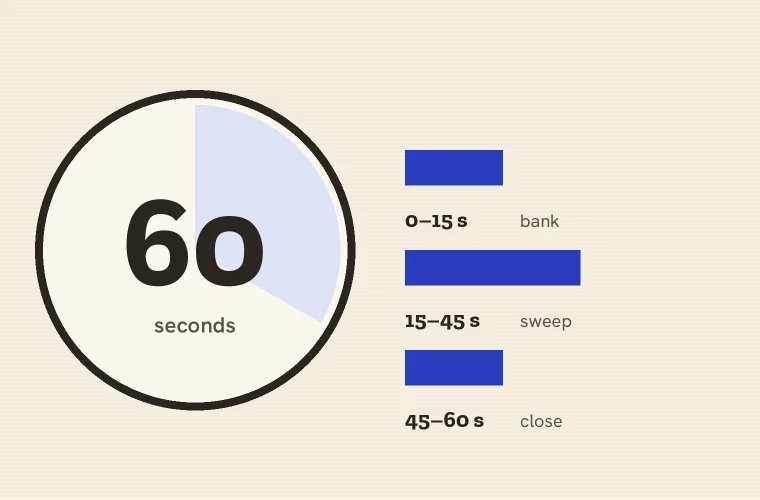
Because there is no bot deadline, the full minute matters in 1v1, and the late part of a round is where matches are won. The pacing advice changes accordingly: in Adventure, bank short words early and never stall; in 1v1, keep searching new starting pairs until the clock hits zero.
What the tests changed
The formulas in the game’s code were right, but running real rounds showed that the words on screen did not match them. Three pieces of the game’s own text were wrong, and all three were fixed. The start screen, as noted above, now shows the bot’s real finishing time instead of 60 seconds. The how-to-play text used to tell players to beat the bot “and the clock”; it now says the round is over when the bot’s bar fills, even with time left, and it explains that anything other than a plain letter is removed before checking, so café is read as caf. And the 1v1 rules said a match was “best of three”, which suggests it can stop after two rounds. It cannot: all three rounds are always played, a tied round counts for no one, and a match can end level. Our own advice on winning timed word games had made the same sixty-second assumption and was corrected too. The lesson we took is that the code was never the problem; the descriptions of it were, and only playing the live game exposed them.
What to do with this
- Know your number. Find your level in the table and note the time per word. If it is under three seconds, go in with a mental list of short words for the common letters.
- Practise the frequent letters first. S, C and P come up in about 27% of rounds. X comes up in under 1%.
- Keep a rhythm. In Adventure a pause costs as much as a wrong word. Type the word you are sure of now rather than the better word you might remember later.
- Ignore the big clock on high levels. Watch Lexi’s bar instead; that is the deadline.
- Play 1v1 differently. The full sixty seconds count, so the last twenty seconds are worth fighting for.
When you are ready to try it, start a round.
New to The Verbarium? Follow the reading path, with tools and printables