How to Win Timed Word Games: A 60-Second Strategy Based on 172,727 Words


“Keep a steady rhythm” is poor advice for a starting-letter game.
An S round may give you hundreds of familiar routes. An X round gives you only 15 words between three and five letters. Treating those rounds alike does not create consistency. It ignores the dictionary.
The strategy I use in Find the Word changes with the assigned letter. I begin with short answers, but I do not search for them in the same way every time. Broad letters need structure. Narrow letters need preparation. The final seconds need certainty rather than invention.
That approach comes from counting the same 172,727-word dictionary used by the game, not from assuming that conventional word-game advice applies unchanged.
The available pool changes the task
I counted every dictionary entry containing three, four or five letters and grouped the results by opening letter.
The short-word pool contains 13,511 entries, but its distribution is extremely uneven:
| Opening letter | Words of 3–5 letters |
|---|---|
| S | 1,471 |
| C | 932 |
| B | 892 |
| P | 883 |
| T | 853 |
| A | 760 |
| I | 195 |
| Y | 191 |
| U | 169 |
| Z | 94 |
| Q | 69 |
| X | 15 |
S has more than 98 times as many short entries as X.
The count does not tell us how many of those words an ordinary player knows. It does establish that the search spaces are different before memory, familiarity or typing speed enters the picture.
With S, the danger is becoming lost among too many possible routes.
With X, the danger is expecting the route to be there at all.
This is why I do not divide letters into “easy” and “hard” and then apply one routine to each group. I divide them by the type of search they permit.
The first ten seconds belong to answers you already know
Find the Word gives one unit of progress for every new accepted answer. A three-letter word moves the round forward by the same amount as a ten-letter word.
That makes the opening decision simple: enter certainty before exploring.
For J, that might be:
jam, jar, jet
For V:
van, vet, vow
For Z:
zap, zip, zoo
For Q:
qat, qua
For X:
xis
The exact anchors should come from the player’s own memory. Someone who retrieves vex faster than vet should use vex.
What matters is that the first answer is already complete before the timer starts. A half-remembered long word creates several decisions: continue reconstructing it, risk the spelling or abandon it. A prepared short answer creates progress.
I disagree with the common advice to open by searching for the longest word available. That may make sense in a game that rewards length. It does not make sense here unless the long word arrives immediately and intact.
The game’s rules are available at Find the Word. The important scoring detail is that every unique accepted answer counts once.
Broad letters need routes, not more vocabulary
Suppose the assigned letter is A.
Among the dictionary’s three-to-five-letter A-words, every letter from A to Z appears somewhere in second position. A broad second-letter sweep can therefore trigger several unrelated answers:
ace, aft, age, aid, ale, amp, ant, ape, arc, ash, ask, awe, axe
The purpose is not to complete all 26 combinations mechanically. The sweep gives the mind a smaller instruction than “think of another A-word.”
B is also generous, but its short words use only ten second-letter routes:
BA, BE, BH, BI, BL, BO, BR, BU, BW, BY
In ordinary play, the familiar productive areas are narrower still:
- BA: bad, bag, ban, bar, bat
- BE: bed, bee, beg, bet
- BI: bid, big, bin, bit
- BO: bob, bog, box, boy
- BU: bud, bug, bun, bus
If BA stops producing answers, the next useful move is not “try harder.” It is “move to BE.”
That shift sounds obvious outside the game. Under a timer, players often remain inside the first cluster that produced a word. A round containing bad, bag, ban, bar and bat can feel productive while the player never visits BE-, BI-, BO- or BU-.
The problem is not a lack of B vocabulary. It is search fixation.
Narrow letters should not be searched alphabetically
The same second-letter sweep becomes wasteful under Q, X or Z.
Short Q-words use only three second letters:
QA, QO, QU
Short X-words also use three:
XE, XI, XY
Z uses six:
ZA, ZE, ZI, ZL, ZO, ZY
Testing every possible second letter means spending most of the search on combinations that produce no short entries in this dictionary.
For X, the complete three-to-five-letter pool is:
xis, xyst, xebec, xenia, xenic, xenon, xeric, xerox, xerus, xylan, xylem, xylol, xylyl, xysti, xysts
There is no reason to conduct a broad alphabet scan after xis. The remaining short routes sit under XE- and XY-.
For Q, qat and qua should come before a search through the dominant QU- family.
For Z, a prepared group such as zap, zed, zip, zit and zoo covers several of the small number of short routes.
This conclusion is specific to the site’s fixed dictionary. Another game may include different entries or permit two-letter words. The counting procedure used here is described in How We Check Words.
One accepted word can reveal a family
After the first answers are entered, I look for forms connected to words already on the board.
The dictionary contains 4,976 base entries for which all four of these exact strings appear:
- the base;
- the base plus
s; - the base plus
ed; - the base plus
ing.
Examples include:
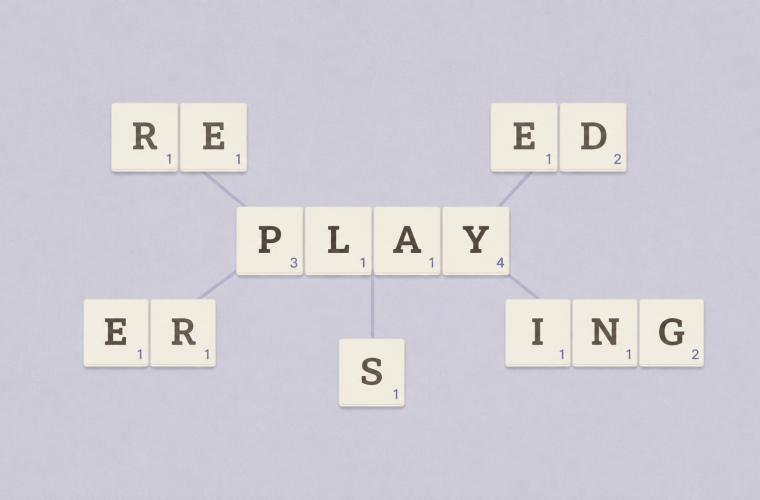
play, plays, played, playing
paint, paints, painted, painting
plant, plants, planted, planting
jump, jumps, jumped, jumping
walk, walks, walked, walking
work, works, worked, working
These forms preserve the original starting letter, which makes them especially useful in Find the Word.
The count is mechanical. It finds exact strings and does not include every grammatical family. It misses spelling changes such as:
- make → making
- try → tried
- run → running
It can also include uncommon or specialised entries. The number shows that direct families are widespread in the dictionary, not that every base accepts every ending.
My rule is to expand words I already know, not to manufacture forms speculatively.
If paint appears, I check paints, painted and painting.
If break appears, I do not try breaked. The dictionary contains break, breaks and breaking, but its past form follows a different pattern.
A family is a recall path, not a licence to attach endings blindly.
Change one part of the search at a time
When a round stalls, the weakest instruction is:
Think of another word.
It gives the mind no new handle.
I use a fixed recovery order:
- Change the second letter.
- Change the length.
- Revisit an accepted root.
- Try a subject category only when one comes immediately.
Imagine a C round.
If CA- has stopped working, move to:
CE-, CH-, CL-, CO-, CR-, CU-
If car has already appeared, change length or form:
card, cards, cared, caring
If cap appears:
cape, caper, capes
Each step keeps one useful part of the previous search and changes another. That is more efficient than abandoning the entire route and trying to imagine a random animal, object or place beginning with C.
Semantic categories still have a role. A player may quickly produce several foods or animals. I use them after structural search, because a category can become its own trap. Spending eight seconds searching only for a C-animal is expensive when cold, coat, crop or cup may already be available.
The clock should change your standards
A possible word is not worth the same amount at every point in the round.
With 40 seconds remaining, reconstructing a longer answer may be reasonable.
With five seconds remaining, “I almost have it” is usually a reason to abandon it.
The scoring system does not compensate for the extra search time. A difficult nine-letter word counts once. So does a familiar three-letter word.
During the final ten seconds, I return to:
- short anchors not yet used;
- known forms of accepted roots;
- a productive second-letter cluster I skipped.
I do not start a new technical word unless its spelling arrives completely.
This is a judgment based on the rules and the available word pools, not a result from a controlled player experiment. The site has not yet recorded enough matched rounds to claim that this timing plan improves scores by a particular percentage.
That experiment would require the same letters, comparable targets and results recorded before and after using the method.
Until then, the honest claim is that the plan reduces unproductive search. It does not guarantee a win.
Review the route, not only the score
A weak round can produce a useful note.
Suppose a player finishes a B round with:
bad, bag, ban, bar, bat, bed, bet, big, bin
The score alone says how many answers were accepted.
The list shows something else. The player moved through BA-, BE- and BI-, but never entered BO- or BU-. Common answers such as box, boy, bud, bug, bun and bus never had a chance to surface.
The useful post-round note is not:
Learn more B-words.
It is:
I stopped after BI-. Open BO- deliberately next time.
That is specific enough to change the next search.
The same review works for roots. If walk appeared but walks, walked and walking did not, the missed opportunity is visible. If none of them appeared, studying the family may not help until the base itself becomes accessible.
Recognition and production must remain separate. Reading box, boy, bud and bug after the round does not prove they will appear next time. Close the list and reproduce them before counting the gap as repaired.
What the minute can look like
A B round using this method might unfold like this:
0:00–0:08
Bank familiar anchors: bad, bag, bar, bat.
0:08–0:20
Move to BE- and BI-: bed, bee, beg, bet, bid, big, bin, bit.
0:20–0:37
Continue through BO- and BU-: bob, bog, box, boy, bud, bug, bun, bus.
0:37–0:50
Change length and revisit roots: bags, bats, beds, bigger, boxed.
0:50–1:00
Use complete familiar answers only. Leave the partly remembered word for the post-round review.
The exact words will change from player to player. The order of decisions is the part worth keeping: certainty first, structure in the middle and fewer experiments as the clock disappears.