The Prefix and Suffix Cheat Sheet: A 20-Second Word-Family Check

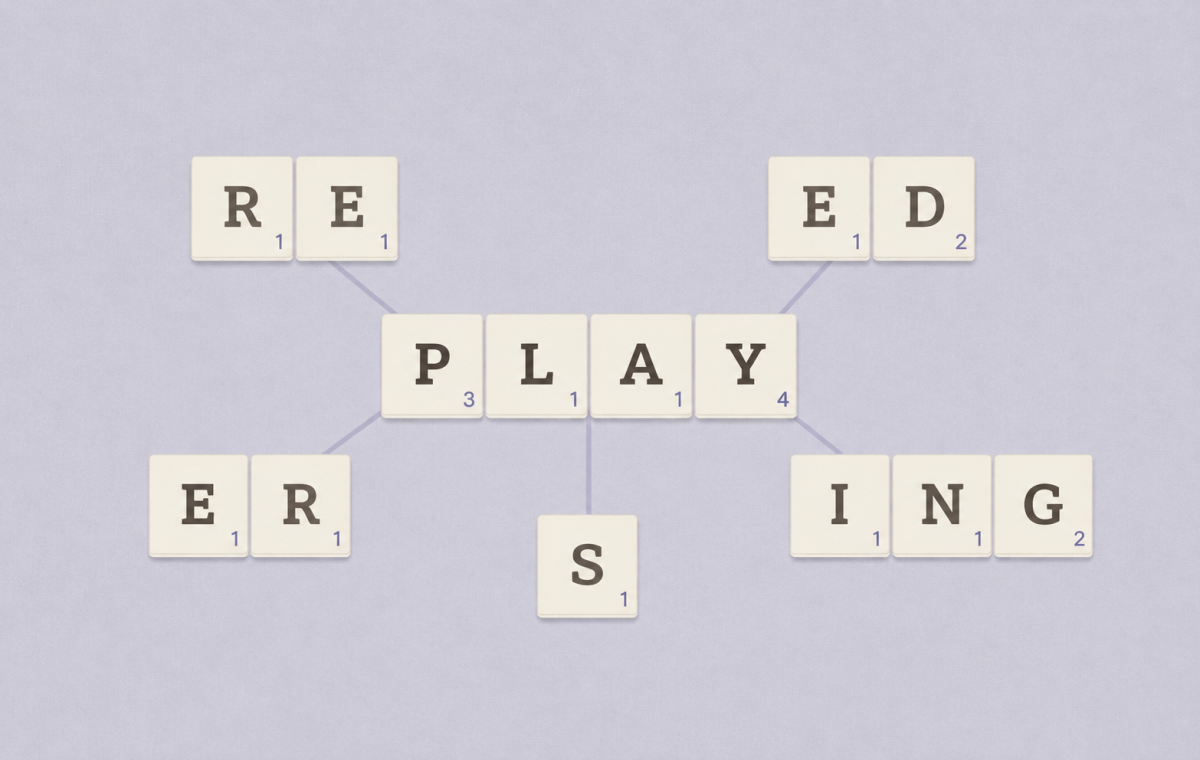
In a P round, play can lead to at least eight useful answers:
play, plays, played, playing, player, players, playful, playable
Replay is also accepted by our dictionary, but it does not belong in that round. The prefix changes the first letter from P to R.
That is the distinction most prefix-and-suffix advice misses.
Suffixes usually keep a word inside the current starting-letter round. Prefixes usually move it somewhere else.
The practical skill is not attaching every possible word part. It is knowing which family checks are worth making before leaving a root.
What the dictionary says about common endings
I searched Find the Word English Dictionary v1.0 for exact base-and-ending pairs.
For example, the -ing count includes a base only when the dictionary contains both:
paint
painting
The most productive direct additions were:
| Ending added directly | Base entries with a matching result |
|---|---|
-s |
48,233 |
-ing |
6,551 |
-es |
6,044 |
-ed |
5,980 |
-ly |
4,451 |
-er |
2,599 |
-ness |
2,261 |
-able |
635 |
-less |
630 |
-ment |
453 |
These are exact spelling matches, not a full grammatical analysis.
The -s count can include plurals, verb forms and other relationships. A match such as care plus er producing career does not prove that career means “a person who cares.”
The count is useful because it shows which checks cover the most territory. It should not be used to generate unfamiliar words blindly.
The full rules behind the dictionary are explained in How We Check Words.
The 20-second family check
After entering a familiar base word, I use four checks.
Each check should take only a few seconds. If the form does not come immediately, move on.
Check 1: S or ES
This is the highest-yield check.
Examples:
- plant → plants
- walk → walks
- teach → teaches
- box → boxes
The dictionary contains 48,233 direct base-plus-S matches and another 6,044 base-plus-ES matches.
That does not mean every noun or verb accepts both endings. It means these should be the first forms considered when the spelling is already known.
Check 2: past and ING forms
Examples:
- paint → painted, painting
- jump → jumped, jumping
- work → worked, working
- train → trained, training
There are 4,976 base entries for which the dictionary contains all four exact forms:
- the base;
- base plus
s; - base plus
ed; - base plus
ing.
That gives the player a common four-word family without changing the starting letter.
Check 3: a person or thing form
Examples:
- paint → painter, painters
- walk → walker, walkers
- jump → jumper, jumpers
- train → trainer, trainers
Among the 4,976 direct four-form families, 1,653 also contain both the direct -er and -ers forms.
That creates a six-entry pattern:
paint, paints, painted, painting, painter, painters
It is one of the most useful repeatable structures in the dictionary.
Check 4: one familiar derivative
Only after the basic forms should the player check a known adjective, noun or adverb.
Examples:
- care → careful, careless
- kind → kindly, kindness
- read → readable
- move → movement
- hope → hopeful, hopeless
- quick → quickly
Do not test every ending against every root.
-ful, -less, -ness, -able and -ment are far less productive than S, -ed and -ing. They are worthwhile when the finished word is already familiar.
Spelling changes are part of the check
A direct attachment count misses thousands of ordinary forms.
Drop final E before ING
Examples:
- hope → hoping
- make → making
- write → writing
- use → using
The dictionary contains 4,734 base entries matching this dropped-E pattern.
The E often remains before a consonant ending:
- hope → hoped
- love → loved
Change consonant plus Y to I
Examples:
- study → studies, studied
- carry → carries, carried
- happy → happier, happiest
The file contains 4,769 base entries matching the consonant-Y to -ies pattern and 424 matching -ied.
After a vowel, Y normally remains:
- play → plays, played
- enjoy → enjoys, enjoyed
Plaied is absent.
Double the final consonant
Examples:
- run → running, runner
- stop → stopped, stopping
- plan → planned, planning
The dictionary contains 1,105 bases matching the doubled-consonant -ing pattern and 1,061 matching the corresponding -ed pattern.
The spelling decision depends on more than the final letter, so this should remain a known-word check rather than a mechanical guess.
Change final IE before ING
Examples:
- die → dying
- lie → lying
- tie → tying
Twenty-eight entries in the file match this exact pattern.
These spelling changes explain why a suffix checklist cannot consist only of attaching letters to the visible end of a word.
Prefixes belong on another round card
The dictionary contains thousands of direct prefix matches:
re-: 4,225un-: 3,084over-: 1,648out-: 1,244pre-: 1,115mis-: 1,093dis-: 1,078
They are productive, but they usually change the first letter.
The PLAY family shows how the same idea separates across rounds.
P round
play, plays, played, playing, player, players, playful, playable
R round
replay, replays, replayed, replaying
M round
misplay, misplays, misplayed, misplaying
O round
overplay, overplays, overplayed, overplaying
outplay, outplays, outplayed, outplaying
U round
underplay, underplays, underplayed, underplaying
The root connection still helps memory. It simply cannot override the letter shown by the game.
A useful habit is to keep a mental “prefix parking lot.” When replay appears during a P round, do not type it. Store it as an R-word for a future round.
Where the checklist creates false confidence
A mechanical system can produce strings that look convincing but fail for different reasons.
The grammatical form is irregular
The dictionary contains:
break, breaks, breaking, breaker, breakers
It does not contain:
breaked
The correct past form is broke, which is not formed through direct attachment.
The proposed prefixed word is absent
The old version of this article recommended:
rebreak, rebreaking
Neither appears in the current dictionary.
Unbreakable is accepted, but it belongs to a U round rather than a B round.
The string match is not a real family
A direct letter test produces pairs such as:
care+er→ careerdis+play→ displayre+turn→ returnre+move→ remove
Both shorter and longer spellings exist, but the longer word is not necessarily built from the shorter word’s modern meaning.
The dictionary can confirm the strings. It cannot perform a full morphological or etymological analysis.
The form exists but is unfamiliar
A generated form may appear in the dictionary while being regional, historical or specialised.
A player should prioritise forms they can spell and understand confidently. The checklist is most valuable when it retrieves known words that had not yet surfaced.
Three-root family challenge
Use this section as a short drill.
Set a timer for 20 seconds per root. Write only words that:
- begin with the same letter as the root;
- belong to an immediately recognisable family;
- and appear in the game’s dictionary.
Do not use prefixes.
Root 1: PAINT
Your answers:
Root 2: WALK
Your answers:
Root 3: HOPE
Your answers:
Stop before reading the answer key.
Answer key
PAINT
paint, paints, painted, painting, painter, painters
Six core forms.
WALK
walk, walks, walked, walking, walker, walkers, walkable
Seven core forms.
HOPE
hope, hopes, hoped, hoping, hoper, hopers, hopeful, hopeless
Eight core forms.
These are not every dictionary entry beginning with the same letters. Compounds and longer derivatives exist beyond the exercise.
The challenge tests one narrower skill: whether a familiar root can produce several same-round answers before the player abandons it.
For another session, choose three roots that appeared in your own weak round and build the same card before checking the dictionary.