822 Words Start With Q — and Only Two Can Rescue You

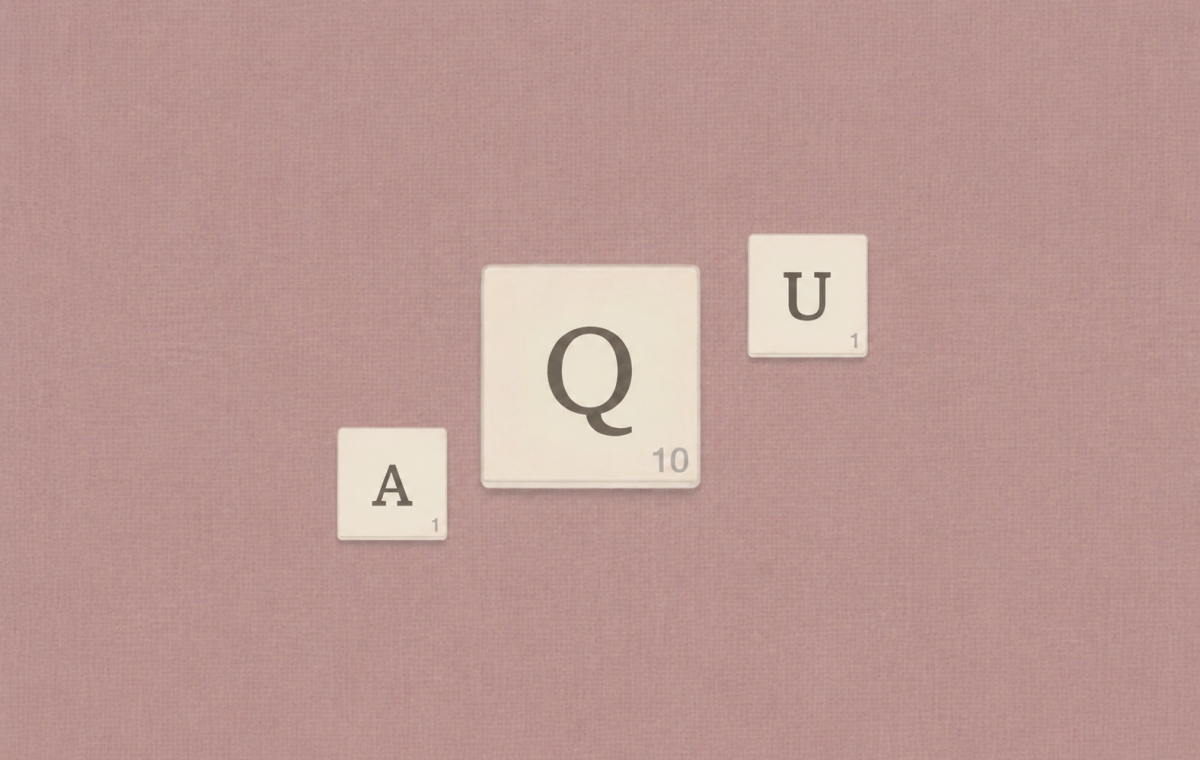
We counted 822 words beginning with Q in the dictionary used by Find the Word.
That sounds like a reasonable supply until the list is filtered by length.
Only two have three letters:
qat, qua
There are 14 four-letter Q-words and 53 five-letter Q-words. So the complete three-to-five-letter pool contains just 69 entries.
That is why I think Q’s difficulty is better understood through its short-word supply than through its total of 822. Hundreds of longer Q-words exist, but the emergency end of the dictionary is narrow.
There is another split hiding inside those 822 entries:
805 begin QU-. Only 17 do not.
That Q/U divide is the most useful way I found to organise the letter.
How I checked the Q section
I searched Find the Word English Dictionary v1.0, the site’s fixed ENABLE-based dictionary containing 172,727 lowercase entries of at least three letters.
For this article I counted:
- every entry beginning with Q;
- whether U immediately follows Q;
- the third letter of every QU-word;
- and the number of Q-words containing three, four or five letters.
Inflected forms count separately whenever the dictionary stores them separately.
The full preparation and validation method is explained in How We Check Words.
The result is reproducible:
- 822 Q-words in total;
- 805 beginning QU-;
- 17 beginning Q without U;
- 69 containing three to five letters;
- and exactly two containing three letters.
805 Q-words take the U route
Of the 822 Q-words in the dictionary, 805 begin qu.
That is 97.9%.
Those 805 entries then split into only five third-letter branches:
| Branch | Words | Examples |
|---|---|---|
| QUA- | 370 | quack, quail, quake, qualm, quart, quartz, quasar |
| QUI- | 275 | quick, quiet, quill, quilt, quirk, quiche, quiver |
| QUE- | 115 | queen, queer, quell, query, quest, queue, quench |
| QUO- | 41 | quod, quota, quote, quoth, quoin, quorum |
| QUR- | 4 | qursh, qurshes, qurush, qurushes |
The total closes exactly:
370 + 275 + 115 + 41 + 4 = 805.
QUA- and QUI- alone contain 645 entries.
That is 78.5% of every Q-word in the dictionary and 80.1% of the QU- section.
For me, those two branches are therefore the natural first places to search. That is an editorial judgment based on coverage; it does not prove that every player will recall QUA- and QUI-words faster than the others.
There are no QUU- or QUY- entries in this file.
But these five branches are not the entire Q dictionary.
Seventeen entries skip U completely.
The 17 Q-words without U
Here is the complete no-U group in this dictionary:
qaid, qaids, qanat, qanats, qat, qats, qindar, qindarka, qindars, qintar, qintars, qiviut, qiviuts, qoph, qophs, qwerty, qwertys
There are exactly 17.
The list is small enough that it is more useful to publish the complete set than a sample.
They do not form one neat linguistic family, so I do not think it helps to force them into a single origin story. What matters for this page is their behaviour inside the actual game dictionary.
Seven of the 17 contain five letters or fewer:
qaid, qaids, qanat, qat, qats, qoph, qophs
The other ten contain six letters or more:
qanats, qindar, qindarka, qindars, qintar, qintars, qiviut, qiviuts, qwerty, qwertys
So no-U Q-words are rare overall, but they are not irrelevant in the short-word pool.
Of the 69 Q-words containing three to five letters, seven—10.1%—skip U.
That is enough that I would not train myself to type U automatically after every Q.
A more accurate habit is:
expect QU, but remember that the dictionary contains 17 exceptions.
Qat and qua are the entire three-letter pool
The complete three-letter Q vocabulary in this dictionary is:
qat
qua
Nothing else qualifies.
That gives Q one of the smallest three-letter inventories of any starting letter in the file.
The two words are also structurally useful because they represent both sides of Q:
qat — Q without U
qua — QU
If I want a three-letter answer in a Q round, there is literally nowhere else to search.
That is different from a letter such as W or Z, where several additional three-letter routes remain available after the first answer.
For Q, the category closes after two words.
The short Q pool has 69 entries
Breaking the pool down by length gives:
3 letters — 2
4 letters — 14
5 letters — 53
Total:
2 + 14 + 53 = 69.
The 69 short Q-words then divide into two larger groups:
62 begin QU-
7 do not
The 62 short QU-words break down further:
QUA- — 24
QUI- — 20
QUE- — 10
QUO- — 7
QUR- — 1
Again, the arithmetic closes:
24 + 20 + 10 + 7 + 1 = 62.
Add the seven no-U entries:
62 + 7 = 69.
This is more useful to me than the headline number of 822.
When the timer is low, I am not really searching an 822-word vocabulary. I am searching a 69-word short pool whose structure is heavily concentrated inside QUA- and QUI-.
QUA- and QUI- are not interchangeable
The two biggest branches dominate the full dictionary, but they give different kinds of recall cues.
QUA- supplies familiar beginnings such as:
quack, quad, quail, quake, qualm, quart, queen-sized-looking structures like quantity and quality farther down the branch
The useful feature is that several common Q words begin with the same qua- sequence before splitting quickly.
QUI- instead gives familiar anchors such as:
quick, quiet, quill, quilt, quirk, quip, quit, quiz
For me, QUI- is especially easy to neglect after entering quick or quiet, because those obvious answers can make the route feel exhausted when it is not.
The dictionary says otherwise: there are 275 QUI- entries overall.
I would therefore treat a successful first answer as a reason to search the route again, not as a reason to leave it.
QUE- and QUO- are smaller, but easier to isolate
QUE- contains 115 entries overall.
Its familiar anchors include:
queen, queer, quell, query, quest, queue
The repeated spelling in queue makes it memorable, but being memorable does not give it extra value inside Find the Word. It is simply another accepted entry.
QUO- contains 41 words.
Familiar examples include:
quota, quote, quoth, quorum
The branch is much smaller than QUA-, QUI- or QUE-, which makes it easier to treat as a separate search rather than as an endless family.
QUR- is smaller still.
Its complete family is:
qursh, qurshes, qurush, qurushes
Only one of those four contains five letters or fewer.
That is why QUR- belongs near the edge of my search rather than at the beginning.
Some famous Q words do not help here
Q is a good example of why a site’s own dictionary rules have to be stated explicitly.
Qi is famous in other word games, but it contains only two letters.
Find the Word requires at least three.
So qi cannot be played here regardless of whether another game accepts it.
Qis might appear to solve that problem by adding an S, but that exact spelling is absent from this dictionary.
Qadi is also absent.
Qaid, however, is present.
Those distinctions are why I avoid calling a spelling universally “valid” or “invalid.” The useful statement is narrower:
accepted here or not accepted here.
A different word game can legitimately produce a different result.
The broader issue is explained in The Words You Can’t Play.
A large Q family can still be a poor emergency answer
The full dictionary includes hundreds of longer Q derivatives.
That does not make all of them equally useful in a 60-second starting-letter round.
If quick comes to mind immediately, I would enter it before trying to reconstruct a longer related form.
Likewise, quote should come before a more elaborate derivative if both are available to me.
The dictionary counts forms.
It does not measure retrieval speed.
That limitation matters particularly for Q because the difference between 822 total entries and only 69 short ones is so large.
A long family can make Q look statistically rich while contributing little to the last few seconds of a round.
Q has one decision no other letter makes this sharply
When Q appears, there is one question I can ask before searching for an actual word:
Does the next letter have to be U?
Usually, yes.
The full dictionary splits:
805 QU-words
17 no-U words
But at short lengths the split is still large enough to matter:
62 short QU-words
7 short no-U words
And at exactly three letters, the entire dictionary reduces to a perfectly balanced fork:
qat — no U
qua — with U
That gives me a specific way to diagnose a failed Q round.
If I never moved beyond QU-, I may have ignored the no-U side completely.
If I remembered qat and then spent time trying to invent another three-letter no-U Q-word, I was searching a category that does not exist.
If I remained inside QUA- because it produced the first few answers, I may have left QUI-, QUE- and QUO- unopened.
And if I searched every QU branch but never considered qaid, qanat or qoph, then I treated a strong pattern—Q followed by U—as though it were an absolute rule.
That is the useful map I take from the count:
Q → U → five branches
or:
Q → no U → 17 total exceptions
Once I know which side of that fork I have not searched, Q becomes a much smaller problem than the number 822 makes it appear.