Words That Start With V: All 21 Three-Letter Words, Lists and Spelling Rules

There are 2,729 words that start with V in the word list we use, the list behind our word game: 172,446 words from the public-domain ENABLE list, with offensive words removed (see how we check words). That puts V 20th of 26 letters, about 1.6% of the list, behind W (3,684) but well ahead of K (1,710). Only 21 of those words have three letters, and the most useful are van, vat, vet, vex, via, vie, vim and vow. The complete three-letter list with meanings comes first, then longer V words worth knowing, the spelling habits of V, and four two-minute drills.
All 21 three-letter words that start with V
This is the complete set in the list, not a selection. Ten are everyday English (van, vat, vee, veg, vet, vex, via, vie, vim, vow); the other eleven are rarer, and several are informal short forms or the names of letters. Every one has a vowel in second place, and VA alone supplies eight of them.
| Word | Meaning |
|---|---|
| vac | informal: a vacation, or a vacuum cleaner |
| van | a covered vehicle; also short for vanguard |
| var | a unit of electrical power in AC circuits |
| vas | a duct or vessel in the body (anatomy) |
| vat | a large tub or tank |
| vau | another spelling of vav |
| vav | the sixth letter of the Hebrew alphabet |
| vaw | another form of vav |
| vee | the letter V, or a V shape |
| veg | vegetables (informal); also to laze about |
| vet | an animal doctor, or a veteran (both short forms) |
| vex | to annoy or trouble |
| via | by way of |
| vie | to compete |
| vig | slang: the cut taken on bets or loans |
| vim | energy, vigour |
| vis | force, power |
| voe | a narrow sea inlet, especially in Shetland |
| vow | a solemn promise |
| vox | the voice, especially a singing voice |
| vug | a small cavity inside rock |
Four- and five-letter V words worth knowing
We chose these by hand as everyday or genuinely useful words, not by frequency, and left out anything offensive. Every one is in the list; meanings are given for the less familiar ones.
4 letters: vain, vary, vase, vast, veal, veer, veil, vein, vent, verb, very, vest, veto, vibe, vice, view, vile, vine, visa, void, volt, vote, vale (a valley, mostly in poetry), vane (as in weather vane), veld (South African grassland), vend (to sell), vial (a small bottle), vole (a small rodent)
5 letters: vague, valid, value, valve, vapor, vapour, vault, vegan, venom, venue, verge, verse, video, vinyl, viola, viper, viral, virus, visit, visor, vital, vivid, vocal, vodka, vogue, voice, vouch, vowel, vixen (a female fox), vista (a distant view), vigil (a night of keeping watch), vicar (a parish priest), verve (energy and enthusiasm), vapid (dull, bland), vaunt (to boast), venal (open to bribery)
Interesting words that start with V
For writers and anyone collecting good words, these are the longer V words we would pick out, again all in the list. Several have a formal, bookish air, which is part of their appeal.
- velleity: a wish too slight to act on
- verisimilitude: the quality of seeming true or real
- vespertine: of or active in the evening
- vexillology: the study of flags
- vicissitude: a change of fortune, often in the plural
- vicarious: experienced through someone else
- vitriol: bitterly abusive language
- vociferous: loud and forceful in giving opinions
- voracious: hungry for great quantities, of food or anything else
- vivacious: lively and full of energy
- vernacular: everyday speech, as opposed to formal language
- vermilion: a vivid orange-red
- vellum: parchment made from the skin of a calf, lamb or kid, or high-quality writing paper
- vamoose: to leave in a hurry (slang)
Why so few English words begin with V
The main reason is history. According to Etymonline’s entry for V, no native Old English word begins with V except a few, such as vat, vane and vixen, that were altered by a southwestern English habit of pronouncing initial F as V. The sound itself was not missing: Wiktionary’s entry for the letter describes English V as partly a respelling of Old English F between vowels and voiced consonants, which suggests Old English wrote that sound with F in the middle of words. With so few native V- words, the great majority of today’s V vocabulary arrived later, mostly from French and Latin, where a V at the start of a word is normally followed by a vowel. The exceptions fit the same picture: vroom imitates an engine, vrouw is borrowed from Dutch, and vying is simply vie with its ending.
To see how that plays out in ordinary vocabulary, we looked up 26 everyday V words one by one in Etymonline: vain, value, valley, van, vase, vast, veal, veil, vein, verb, very, vest, vet, vex, via, video, vie, view, vine, visa, visit, vivid, voice, void, vote and vow. Twenty-four came into English from French, Latin or both; very, for instance, is from Anglo-French verrai, “true”. The other two, van and vet, are shortenings of longer words (caravan or vanguard, veterinarian or veteran). Twenty-six words we chose ourselves are a sample, not a survey of the letter, but the pattern in it is hard to miss.
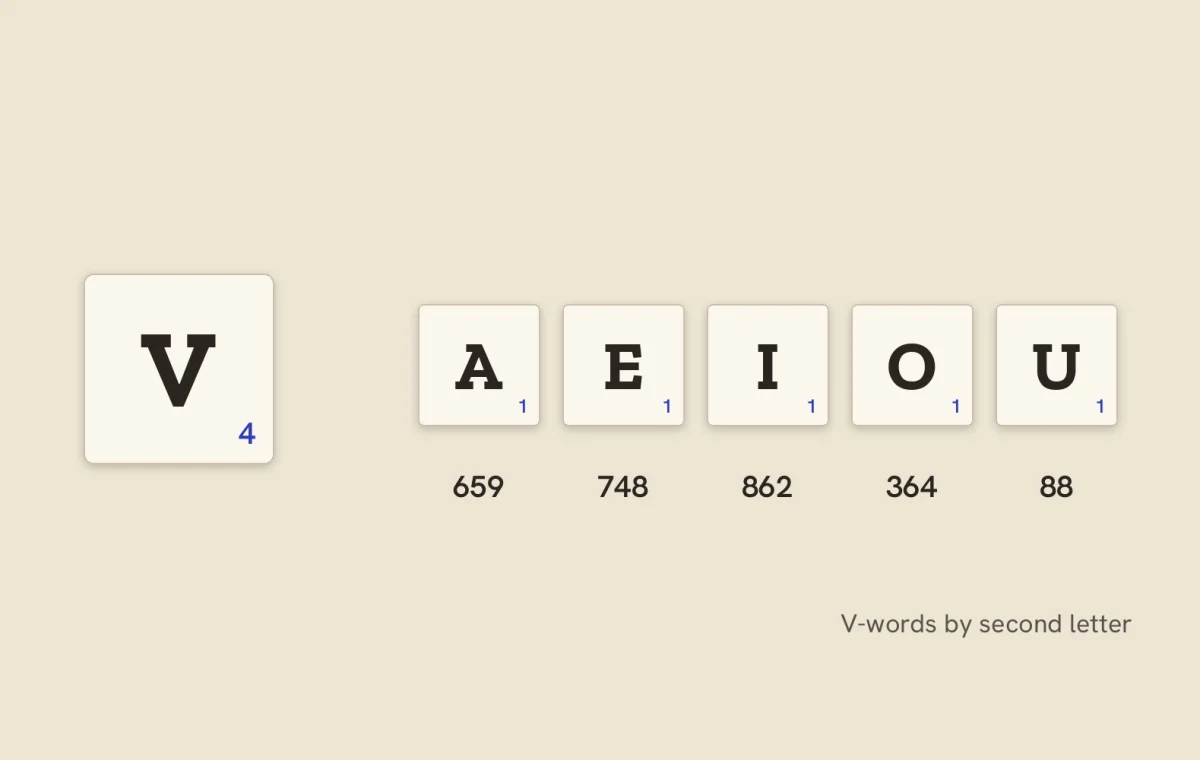
The borrowed vocabulary also helps explain why the V section of the list is so concentrated. Of the 2,729 playable words beginning with V, 2,719 have A, E, I, O or U as their second letter, which is 99.6% of the section. VI is the largest opening with 862 words, followed by VE with 748, VA with 658, VO with 364 and VU with 87. Only ten words break the pattern: vroom, vroomed, vrooming, vrooms, vrouw, vrouws, vrow, vrows, vying and vyingly.
Three spelling habits of V, checked against the list
Three spelling habits of V are easy to state as rules. Counted against 172,446 words, each holds up as a strong habit with a small, identifiable set of exceptions, which is how we think they are best taught.
1. A V at the start is followed by a vowel. True for 2,719 of 2,729 V words, as shown above. The exceptions are vroom, vrouw, vrow, vying and their forms.
2. English words do not end in V. Nearly true: 1,200 words in the list end in VE (have, give, love, five) and only 17 end in a bare V. Seven of those are shortened or respelled informal words (dev, guv, improv, lav, luv, maglev, rev), seven are variant spellings, foreign names or letter names (ganev, leitmotiv, lev, the Bulgarian currency, moshav, an Israeli farming settlement, schav, a sorrel soup, and tav and vav), two are slang (shiv, a makeshift knife, and spiv, a flashy black-market dealer), and one is a map term (isogriv). Wiktionary notes that before the 1700s printers used one letter shape at the start of a word and another elsewhere, regardless of sound, so have was printed haue; Etymonline dates the settled split between U and V in English to about 1630, Wiktionary to the 1700s. Neither source says that this is why the final E survives in have and give, so we leave the reason open.
3. V is not doubled. Also nearly true. Only 26 words in the list contain VV, and they belong to eight families: chivvy, civvy, divvy, flivver (an old, cheap car), navvy (a labourer on a canal or railway), revved and revving, savvy and skivvy. Three of them (civvy, divvy, savvy) are labelled informal in Wiktionary.
What we got wrong about V, and what the count changed
An earlier version of this page listed one V word as playable that the game in fact refuses, because it is on our offensive-word blocklist. We removed it when we rewrote the page on 13 September 2026 and recorded the error in the corrections log. Since then every word shown here is checked against the blocklist as well as the dictionary, and the page was recounted again when the blocklist was extended on 14 September.
The count also shows something easy to miss. V begins 1,019 more words than K, yet it has 95 fewer words of three to five letters (255 against 350): only 9.3% of V words are that short, compared with 20.5% for K. We have not measured why; the borrowed vocabulary is a plausible part of the answer, but we did not trace origins across the whole letter. In practice that means a short list of V words runs out quickly, and people searching for “three-letter words that start with V” are right to expect a small set; 21 is all there is in this list.
Our advice for learners of English is to master the ten everyday three-letter words and the four-letter core (very, view, vote, vast, vary), and to learn the final-V and double-V habits as “almost never”, with a short list of mostly informal or foreign exceptions, because that is exactly what the count shows. For writers, vim, vex and verve are the V words we would reach for: short, vivid and hard to replace with anything as compact.
Four timed drills for V
These drills are for teachers, word-game players and anyone who wants the words above to come to mind quickly. Each takes two minutes or less, so grab a pen, a sheet of paper and a timer. None of them needs our game: Drill 1 works on a classroom whiteboard with the class calling out words for each column, and Drill 2 is a useful warm-up before a Scrabble game, where short V words are valuable because the standard Scrabble word lists have no two-letter V words to fall back on.
V is also less scarce than its reputation suggests. It has 255 words of three to five letters, more than J’s 240 and far more than the 15 available for X. The difficulty in a V round is rarely a lack of words; it is failing to visit all five vowel openings, which is exactly what the first drill below corrects.
Drill 1: the five-column sweep
Set a two-minute timer. Write VA, VE, VI, VO and VU as headings across the top of the page, then fill the columns with V words of any length. The rule is that you may not add a fourth word to any column until every column has at least three. When the timer stops, count the columns that reached three rather than the total number of words.
The reason for the rule is that almost every V word lives behind one of those five vowels, and an easy mistake in a timed V round is to keep mining whichever column produced the first answer. Forcing yourself across the page builds the habit of switching before the well runs dry.
Show sample answers for each column
VA: vacant, vacuum, vague, vain, valid, valley, value, valve, vampire, van, vanilla, vanish, vapour, variety, various, vase, vast, vault
VE: veal, vegan, vegetable, vehicle, veil, vein, velvet, vendor, venom, vent, venture, venue, verb, verdict, verge, verse, very, vessel, vest, veto
VI: via, vial, vibe, vice, victim, victory, video, view, vigour, village, villain, vine, vinegar, vinyl, violin, viral, virus, visa, visit, vivid
VO: vocal, vodka, vogue, voice, void, volcano, volley, volt, volume, vomit, vote, vouch, vow, vowel, voyage
The VU column is the one that usually stalls, and for good reason. It holds only 87 playable words and just eight of five letters or fewer. Everyday choices are vulgar, vulnerable and vulture; the short ones include vug, a small cavity in rock, and vulgo. Two VU words is a fair result, and all of the words above were checked against the game’s list.
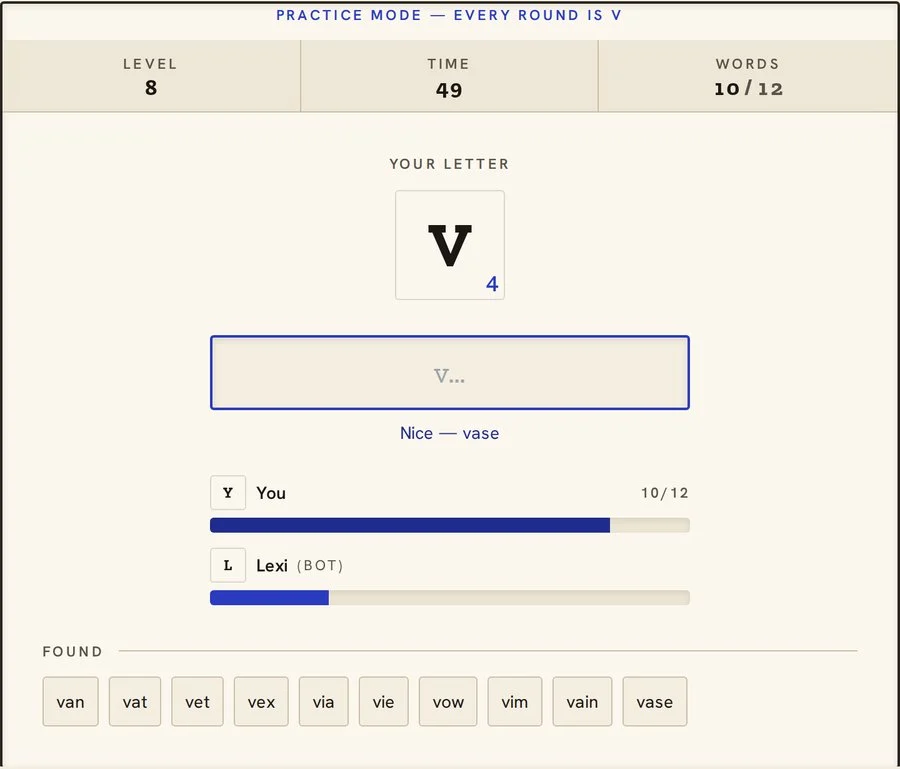
A note on when these drills pay off: the game serves V in about 1.8% of rounds, roughly one in 55, which is more often than K, J or X but far less often than S or C. The drills are short for that reason. A few sessions are enough to cover a letter you will meet occasionally, and the tested level requirements show why a quick, dependable start matters more than a long list.
Drill 2: the three-letter sprint
Set a ninety-second timer, cover the table at the top of this page, and write every three-letter word beginning with V that you can think of. Do not stop to wonder whether an unusual one counts; write it down and check afterwards. The full set is small enough to learn completely, so mark your list against the table and treat whatever you miss as your study list for the week.
Drill 3: family ladders
Set a two-minute timer and work down the five roots below. For each one, write as many longer words as you can that begin with the same spelling or grow directly from it: plurals, past tenses, -er and -able forms and so on. Give each root roughly twenty seconds and move on when the time is up, even mid-thought.
value · view · visit · voice · vote
This drill copies something that happens in real play. Once view is on the screen, typing views, viewed and viewer costs far less effort than inventing a fresh V word from nothing. The catch is that endings cannot be bolted on blindly, because the list only contains forms that were recorded individually.
Show the answer key, including the traps
| Root | Forms in the list | Tempting forms that are not |
|---|---|---|
| value | values, valued, valuing, valuer, valuers, valueless, valuable, valuably, valuation, valuations | valuings |
| view | views, viewed, viewing, viewings, viewer, viewers, viewable, viewless, viewpoint, viewpoints, viewy | none of the obvious ones |
| visit | visits, visited, visiting, visitor, visitors, visitant, visitants, visitation, visitations, visitable | visitings |
| voice | voices, voiced, voicing, voiceless, voicer, voicers, voiceful, voiceprint | voicings |
| vote | votes, voted, voting, voter, voters, voteable, votable, voteless | votings |
Notice the inconsistency: viewings is accepted but votings, voicings and visitings are not. That is why a family is best treated as a list of things to try rather than a rule that always works. The prefix and suffix worksheet practises the same check across many more roots.
Drill 4: playable or not?
Give yourself one minute. Copy the twelve spellings below and mark each one with a tick if you think Find the Word accepts it or a cross if you think it will be refused. Go with your first instinct, since that is the judgement you make during a round.
vape · vlog · vroom · vying · vug · voicemail · videogame · vext · vapour · vapor · vaping · viewy
Show the verdicts
| Spelling | Verdict | Note |
|---|---|---|
| vape | Not valid | Also absent: vapes, vaping |
| vlog | Not valid | Also absent: vlogs, vlogger |
| vroom | Valid | One of only ten V words without a vowel second |
| vying | Valid | The present participle of vie |
| vug | Valid | The only three-letter VU word |
| voicemail | Not valid | Voice and mail both are |
| videogame | Not valid | Video and videos are accepted |
| vext | Valid | An older past tense of vex |
| vapour | Valid | British spelling |
| vapor | Valid | American spelling |
| vaping | Not valid | No form of vape is listed |
| viewy | Valid | Also viewier, viewiest |
If you ticked vape and vlog, you were right about English and wrong about this particular list. The reasons a fixed word list refuses familiar modern words are explained in the words you can’t play, and the case of British and American pairs such as vapour and vapor is covered in color or colour.
Build your own V drill
Use the explorer to pick an opening such as VI or VO, read its short words once, then close it and run Drill 1 again on that opening alone.
Letter explorer
Shows every two-letter opening for the letter, how many accepted words start with it, and the short words behind each one.
Where to go next
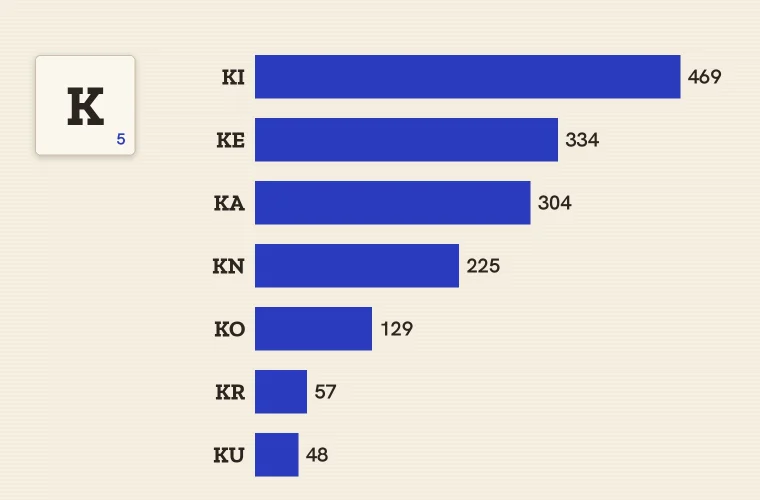
If you want to see how V’s tidy structure compares with its neighbours, the map of K words shows a letter that spreads across thirteen opening pairs, and the W myths page tests some common assumptions about WH and WR. For the letters that really are short of words, start with the guide to Q, X, Z and J.
To make these drills stick, repeat them over several days rather than all at once; the word recall training routine explains how to space the practice. When you feel ready, try a V practice round in Find the Word and see whether you sweep all five columns before the timer runs out.
Updated 14 September 2026: added the complete three-letter list with meanings, longer V words, the history and spelling habits of V, and our own reading of the counts; the drills are unchanged apart from Drill 2, which now uses the table above as its answer key. On 13 September 2026 the page was rewritten, every count and word verdict was rechecked against the game’s word list and blocklist, and a word the game blocks, which the earlier version listed as playable, was removed. Details are in the corrections log.
New to The Verbarium? Follow the reading path, with tools and printables