A Napron, an Apron: The Words That Lost or Gained an N

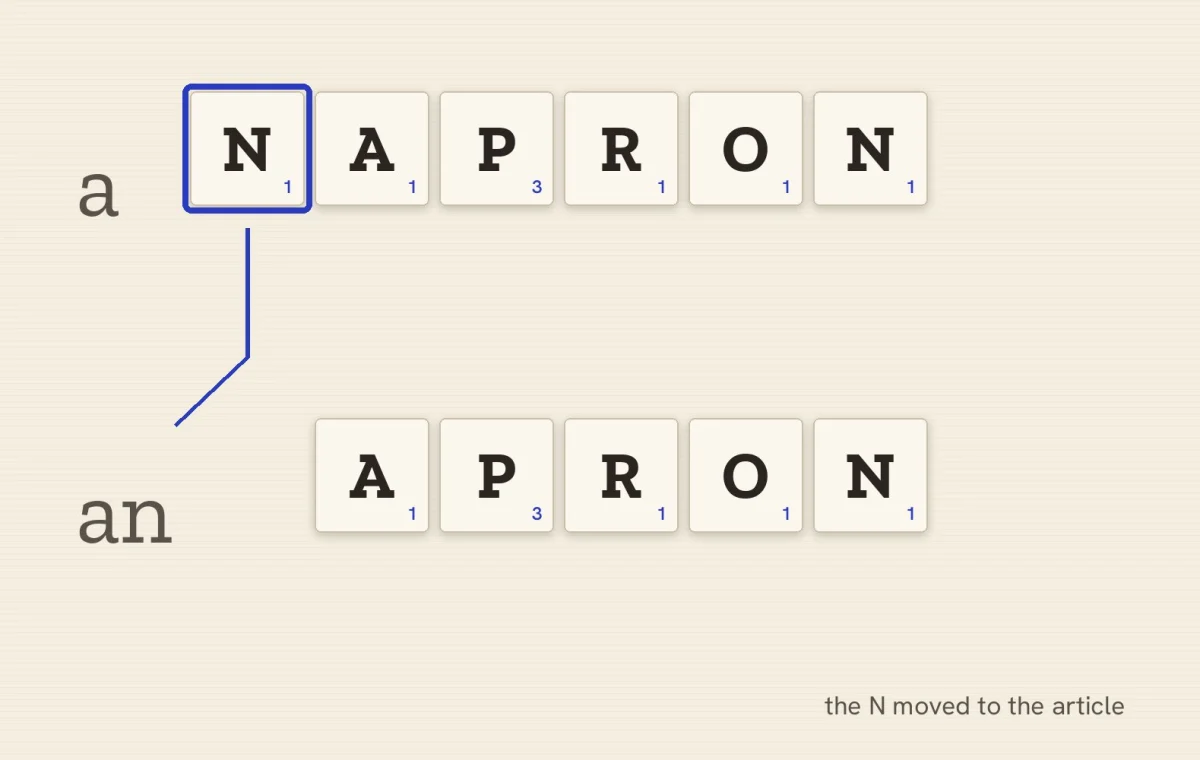
Say “a napron” aloud a few times at normal speed and then say “an apron”. In running speech the two are almost impossible to tell apart, because the sound stream is the same and only the place where the listener puts the word break is different. Over a few generations of Middle English speakers, enough people heard the second version that it became the word. The garment kept its shape, but the noun lost its first letter to the article in front of it.
Linguists call this rebracketing, or false splitting, and it is one of the few processes in the history of English that you can watch happening in a single sound. This article explains how it works, why the letter involved is usually N, which words it demonstrably changed, and how to tell a real case from a coincidence. Every case in the table below is documented in standard etymological references, and each row links to its entry so you can read the evidence yourself. The word counts near the end refer to the Find the Word word list, not to English as a whole.
How a letter moves from one word to the next
The mechanism depends on a quirk of the indefinite article. In Old English, an was the word for “one”. As it weakened into an article, the final N dropped away before consonants (a loss mostly complete by the mid-1300s, according to the Online Etymology Dictionary) and survived before vowels, which is why we still say “a pear” but “an apple”. The possessives my and mine followed the same pattern for a long time: Middle English speakers said “my father” but “mine uncle”, and that pattern is still preserved in older texts such as the King James Bible (“mine eyes”).
This created an unstable spot. Whenever a noun began with N, the phrase “a n-” sounded exactly like “an” plus a vowel-initial word. Whenever a noun began with a vowel, “an” plus that noun could be heard as “a” plus an N-word. Most people learned words by hearing them, not by reading them, and spelling was not fixed; Etymonline also notes that late Middle English scribes often wrote a and an joined to the following noun, which left the division unclear even on the page. A child who only ever heard “a nadder” or “an adder” in fluent speech had no way to know where the boundary had been for their grandparents.
The direction of the change was not fixed either. Some nouns lost their N to the article (napron became apron), and others borrowed the article’s N and kept it (ewt became newt). The same logic works with mine: “mine uncle” could be reheard as “my nuncle”, a form that turns up in Shakespeare. Once a new form was written down and copied, it tended to stick, and the older division faded from use.
How we know it really happened
Etymologists do not rely on a neat story here. The evidence comes from three kinds of record. First, older written forms survive: manuscripts show napron, nadder and noumpere before the newer spellings take over. Second, the source words in other languages keep the original letter: apron comes from Old French naperon, a small cloth, related to the nappe that gave English napkin and napery. Third, related languages sometimes preserve the old shape, as German Natter (a snake) does for adder.
When all three kinds of evidence line up, the case is secure. Several popular examples do not pass that test, and they are left out of the table. Notch, for instance, is sometimes said to come from “an otch”, but the Online Etymology Dictionary gives that only as “probably” the explanation, so it is not treated as established here.
The documented cases
The table gives the older form, the modern form, which way the N moved, and an approximate period. “Middle English” covers roughly the twelfth to the fifteenth centuries; where the records do not support anything more precise, no narrower date is given. The last column links to the Etymonline entry for each word.
| Older form | Modern form | What happened | Approximate period | Source |
|---|---|---|---|---|
| a napron | an apron | N lost to the article; from Old French naperon, a small cloth | Middle English | Etymonline: apron |
| a nadder | an adder | N lost; Old English næddre meant any snake | Middle English to 16th century | Etymonline: adder |
| a noumpere | an umpire | N lost; from Old French nonper, “not equal”, a third party between two | Middle English | Etymonline: umpire |
| a nauger | an auger | N lost; Old English nafogar, a tool for boring a wheel’s nave | Late Middle English (c. 1500) | Etymonline: auger |
| a nyas | an eyas | N lost; nyas is from Old French niais, a bird taken from the nest | Not dated in the source | Wiktionary: eyas |
| numbles | umbles | N lost; the edible innards of a deer | Middle English | Etymonline: humble pie |
| an ewt | a newt | N gained; ewt is a variant of eft | Middle English | Etymonline: newt |
| an ekename | a nickname | N gained; eke meant “an increase”, so an additional name | Middle English | Etymonline: nickname |
| for then anes | for the nonce | N gained from the ending of an old form of the definite article; anes meant “once” | Middle English | Etymonline: nonce |
| mine uncle | my nuncle | N gained from mine; now archaic | Early Modern English | Wiktionary: nuncle |
What the cases have in common
Every word in the table was an everyday noun that people said far more often than they wrote, usually after “a”, “an”, “my” or “mine”. Tools, animals, garments and kitchen words dominate, which fits the idea that these changes spread through speech in households and workshops rather than through books. Words that lived mainly in writing, where the space between words is visible, were probably less exposed.
The results can hide family resemblances that are obvious once you see them. Apron and napkin share an ancestor, but only one of them kept the N. Newt and eft are the same word, split into two dictionary entries by an article. Umbles went on to a second life when umble pie (recorded from the 1640s) became associated with humble, giving us “to eat humble pie”, attested from 1830. For more histories where a word’s look hides its past, see where our strangest words come from.
Orange is a related case that happened before the word reached English. The fruit’s name travelled west from Persian and Arabic forms beginning with N, and Spanish naranja still has it. The N was probably lost in Italian and French through the same confusion with an article (the Online Etymology Dictionary also mentions possible influence from French or, “gold”), so that by the time English borrowed the word from French it had already gone. Because that loss did not happen in English, it sits outside the table.
Does rebracketing explain other words?
Sometimes, and the Online Etymology Dictionary records far more examples than the famous few. Its entry for the letter N quotes Middle English manuscripts with a nox for “an ox”, a negge for “an egg” and a narawe for “an arrow”, none of which lasted, and records nidget, a 16th-century word that grew out of an idiot heard as a nidiot. The same misdivision gave nother from another, and a different boundary produced tother from that other. Other letters can travel too: tawdry comes from St. Audrey’s lace, sold at a fair in Ely, with the T of Saint stuck to the front. Borrowing can do the same with a foreign article, so alligator is Spanish el lagarto, “the lizard”, and lariat is la reata, “the rope”.
We would still use the idea carefully. When we checked the word list behind our game, Find the Word, for pairs where an N in front of a vowel-initial word makes another accepted word (ape and nape, eat and neat, ear and near), we found 124 of them. Only a handful touch a documented case: umbles and numbles, uncle and nuncle, once and nonce, other and nother. The rest are not rebracketing: most are coincidences of spelling, and a few, such as aught and naught, are related in other ways (naught is Old English for “no thing”). Arrow and narrow make the point best: Middle English scribes really did write a narawe for “an arrow”, yet narrow is a separate Old English word, nearu, with no connection to it. A tidy pair of spellings proves nothing on its own.
Where we land
For anyone writing today, nothing in this history needs acting on. Apron, adder, umpire and newt are the standard forms, and the older spellings are records, not alternatives. The practical value is in reading etymologies. Our rule of thumb is to accept a “lost N” or “gained N” story only when the three kinds of evidence described above line up: older written forms, a source word that keeps the original letter, and ideally a related language that agrees. By that test the cases in the table pass (for eyas and nuncle on Wiktionary’s evidence alone), notch is a strong “probably”, and a neat coincidence such as narrow fails.
The word list keeps a small record of the split. The modern forms in the table are all accepted, while napron, nadder, noumpere, ewt and ekename are not in it, and the deer-offal word is accepted as umbles, numbles and nombles, so on that one word both sides of the boundary survive. How we check words explains the list, and the long view of how English spelling came apart is in why English spelling is so weird. If you want to try the modern forms against the clock, Find the Word accepts every one of them.
Sources
- Online Etymology Dictionary entries for apron, adder, umpire, auger, humble pie (for umbles), newt, nickname, nonce, notch, orange, nother, tother, tawdry, alligator, lariat, narrow, naught and the letter N.
- Wiktionary entries for eyas, nyas and nuncle; these are the only sources used for those three words.
- Word validity checked against the Find the Word playable word list, as described in how we check words.
New to The Verbarium? Follow the reading path, with tools and printables