How to Teach Silent Letters: A Lesson Plan Built From the Counts

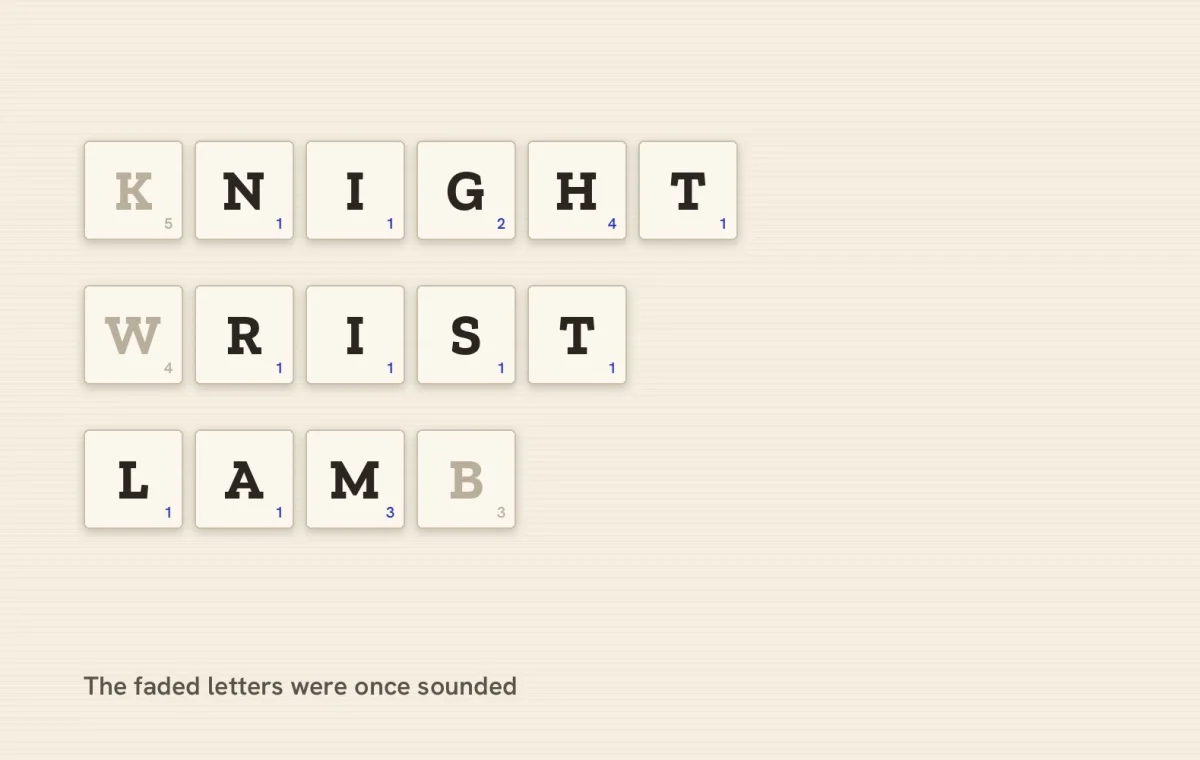
Silent letters are easiest to teach one family at a time, in this order: KN- (knee, knife, know), WR- (write, wrong, wrist), -MB (lamb, thumb, climb), then -GN (sign, design), with GN- and -MN as ten-minute footnotes and PS-/PN- left for older learners. What follows is a lesson plan for that sequence: aims, materials, five steps with estimated timings, a sorting activity, a dictation and a review a week later, plus a two-page printable. The order comes from counting each family in a 172,446-word list. The lesson itself has not been trialled in a classroom, so the timings are estimates.
Lesson at a glance
- Aims
- Learners recognise a silent-letter word by its family rather than by memorising it alone; can spell twelve everyday words from four families in dictation; can explain in one sentence why the letter is there.
- Age and group
- Written for seven- to nine-year-olds in a class or one-to-one. Adaptations for older learners and for learners of English as an additional language are given near the end.
- Time
- About 40 minutes for one family, or 45 to 50 minutes for KN- and WR- together, plus five minutes a week later. These are estimates, not measured timings.
- Materials
- The two-page printable (36 word cards, a sorting sheet, a dictation list with answer key and a review grid), scissors, and a board or sheet on which the silent letter can be shown in a second colour.
- Order of families
- KN-, WR-, -MB, -GN; then GN- and -MN as short add-ons; PS- and PN- for older learners only. The section after next says how that order was chosen.
- What has and has not been tested
- The word counts, the pronunciation claims and every word on the printable were checked with scripts and dictionary pages. The lesson sequence has not been run with children.
The seven families, counted
“Silent letters” as a topic is enormous, so a lesson has to pick, and the picking is easier with numbers. A script counted every word matching each spelling pattern in a 172,446-word list built from the public-domain ENABLE word list with offensive words removed (how we check words describes it). The list has no capitalised words and nothing under three letters, and it includes rare and archaic words alongside everyday ones, so the totals are far larger than a child’s vocabulary. The column for words of three to five letters is the better guide to what a young learner will meet.
Initial H after W (what, when) was left out because the H is not silent in every accent, and silent E was left out because it is a rule about vowels rather than a family of words; there is a note on it after the family descriptions.
| Family | Silent letter | Words in the list | Of 3 to 5 letters | Including forms with endings | Everyday examples |
|---|---|---|---|---|---|
| KN- | K | 225 | 35 | 225 | knee, knife, know |
| WR- | W | 199 | 27 | 199 | write, wrong, wrist |
| GN- | G | 66 | 13 | 66 | gnat, gnaw, gnome |
| -GN | G | 41 | 7 | 185 | sign, design, foreign |
| -MB | B | 48 | 20 | 181 | lamb, thumb, climb |
| -MN | N | 12 | 3 | 51 | autumn, column, hymn |
| PS- and PN- | P | 327 and 30 | 10 and 0 | 357 | psalm, psychology, pneumonia |
Each family below gets its count, a hand-picked set of the words a child is likely to meet (rare words left out), the exceptions where the letter is sounded, and a short history. The history is part of the teaching: “the K used to be said out loud” turns an arbitrary spelling into a story, and stories are easier to keep than rules.
KN- (225 words, 35 short ones)
knee kneel knew knife knight knit knob knock knot know known knowledge knuckle knapsack knead
The K was pronounced in Old English and Middle English. Etymonline’s entry on kn- says the sound “was reduced to n- in standard pronunciation by 1750, after about a century of weakening and fading”, and that it survives in most of the related languages. Know was Old English cnawan (Etymonline: know), so the spelling records a sound that English speakers gave up only around the time of the first dictionaries. Exceptions are loanwords and rare: in knish and knesset, from Yiddish and Hebrew, Wiktionary gives pronunciations with the K sounded (Wiktionary: knish). No everyday English KN- word sounds its K.
WR- (199 words, 27 short ones)
wrap wreck wren wrestle wriggle wring wrinkle wrist write wrong wrote written wreath wrench
Etymonline describes wr- as a common Germanic opening “especially to start words implying twisting or distortion”, which is worth pointing out to a class: wring, wrist, wriggle, wrench, wrap and wrinkle all involve a twist. The W “ceased to be pronounced c. 1450-1700 except in dialects”, and Dutch and Flemish still keep it. We found no WR- word in which the W is sounded.
GN- (66 words, 13 short ones)
gnat gnaw gnome gnash gnarl gnarled gnu
The smallest opening family, with about seven everyday words, so it fits into a few minutes at the end of the KN- lesson. Etymonline’s gn- entry says “the -g- formerly was pronounced” and separates two sources: Old English words such as gnat and gnaw, and Greek and Latin words such as gnomon and gnostic. Gnu, from a southern African language, has both “new” and “g-noo” pronunciations in Wiktionary (Wiktionary: gnu). Leave gnocchi out of a young class: its G belongs to an Italian “ny” sound rather than being silent, and English speakers say it several ways.
-GN at the end (41 words, 185 with endings)
sign design resign assign align reign foreign campaign benign feign ensign sovereign consign
These are mostly French and Latin words: sign came through Old French signe from Latin signum (Etymonline: sign), and the G was kept in writing because the Latin had it. What makes this family different is that the G comes back. It stays silent when -s, -ed, -ing, -er or -ment is added (signed, designer, assignment, foreigner: Wiktionary gives no G sound in any of them), but it is sounded in signal, signature, designate, resignation and malignant, where a vowel follows it inside the word (Wiktionary: signal). Older learners can use that as a memory aid: unsure whether design has a G, say designate.
-MB at the end (48 words, 181 with endings)
lamb thumb climb comb crumb dumb numb limb bomb tomb womb plumb jamb
Twenty of these 48 words have five letters or fewer, and nearly all of those are words a six-year-old knows, which is why the family sits third in the plan. Etymonline says of lamb that “the -b probably has been silent since 13c.”, and of climb that “other Germanic languages long ago dropped the -b”, so this silent letter is older than the KN- and WR- ones by several centuries. The B stays silent when an ending is added: climbing, climber, lambs, thumbs, combed and plumber all lose it in Wiktionary’s pronunciations (Wiktionary: plumber).
The exceptions are the near-misses that the sorting activity is built around. In number, timber, amber, chamber, member, remember and cucumber the B is sounded, because the M and the B belong to different syllables and the words were never -MB words with an ending added (Wiktionary: number gives the B throughout, and the same page notes that number meaning “more numb” is said without it). The same goes for bombard and crumble, where a vowel or an L follows. The list has 1,988 words with MB somewhere other than the end, against 48 with it at the end, so “silent B” is a rule about MB at the end of a word or right before an ending, not about the letters MB. Among the 48, the only wobble we found is rhomb, a geometry term for which Wiktionary lists pronunciations with and without the B (Wiktionary: rhomb); the everyday words have no such exceptions.
-MN at the end (12 words, 51 with endings)
autumn column hymn solemn condemn damn
Six words cover this family for most purposes. All are Latin or Greek by way of French: autumn is from Old French autumpne and Latin autumnus (Etymonline: autumn), and for hymn Etymonline says “evidence for the silent -n- dates from at least 1530” (Etymonline: hymn). As with -GN, the letter returns before certain endings: autumnal, hymnal, solemnity, condemnation and damnation all sound the N (Wiktionary: autumnal), while columns, condemned and damned keep it silent. Columnist goes both ways in Wiktionary, which is a fair thing to tell a class that asks.
PS- and PN- (327 and 30 words)
psalm psychology psychologist psychic psychiatrist pseudonym pneumonia pneumatic
These are Greek clusters and belong with older learners. PS- looks like the biggest family in the table, but 300 of its 327 words are longer than five letters and most are built on psych- (psychology goes back to Greek psykhē, “breath, spirit, soul”: Etymonline: psychology). Etymonline’s note on pn- makes the point that helps learners of other languages: “the p- typically is silent in English but pronounced in French, German, Spanish, etc.” Two PS- words, pshaw and psst, are interjections in which the P is often said, so leave them off the family list. The related PT- opening (ptarmigan, pterodactyl, 43 words) behaves the same way and is covered in the essay on why English spelling is so weird.
A note on silent E. Silent E (hope, bite, cube) is by far the commonest silent letter, but it is a different kind of thing: a signal that changes the vowel before it, governed by a rule rather than belonging to a family. It is better taught with the vowel rules, and it has its own row in our ranking of spelling rules by how reliably they hold.
Step 1: hear it (about 5 minutes)
Say pairs aloud without showing them: not and knot, night and knight, ring and wring, right and write. Ask whether the two words sound different. They do not, and that is the whole point of the lesson: the ear cannot tell you which spelling to use, so the spelling has to be learned as a family. Then tell the one-sentence history for the family you are teaching (for KN-: “people said the K until about three hundred years ago”).
The script found plenty of these sound-alike pairs to draw on. Thirty-six of the 225 KN- words have a twin in the list once the K is dropped, including knot/not, knight/night, knew/new, knit/nit and knock/nock; the pair know/no works the same way, though no is too short for the list. WR- has the most of all, 47 of its 199 words, including write/rite, wring/ring, wrap/rap, wrest/rest, wrung/rung and wright/right. The end-of-word families have fewer (lamb/lam, plumb/plum, reign/rein, sign/sin, damn/dam), so for -MB and -GN use the near-miss words from the sorting cards instead.
Step 2: see the family (about 10 minutes)
Show eight to twelve words from one family on the board, silent letter in a second colour, and read them together. Ask what they have in common before you say it. For KN- and WR-, point out that the silent letter is always first and always followed by the same letter, so the family can be recognised on sight; for -MB and -GN, that it is always last. Use the word rows above as the source, and keep to the everyday words: a child who meets knout or corymb in the first lesson learns that the family is full of words nobody uses.
This is also the place for the history, told as a fact with a date rather than as a mystery. For KN- and WR- the letter was said in Old English and dropped out of speech between the 1400s and the 1700s; for lamb the B was probably silent by the 1200s; for -GN and -MN the letter was kept because the Latin or French word had it, and it can still be heard in signal and autumnal. “Knee was once said k-nee” is the sentence to send home, because it gives the child a reason for the letter rather than an instruction to remember it.
Step 3: sort it (about 10 minutes)
Hand out the word cards from the printable, shuffled. There are 36: eight each for KN-, WR- and -MB, six for -GN, and six words with no silent letter. Pairs sort them onto the sorting sheet by family and set the six impostors aside. Sorting forces a decision about every card, and the pile of mistakes at the end tells you which family is not yet secure.
The no-silent-letter cards are what make the activity teach something, and they were chosen from the near-misses found in the count. Number and timber look like -MB words and are not; signal contains sign and yet sounds its G; magnet has GN in the middle with both letters said, as do the 1,058 words in the list with GN somewhere other than the start or the end; nest and ring are there for the child who has just learned KN- and WR- and is tempted to see them everywhere. A quicker version for one child at home needs no scissors: write the 36 words on a page and ask the child to circle the silent letter in each or write “none”.
Step 4: spell it (about 10 minutes)
Read each sentence twice, then the target word once more on its own, and give time to write. The twelve words cover the four families on the cards plus one -MN word and one GN- word; three stretch words for confident spellers (knuckle, wrinkle, column) are on the printable.
| # | Sentence | Word | Family |
|---|---|---|---|
| 1 | She scraped her knee on the step. | knee | KN- |
| 2 | Use a knife to cut the bread. | knife | KN- |
| 3 | Do you know the answer? | know | KN- |
| 4 | He wore a watch on his wrist. | wrist | WR- |
| 5 | Please write your name at the top. | write | WR- |
| 6 | That answer is wrong. | wrong | WR- |
| 7 | The lamb stayed close to its mother. | lamb | -MB |
| 8 | He hurt his thumb with the hammer. | thumb | -MB |
| 9 | We will climb the hill after lunch. | climb | -MB |
| 10 | Stop when you reach the sign. | sign | -GN |
| 11 | The leaves turn red in autumn. | autumn | -MN |
| 12 | The dog likes to gnaw on a bone. | gnaw | GN- |
Mark each word right or wrong, then note which kind of error it is, because the two common kinds need different follow-up.
- Missing the letter: nife, rist, lam, sine
- The child is spelling by ear, which is the sensible default, and has not yet filed the word under its family. Go back to the cards for that family. Expect this error most in the first dictation.
- Adding a letter where none belongs: knest, wring for ring, thumbe, climbe
- Over-generalising: the family has been learned and is now being applied to every word that starts with N or R. It is a sign of progress. The fix is the no-silent-letter cards, sorted again against the family cards, and the sound-alike pairs, because wring is a real word and the child has to choose between two spellings rather than remember one.
- Right silent letter, wrong vowel: clime, autum
- Mark the silent letter as correct. The remaining error belongs to a different lesson (long vowels, unstressed endings), and scoring it as a silent-letter failure is discouraging and misleading.
- Sounding the letter when reading: “k-nife”, “g-nat”
- Common in learners whose first language sounds these clusters, and in young readers who have just been told the letter is there. Read the family aloud together so the child hears the standard pronunciation, then move on; it fades.
Step 5: review it a week later (about 5 minutes)
Dictate the same twelve words in a new order plus knot, wreck and comb, which were on the cards but not in the first dictation, using your own short sentences. A word spelled correctly both times can be left alone. A word missed both times goes back to step 2 with its family, because the problem is usually that the child has not connected the word to the family rather than that the word is hard. The printable’s second page lays the fifteen review words out as a grid to tick off.
If the class enjoyed the sound-alike pairs, they make a good two-minute closer: read wrest/rest, knap/nap or wrung/rung aloud and ask which spelling belongs to which meaning.
Adapting the plan for older learners and learners of English
For learners from about eleven up, the interesting part is the history and the “letter comes back” families. Give them the counts in the table, the Etymonline dates, and the -GN and -MN pairs (sign/signal, autumn/autumnal, condemn/condemnation), and ask them to find more with a dictionary. The PS- and PN- families belong in this version, along with the medical and scientific words that make them worth knowing (psychology, pneumonia, pseudonym). Replace the sorting activity with a hunt: given a page of text, find every silent-letter word and name its family.
For learners of English as an additional language, the history is a practical tool rather than a story. Etymonline’s entries say that the KN- sound persists in most of the related languages, that Dutch and Flemish keep the W of WR-, and that the P of PN- and PT- is pronounced in French, German and Spanish. A German speaker who knows Knie and Knoten, or a French speaker who knows pneu and psychologie, is already halfway to the English spelling; what they need is the reminder that in English the letter is written and not said. Extend step 1 for these learners, model the standard pronunciation several times, and expect the sounding-the-letter error from the marking notes.
Before you take this into a classroom
The plan has not been tested with children, and a lesson that works on paper can fail in a room for reasons a count will never show. The families were chosen by spelling pattern, so the -MB total includes words like coulomb and corymb that nobody needs, and the everyday selections are our judgement rather than a measured vocabulary. The pronunciation claims rest on Wiktionary’s entries, which record several accents and sometimes disagree with one another (columnist, gnu, rhomb), so a child who says a word differently at home may be right for their accent. The list behind the counts is a word-game list with both British and American spellings, no proper nouns and many rare words, which is why the short-word column is the one to trust for classroom purposes.
Two families were left out on purpose. Silent H (hour, honest, ghost, rhyme) does not follow a single pattern, and silent L (walk, half, could) depends on the vowel before it in ways that vary by accent. Both are better handled as short word lists than as families. For more words in the two biggest families here, see words that start with K and words that start with W.
Why KN- first: what the count changed
We would teach KN- first, WR- second and -MB third, and we would not have chosen that order before counting. KN- has the most short words (35 of three to five letters), the clearest shape (K, then N, always at the front), a good stock of sound-alike pairs and a history with a date in it. WR- is nearly as large and has the best pairs of all, 47 of them, plus the “twisting” meaning that ties half its everyday words together. -MB was the surprise: on raw count it looks like a minor family, but 20 of its 48 words are short and nearly all of those are early-vocabulary words, and once endings are counted it is as large as -GN. The end-of-word families also carry the one idea older learners find satisfying, that the silent letter comes back in signal and autumnal, which the opening families cannot offer.
What the count changed most was our view of PS-. It heads the table by a wide margin and it would be tempting to give it a lesson of its own, but with ten short words, most of them obscure, it is a family for secondary school and for learners of other languages, not for the first pass. GN- and -MN, by contrast, are so small that each fits into ten minutes at the end of another family’s lesson. With one session rather than a sequence, spend it on KN- and WR- together, since they share the same story and the same shape, and leave -MB for the review week.
Materials: the printable and the counting script
Printable (PDF, two pages, A4): Silent letters: word cards, sorting sheet, dictation list and answer key. Page 1 has the 36 cards and the sorting sheet; page 2 has the dictation sentences, the marking notes and the review grid. Free to print and copy for teaching.
To repeat the counts on a word list of your own, save it as one word per line in a file called words.txt and run this in Python 3. On our list it prints 225, 199 and 66 for the openings and 48, 41 and 12 for the endings.
words = open("words.txt").read().split()
for family in ("kn", "wr", "gn"):
    hits = [w for w in words if w.startswith(family)]
    short = [w for w in hits if len(w) <= 5]
    print(family.upper() + "-", len(hits), "words;", len(short), "of 3-5 letters")
for ending in ("mb", "gn", "mn"):
    hits = [w for w in words if w.endswith(ending)]
    print("-" + ending.upper(), len(hits), "words")
For a class that has finished the sequence, the same families make a good round of the no-preparation classroom word games: call out a family and see who can list the most words in a minute. Anyone who wants to test their own recall of KN- and WR- words against a clock can try the word game on this site, which uses the same list as these counts.
New to The Verbarium? Follow the reading path, with tools and printables