How to Find the Words Hidden in a Set of Letters

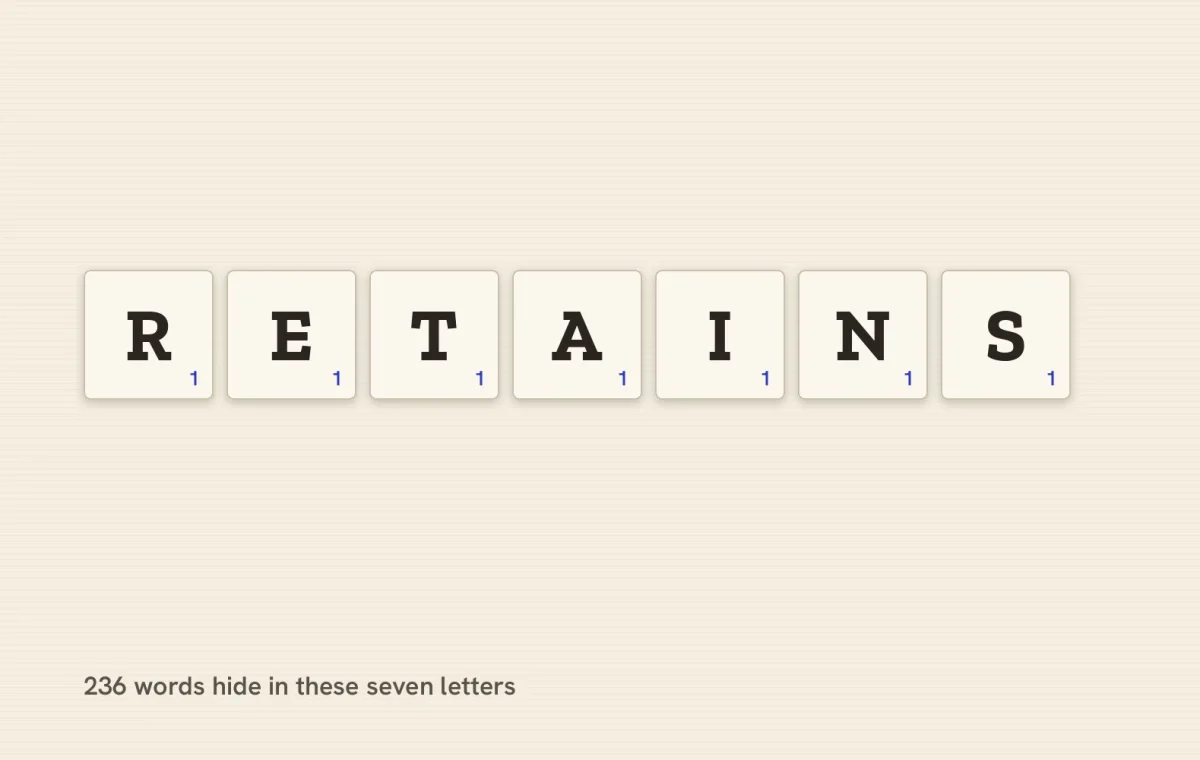
Take the seven letters R, E, T, A, I, N, S. Sorted, they read A E I N R S T. Set the S aside and the six that remain spell retain and retina; put the S back and you have two seven-letter words. Move one letter at a time and retinas turns into nastier and stainer. That is the method: sort, strip the common endings, pair vowels with consonants, swap letters in a near-miss, and check a candidate by sorting it too. Below, the rack is solved, then five more, and a twelve-line script handles any letters.
A E I N R S T, solved from a standing start
Sort first. Writing the letters in alphabetical order destroys whatever word or non-word you were handed, so your eye stops drifting back to it, and it puts the vowels at the front where they can be counted. A E I N R S T has three vowels and four consonants, which is the most productive shape a seven-letter rack can have, as the sample later on this page shows.
Take the S out. Among the 75,220 words of five to eight letters in our list, 32 per cent end in S; among seven-letter words alone, 7,477 of 23,060 do. So a spare S is not a letter to solve, it is a letter to add afterwards. With the S set aside, the problem shrinks to A E I N R T, a six-letter rack, and retain and retina come almost at once. Adding the S gives retains and retinas. The same move works for E and D (8.7 per cent of five-to-eight-letter words end in ED), E and R (6.7 per cent) and I, N and G (5.2 per cent), and at the front for RE (3.2 per cent) and UN (1.6 per cent). Our prefix and suffix cheat sheet lists these pieces and the spelling changes they cause.
Pair the vowels with the consonants and say the pieces. The rack has A, E, I to share among N, R, S, T. Saying the pairs aloud (NA, NE, NI, RA, RE, RI, SA, TA, TI and so on) and joining them turns up words the eye misses, because you know far more words by sound than by shape. NAS-TI-ER gives nastier; STEAR-IN gives stearin, a waxy substance; STAIN-ER gives stainer, which is also an example of the ER ending doing its work.
Swap one letter at a time in a near-miss. Once you hold one full-length word, do not start again from nothing. Keep the frame and move a single letter: retains with the S pushed inside is retinas; swap the vowels and it is nastier; bring the S to the front of a rearranged middle and it is stainer. Every anagram family works this way, and once you have a member you can usually collect the rest. The list also holds anestri, antsier, ratines and retsina, which are the kind of word only a list produces.
Check a candidate by sorting it. Two words are anagrams when their letters, sorted alphabetically, are identical, and a shorter candidate fits a rack when its sorted letters can be crossed off the sorted rack one by one. Sort stainer and you get A E I N R S T, a match. Sort strain and you get A I N R S T, which crosses off cleanly. Sort nearest and you get A E E N R S T, which needs a second E the rack does not have, so it fails. On paper this takes seconds because both lists are already in order, and it is exactly what the script at the end does, once for each of the 99 ways of choosing three or more letters from seven.
Done in full, A E I N R S T yields 236 words of three letters or more: the nine seven-letter words above, 28 six-letter words, 72 of five letters, 75 of four and 52 of three. It is close to the best rack there is, and the complete list is below.
All 236 words from A E I N R S T
7 letters (9): anestri antsier nastier ratines retains retinas retsina stainer stearin
6 letters (28): airest antres arisen arsine astern estrin inerts insert instar inters niters nitres ratine retain retina santir satire sinter sterna strain striae tenias terais tineas tisane trains triens trines
5 letters (72): airns airts anise antes antis antre arise aster astir earns entia etnas inert inset inter irate nares naris nates nears neats neist nerts niter nites nitre rains raise ranis rants rates reins rents resin retia riant rinse risen rites saint saner sarin satin senti serai serin siren sitar snare stain stair stane stare stein stern stria tains tares tarns tarsi tears tenia terai terns tiers tinea tines tires train trans tries trine
4 letters (75): ains airn airs airt aits anes anis ante anti ants ares arts ates earn ears east eats eras erns erst etas etna ires near neat nest nets nite nits rain rani rant rase rate rats rein reis rent rest rets rias rins rise rite sain sane sari sate sati sear seat sent sera seta sine sire site snit star stir tain tans tare tarn tars tear teas tens tern tier ties tine tins tire tsar
3 letters (52): ain air ais ait ane ani ant are ars art ate ear eat ens era ern ers eta ins ire its nae net nit ran ras rat rei res ret ria rin sae sat sea sei sen ser set sin sir sit sri tae tan tar tas tea ten tie tin tis
Five more racks, with every answer
Each of these was chosen to show one of the moves above carrying the load. The table gives the totals; the sections show the reasoning and the complete lists. Every word listed is in the 172,446-word list described at the end of this page, which accepts many rare words, so treat each list as the ceiling for that rack rather than as words any particular game will take.
| Rack | Sorted | Words of 3+ letters | Words using every letter | The move that solves it |
|---|---|---|---|---|
| TINSEL | EILNST | 79 | 6 | Set the S aside, then swap |
| ADEPTS | ADEPST | 81 | 2 | Take ED off, then S off |
| ORANGE | AEGNOR | 61 | 2 | Say the consonant-vowel pairs |
| QUAINT | AINQTU | 27 | 2 | Weld Q to U first |
| AEIOUT | AEIOTU | 19 | 0 | Accept a four-letter word |
TINSEL (E I L N S T): 79 words, 6 full anagrams
Two vowels, an S, and the consonants L, N and T. Setting the S aside leaves E I L N T, which gives inlet and the rarer elint, so inlets and elints are the first two full anagrams. The other four come from swapping: a first find is often silent; bring the L forward for listen, start with EN for enlist, and end with EL for tinsel. A family of six is large for six letters, and our article on the biggest anagram families in English lists the ones that beat it.
All 79 words from TINSEL
6 letters (6): elints enlist inlets listen silent tinsel
5 letters (16): elint inlet inset islet istle lenis liens lines lints neist nites senti stein stile tiles tines
4 letters (32): isle leis lens lent lest lets lien lies line lins lint list lite lits nest nets nils nite nits sent silt sine site slit snit tels tens ties tile tils tine tins
3 letters (25): els ens ins its lei let lie lin lis lit net nil nit sei sel sen set sin sit tel ten tie til tin tis
ADEPTS (A D E P S T): 81 words, 2 full anagrams
This rack shows the ED ending at work. Take E and D aside and the remaining A P S T gives past, pats, taps and spat; put ED back on past and you have pasted. Then treat the S as the spare letter instead: A D E P T gives adept and taped, and adepts is the second full anagram. The five-letter layer is unusually rich (paste, spade, spate, stead, tapes, dates) because A, E, S and T are the four letters that combine most freely in English.
All 81 words from ADEPTS
6 letters (2): adepts pasted
5 letters (17): adept dates paste pated pates peats sated septa spade spaed spate stade stead taped tapes tepas tsade
4 letters (34): aped apes apse ates daps date east eats etas pads pase past pate pats peas peat peds pest pets sade sate seat sept seta spae spat sped step tads tape taps teas teds tepa
3 letters (28): ads ape apt asp ate dap eat eta pad pas pat pea ped pes pet sad sae sap sat sea set spa tad tae tap tas tea ted
ORANGE (A E G N O R): 61 words, 2 full anagrams
No S, no ED, but three vowels and three friendly consonants, so the pairing move is the one that solves it. Spoken in turn, RA, RE, RO, NA, NE, NO, GA, GE and GO produce OR-AN-GE and ON-AG-ER: orange and onager, a wild ass. The five-letter layer holds anger, range, organ, groan, argon and goner. Notice that range, anger and regna are one family and organ, groan, argon and orang another: find one member and the swap move gives you the rest.
All 61 words from ORANGE
6 letters (2): onager orange
5 letters (11): agone anger argon genoa genro goner groan orang organ range regna
4 letters (19): aeon aero ager agon earn ergo gaen gane gear gnar goer gone gore gran near ogre rage rang roan
3 letters (29): age ago ane are ear ego eng eon era erg ern gae gan gar gen goa gor nae nag nog nor oar one ora ore rag ran reg roe
QUAINT (A I N Q T U): 27 words, 2 full anagrams
The awkward letter goes first. The Q has a U, so weld them into QU and the rack becomes QU A I N T, four pieces instead of six. QU with A-I-N-T gives quaint; QU with I-N-T-A gives quinta. Below that, QU with three of the other letters gives quant and quint, and with two gives quai, quin and quit. The one Q word here that does not need the U is qat, a shrub whose leaves are chewed as a stimulant, worth learning because three-letter Q words are so scarce.
All 27 words from QUAINT
6 letters (2): quaint quinta
5 letters (2): quant quint
4 letters (9): anti aunt quai quin quit tain tuna unai unit
3 letters (14): ain ait ani ant nit nut qat qua tan tau tin tui tun uta
AEIOUT (A E I O T U): 19 words, no full anagram
Five vowels and one consonant is the worst shape a six-letter rack can take, and this one has no six-letter word at all. The best available are four letters long: auto, iota, etui (a small case for needles) and toea (a coin of Papua New Guinea). Everything else is three letters, and most of those are the T with two vowels: ate, eat, eta, oat, out, tae, tao, tau, tea, tie, toe, tui, uta. Knowing when a rack has nothing longer saves time, and our article on words with no vowels and words that are almost all vowels covers both extremes.
All 19 words from AEIOUT
4 letters (4): auto etui iota toea
3 letters (15): ait ate eat eau eta oat out tae tao tau tea tie toe tui uta
The endings worth trying first
The order in which to try endings follows from how many words each one finishes. The table covers the 75,220 words of five to eight letters, the lengths that matter in most letter games; four-letter endings are led by -LING (557 words), -IEST (539) and -TING (514).
| Ending | Words of 5 to 8 letters | Share | Ending | Words of 5 to 8 letters | Share |
|---|---|---|---|---|---|
| -S | 24,070 | 32.0% | -ING | 3,947 | 5.2% |
| -ED | 6,514 | 8.7% | -ERS | 2,661 | 3.5% |
| -ES | 6,482 | 8.6% | -IER | 1,082 | 1.4% |
| -ER | 5,060 | 6.7% | -EST | 984 | 1.3% |
| -LY | 1,682 | 2.2% | -IES | 930 | 1.2% |
Among the 23,060 seven-letter words alone, 7,477 end in S, 2,073 in ED, 1,817 in ER and 1,521 in ING, while 751 begin with RE and 337 with UN. Roughly half of all seven-letter words carry one of those pieces, which is why stripping them is the first move and not the last.
What a random seven-letter rack is worth
To find out what to expect from a rack you did not choose, we drew 1,000 random seven-letter racks, each letter picked independently with a probability equal to its share of all the letters in the list (E 11.5 per cent, S 9.5, I 9.0, A 7.6, R 7.1, N 6.8, T 6.7, O 6.6, down to J and Q at 0.2). The typical rack hid 44 words of three letters or more (median 36, range 0 to 193). Only 110 racks in 1,000 contained a seven-letter word. Racks with an S averaged 55 words and racks without one 33. The vowel count mattered as much as anything.
| Vowels (A, E, I, O, U) in the rack | Racks in sample | Average words of 3+ letters | Racks with a 7-letter word |
|---|---|---|---|
| 0 | 36 | 0.5 | 0% |
| 1 | 164 | 25.6 | 1% |
| 2 | 276 | 52.2 | 11% |
| 3 | 275 | 55.9 | 22% |
| 4 | 177 | 47.6 | 11% |
| 5 | 58 | 25.0 | 0% |
| 6 | 14 | 6.7 | 0% |
Repeated letters cost almost as much as missing vowels. Racks with seven different letters averaged 73 words; with six different letters 46; with five, 27; with four, 14. The longest word available was seven letters in 110 racks, six in 405, five in 319 and four in 119, and 28 racks contained no word at all, every one of them a consonant pile such as K L S B M H N.
Two of these results were not what we expected. The seven-letter word is rarer than it feels: 11 racks in 100 have one, rising to 22 in 100 with exactly three vowels, so hunting for it before collecting the fours and fives is usually time spent on a word that does not exist. And S earns its reputation by a narrower margin than the folklore suggests. In a second test, adding a letter to each of 300 random six-letter racks gave 27.7 extra words for an S, 27.1 for an A, 24.8 for an E, 24.6 for a T and 24.2 for an R, against 22.6 for a D and 0.9 for a Q. The S bonus is real, and it comes mostly from plurals doubling every word already found, but the gap between S and a good vowel is small next to the gap between all of them and the awkward letters.
Q, X, Z and J: decide them before anything else
These four letters appear in so few words that they fix the shape of the answer, so settle them first. Q nearly always needs a U. The list has 29 words with a Q and no U, mostly borrowings such as qat, qaid, qanat, faqir, qoph, suq, tranq and umiaq with their plurals; if the rack has both letters, treat QU as one consonant, as in the QUAINT example. X sits comfortably at the end of a short word (tax, box, flex, next) or after an E (exit, extra). Z likes A and E on either side (zebra, braze, raze, zone); the five letters of ZEBRA give 13 words, and braze is the only other one that uses all five. J starts words far more often than it ends them, and no five-letter word on the list ends in J. Our guide to the hard letters Q, X, Z and J has the complete short-word lists for all four.
When this stops working
The list decides what counts as a word, and lists differ. Ours accepts retsina, anestri and toea; a school dictionary will not, and the rules of a particular game may not either. Ours also lacks many longer British spellings (colourful and favourite are absent), so a British player will sometimes find a word we cannot count. The complete lists above are an upper bound, not a promise.
The sorting check confirms a candidate but never produces one. If you have never met onager, no amount of sorting will surface it; the only cure is reading, and our page on word recall training is about getting words you do know to arrive when called. The ending move fails on racks without an S, E or D, which is why ORANGE had to be solved by syllables. And the sampling model is rough: real games draw from a fixed bag without replacement, often with blank tiles, so the exact averages will differ even if the shape of the results (two or three vowels good, an S better, one vowel or five vowels bad) carries over.
The order we settled on
After working through the racks and the sample, this is the sequence: settle a Q, X, Z or J first if there is one; put the S aside and note any ED, ER or ING; count the vowels and, if there are two or three, work the consonant-vowel pairs aloud; then take every word found and swap one letter at a time to collect its family. Sorting a candidate is the last step, for when a word looks right and you want to be sure. If you would like to practise pulling words out of letters against a clock, our free word game gives you one starting letter and sixty seconds, and the short words that carry both tasks are collected in three-letter words for timed word games.
Twelve lines of Python that find every word in a rack
The script builds the sorted-letters index from a plain text word list (one word per line; any list will do) and then tries every way of choosing three or more letters from the rack. Save it next to words.txt, change rack, and run it with Python 3. On our list it prints the 236 words for RETAINS, longest first, in about a second.
from itertools import combinations
rack = "retains"
index = {}
for w in open("words.txt"):
    w = w.strip().lower()
    if len(w) >= 3:
        index.setdefault("".join(sorted(w)), []).append(w)
found = set()
for k in range(3, len(rack) + 1):
    for combo in set(combinations(sorted(rack), k)):
        found.update(index.get("".join(combo), []))
for w in sorted(found, key=lambda w: (-len(w), w)):
    print(w)
How we counted
Every figure on this page comes from a 172,446-word list built from the public-domain ENABLE word list with offensive words removed; how we check words describes it. The list has no capitalised words and nothing under three letters, and it includes rare and archaic words and both British and American spellings where ENABLE has them, so the counts describe that list rather than everyday vocabulary. We indexed every word by its sorted letters, which collapsed the 172,446 words to 156,192 keys, meaning roughly one word in ten shares its letters with at least one other. The rack lists came from that index by the method in the script above; the ending and beginning counts are plain tallies over words of five to eight letters; and the random racks were generated in Python with a fixed seed so the run can be repeated. Offensive words were removed before anything was counted, and none appeared in any of the six rack lists.
New to The Verbarium? Follow the reading path, with tools and printables