Word Recall Training: A Ten-Minute Routine and a Blank Seven-Day Log

Recognition is knowing a word when you see it; recall is producing that word when nothing is in front of you. You can know a word the moment you see it and still fail to produce it when you need it, and a word list only ever tests recognition, because it shows you the answer and asks whether it looks familiar. A timed starting-letter round in Find the Word is a recall test from the first second: you get one letter, a blank box and at most sixty seconds.
This page sets out a ten-minute practice routine aimed at that second skill, the reasoning behind each step, a blank seven-day log you can print or copy, and answers to the problems that tend to come up. Nothing in it depends on the game: it works on paper for any vocabulary you want to bring to mind faster, and its core steps draw on two well-studied ideas from memory research, retrieval practice and spacing, with the studies cited below. It makes no promise about how quickly anyone will improve. What it gives you is a way to see, in your own records, whether practice is making words easier to retrieve.
The ten-minute routine
Do the steps in order, with a timer and a sheet of paper or a blank note. The minute markers are a guide; if a step runs slightly long, take the time from step 8 rather than skipping the recall attempts.
- Choose one starting letter (0:00 to 0:30). Pick a letter that gave you trouble recently, or one you tend to avoid. Write it at the top of the page.
- Take a cold sixty-second test (0:30 to 1:30). Without looking at any list, write or type every word of three or more letters that starts with that letter. A practice link such as theverbarium.com/play/?letter=x locks the game to one letter; change the final letter in the address to match yours. Stop exactly when the timer ends and count the distinct words you are confident are real.
- Sort and diagnose (1:30 to 3:00). Group your words by their first two letters and look for the gap. Write one specific sentence about what went wrong, such as “never left BA and BE” or “only three-letter words”.
- Choose five target words (3:00 to 5:00). Open a checked word list and pick five valid words that address the gap you just described. Choose words you know the meaning of but did not produce.
- Read once, then hide them (5:00 to 5:30). Read the five words a single time, then cover or close the list.
- Take a short break on a different letter (5:30 to 6:00). Spend thirty seconds writing words for any other starting letter.
- Recall the five (6:00 to 7:00). Return to your original letter and write the five target words from memory. Score yourself out of five.
- Add a cue for each miss, then try again (7:00 to 9:00). For every word you missed, write a short cue that does not contain the word itself. Look at the missed words once more, hide them, and attempt all five again.
- Log it (9:00 to 10:00). Fill in the row for this session in the log below, including the five target words, so tomorrow’s session can open by testing them.
Why each step is there
One letter, and a cold test first
Letters differ so much in how many words they offer that comparing scores across letters tells you very little. In the game’s word list, a version of the public-domain ENABLE list with offensive words blocked that leaves 172,446 playable words (how we check words explains how it is checked), X has 15 words of three to five letters, while S has 1,452. A score of eight under X and twenty under S could easily be the stronger performance under X. Keeping to one letter per session, and comparing each result only with earlier results for the same letter, avoids that trap.
| Starting letter | Words of 3 to 5 letters | Three-letter words |
|---|---|---|
| X | 15 | 1 |
| Q | 69 | 2 |
| Z | 94 | 12 |
| U | 169 | 15 |
| Y | 189 | 26 |
| I | 195 | 19 |
| J | 240 | 22 |
| V | 255 | 21 |
| K | 350 | 27 |
| S | 1,452 | 61 |
The test is cold because the point is to measure what you can produce before any reminder. If you read a list first, the score reflects what you have just seen rather than what you can find on your own, and the log stops being useful.
A written diagnosis rather than a general verdict
“My vocabulary is poor” gives you nothing to practise. Sorting your answers by their first two letters usually shows something more specific: an S round that never reached ST or SH, a K round with no KN words, or a list of short words with none of their plural or past forms. The timed word game playbook describes these search habits in more detail, and the diagnosis you write here should name one of them.
Only five target words
Five is an editorial limit rather than a scientifically established number. Its purpose is to stop the session turning into another reading exercise, since a long list is easy to skim and hard to test. Choose the five so that they cover more than one starting pair and more than one length. For example, if the gap were a B round that never reached BU, a set such as bud, bug, bun, bunk and burst would target it directly, and for X a set such as xis, xebec, xenia, xenon and xylem covers both XE and XY as well as the only three-letter X word. Both sets are illustrations checked against the dictionary, not recommendations for everyone.
Avoid choosing five forms of the same word, such as paint, paints, painted, painting and painter. If the root fails to come to mind, the whole set fails with it. The exception is when your diagnosis was specifically that you miss word families, in which case practising a family is exactly the point, and the prefix and suffix worksheet is a better place to start.
Hiding the words and trying to retrieve them
Steps 5 to 8 are retrieval practice: trying to pull the words out of memory instead of reading them again. Two published studies are close to what the routine asks. In a 2008 study in Science, Karpicke and Roediger had students learn foreign-language vocabulary. Once a student had produced a word correctly, further studying of it had no effect on a later recall test, while further testing had a large positive effect, and the students’ predictions of their own performance bore no relation to how they actually did. In an earlier study with prose passages, Roediger and Karpicke (2006) found that rereading gave better recall on a test five minutes later, but earlier testing gave substantially better retention two days or a week later, even though rereading made students more confident. Rereading feels productive because the words look increasingly familiar, but familiarity is recognition, and it is not what a cold test asks for.
The thirty-second break on another letter is our own addition, not a step taken from those studies. Without it, the recall attempt in step 7 can be little more than repeating what you read a few seconds earlier, and the 2006 result is a reminder that a test straight after reading flatters rereading.
Cues that point to the word without giving it away
A cue should give you a way back to the word while still making you do the retrieving. Meaning works well for some people: xenon is a chemical element, quay is a landing place beside water, qoph is a letter of the Hebrew alphabet, and zed is the British name for the letter Z. Others find spelling cues easier, such as “XEN plus two letters” or “Q word with no U”. The right cue is whichever one works for you, and it can change if it stops helping.
Coming back on later days
The log asks you to open each session by testing the previous day’s five words, and to retest your first letter a week after you started. That is spaced practice. A review by Cepeda and colleagues (2006) pooled 839 assessments of spaced practice from 317 experiments on verbal recall, and found that the gap giving the best retention grew with the length of time the material had to be remembered. There is no single right interval, then. Our seven-day retest is a practical choice, not a figure from that review; keeping it the same each time makes your records easier to compare.
What we can and cannot claim for this routine
The studies above used students, word pairs, prose passages and delayed tests. None of them used a sixty-second starting-letter round, so applying them here is our inference, and we have not measured the routine’s effect on anyone. The design choices that come from our own work are narrower and checkable. One letter per session follows from the counts in the table above, where S offers nearly a hundred times as many short words as X. The advice to keep score on paper follows from our scripted tests of the live game, which showed that an Adventure round stops the moment its target is reached, so an in-game count is capped. Judge the routine on your own log, not on our confidence in it.
Using it for vocabulary you are learning
A starting letter is only a cue that keeps the cold test comparable from day to day. Learners of English can swap it for a topic, such as kitchen words or words for feelings, as long as the same cue is used all week. Choose target words from your own reading or a learner’s dictionary rather than from a word-game list, because game lists hold many words that are rare in ordinary use. When we sorted the 27 three-letter K words in the game’s list, only five of them, keg, key, kid, kin and kit, looked to us like everyday words (the full sorting covers nine letters). A target you would never use in a sentence wastes one of your five slots.
A higher score on one day is encouraging, but a single round can go well or badly for many reasons, including how alert you are and which words happen to surface. Look at the log over the whole week, and pay most attention to whether your target words are still there when you return to them.
If you want to measure recall inside the game instead of on paper, use a practice link for your chosen letter, such as /play/?letter=s. Bear in mind that an Adventure round stops as soon as you reach the level’s target, so on low levels you will hit the cap before you run out of words. For an uncapped count over a full minute, play a 1v1 Live round with a friend, or keep using paper. Adventure mode, tested explains both modes in detail.
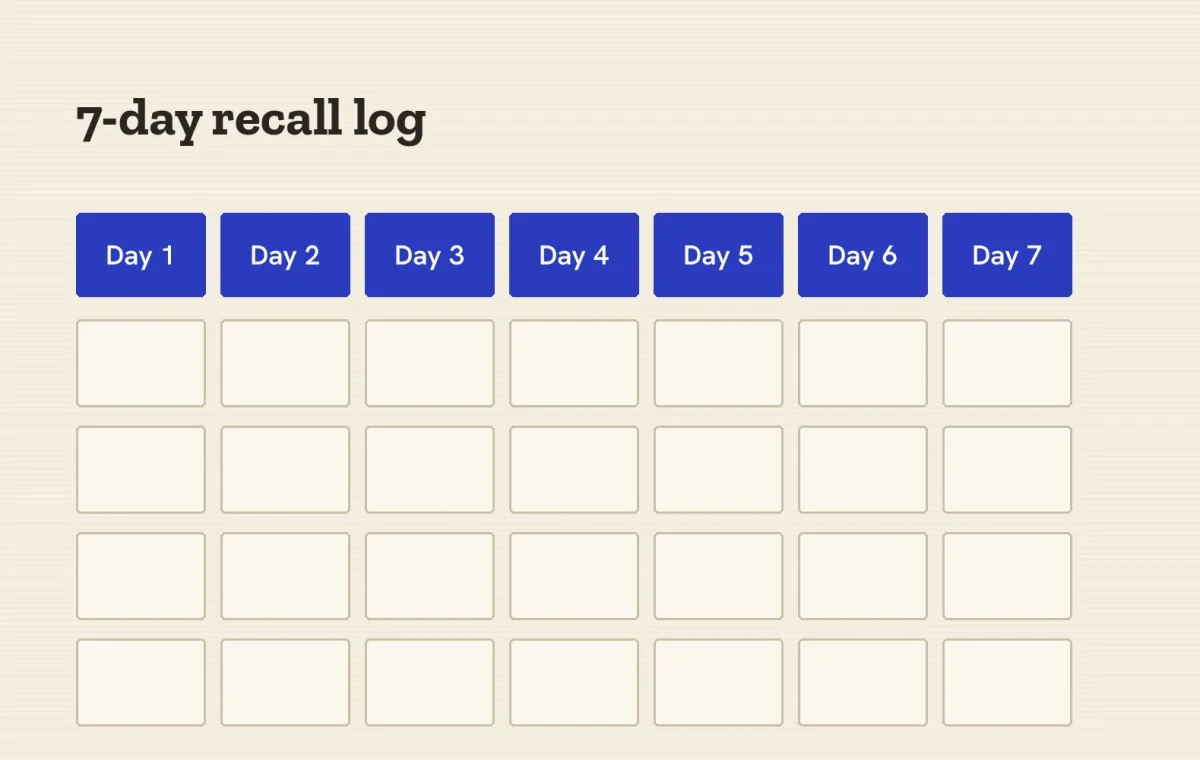
Blank seven-day log
Printable: Download the recall log (PDF, one page). A printable version of the table below with room to write.
Print this page or copy the table into a notebook. Each row is one ten-minute session. In the last column, record how many of the previous day’s five target words you could write from memory before starting the new session.
| Day | Date | Letter | Cold score | Main problem | Five target words | Recalled after break (of 5) | Yesterday’s five recalled (of 5) |
|---|---|---|---|---|---|---|---|
| 1 | none yet | ||||||
| 2 | |||||||
| 3 | |||||||
| 4 | |||||||
| 5 | |||||||
| 6 | |||||||
| 7 | |||||||
| Retest | Day 1 letter | Did it return? | Day 1 words recalled: |
If you want ready-made material for the narrowest letters, the three-letter words quiz lists every three-letter word for X, Q, Z, U, I, V, J, K and Y, and the hard letters Q, X, Z and J reference goes further for the four hardest starts.
Troubleshooting
- My score went down on the retest.
- Check the log before drawing conclusions. You may have recalled several target words but missed some ordinary ones from the first test, or spent longer on doubtful words. Repeat the same letter once more before deciding the routine is not helping, since a single minute varies a good deal on its own.
- I keep missing the same target words.
- Change the cue first; a meaning cue might work where a spelling cue did not, or the reverse. If a word still will not come after several sessions, replace it with a more familiar word from the same starting pair. Being in the dictionary does not make every word equally worth the effort.
- I recall all five every time.
- The five words are too easy, or you are picking words you already produce. Choose targets from words that were missing from your cold test, and try harder letters or longer words.
- I do not have ten minutes.
- Keep steps 2, 5, 6 and 7, which are the cold test, the hiding, the break and the recall attempt. Cutting the diagnosis and the cues loses some detail, but cutting the recall attempts removes the part that practises recall.
- I cannot tell whether a word is valid.
- Do not include it as a target until you have checked it against the game’s word list. Practising a word the game rejects wastes the session, and the words you can’t play page covers many familiar surprises.
- My letter has almost no short words.
- For X and Q, learn the complete three-letter sets first, which are only xis, qat and qua, and then choose longer targets. With so few words available, a cold score under these letters will be low for everyone, so compare it only with your own earlier scores for the same letter.
Updated 14 September 2026: the passages on retrieval practice and spacing now cite the studies behind them and say what those studies did not test; the reason for the thirty-second break is now given as our own reasoning. Added advice for using the routine with vocabulary you are learning. Updated 13 September 2026: rewritten and restructured, with every count and word verdict rechecked against the game’s word list and blocklist. Details are in the corrections log.
New to The Verbarium? Follow the reading path, with tools and printables