Color or Colour? A Decision Chart for Writers and Word-Game Players

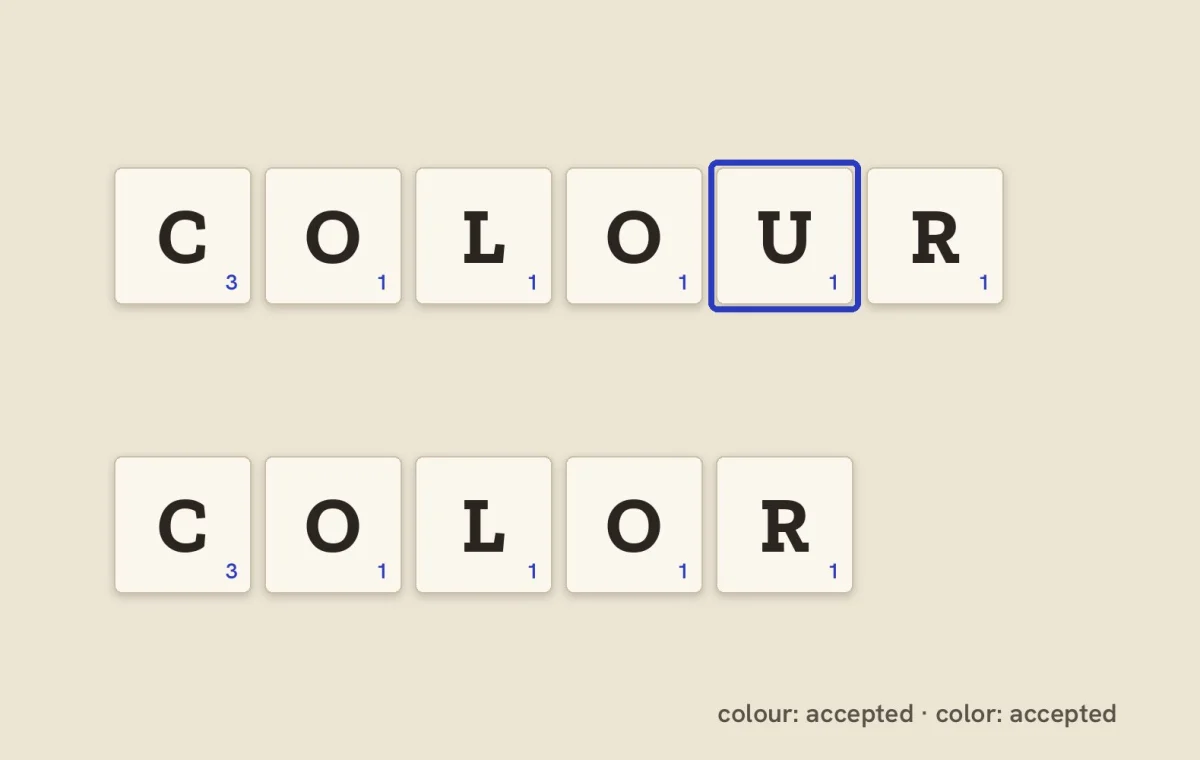
In your own writing, choose color or colour by who will read the text and then stay consistent, but in a Find the Word round the only question is whether the exact form you type appears in the game’s word list, and that list accepts colour while rejecting colourful.
The chart splits early because the two situations ask different things. A style guide wants consistency across a whole document. A word game has no opinion about style at all; it compares a string of letters with a fixed list, so a perfectly normal British spelling can fail while its American twin scores. The sections below give the full picture for the colour family, then return to ordinary writing.
The twelve pairs where both spellings score
The game’s list is a fixed file of 172,446 words, built from the public-domain ENABLE list with an offensive-word blocklist removed and described in more detail in how we check words. A script found 102 entries containing the letters color and only 12 containing colour. Swapping color for colour inside each of the 102 entries, and checking whether the result also exists, produces exactly 12 matching pairs. Every one of the 12 British-style entries belongs to one of those pairs, so the table below is the complete set.
| Round | American form | Verdict | British form | Verdict |
|---|---|---|---|---|
| B | bicolor | Valid | bicolour | Valid |
| B | bicolors | Valid | bicolours | Valid |
| C | color | Valid | colour | Valid |
| C | colors | Valid | colours | Valid |
| C | colored | Valid | coloured | Valid |
| C | coloring | Valid | colouring | Valid |
| C | colorer | Valid | colourer | Valid |
| C | colorers | Valid | colourers | Valid |
| D | decolor | Valid | decolour | Valid |
| D | decolors | Valid | decolours | Valid |
| D | decolored | Valid | decoloured | Valid |
| D | decoloring | Valid | decolouring | Valid |
Six of the pairs begin with C, which makes a C round the one place where this knowledge pays off. Typing color, colour, colors, colours, colored, coloured, coloring, colouring in quick succession gives eight answers from a single idea, and the less natural colorer and colourer forms add four more if you remember them. Because the game counts each spelling once, there is no penalty for entering both halves of a pair. Stringing related forms together like this is one of the habits described in how to win timed word games, and you can try it straight away in a C round of Find the Word.
Where adding a U fails
The pattern breaks as soon as you move beyond the core forms. Each American spelling in the next table is in the list, and each British counterpart is missing, even though most of those British forms are standard in UK publishing. ENABLE was compiled in the United States, which probably explains why its gaps lean in one direction. That is a limit of this particular file rather than a judgement that the British spellings are wrong.
| American form | Verdict | British form | Verdict |
|---|---|---|---|
| colorful | Valid | colourful | Not valid |
| colorless | Valid | colourless | Not valid |
| colorist | Valid | colourist | Not valid |
| colorant | Valid | colourant | Not valid |
| coloration | Valid | colouration | Not valid |
| colorize | Valid | colourise | Not valid |
| colorings | Valid | colourings | Not valid |
| bicolored | Valid | bicoloured | Not valid |
| discolor | Valid | discolour | Not valid |
| recolor | Valid | recolour | Not valid |
| multicolor | Valid | multicolour | Not valid |
| watercolor | Valid | watercolour | Not valid |
Two rows deserve a second look. Coloured is valid but bicoloured is not, and colouring is valid while its plural colourings is not, so even a family that works at its base can drop out one step further along. The practical rule is to treat every British form as its own check and never to assume that a U can be added because a related word accepted one. Several of these rejections turn up in the list of words you can’t play and why. Note too that recolor, discolor and multicolor begin with R, D and M, so in a C round they would not count whichever way they were spelled; the prefix and suffix worksheet explains why prefixes move a word into a different round.
The rest of the -our family
The same uneven coverage applies to other words with the -or and -our split. A script confirmed that both spellings of each base word below are in the list, which means each pair gives two answers in its round.
honor honour humor humour favor favour flavor flavour labor labour neighbor neighbour harbor harbour rumor rumour vapor vapour savor savour valor valour armor armour
Longer derivatives are less predictable. Honourable, labourer and armoury are all accepted alongside their American versions. Favourite, humourless, neighbourhood and flavourful are not, although favorite, humorless, neighborhood and flavorful are. If you play in British English by habit, the safest fallback under time pressure is the American spelling of any long derivative.
Why our list passes both, and what that leaves out
Both spellings pass in Find the Word because both are in the ENABLE-based list the game uses, and we have not edited that list by region. The only words we take out are the ones on an offensive-word blocklist, and we have not patched missing British forms in. We have kept it that way because every count on this site describes exactly the list the game loads, identified by a published fingerprint so any figure can be checked, and each change to the list means recounting the whole site, as happened every time the blocklist grew. Adding colourful by hand would be friendlier to British players, but it would move our list further from the public one it is built on, in a way readers could not easily see.
The cost is an asymmetry we would rather state than hide. Across the whole list we found 44 words accepted with both -or and -our, so British spellers are well served at the base. One step further along, they are not. This page is written in British spelling, and everyday British words such as colourful and favourite are ones our own game turns down.
That gap is also our main advice to writers. A word list built for games, like a spell checker set to American English, is not evidence that a British spelling is wrong. When in doubt, check a dictionary that labels regional forms, as Cambridge does for colour, and when editing someone else’s text, leave their convention alone unless a house style says otherwise. In running prose, the error worth correcting is mixing the two conventions in one document, not choosing either of them.
Choosing a spelling for writing
Outside a game, both spellings are correct, and the choice signals which editorial convention a text follows. The Cambridge Dictionary gives colour as the UK spelling and color as the US one, which matches ordinary experience: American publishers use color, while British, Irish, Australian and New Zealand publishers generally use colour. Canadian usage leans towards colour as well, though house styles vary.
Writing for American or British readers
Pick the convention of the main readership and apply it to every related word. An American text should read color, colored, coloring, colorful; a British one should read colour, coloured, colouring, colourful. Mixing them in running prose rarely looks international. It usually looks as if nobody checked the page.
Writing for a mixed audience
When the readership is spread across countries, follow the organisation’s house style if one exists. If none exists, choose one convention at the start, note it in whatever style sheet the team uses, and keep to it. The deciding factor can be as simple as where the editors are based or which dictionary they already use.
Quotations, names and titles
Quoted material keeps the spelling of its source, so a British article quoting an American writer should leave color alone, and the reverse applies too. Proper names follow the same principle. A company, product or book title keeps its official spelling even when the sentence around it follows a different convention.
Code is not prose. CSS defines its properties with American spelling, so color, background-color and border-color are correct on every website, including sites written in British English. A British page can therefore say “choose a background colour” in its text while its stylesheet says background-color, and a global find-and-replace from color to colour would break the styling.
Why the two spellings exist
English took the word from French in the Middle Ages, and the French form behind it goes back to Latin color. The Etymonline entry for color traces that path. Colour was the usual English spelling from the 14th century, with color an alternative from the 15th. According to Etymonline’s entry for -or, the -or spelling became established in the United States largely through Noah Webster, who dropped the u in an 1804 revision of his speller and in his 1806 dictionary. Not every reform Webster favoured caught on, which is probably one reason American and British spelling differ in some word groups but not others. The wider story of how printing, borrowing and reformers shaped these patterns is told in why English spelling is so weird.
A worked edit
Here is a short draft with every kind of problem the flowchart covers: mixed spellings in prose, a prefixed verb and a CSS property.
| Version | Text |
|---|---|
| Draft | The colour picker updates the color palette. When a user recolors a button, the CSS background-colour property changes. |
| American edit | The color picker updates the color palette. When a user recolors a button, the CSS background-color property changes. |
| British edit | The colour picker updates the colour palette. When a user recolours a button, the CSS background-color property changes. |
In the American edit, only the first word of the draft changes, along with the misspelled property name. The British edit changes color to colour and recolors to recolours, but it also has to correct background-colour to background-color, because that string is code and was never valid in either version. Marking the property as code in the edited text makes the exception visible to the next person who revises the page.
Updated 14 September 2026: added why the game’s list passes both spellings and what that means for writers. 13 September 2026: rewritten and restructured, with every count and word verdict rechecked against the game’s word list and blocklist. Details are in the corrections log.
New to The Verbarium? Follow the reading path, with tools and printables