Words That Start With Q, X, Z and J: Lists, History and the Hardest Letters

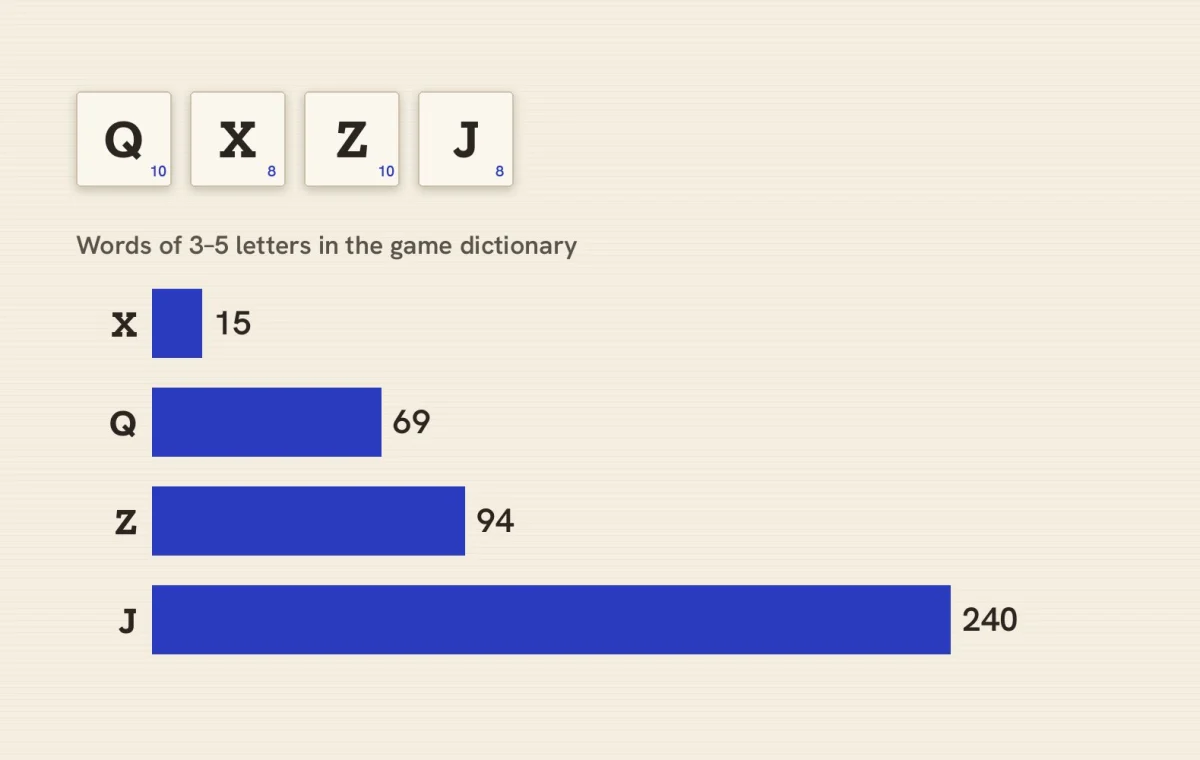
Few English words start with Q, X, Z or J. In the word list behind Find the Word, our timed word game, the four letters together begin 2,856 of 172,446 accepted words, about 1.7%, and the most familiar ones fit in the short table below. X is the hardest starting letter by any sensible count: only 134 entries begin with it, just 15 of those have five letters or fewer, and a single one, xis, has three. Q, Z and J are hard in different ways. Q hides almost everything behind QU, Z has a tiny vocabulary but a healthy handful of short words, and J turns out to be far more searchable than its reputation suggests.
| Letter | Everyday words | Short, unusual and accepted |
|---|---|---|
| Q | quack, quail, quake, quality, quarter, queen, question, queue, quick, quiet, quilt, quiz, quota, quote | qat, qua, qoph, qwerty |
| X | xenon, xenophobia, xerox, xylem, xylophone | xis, xyst, xebec, xeric |
| Z | zany, zeal, zebra, zero, zest, zigzag, zinc, zip, zodiac, zombie, zone, zoo, zoom, zucchini | zax, zek, zin, zoa |
| J | jacket, jam, jar, jazz, jealous, jeans, jelly, jewel, job, join, joke, journey, judge, juice, jump, jungle, jury | jeu, jow, jun, jus |
Every count on this page describes the Find the Word word list, not English as a whole: the public-domain ENABLE list with an offensive-word blocklist removed, which leaves 172,446 playable words (how we check words has the details). Other word apps use similar but not identical lists, and Scrabble’s official dictionaries differ in places that matter for these four letters. Where they part company, the table of famous spellings shows both verdicts.
Why English has so few of these words
The scarcity is historical. Z was not a native letter of Old English, and only settled into its modern role for the voiced S sound by about 1400. J is a latecomer: it began as a scribe’s hooked variant of I, took on its own consonant sound in English only around 1600 to 1640, and English dictionaries did not separate I words from J words until the 19th century. No J word descends from Old English. X fared worse still; Samuel Johnson’s dictionary of 1756 said it “begins no word in the English language”, and most modern X words are either Greek-based scientific terms or commercial coinages such as xerox, a 1952 trademark. Q did have native words, but Old English spelled them with CW: queen was cwen and quick was cwic, and the QU spelling returned with Norman French, displacing CW by about 1300.
That history shows in our counts. Q’s section is 97.9% QU, the spelling habit English took over. X’s section is dominated by the XYL, XER and XEN families, 98 of its 134 entries, built on the Greek words for wood, dry and stranger. The scarcity is not a quirk of one word list; any English dictionary inherits the same history.
Why “hardest” depends on what you count
The game also blocks a short list of offensive words, so every count here is of words the game actually accepts rather than the raw word list. Plurals and verb forms count as separate entries whenever the dictionary stores them separately, and nothing shorter than three letters is included, because the game will not accept it.
The obvious measure of difficulty is the size of each letter’s section. By that yardstick the five smallest letters are X, Z, Y, Q and J, and together they account for fewer than 2% of all entries. At the other end, S, C and P between them hold 28.8% of the dictionary. A round on S and a round on X are not the same exercise with a different letter; they are different exercises.
Totals mislead, though, because a big section can be built mostly from long derivatives that nobody reaches for under a clock. A second measure is more practical: how many words of three to five letters sit behind the letter. These are the quick answers that keep a round moving when the first ideas dry up, and they tell a different story.
| Letter | All entries | 3 to 5 letters | 3 letters |
|---|---|---|---|
| X | 134 | 15 | 1 |
| Z | 532 | 94 | 12 |
| Y | 542 | 189 | 26 |
| Q | 822 | 69 | 2 |
| J | 1,368 | 240 | 22 |
| K | 1,710 | 350 | 27 |
| V | 2,729 | 255 | 21 |
The Y and Q rows show the problem neatly. Q has more entries than Y overall, 822 against 542, yet Y offers 26 three-letter words and Q offers two. Y’s short pool of 189 is nearly three times the size of Q’s 69. Ranked by total size Q looks middling; ranked by quick exits it sits next to X.
The mismatch is not confined to the hard letters. U begins 5,063 entries but has only 15 three-letter words, largely because about three quarters of its section starts with UN, a prefix that mostly builds longer words. I begins 6,971 entries and has 19 three-letter words. C has the second-largest section of all, at 16,215, but only 36 three-letter words, the same as W and fewer than E or G. A letter can be rich on paper and still leave a player short of something to type in the last ten seconds.
Neither count measures familiarity. The dictionary can confirm that xyst is accepted, but it has no way of knowing whether an ordinary player will think of it, or whether someone will overlook an everyday word such as ice. So the ranking used on this page is a statement about supply. X is last on every supply measure, Q is last-but-one on short words, and Z and J are scarce overall but give a prepared player something to work with. How those facts translate into a real round depends on what you already know, which is why general advice on winning timed word games changes with the letter you are dealt.
Why this is one guide rather than four pages
Until September 2026 this site had a separate short page for each of these letters. We merged them into this guide, and the old addresses now redirect here, because the most useful findings only appear when the letters sit side by side. On its own page, Q’s 822 entries look respectable; next to Y’s 542 entries and 26 three-letter words, Q’s two three-letter words show that it belongs beside X. Four thin pages also meant four copies of the same method notes and four sets of figures to keep right. Rechecking the combined page caught two errors: a comparison of C and W three-letter words was wrong (both have 36), and the letter odds had been rounded from a simulation rather than calculated exactly. Both corrections are in the corrections log. If you only memorise one list from this page, we would pick the twelve three-letter Z words. X and Q have too few short words for memorising to rescue a round, most of J’s are ordinary English already, and Z sits in between: short enough to learn in minutes, with zek, zin and zoa that few people would otherwise think of.
How often these letters actually come up
Scarcity in the dictionary is only half of the practical picture; the other half is how often the game serves the letter. Find the Word draws letters with fixed weights that favour common starting letters and never repeats the previous letter. Working from those rules, Q, X, Z and J each come up in about 0.6% of rounds, roughly once in every 163, while S alone accounts for 9.9%. That is worth weighing when you decide what to practise: these four letters are the hardest to play, but a player climbing Adventure mode will meet S, C or P about forty-five times for every X.
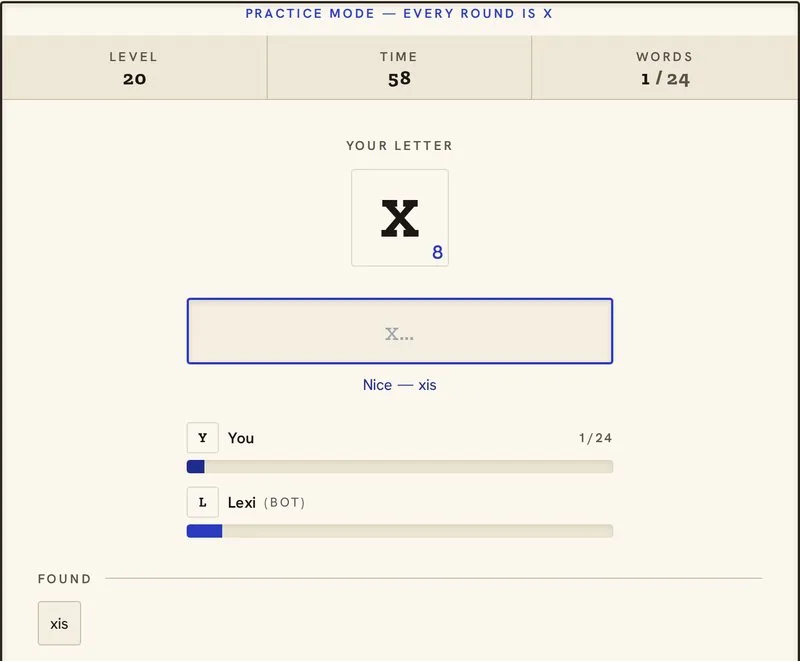
X: the whole map fits on one card
X is not a close contest. Z, the next-smallest section, is almost four times larger. What X lacks in size it makes up for in tidiness: every one of its 134 entries begins with XA, XE, XI or XY, and four three-letter families (XYL, XER, XEN and XAN) account for 119 of them, or 88.8% of the section.
| Opening | All entries | 3 to 5 letters | Families inside |
|---|---|---|---|
| XE | 64 | 7 | XER 32, XEN 30, XEB 2 |
| XY | 44 | 7 | XYL 36, XYS 8 |
| XA | 21 | 0 | XAN 21 |
| XI | 5 | 1 | XIP 4, plus xis |
The short list is small enough to print in full. These are all fifteen X words of five letters or fewer, in alphabetical order:
xebec xenia xenic xenon xeric xerox xerus xis xylan xylem xylol xylyl xyst xysti xysts
That is one three-letter word, one four-letter word (xyst) and thirteen of five letters. The remaining 119 entries are all six letters or longer, and XAN contributes nothing to the short pool at all: its 21 members are all built on xanth-, from xanthan to xanthophylls. For the first half of an X round, XE and XY are where the quick words are.
Once the short words are used, the longer families are more productive than they look, because one remembered base usually brings several forms with it. Xerox gives xeroxed, xeroxes and xeroxing; xylophone gives xylophones, xylophonist and xylophonists. Type the base first and then its forms, rather than trying to reconstruct a long derivative while xenon sits unused.
Words that merely contain X, such as box, fix or wax, are no help in a starting-letter round. The useful consequence of X’s size is that you can know when you have finished. After XAN, XEB, XEN, XER, XI, XYL and XYS have each been tried, there is no other opening left in the dictionary to look for. To rehearse the list under time, open a practice round locked to X.
Q: one doorway and seventeen side doors
Q begins 822 entries, which puts it ahead of X, Z and Y on raw size. The catch is that 805 of them, or 97.9%, begin with QU. That leaves a Q round with one very large doorway and a scattering of exceptions, and the short end is narrower still: 2 three-letter words, 14 of four letters and 53 of five, for 69 in all.
| Opening | All entries | 3 to 5 letters | Short examples |
|---|---|---|---|
| QUA | 370 | 24 | quack, quail, quake, qualm, quart |
| QUI | 275 | 20 | quick, quiet, quilt, quip, quiz |
| QUE | 115 | 10 | queen, quell, query, quest, queue |
| QUO | 41 | 7 | quod, quoit, quota, quote, quoth |
| QUR | 4 | 1 | qursh |
| QA, QI, QO, QW | 17 | 7 | qaid, qanat, qat, qats, qoph |
QUA and QUI together hold 645 entries, 78.5% of the entire Q section, so they are the natural first stop. QUI is the one most often abandoned too early. After quick and quiet it can feel spent, but quill, quilt, quip, quirk, quit and quiz are all short and all everyday words. QUE and QUO are smaller and easier to sweep in one pass, and QUR contains only qursh, qurshes, qurush and qurushes.
The seventeen Q words in which the Q is not followed by U are the complete list, not a sample (two of them, qiviut and qiviuts, contain a U later on). None of them follows a single pattern, so they are best learnt as a set:
qaid qaids qanat qanats qat qats qindar qindarka qindars qintar qintars qiviut qiviuts qoph qophs qwerty qwertys
Seven of these have five letters or fewer, which means roughly one short Q word in ten skips the U. That is enough to make “always type U after Q” a habit worth unlearning. The three-letter level is the clearest illustration: the only two words are qat, which has no U, and qua, which does. Once both are typed, there is no third three-letter Q word to hunt for, and time spent looking is time lost.
A useful review question after a weak Q round is which side of the fork went unsearched. If every answer began QUA, the other four QU openings were never visited; if every answer began QU, the no-U set was ignored. A practice round locked to Q is a quick way to test both sides of that fork.
Z: small, but not empty at the short end
Z has the second-smallest section, at 532 entries, but its short pool is much healthier than that suggests. It has 94 words of three to five letters and 12 of exactly three, which puts it well ahead of Q on both measures despite having a smaller total. All 532 entries pass through eight second letters, and five of those do nearly all the work.
| Opening | All entries | 3 to 5 letters | Short examples |
|---|---|---|---|
| ZO | 165 | 27 | zone, zoom, zonal, zombi, zowie |
| ZI | 119 | 25 | zinc, zing, zilch, zippy, ziti |
| ZE | 97 | 23 | zeal, zebra, zero, zest, zesty |
| ZA | 90 | 15 | zany, zappy, zarf, zazen |
| ZY | 47 | 2 | zyme, zymes |
| ZL | 5 | 2 | zlote, zloty |
| ZW | 5 | 0 | (zwieback and longer) |
| ZU | 4 | 0 | (zucchini and longer) |
ZA, ZE, ZI and ZO contain 471 entries, 88.5% of the section, and 90 of the 94 short words. The only short Z words outside those four openings are zlote, zloty, zyme and zymes. In practice that makes the short end of Z a four-opening search with four exceptions, which is about as manageable as a scarce letter gets.
These are all twelve three-letter Z words. Most players will know zap, zip, zit and zoo already, while zek, zin and zoa are the ones worth drilling:
zag zap zax zed zee zek zig zin zip zit zoa zoo
ZY behaves like two different openings depending on length. It contributes only two short words, but it holds 47 entries overall, including zygote, zygoma, zymase, zymogen and zymurgy. When the short ZA to ZO words are exhausted and time remains, ZY is where the longer search should go next, well ahead of the tiny ZL, ZW and ZU groups.
Z also holds the very end of the dictionary. Sorted alphabetically, the last two entries are zyzzyva and its plural zyzzyvas, so the plural is the final word in the file. For a round that works through the twelve short words and then the longer openings, try a practice round locked to Z.
J: five vowels and almost nothing else
J has the largest section of the four, 1,368 entries, and the most useful structure. Of those entries, 1,366 put a vowel straight after the J. The only exceptions in the whole dictionary are jnana and jnanas, which means a J round almost never needs to test consonant openings at all.
| Opening | All entries | 3 to 5 letters | Three-letter words |
|---|---|---|---|
| JA | 395 | 58 | jab, jag, jam, jar, jaw, jay |
| JU | 321 | 49 | jug, jun, jus, jut |
| JO | 290 | 54 | job, joe, jog, jot, jow, joy |
| JE | 213 | 40 | jee, jet, jeu |
| JI | 147 | 38 | jib, jig, jin |
| JN | 2 | 1 | none |
The short counts are much more even than the totals. JA is largest with 58, but JO has 54 and JI, the smallest vowel opening, still has 38. A player who has typed three or four JA words has barely started on J. JU is larger than JO overall yet a little smaller at the short end, a reminder that total size and quick-word supply are separate questions even within one letter.
The complete set of 22 three-letter J words is below. Most are ordinary English; jeu, jow, jun and jus are the ones a player is least likely to produce without having seen them first:
jab jag jam jar jaw jay jee jet jeu jib jig jin job joe jog jot jow joy jug jun jus jut
J rewards family thinking once a base word arrives. Jump leads to jumped, jumper, jumping, jumps, jumpy and jumpsuit; judge leads to judged, judges, judgement and judgeship. JUD, JUR and JUS between them hold 116 entries. The general technique of stretching a base with endings is covered in the prefix and suffix cheat sheet.
The most practical J habit is to name the vowels in order when a round stalls: JA, JE, JI, JO, JU. If all five have been searched and the answers are still thin, the problem is depth within each opening, and the fix is to learn more words. If most answers came from JA alone, the problem is switching, and the fix is simply to move on sooner. Practising both kinds of retrieval is the subject of our guide to word recall training, and a practice round locked to J lets you try the vowel sweep straight away.
Almost no supply
Fifteen short words in total. Learn them all and treat the seven families as a checklist.
Concentrated supply
Nearly everything is behind QU. Sweep all five QU openings, then the seventeen no-U words.
Small but learnable
Twelve three-letter words and a short end that lives almost entirely in ZA, ZE, ZI and ZO.
Predictable supply
Five vowel openings cover all but two entries. The work is going deep in each one.
Famous spellings: this game, Scrabble and Boggle
Players who come from board games often arrive with a few high-value spellings in mind, and several of them fail in Find the Word for the simple reason that they are two letters long. The third column shows how the same spellings fare in the official Scrabble dictionaries, where two-letter words are allowed. The game’s list is not a subset of those dictionaries or the reverse: the home edition, for example, only lists words of two to eight letters, while the game accepts words up to 28 letters long. The game’s word list also differs from other lists in places, so a word accepted elsewhere is not guaranteed here. Our FAQ on the words you can’t play explains the general rules.
| Spelling | Find the Word | Scrabble dictionaries | Why |
|---|---|---|---|
| qi | Not valid | Valid | Two letters; the game needs at least three |
| qis | Not valid | Valid | Not in this dictionary |
| qadi | Not valid | Valid | Not in this dictionary |
| qaid | Valid | Valid | One of the seventeen no-U words |
| za | Not valid | Valid | Two letters |
| zzz | Not valid | Valid | Three letters, but not in this dictionary |
| zax | Valid | Valid | One of the twelve three-letter Z words |
| jpeg, jetlag | Not valid | Not checked here | Neither spelling is in this dictionary |
| jukebox, jujitsu | Valid | Valid | Both are listed, as are jujutsu and jiujitsu |
Standard English editions of Boggle sidestep the hardest part of Q altogether: the Q face is printed Qu, so quit, quiz and quack each use one die for the two letters. The flip side is that the seventeen Q words where no U follows the Q, from qat to qwerty, cannot be formed on such a grid at all.
If three-letter words are the part of these letters you most want to secure, the three-letter words quiz tests them letter by letter, and the pages on K and V cover the next tier of narrow letters. When you are ready to try the lists under time, the game will serve a letter and start the clock.
Explore any letter yourself
The tables above cover four letters. The explorer below builds the same breakdown for any letter from the game’s word list: every two-letter opening, how many accepted words start with it, and the short words behind each one.
Letter explorer
Shows every two-letter opening for the letter, how many accepted words start with it, and the short words behind each one.
Printable cheat sheet
Printable: Download the hard letters cheat sheet (PDF, one page). It adds the complete no-U Q list and every short X word to the table below.
This table gathers the essentials for all four letters in one place. It is designed to be printed or kept open beside a practice round: the first rows give the numbers, the rest give the openings to search and the short words most worth memorising.
| X | Q | Z | J | |
|---|---|---|---|---|
| All entries | 134 | 822 | 532 | 1,368 |
| 3 to 5 letters | 15 | 69 | 94 | 240 |
| 3-letter words | xis | qat, qua | zag, zap, zax, zed, zee, zek, zig, zin, zip, zit, zoa, zoo | jab, jag, jam, jar, jaw, jay, jee, jet, jeu, jib, jig, jin, job, joe, jog, jot, jow, joy, jug, jun, jus, jut |
| Search order | XE, XY, XI, then XAN | QUA, QUI, QUE, QUO, QUR, then no-U | ZO, ZI, ZE, ZA, then ZY | JA, JE, JI, JO, JU |
| 4-letter words | xyst | qaid, qats, qoph, quad, quag, quai, quay, quey, quid, quin, quip, quit, quiz, quod | zany, zeal, zebu, zero, zest, zeta, zinc, zing, ziti, zone, zonk, zoom, zori, zyme | jack, jade, jail, jazz, jeep, jeer, jerk, jest, jilt, jinx, jive, join, joke, jolt, jowl, judo, jump, junk, jury, just |
| Exceptions | XAN has no word under six letters | 17 words skip U | Short words outside ZA to ZO: zlote, zloty, zyme, zymes | Only jnana and jnanas skip the vowel |
Sources
- Online Etymology Dictionary entries for the letters Q, X, Z and J, and for queen, quick, Xerox, xylophone and xeno-.
Updated 13 September 2026: rewritten and restructured, with every count and word verdict rechecked against the game’s word list and blocklist. The former Q, X, Z and J articles were merged into this guide, and a comparison of C and W was corrected. Details are in the corrections log.
New to The Verbarium? Follow the reading path, with tools and printables