How to Check Whether a Word Is a Real Word

Take irregardless in a work email. It is in the dictionary, so it is a real word. Cambridge marks it “not standard” and Wiktionary marks it “nonstandard, proscribed, sometimes humorous”, so some readers will count it as a mistake. Write regardless.
That is the whole method in one example. “Is it a real word?” is rarely the question you need answered when you are writing something. The useful question is whether you can use the word in this email, report or CV, and the answer sits in the small label printed next to the definition.
Four checks, in order
- Look it up in two dictionaries. Use Wiktionary first, because it is the widest net, then an edited dictionary such as Cambridge or Merriam-Webster. If neither has it, do not use it.
- Read the label on the meaning you intend. This is the step people skip. The next section says what each label means for your draft.
- Check the list that governs what you are writing, if there is one: your employer’s style guide, a client’s spelling preference, a journal’s rules.
- Think about the reader. A word can pass the first three checks and still be wrong for the person who will read it.
What the label tells you to do
A dictionary entry is not an endorsement. Dictionaries record ain’t and irregardless so that they can tell you how those words are received. Wiktionary puts its labels in brackets at the start of each definition, and Cambridge prints them just before it.
- No label. Standard English. Use it.
- informal, colloquial, slang. Correct in conversation and casual writing. Slang is the most casual of these. Fine in a message to a colleague you know. Replace it in a report, a CV, or a first email to a client.
- not standard, nonstandard. In use, but in Wiktionary’s words “frequently considered incorrect”. Replace it. The dictionary entry will usually point you to the standard form.
- proscribed. A Wiktionary label: “some authorities or commentators recommend against or warn against the listed usage”. Replace it in anything formal. With “sometimes proscribed” the objection is weaker, but the safe form costs you nothing.
- A place: US, UK, Welsh English, Indian English. Normal in that region and possibly unfamiliar elsewhere. Keep it for readers there. For anyone else, swap it or explain it.
- old use, old-fashioned, dated, archaic. Correct but no longer current. Wiktionary ranks them dated, then archaic, then obsolete. Use the modern word unless you want the old-fashioned effect.
- formal, specialized. Standard, but tied to official or technical writing. Correct. Check that a plainer word would not do the same job.
- humorous, jocular. Used as a joke. Only where a joke is welcome.
- offensive, derogatory. Likely to insult the people it describes. Do not use it. The entry often gives the term people prefer.
- trademark. A brand name used as an ordinary word. Use the spelling and capitals the dictionary shows.
Two things go wrong at this step.
Labels belong to meanings, not to whole words. Wiktionary calls thrice somewhat dated, but only outside Asia, Canada, Australia and New Zealand, and Cambridge gives it two labels, “old use” and “Indian English”. For a reader in Mumbai it is an ordinary word. Read down to the sense and the region that match yours.
A page loading is not an entry. Open the Cambridge address for a word it does not have and you land on the dictionary’s front page with no error message. Ask for wifi and you are sent to Wi-Fi. Look at the headword at the top before you trust what is below it. On Wiktionary, make sure you are in the English section, since the same spelling may be a word in another language.
Nineteen words, looked up
We looked up 18 words people hesitate over, plus one we invented (quorify), on 3 October 2026. Each was checked in the English section of Wiktionary and in the Cambridge Dictionary, then run through Hunspell 1.7.2, the spellchecker used by LibreOffice and Firefox, with its American and British dictionaries. Labels are quoted as the dictionaries print them.
- irregardless. Write regardless. Wiktionary: nonstandard, proscribed, sometimes humorous. Cambridge: US, not standard. Hunspell accepts it in both.
- alright. Write all right. Wiktionary: sometimes proscribed. Cambridge: “non-standard form of all right”. Hunspell accepts it in both.
- alot. Write a lot. Wiktionary: nonstandard, proscribed. Cambridge: no entry. Hunspell rejects it in both.
- supposably. Write supposedly. Wiktionary: nonstandard in the sense “supposedly”. Cambridge: entry, no warning. Hunspell rejects it in both.
- conversate. Write talk, converse. Wiktionary: now chiefly African American Vernacular English, nonstandard. Cambridge: no entry. Hunspell rejects it in both.
- unthaw. Write thaw. Wiktionary: proscribed. Cambridge: no entry. Hunspell rejects it in both.
- learnings. Write lessons, findings. Wiktionary: proscribed. Cambridge: no entry for the plural. Hunspell rejects it with the American dictionary and accepts it with the British one.
- ain’t. Write isn’t, aren’t, haven’t. Wiktionary: dialectal, informal or nonstandard. Cambridge: not standard. Hunspell accepts it in both.
- gonna. Write going to. Wiktionary: colloquial. Cambridge: informal, mainly US; “not standard” in its American dictionary. Hunspell accepts it in both.
- anyways. Write anyway. Wiktionary: informal, chiefly North America. Cambridge: US, informal. Hunspell accepts it with the American dictionary and rejects it with the British one.
- hangry. Casual messages only. Wiktionary: slang. Cambridge: informal. Hunspell rejects it with the American dictionary and accepts it with the British one.
- embiggen. Write enlarge. Wiktionary: nonstandard, usually jocular. Cambridge: no entry. Hunspell rejects it with the American dictionary and accepts it with the British one.
- thrice. Write three times, unless your readers use it. Wiktionary: somewhat dated outside Asia, Canada, Australia and New Zealand. Cambridge: old use; Indian English. Hunspell accepts it in both.
- handicapped. Write disabled. Wiktionary: sometimes considered offensive. Cambridge: old-fashioned, offensive. Hunspell accepts it in both.
- cwtch. Fine for Welsh readers; otherwise hug. Wiktionary: Wales. Cambridge: Welsh English. Hunspell rejects it in both.
- wifi. Write Wi-Fi. Wiktionary: alternative form of Wi-Fi. Cambridge: sends you to Wi-Fi; trademark. Hunspell rejects it in both.
- impactful. Usable. Wiktionary: no label. Cambridge: no label. Hunspell rejects it with the American dictionary and accepts it with the British one.
- emoji. Usable. Wiktionary: no label. Cambridge: no label. Hunspell accepts it in both.
- quorify (invented). Not a word. Wiktionary: no page. Cambridge: no entry. Hunspell rejects it in both.
Wiktionary had an entry for all 18 real words. Cambridge had 13, counting Wi-Fi, and the five it lacks are all words Wiktionary flags as nonstandard or proscribed. A word that appears only in Wiktionary deserves a second look for that reason.
The two dictionaries mostly agree, and supposably is the exception. Wiktionary lists a neutral older sense, “able to be supposed”, and labels the everyday sense, the one that means supposedly, as nonstandard. Cambridge defines it with that everyday meaning and gives no warning at all. When two references disagree like this, I’d take the form neither of them questions. It is not the brave choice, and a CV is not the place to be brave.
Handicapped shows why the label is worth the ten seconds. The spellchecker passes it. Cambridge labels it “old-fashioned, offensive” and says in the definition that people “prefer to say someone has a disability or is disabled”.
Don’t ask the spellchecker
The red underline answers a different question. With the American dictionary, Hunspell accepted eight of the 18 real words, and seven of those eight carry a warning in at least one dictionary: irregardless, alright, ain’t, gonna, anyways, thrice and handicapped. It rejected impactful, which neither dictionary labels at all.
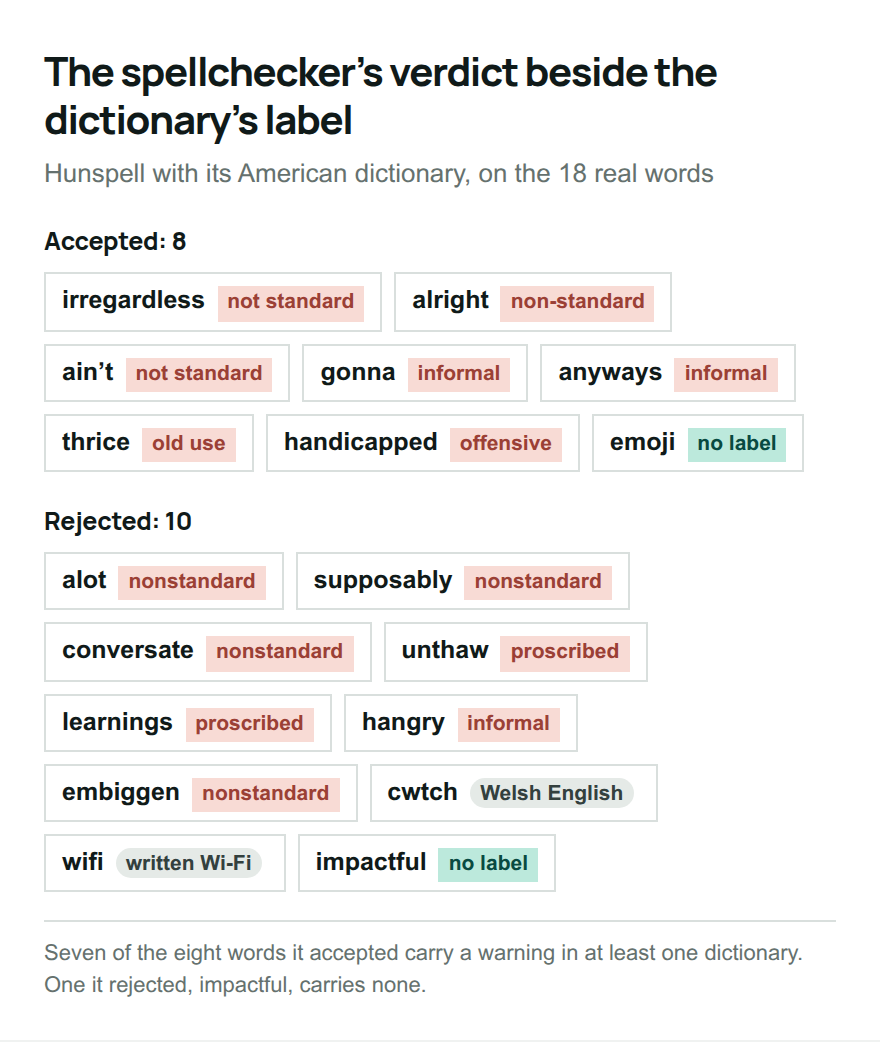
Switching to the British dictionary changed five verdicts. Impactful, hangry, learnings and embiggen were now accepted, and anyways was rejected. The same word in the same sentence gets a different verdict depending on which language your document is set to.
A spellchecker’s list is built to recognise the strings people commonly type. It carries no labels, so it cannot tell you that a word is informal, regional or disputed. It also passes real words used in the wrong place, which is a separate problem covered in what spellcheck misses.
When a list overrules the dictionary
Some writing is governed by a fixed list, and for that piece of writing the list wins.
- A house style guide. It may ban a word that every dictionary accepts without comment. That is a rule of the house and says nothing about the word. If your employer’s guide rules out impactful, the dictionary will not help you argue.
- A spelling variety. If the client writes British English, anyways and gonna are marked as American as well as informal. The wider patterns are in British and American spelling differences.
- A word-game list. Games score against their own word lists, which are compiled for play. ENABLE, a public-domain list made for word games, includes irregardless and does not include emoji. Neither result tells you anything about writing.
The last check has no reference to consult. Gonna is right in a quoted line of speech and wrong in a cover letter. Hangry works in a team chat and reads as a joke in a client report. If you would have to explain the word to the person reading, or you can picture them stopping at it, choose the one they will read straight past.