What to Write Instead of “Responsible For” on a CV

Take a line from a shop supervisor’s CV:
Responsible for stock control and deliveries.
The usual advice is to swap the opening for a stronger verb. Do that and you get:
Managed stock control and deliveries.
Nothing has been added. Both lines tell the reader that stock control was part of the job, which they could have guessed from the words “shop supervisor”. Neither says how much stock, what you did with it, or whether you were any good at it. Every other supervisor applying can write the same line, word for word.
So the phrase is a symptom. The bullet describes a duty, and a duty belongs to the post, not to the person who held it. A quick test: if the line could be pasted into the advert for your old job without anyone noticing, it is describing the job. The fix is to add something that was only true when you were doing it.
Ordered and counted stock for a two-floor homeware shop, took in two deliveries a week and reported shortages to the supplier the same day.
That version happens to start with a verb too, but the verb is not what improved it. The detail did.
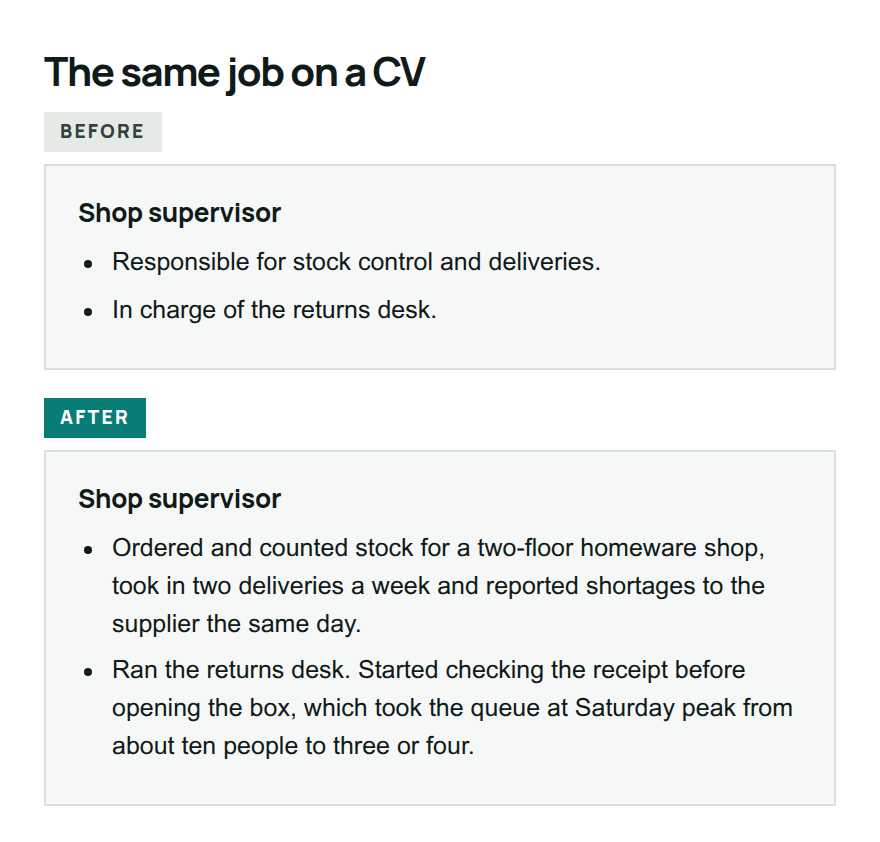
Every bullet on this page is invented. None comes from a real CV.
If you have no numbers
This is where I disagree with most of the advice you will find. It stops at “add a result with a metric”: sales up 20%, costs down by $25,000. That works if you were given those figures. Plenty of people never were. Nobody tells a receptionist what percentage of callers were satisfied, and an apprentice electrician doesn’t have a revenue line.
Do not make a figure up, and do not estimate one because it sounds right. A percentage on a CV invites the question “how was that measured?”, and at interview you need an answer.
What you do have is detail that you know from having been there. Five kinds of it turn a duty into a description of you, and none needs a measured result. You will notice that some of the rewrites below contain plain counts: how many people, how many sites, how often. Those are fine, because you know them without anyone’s spreadsheet. If you are only roughly sure, write “about” or “around” and give the figure you would give if asked in person.
How big it was
Say what the thing covered: how many people, sites, products, machines, rooms.
Before (IT support): Responsible for IT support for the office.
After: Only IT person for a 35-person office: laptops, phones, the door-entry system and the accounts software, with an outside contractor for the servers.
Before (office administrator): Duties included diary management.
After: Kept the diaries for three surveyors, booking site visits by area so that each had one round trip a day.
How often you did it
“Daily”, “every Friday”, “four or five a week”, “each January”. Frequency tells the reader whether this was the core of your job or something you did twice.
Before (electrician): Responsible for inspection and testing.
After: Inspected and tested the wiring in rented houses and flats, usually four or five properties a week, and wrote the condition report for each.
Before (office administrator): Responsible for taking minutes.
After: Took the minutes at the weekly managers’ meeting and sent out the list of actions the same afternoon.
Who relied on it
Name the person or team who used your work, and what they used it for. This is the easiest way to show that a junior job mattered.
Before (accounts assistant): Assisted with payroll.
After: Collected and checked the monthly timesheets for 60 hourly staff. The payroll officer ran pay from my figures.
Before (junior developer): Worked on the internal reporting tool.
After: Wrote the spreadsheet export for the internal reporting tool. The finance team now builds its month-end figures from it.
What was different afterwards
A change you made that stayed made. You don’t need to have measured the effect. You need to be able to say what you changed and that it was kept.
Before (heating engineer): Involved in managing van stock.
After: Drew up a standard parts list for the firm’s three vans, so the common fittings are always on board and nobody has to drive to the merchant for them. The list is still in use.
Before (sales assistant): Responsible for visual merchandising.
After: Moved the seasonal table from the back wall to the entrance and rewrote its price tickets. The manager kept the layout for the following season.
What you were trusted with
Keys, cash, a shift alone, a new starter, a client. If someone handed you something they could not afford to have go wrong, say what it was and how soon they handed it over. For a first job this is often the strongest thing you have.
Before (weekend café job): Helped with opening and closing.
After: Keyholder from my third month. Opened alone at 6.30 on Saturdays, cashed up and banked the takings on Sundays.
Before (graduate trainee): Exposure to client meetings.
After: Sat in on client meetings from my second month and drafted the follow-up email for the account manager to send.
If you do have a number
Then use it, with the action that produced it. A figure alone is a claim. A figure with the cause next to it is a short account of what you did.
Before (web developer): Responsible for improving site performance.
After: Cut the homepage load time from 4.1 seconds to 1.6 by compressing the images and removing two unused scripts.
Before (shop supervisor): In charge of the returns desk.
After: Ran the returns desk. Started checking the receipt before opening the box, which took the queue at Saturday peak from about ten people to three or four.
The second one is a count made by standing there and looking. That is allowed, as long as you say “about” and it is what you saw.
Where “responsible for” is the right phrase
Sometimes the responsibility is the fact. If you held the budget, signed off the work or carried legal accountability for something, that is exactly what the phrase means, and a verb like “handled” would undersell it.
Responsible for the site’s fire-safety checks and the only person authorised to sign them off.
The difference is that this line says what you answered for. Keep the phrase for cases like that, once or twice on a page. The checker below will still highlight it, because it matches the phrase and cannot read the rest of the sentence.
Check your own bullets
Paste your CV, or one section of it, into the box. It runs in your browser and the text is not sent anywhere.
Check your CV wording
Runs in your browser. Your text is not sent anywhere or stored.
The checker marks three kinds of phrase. Red is for duty phrases such as “responsible for”, “assisted with” and “involved in”. Yellow is for descriptions of yourself that a reader cannot check, such as “hard-working”, “team player” and “proven track record”. Blue is for padding such as “successfully”, “various” and “on a daily basis”. On the four sample bullets it marks nine phrases, three of each kind.
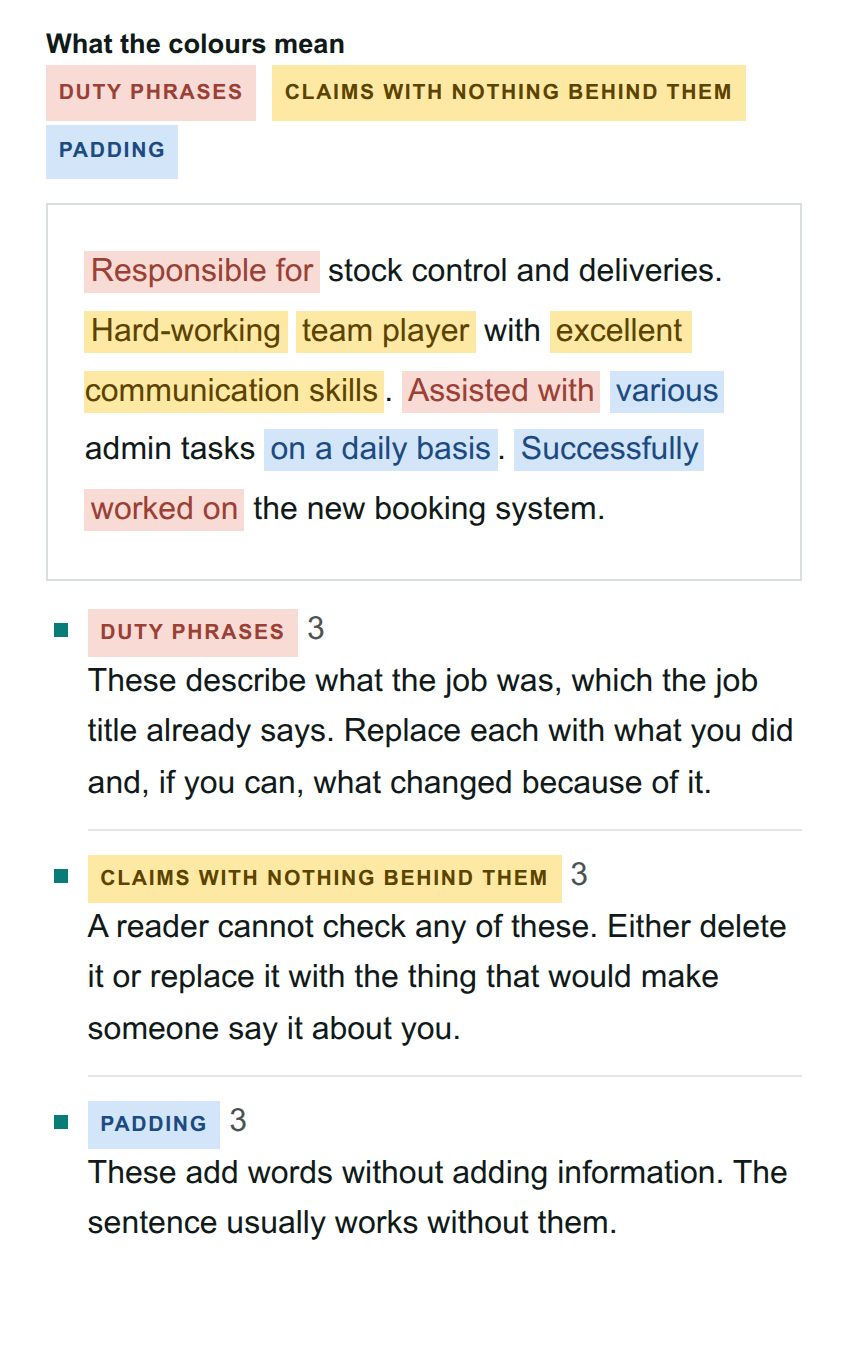
The next result is the one that matters. We ran the synonym version of the same sample through it, “Managed stock control and deliveries. Oversaw admin tasks. Led the new booking system.”, and it reported nothing, although those three bullets are as empty as the originals. The checker finds phrases. It cannot tell whether a bullet says anything.
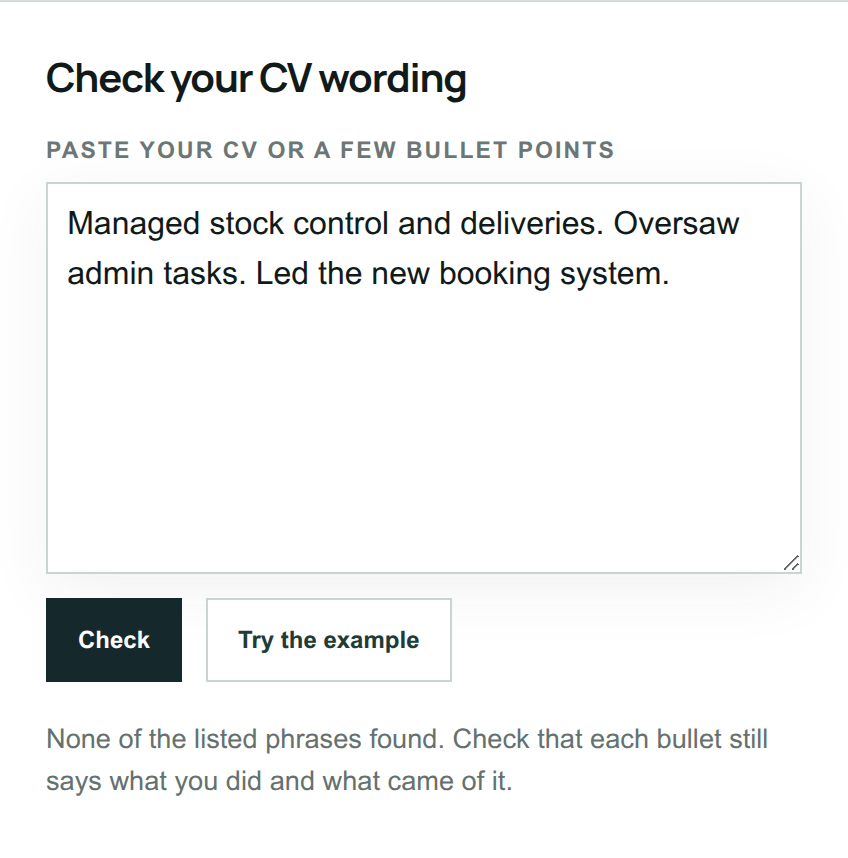
It also goes by spelling and not by meaning. “Moved the mail service to a dedicated server” gets a yellow mark on “dedicated”, and “Familiar with Excel” in a skills list is marked as a duty phrase. Leave a marked phrase alone if it is doing a real job where it stands.
For every bullet that is left, marked or not, go back to the five headings above. One answer per bullet is enough.