Find Mixed British and American Spelling in Your Text

Paste a document below and the checker tells you whether its spelling is British, American or a mixture, and which words are the odd ones out. It runs in your browser, so the text is not uploaded anywhere.
Find mixed British and American spelling
Runs in your browser. Your text is not sent anywhere or stored.
Reading the result
Press “Try the example” and the verdict reads: “Mixed: 12 British and 1 American spelling. The text is mostly British, so the American ones are the ones to change.” The one American spelling, favorite, is marked in red. The twelve British ones (organising, centre, travelled, colour, labelling, finalise, catalogue, defence, summarised, apologise, cheque, licence) are marked in blue, and each is listed underneath with its counterpart.
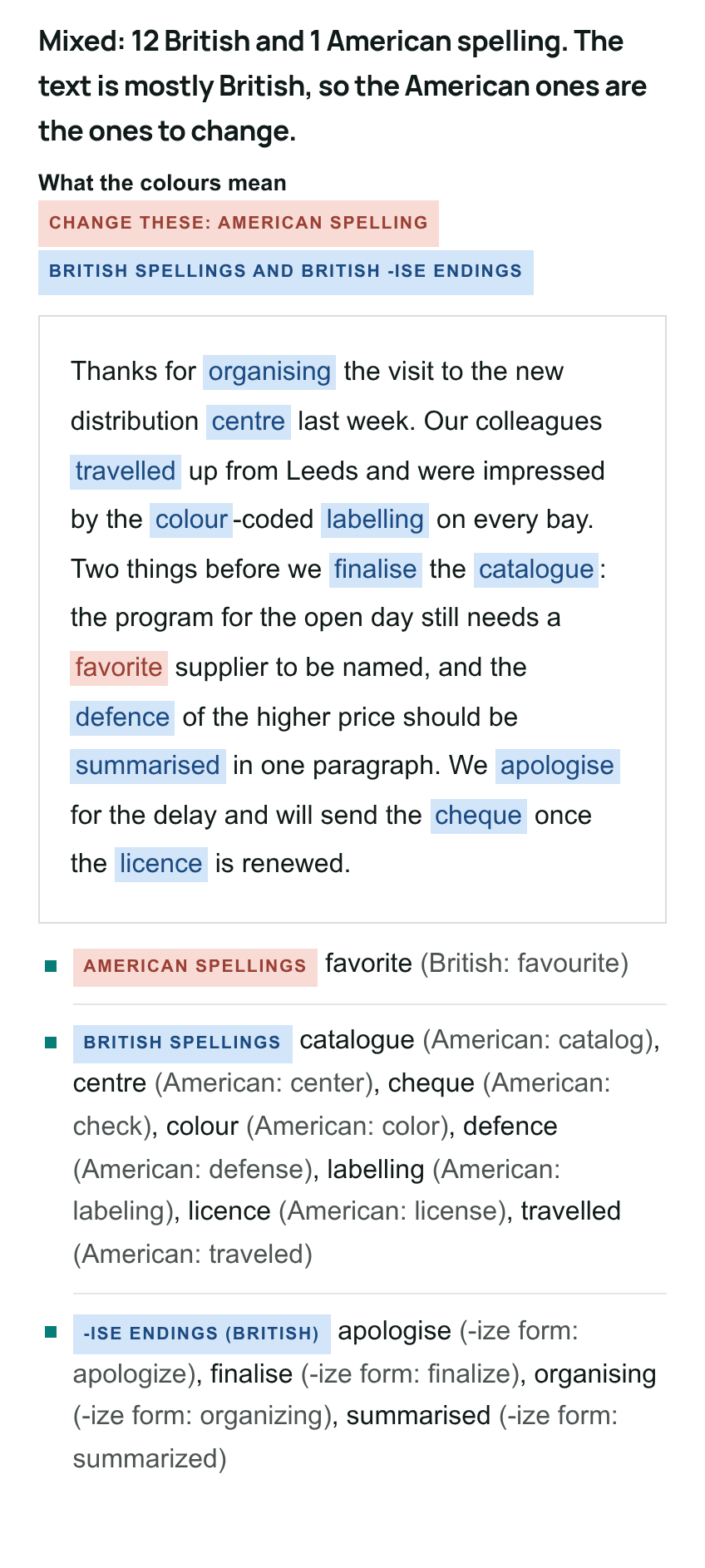
The checker counts every word it recognises, decides which variety is in the majority, and paints the minority red. If the counts are equal it says so and leaves the choice to you. A legend above the result says what each colour means. It does not correct anything. You decide which way to go and change the words yourself.
The example also shows what the checker cannot see. A British writer would put programme for an open day, but program is not flagged, because program is also a correct British word (for software). More on that below.
Words ending in -ize get their own line in the result, because they are correct in American English and accepted in British English. We ran three more texts through the checker to show what it returns:
- A British report using recognizes, organization, modernize, emphasize and finalized alongside catalogue, travelled, centres, analysed, colour and programme. Verdict: “British spelling with -ize endings (Oxford style). Consistent.”
- A British sentence with organise, summarise, grey and colour, plus prioritize and standardize. Verdict: “British spelling throughout, but -ise and -ize endings are mixed.” The two -ize words are marked in red.
- An American email with catalog, canceled, gray, center, analyze, fiber, theater, neighbors and rumor, plus programme and organisers. Verdict: “Mixed: 2 British and 9 American spellings. The text is mostly American, so the British ones are the ones to change.”
What it does not check
The checker looks up each word in a fixed list of 4,584 British spellings (3,951 of them -ise forms such as organise), 605 American spellings and 3,951 -ize forms. Anything outside that list passes without comment. Know these limits before you rely on it:
- Spelling only. It will not notice lift and elevator in the same document, or single and double quotation marks, or 3/10/2026 against 10/3/2026. For the vocabulary on a CV there is a separate page: which words to change for a British or an American employer.
- American spellings that are also British words are ignored on purpose. Program, check, tire, meter, license, practice, story, curb, draft and inquiry are never flagged, because a British writer uses all of them correctly: a computer program, a spot check, to tire, a parking meter, to license, a practice, a story, to curb, a first draft, a public inquiry. The checker cannot tell which sense you meant. The British-only forms (programme, cheque, tyre, metre, licence, practise, storey, kerb, draught, enquiry) are recognised. So in an American text it finds these slips, and in a British text you have to look for them yourself. They are also the reason a blanket find-and-replace goes wrong.
- The list has gaps. In our tests it missed organisational, analyser, catalyse and colourised. A “Consistent” verdict means no word on the list breaks the pattern, not that none does.
- -ize endings do not count as American. An American text whose only other marker is one stray colour will be reported as consistent Oxford-style British. Look at the list under the verdict, not only the verdict.
- Names, quotations and code are checked like everything else. It will mark the Organization in World Health Organization. Those are yours to leave alone (see the last section).
The eight patterns
Most differences fall into eight patterns. Each line gives the British form, the American one, and where the pattern breaks. The labels follow the Cambridge Dictionary entries for each example word.
- -our / -or. British: colour, favour, neighbour. American: color, favor, neighbor. British writes humorous, vigorous, honorary and glamorous without the u.
- -re / -er. British: centre, fibre, theatre. American: center, fiber, theater. Acre, massacre, mediocre and ogre are -re everywhere.
- -ise / -ize. British: organise or organize. American: organize. Advertise, supervise, surprise and about twenty others are -ise everywhere.
- -yse / -yze. British: analyse, paralyse. American: analyze, paralyze. Oxford spelling keeps analyse.
- Doubled L. British: travelled, cancelling, labelled. American: traveled, canceling, labeled. Controlled and compelled double everywhere; British fulfil and skilful have one L where American has two.
- -ence / -ense. British: defence, offence, pretence. American: defense, offense, pretense. British licence is the noun, license the verb.
- -ogue / -og. British: catalogue, analogue. American: catalog, analog. American English mostly keeps dialogue.
- ae, oe / e. British: paediatric, anaemia, oestrogen. American: pediatric, anemia, estrogen. Archaeology and aesthetic are normal in American English.
Then there are the one-offs, which follow no pattern: grey and gray, tyre and tire, kerb and curb, cheque and check, storey and story, plough and plow, mould and mold, aluminium and aluminum, jewellery and jewelry, sceptical and skeptical, cosy and cozy, pyjamas and pajamas, ageing and aging, programme and program.
The exceptions that catch careful writers
-ize is British too
Both endings are correct in British English. The Cambridge Dictionary heads its entry organize with “UK usually organise”, and the Oxford Advanced Learner’s Dictionary heads its entry with “British English also organise”. Oxford University Press prefers -ize in its own books, which is why the combination of -ize with otherwise British spelling is called Oxford spelling. The University of Oxford does the opposite: its style guide says to use -ise, “as it is more common in British usage and requires fewer exceptions”, and notes that this differs from the Press’s choice.
So a British document with organize and colour is not mixed. A British document with organize on page one and recognise on page two is.
Words that are -ise everywhere
In these words the ending is part of the root, not the suffix, so they never take a z in either variety. Etymonline’s entry for -ize reports Fowler’s view that British writers stayed with -ise partly to avoid having to remember this list.
advertise, advise, apprise, arise, chastise, comprise, compromise, despise, devise, disguise, enterprise, excise, exercise, franchise, improvise, incise, merchandise, revise, supervise, surmise, surprise, televise
The reverse case is capsize, which has a z in British English as well.
Analyse is not an -ize word
Oxford spelling changes organise to organize but leaves analyse and paralyse alone. The Oxford Advanced Learner’s Dictionary gives analyse as the British English form and analyze as North American, in the same dictionary that prefers organize. A British text with organize and analyze has one American spelling in it.
The u that British English drops
British spelling keeps the u before -able, -ful, -ite and -less: honourable, colourful, favourite, humourless. It drops it before -ous and in some Latin-based forms: humorous, vigorous, glamorous, laborious, honorary. Writers who are converting American text to British by adding a u to every -or word produce humourous, which is wrong in both.
Going the other way, American English keeps glamour. Cambridge lists glamor only as “US also”.
One L or two
British English doubles the L before -ed, -ing and -er even when the last syllable is unstressed. Cambridge marks the verb travel “-ll- or US usually -l-“, and the same for cancel, label and fuel. Where the last syllable is stressed, both varieties double: controlled, compelled, propelled, rebelled. Do not strip those when converting to American.
Then the pattern reverses. In a handful of base words British has the single L and American the double:
British fulfil and fulfilment are American fulfill and fulfillment. The same goes for enrol and enrolment (enroll, enrollment), distil (distill), instalment (installment), and skilful and wilful (skillful, willful).
The past tenses meet in the middle: fulfilled and enrolled are the same in both.
Licence and license, practice and practise
In British English the noun has a c and the verb has an s. American English uses license for both and practice for both.
So a British writer has a driving licence and goes to choir practice, but is licensed to sell alcohol and has to practise every day. An American has a driver’s license, is licensed to sell alcohol, goes to choir practice and has to practice every day.
If you can’t remember which is which, think of advice and advise. They follow the same pattern in both varieties and you can hear the difference.
Which variety to use
If an employer, client, publisher or university has a style guide, that settles it. Otherwise use the spelling of the people who will read the document: American for readers in the United States, British for the UK and Ireland, and for most readers in Australia and New Zealand. For a readership spread across countries, neither is wrong. Pick one at the start, write it down where your co-writers will see it, and keep to it. If you pick British, decide on -ise or -ize at the same time. I write -ise on this site, for the reason the University of Oxford gives: fewer exceptions to remember.
Then set the language of your spellchecker to match. A checker left on American English accepts center and traveled in a British document without a murmur, which is how most mixed documents get that way. The other common cause is pasting in text from a colleague or a source that uses the other variety. Our article on what spellcheck misses covers the errors that survive even with the right setting.
What to leave alone
Some spellings should stay as they are, whatever the rest of the document does.
- Quotations. Quoted words keep the spelling of the source. A British report quoting an American author leaves color as written.
- Names of organisations, places and products. World Health Organization, Australian Labor Party, Pearl Harbor and Lincoln Center keep their spellings in a British text. The Globe Theatre and the Labour Party keep theirs in an American one.
- Titles of books, films and papers. Cite the title as published.
- Code. CSS spells its property color, and that is the only spelling browsers accept. A British page can say “choose a background colour” in its text while the stylesheet says
background-color. A global replace of color with colour across a file that contains both will break the styling.
Corrected on 7 October 2026: the table of verdicts gave “2 British and 10 American spellings” for an email with nine American words listed. The checker returns 9 for those words. The sentence above the table said two more texts were run; there are three.