A Grammar Checker Caught 19 of Our 29 Planted Mistakes

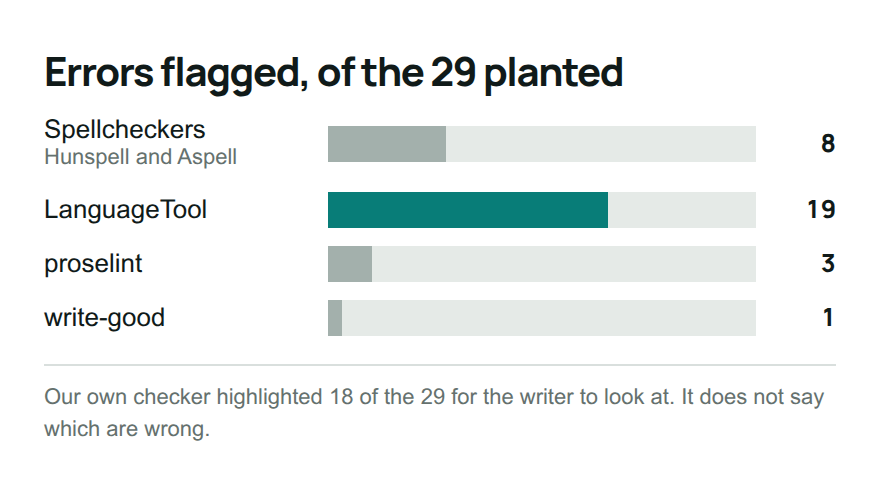
LanguageTool flagged 19 of the 29 errors in our test notice, with no false alarms. A spellchecker alone flagged 8. Of the 21 errors that passed every spellchecker in our earlier test, LanguageTool caught 11 and let 10 through, and those 10 include both of the grammar mistakes.
This is the notice. We wrote it for the earlier test, it is 155 words long, and the 29 errors were planted on purpose.
Dear members,
Thank you for you’re patience while we recieve the the new equipment. The principle hall will be closed form Monday untill Friday, and we would of told you sooner if the dates had been definately confirmed. Please keep quite in the library, as several people has complained about noise; its a real problem and it effects everyone. Volunteers who loose there badge should collect a replacement at the front desk, then walk passed the office to seperate the recycling. The trip to london is to far for the casual link between weather and attendance to be tested, but the organisers recognized that the colour of the posters and the color of the badges should match. Lunch will be served in the refractory, and the english class was lead by more then twenty volunteers. Their will be a meeting at 6pm; these meeting is informal and it’s outcomes will go on the notice bored.
What was tested, and what was not
All of this was run on 4 October 2026, on the notice exactly as printed above.
- LanguageTool, through its free public API, once with the language set to British English (
en-GB) and once with American English (en-US). The API reported version 6.9-SNAPSHOT, built 1 September 2026. We then repeated both runs with the stricterlevel=pickysetting. That is four requests in all. - proselint 0.16.0 and write-good 1.0.8, two open-source style checkers that run on your own computer, each with its default settings.
- Our own checker from the earlier article, which highlights sound-alike words for you to look at.
We could not run Microsoft Word, Google Docs or Grammarly from the machine we test on, so they were not tested and this page says nothing about what they would catch. LanguageTool’s paid Premium version was not tested either. Each API response carried the note “You might be missing errors only the Premium version can find.”
Scoring follows the earlier test. Each planted error is either flagged or not. The two British and American mixes count as caught if either half is flagged. A flag on anything that is not one of the 29 is counted separately.
All 29 errors against each tool
Of the 29 planted errors, the spellcheckers flagged 8, LanguageTool 19, proselint 3 and write-good 1. Our own checker highlighted 18, which is not the same thing as catching them: it marks every sound-alike for you to look at, right or wrong.
The full table: every error, and which tool flagged it
| In the notice | Should be | Spellcheck | LanguageTool | proselint | write-good | Our checker |
|---|---|---|---|---|---|---|
| you’re | your | no | yes | no | no | yes |
| recieve | receive | yes | yes | no | no | no |
| the the | the | no | yes | yes | yes | yes |
| principle | principal | no | no | no | no | yes |
| form | from | no | no | no | no | yes |
| untill | until | yes | yes | no | no | no |
| would of | would have | no | yes | yes | no | yes |
| definately | definitely | yes | yes | no | no | no |
| quite | quiet | no | no | no | flagged, for another reason | yes |
| several people has | have | no | no | no | no | no |
| its | it’s | no | yes | no | no | yes |
| effects | affects | no | yes | no | no | yes |
| loose | lose | no | no | no | no | yes |
| there | their | no | no | no | no | yes |
| passed | past | no | yes | no | no | yes |
| seperate | separate | yes | yes | no | no | no |
| london | London | yes | yes | no | no | no |
| to (is to far) | too | no | yes | no | no | yes |
| casual | causal | no | no | no | no | yes |
| organisers with recognized | one variety | yes | yes | no | no | no |
| colour with color | one variety | yes | yes | yes | no | no |
| refractory | refectory | no | no | no | no | no |
| english | English | yes | yes | no | no | no |
| lead | led | no | yes | no | no | yes |
| then (more then) | than | no | yes | no | no | yes |
| Their | There | no | no | no | no | yes |
| these meeting | this meeting | no | no | no | no | no |
| it’s | its | no | yes | no | no | yes |
| bored | board | no | yes | no | no | yes |
| Total | 29 | 8 | 19 | 3 | 1 | 18 |
The spellcheck figure is the earlier result: an error counts if at least one of the four Hunspell and Aspell runs flagged it. LanguageTool gets one figure because its British and American runs caught the same 19 errors, and the picky setting added nothing to either.
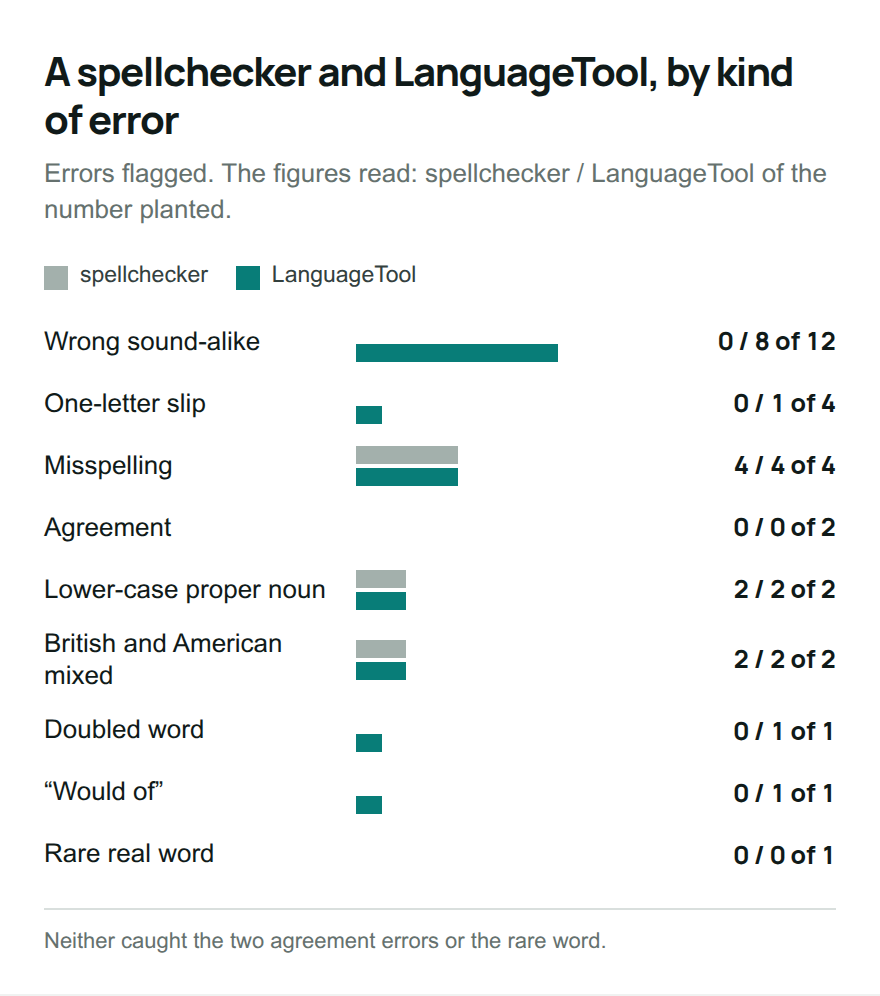
LanguageTool by kind of error
LanguageTool caught everything the spellcheckers did: the four misspellings, the two lower-case proper nouns and the two British and American mixes. On top of that it caught 8 of the 12 wrong sound-alikes, 1 of the 4 one-letter slips that make a real word, the doubled word and “would of”. It missed four sound-alikes (principle, loose, there, Their), three one-letter slips (form, quite, casual), both agreement errors and the rare word refractory.
The eight sound-alikes it caught are the ones where the next word gives the mistake away: you’re patience, its a, it effects, walk passed, is to far, was lead by, it’s outcomes, notice bored. It also caught more then twenty. The ones it missed sit in sentences that still look grammatical to a rule: the principle hall, closed form Monday, keep quite, the casual link.
The agreement errors are the result we did not expect. A grammar checker passed “several people has complained” and “these meeting is informal”, in both varieties and at both settings. Of everything in this test it is the finding I would remember, because agreement is exactly the kind of mistake a grammar checker is for.
Does the language setting matter?
Only for the two spelling mixes, and both runs caught both. Set to American English, LanguageTool flagged organisers and colour and said each “is British English”. Set to British English, it flagged color as “American English” and asked whether we would like the Oxford spelling organizers, adding that organisers “is also correct”. Accepting both British suggestions leaves organizers, recognized and colour twice, which is consistent. The spellcheckers in the earlier test flagged these words as plain misspellings and never named the variety. British and American spelling differences has a checker for the mix alone.
Right fix, wrong explanation
LanguageTool’s first suggestion was the correct word at all 19 flags. Two of its explanations were off even so. For effects it suggested affects and glossed it as “experiences of emotion”, which is the noun, when the sentence needs the verb. For bored it suggested board, glossed as “a committee”, when the notice means a noticeboard. Read the suggestion, not the gloss.
write-good flagged quite, but as a “weasel word”, with no hint that quiet was meant. We did not score that as a catch. proselint’s fix for “would of” was would’ve, which is right but informal for a notice, and for colour and color it reported the inconsistency without choosing a side.
Flags on things that were not errors
- LanguageTool, all four runs: nothing.
- proselint: 6pm, twice. It wanted periods in “p.m.” and a space before it.
- write-good: be closed, be tested and be served as “may be passive voice”, and several as a “weasel word”.
- Our checker: three correct uses of to, one then and weather. It gave no message, because it highlights every sound-alike by design.
proselint and write-good are style checkers and it shows. Between them they found the doubled word, “would of” and one spelling mix. They are not a substitute for a proofread and do not claim to be.
What is still left for you
After a spellchecker and LanguageTool, ten errors remained in the notice. They fall into two groups.
Seven you can search for. principle, form, quite, loose, there, casual and Their. Each is on the search list in the spellcheck article, with a test to apply at every hit. So the list of searches gets shorter with a grammar checker, but it doesn’t go away: principal and principle, from and form, quiet and quite, lose and loose, their and there, causal and casual still need your eye.
Three that only reading finds. “Several people has”, “these meeting is” and refractory for refectory. No tool on this page flagged any of them. The slow read aloud described there is still the step that catches agreement, and a rare word still has to be looked up.
Does our checker add anything on top?
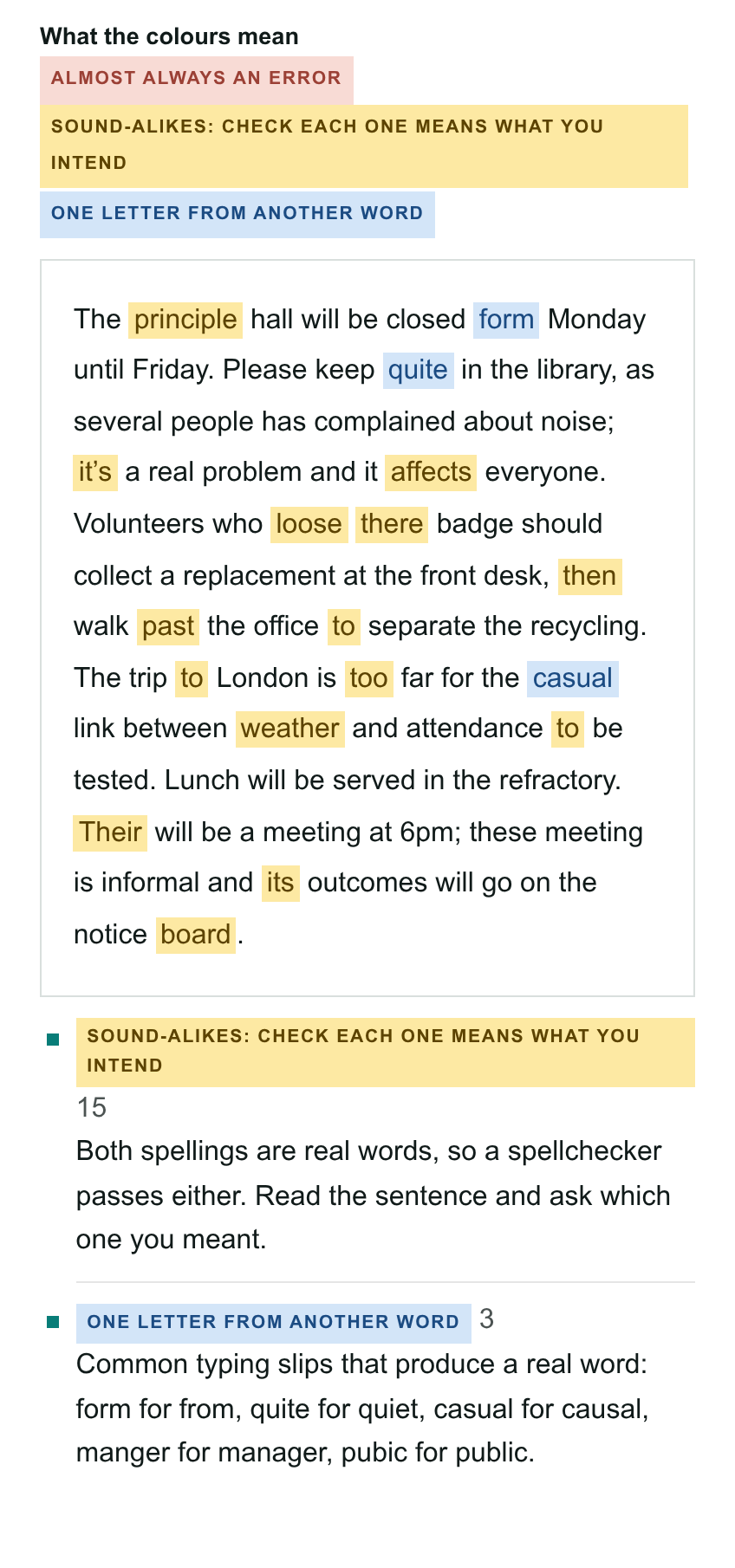
It highlights all seven of the searchable ones in one pass and none of the other three. That is the same ground the searches cover, done faster. The cost is noise. Once LanguageTool’s 19 fixes were applied to the notice, our checker made 21 highlights, and 14 of them were words now used correctly. The example below is most of that corrected notice: 18 highlights, of which 7 are the errors LanguageTool left.
Check your text for errors spellcheck cannot see
Runs in your browser. Your text is not sent anywhere or stored.
Before you paste work text into it
LanguageTool checks your text on its own servers, so whatever you paste is sent to them. Its privacy policy says the company collects content you input, and that it “does not use inputs from any LanguageTool user (Individual or Team Plan) to train its language algorithms or models”. Its documentation says the version running on the free service “may be the latest official release or some snapshot”, so results can change without notice, and that you can set up your own instance if the text is confidential. proselint, write-good and our checker run on your own machine or in your browser and send nothing.
One limit on all of the above: this is one short notice with errors we chose, run on one day. It tells you which kinds of mistake got through, not how often they will in your own writing.