Which Words to Change on a CV for a British or an American Employer


A CV written in a mixture of British and American English has two separate problems. One is spelling (organised next to labor), which a checker can find. The other is vocabulary (referees next to zip code), which no spelling checker sees. This page is about the vocabulary. Every pair in the table was looked up in the Cambridge Dictionary or the Oxford Learner’s Dictionaries, which both print regional labels, and it is here only because one of them labels it.
The pairs, by section of the CV
| British | American |
|---|---|
| The document and your contact details | |
| CV | résumé (or resume) |
| covering letter | cover letter |
| mobile | cell |
| postcode | zip code |
| surname | last name |
| referee | reference |
| driving licence | driver’s license |
| Education | |
| marks | grades |
| university | college (or university) |
| secondary school | high school |
| maths | math |
| postgraduate | graduate |
| work placement | internship |
| Work history | |
| made redundant | laid off |
| holiday | vacation |
| rota | roster |
| stock | inventory |
| diary (for appointments) | calendar |
| turnover (sales) | revenue, sales |
| fortnight | two weeks |
| liaise with | work with |
| line manager | manager, supervisor |
| whilst | while |
| The covering email | |
| Yours sincerely | Sincerely |
| Yours faithfully | not used |
| Monday to Friday | Monday through Friday |
| per cent | percent |
| enquiry | inquiry |
| 3 May 2027 | May 3, 2027 |
The labels read like this. Cambridge marks CV “mainly UK (US usually résumé)” and rota “mainly UK (US usually roster)”. Oxford marks résumé “North American English” and placement “British English”. Four rows rest on one dictionary only, and I wouldn’t insist on them: the sales sense of turnover is labelled “UK” only in Cambridge’s business dictionary, liaise (“especially British English”) and line manager (“British English”) only in Oxford, and internship (“US”) only in Cambridge.
Six that need more than a swap
- CV. In American use it is a different document. Cambridge gives a second sense labelled “US”, “a written description of the previous work of someone who is looking for a job at a college or university”, and Oxford says it lists a college teacher’s publications and courses taught. If an American advert outside a university asks for a résumé, calling your attachment a CV names something else.
- Postcode. A postcode is still a postcode when the reader is American. The word follows the address, not the employer. The simplest fix is to drop the label and write the address.
- College. This is the one that changes meaning. Cambridge gives it a “US” sense, “a university, especially one where you study for an undergraduate (= first) degree”, and a “UK” sense, “a place for education between the ages of 16 and 18”. “Attended college 2019 to 2021” tells a British reader you were there from 16 to 18 and tells an American reader you were at university.
- Degree results. They have no row because they are not two words for one thing. Cambridge defines a first as “the best possible undergraduate university degree you can get in the UK and some other countries”, and Oxford defines grade point average as “the average of a student’s grades over a period of time in the US education system”. Write the result your university gave you, under its own name, and if the reader may not know the scale, add what it means in a few words. Don’t convert it.
- Turnover. It is worth changing for an American reader for a second reason. The sense both dictionaries give without any label is the rate at which staff leave, so “reduced turnover by 12%” can be read as a claim about staff. Revenue is unlabelled and safe in both countries.
- The date. It matters most when it is all numbers. Cambridge’s own example is the fourth of July 2000: “4/7/2000 in British English. In American English this is written 7/4/2000.” A start date written 3/5/2027 is 3 May to one reader and March 5 to the other, two months apart. Write the month as a word in both versions and the order stops mattering.
Words you can leave alone
Revenue, layoff, last name, reference, stock, university, mathematics and notice period carry no label in either dictionary. They pass unnoticed in both countries, which is why several of them appear above as the safe choice. While is correct in both countries too, so there is no need to put whilst in for a British employer.
A label is also not a rule about what each country’s careers offices write. The UK government’s National Careers Service says “references” throughout its CV advice and links to its advice on the letter under the title “How to write a cover letter”, the form Cambridge marks as American. The labelled British forms are the ones certain to read as British, and that is all the label tells you.
One extract, converted both ways
English is my second language, and nobody hands a second-language writer a list of which words belong to which country. So I think of a CV like the made-up one below as the normal state of things and not a careless one: a British degree and work history, with American spellings and labels picked up along the way.
Profile: Operations coordinator with six years in retail logistics. Organised and practical, with a focus on labor costs and stock control.
Operations Coordinator, Harlow & Finch, 2023 to 2027. Liaised with 14 branches, analyzed turnover each fortnight and ran the holiday rota. Made redundant when the distribution centre closed.
Team Leader, Bexley Sports, 2021 to 2023. Finished the management training program whilst working weekends.
Education: BSc Maths, first-class honours, University of Leeds, 2021.
Referees on request. Cell: 07700 900142. Zip code: LS2 9JT. Available from 3/5/2027.
For a British employer
Profile: Operations coordinator with six years in retail logistics. Organised and practical, with a focus on labour costs and stock control.
Operations Coordinator, Harlow & Finch, 2023 to 2027. Liaised with 14 branches, analysed turnover each fortnight and ran the holiday rota. Made redundant when the distribution centre closed.
Team Leader, Bexley Sports, 2021 to 2023. Finished the management training programme whilst working weekends.
Education: BSc Maths, first-class honours, University of Leeds, 2021.
Referees on request. Mobile: 07700 900142. Postcode: LS2 9JT. Available from 3 May 2027.
Six changes: three spellings, two labels and the date. Most of the text was already British.
For an American employer
Profile: Operations coordinator with six years in retail logistics. Organized and practical, with a focus on labor costs and inventory control.
Operations Coordinator, Harlow & Finch, 2023 to 2027. Worked with 14 branches, analyzed revenue every two weeks and ran the vacation roster. Laid off when the distribution center closed.
Team Leader, Bexley Sports, 2021 to 2023. Finished the management training program while working weekends.
Education: BSc Mathematics, first-class honours, University of Leeds, UK, 2021.
References on request. Cell: +44 7700 900142. Leeds LS2 9JT, UK. Available from May 3, 2027.
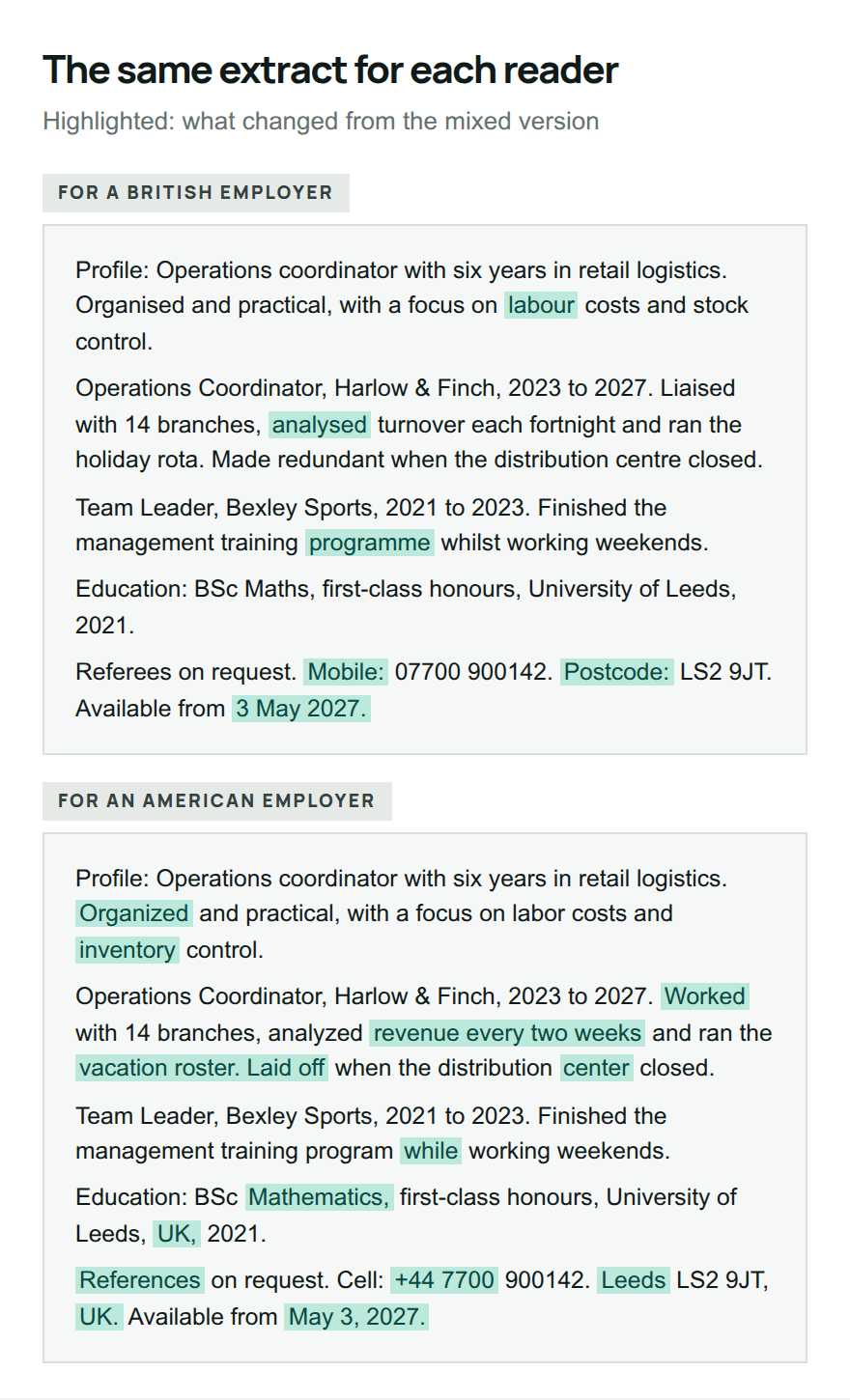
Sixteen words or phrases changed, and fourteen of the sixteen are vocabulary or format, not spelling. Three things were deliberately left alone:
- Job titles and employer names. They are facts. If your title was Stock Controller, it stays Stock Controller in both versions.
- First-class honours. It is the name of the award, so it keeps its British u and is not turned into a GPA. The reader gets “UK” beside the university to explain why it looks unfamiliar.
- The postcode. The label goes, the code stays.
What a spelling checker catches of this
Not much, which is the reason for the table. Our British and American spelling checker is loaded here with the mixed extract.
Find mixed British and American spelling
Runs in your browser. Your text is not sent anywhere or stored.
Its verdict on the mixed extract is “Mixed: 4 British and 2 American spellings. The text is mostly British, so the American ones are the ones to change.” Labor and analyzed are marked in red. Organised, centre, Maths and honours are marked as British.
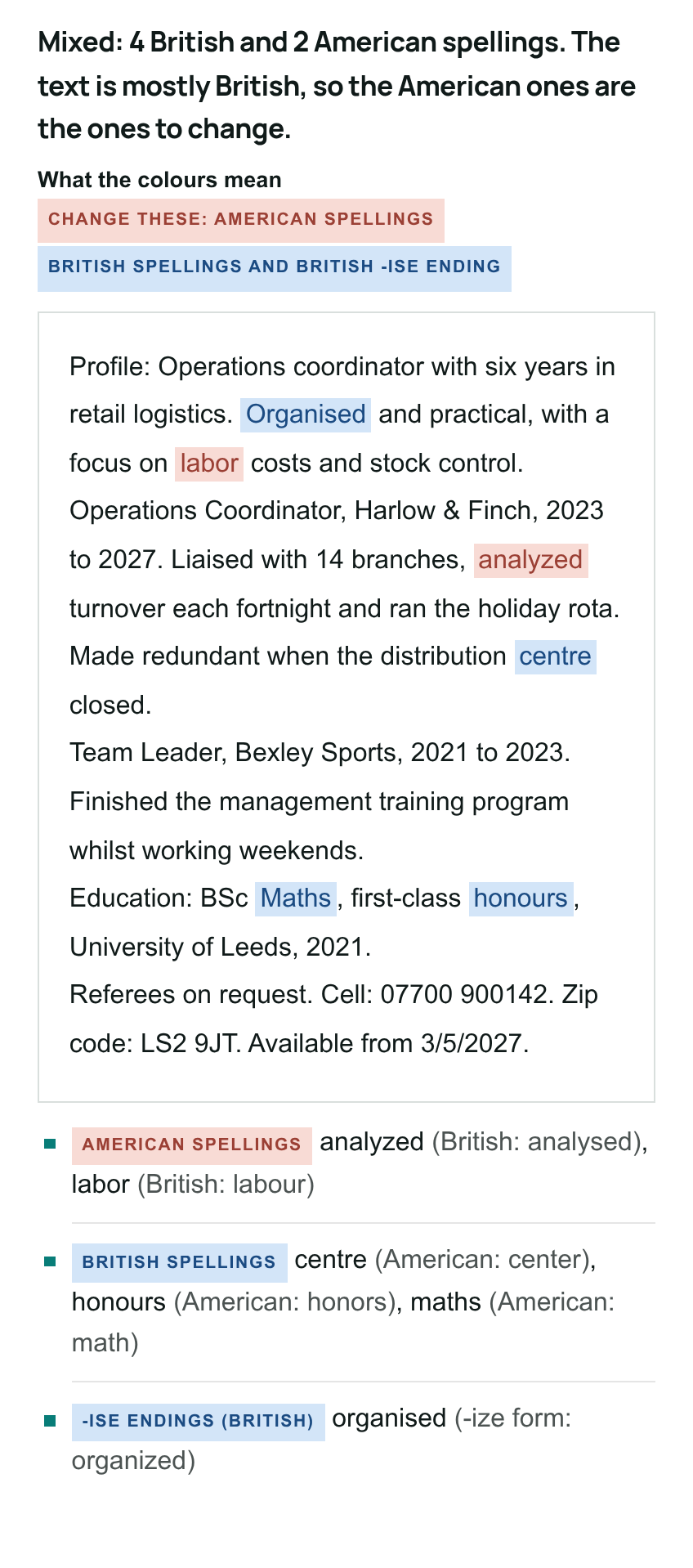
That is two of the six changes the British version needed, and three of the sixteen the American version needed (organised, centre, maths). Cell, Zip code, Referees, Liaised, turnover, fortnight, holiday, rota, redundant and whilst passed without comment, because the checker compares spellings of the same word, and holiday and vacation are two words, each spelled correctly. Program passed too: it is a correct British word for software, so in a British CV you have to find “training program” yourself. And 3/5/2027 is not a word.
Two things about the verdict line. It follows the majority, so if your text is mostly British and you are converting it to American, the red words are the wrong ones for you. Read the list of British spellings under the verdict instead. And the finished American version does not come back clean: the verdict is “Mixed: 1 British and 3 American spellings”, and the one British spelling is honours in first-class honours. That flag is correct about the spelling and wrong about what to do. Leave the name of the award alone. The finished British version returns “British spelling throughout. Consistent.”
Outside the wording
What goes on the page besides words also differs, and that is a question for a careers service, not a dictionary. The UK National Careers Service says you “should not include your age, your date of birth, whether you’re married or your nationality”, and that you should not put a referee’s contact details on the CV but can say “references are available on request”. Pomona College’s Career Development Office, in its U.S. résumé tips for international students, says not to include a photograph, age or birth date, marital status, race, religion or visa status, and limits the résumé to “1-2 pages maximum”.
Corrected on 8 October 2026: the American version of the extract was said to change fourteen words or phrases. It changes sixteen. The “UK” added after the university and the “+44” in the phone number had not been counted.