What a Consistency Check Finds in Published Sample CVs and How to Run One on Yours


Two date lines from the work history of one CV:
February 2021–May 2022
September 2019- April 2020
The first joins its dates with an en dash and no space. The second uses a hyphen and a space after it. Nothing is misspelled, and no checker will ever mark it. The CV is a sample that a university careers service publishes for students to copy.
What follows is a pass over a finished CV that finds differences of that kind: five searches, about five minutes. They are in the order in which the differences turned up in 41 such samples. Each comes with the lines we found, what I would change them to, and what a search will stop at that is not a slip at all.
The 41 are CVs and résumés that eleven university careers services publish as models: Memphis, Cal Poly, Baltimore, Marietta College and Kansas State in the United States, Sheffield, Aberdeen and Reading in the United Kingdom, Dublin City University in Ireland, and McGill and British Columbia in Canada. We took up to four from each, the first ones its page lists. Twenty of the 41 write the same kind of thing in two ways somewhere. I quote their lines without saying which university each comes from, because nearly half of the samples have one.
1. What joins the two ends of a date range
Search your CV for a hyphen with a space before it, then for an en dash, which is the longer one, then for the word “to” between two dates. Every range should be joined the same way.
This was the commonest difference by a long way. Of the 34 samples with two or more date ranges, 11 join them in more than one way. Nine have both a hyphen and an en dash, like the two lines at the top of this page. Another of the nine has “Sept 2023 – Present” a few lines above “Oct 2023 – Present”. The other two switch between a dash and a word: “Winter 2007 – 2008” in one entry and “Summer 2004 to Present” in the next.
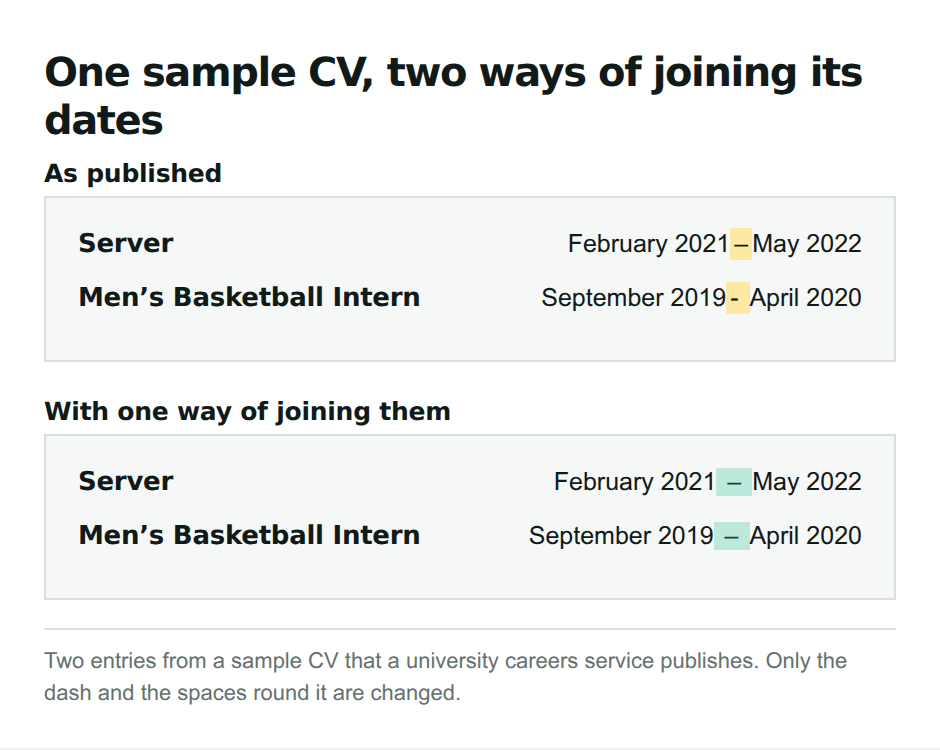
I would use an en dash with a space on each side, as in “Sept 2021 – June 2023”, because the spaces keep the two dates apart at a glance. On a Mac it is Option and the hyphen key. On Windows, hold Alt and type 0150 on the number pad. If neither works for you, a hyphen with a space on each side is fine, as long as it is the same every time.
Look at the spaces while you are there. In 13 of the samples the spaces round the dash seem to differ from one line to the next. I have left that out of the twenty, because text taken from a PDF cannot be trusted for spaces, but on your own page you can see them. And read each range once as dates. One sample has a job that runs from December 2020 to January 2020.
2. The last character of every bullet point
Go down the bullet points that say what you did and look only at how each one ends. All with a full stop, or all without.
Eight of the 34 samples with five or more bullet points do both. In one of them these two stand under the same job:
• Handled customer enquiries and assisted customers in accessing store facilities
• Operated tills accurately following company procedures.
Two samples have a single stray: ten bullets without a full stop and one with, or ten with and one without. In the rest the two habits are mixed through the page, or one section keeps one habit and the next section keeps the other.
Not a slip: full stops on the bullets that are sentences and none on lines that are lists, such as courses, grades or software. Several samples do that, and it reads as a decision.
I would leave the full stops off everywhere, because most CV bullets are not sentences. They have no subject. Either way is right if it is the same way. What goes inside a bullet is another matter, and What to Write Instead of “Responsible For” on a CV is about that.
3. The months
Read down the months. A long month should not be written in full in one entry and short in another.
Three samples do that: “August 2023” in one entry and “Sept 2024” in the next, or “April – September 2018” above “May – Aug 2016”.
Not a slip: March, April, May, June and July in full beside “Sept” and “Oct”. Many publications do that on purpose, the Associated Press among them, and shorten only the seven long months. Seven of the samples follow that pattern, and they are consistent.
I would shorten the long months without a full stop, as Jan, Feb, Aug, Sept, Oct, Nov and Dec, and leave the five short ones alone. It saves room on the line where room is shortest.
4. The word for a job you still have
Search for “present”, “current”, “now” and “to date”. Pick one word and one capital letter.
Two samples have two. One writes “2010 – Current” for a degree and “2011 – Present” for everything after it. The other ends a job with “– Present” and three memberships with “to present”.
Not a slip: “from 2017 to present” inside a sentence, on a page whose date lines say “2017 – Present”. A sentence is prose and takes a small letter.
I would write “Present”, with a capital, after the same dash as every other range.
5. Hyphens and spelling
Search for a hyphen with no space on either side. That lists every compound you hyphenated. For each one, search for the same two words with a space between them, and as one word.
Three samples write one compound two ways in the same position: “online catalogue” and “on-line searches”, “final year project” and “final-year degree studies”, “game day marketing” and “game-day events”.
Not a slip: a hyphen where the pair comes before a noun and none where it stands alone, as in “a full-time post” and “I worked full time”. That is the usual rule, and a page that follows it is consistent. In the three samples both forms stand before a noun.
Then the spelling. None of the 41 samples mixes British and American spelling. One has “honours” beside “analyze”, and it is a Canadian CV: that pairing is ordinary Canadian spelling. If your CV is going to an employer in the other country, the words that change are in Which Words to Change on a CV for a British or an American Employer.
A name keeps its own spelling, and so does a quotation. I ran the spelling search over the 22 older guides on this site before I published this one. It stopped in three of them, and none was a slip. One was a dictionary’s usage label, “specialized”, printed the way the dictionary prints it. The other two were words the guide itself is about. On a CV the same goes for an employer called a “Center”, a course called “Organizational Behavior” and the World Health Organization. Leave them as their owners write them.
Does any of this matter?
I have no evidence that an employer has ever turned down a CV over a hyphen, and I would distrust anyone who said they had. These 41 were chosen by careers staff as models to copy, and nearly half of them have one of these differences, so most readers plainly do not notice.
My reason for doing the pass anyway is a narrower one. Most of what a CV says cannot be checked by the person reading it. Whether it is consistent can be seen at a glance, and it depends on nobody but you. It costs five minutes. I would spend them and then stop, because none of this is worth an evening.