Write English Emails That Are Easier to Translate


“The manager gave us the green light to start” came back from our Spanish translation request as:
El gerente nos dio luz verde para empezar.
The image survived, and so did the permission to begin. “Luz verde” is an established Spanish expression; the Royal Spanish Academy’s dictionary includes the figurative sense. An idiom that looks literal in another language is not necessarily a bad translation.
The more useful question for someone sending an English email is whether the recipient will recover the same instruction, condition or degree of certainty. You can make those clearer before the message leaves your outbox, even if you cannot read the translation yourself.
Say whether a figure is remembered, estimated or confirmed
One test sentence said:
Off the top of my head, I think the order was for 200 units.
The German answer began “Aus dem Bauch heraus würde ich sagen”. That is closer to saying something on a gut feeling. The Spanish answer began “Así de memoria”, explicitly referring to memory.
The expressions overlap in being informal and unprepared. But if you mean that you remember an order without checking it, the German wording makes the basis of the figure less clear. BBC Learning English explains “off the top of my head” through memory and lack of preparation; Duden’s entry for “Bauch” gives feeling or instinct as the figurative sense used in “aus dem Bauch heraus”.
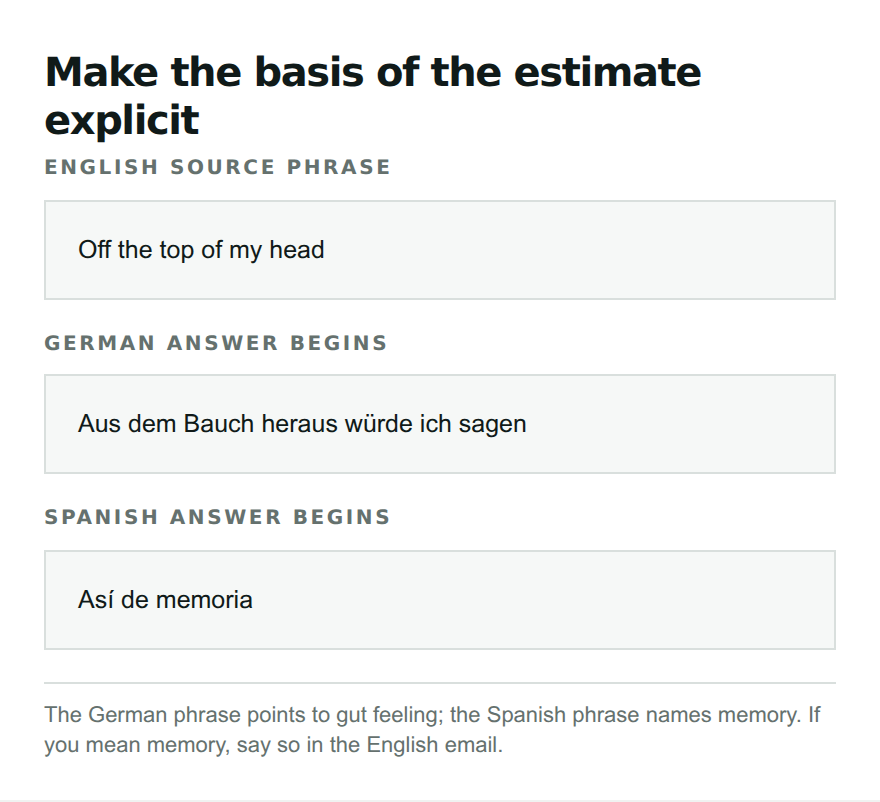
Write the basis directly: “From memory, I think the order was for 200 units.” If you have checked the order, say that instead. Do not turn an uncertain recollection into “The order was for 200 units” merely to make the sentence short.
These examples come from 35 sentences we composed around office expressions found in historical work emails. We asked Gemini 3.5 Flash to translate each into German and Spanish and examined those 70 first translations. This guide draws on an AI-assisted reading, with the dictionary checks named here; it is not an independent native-speaker assessment or a translation accuracy score. The run used Google’s API on 12 October 2026, default temperature, minimal thinking and one answer per request. It did not test the translation button in your recipient’s email program.
Name the thing behind the office shorthand
“The new schedule is a win-win for staff and customers” presents two possible problems: the business phrase and the word “schedule”. In our German response, the model handled the first by saying that both groups benefit. For “schedule”, it offered different sentences depending on what was being scheduled.
The first used “Fahrplan”, and the response explicitly labelled it for public transport. It then offered “Zeitplan” for a general schedule and “Schichtplan” for work shifts. Calling the first answer a mistranslation would hide the useful warning the model supplied: the English sentence lacks context.
Put that context in the original. “The new shift schedule benefits staff and customers” gives the translator more to work with. If the actual change is opening hours, name the opening hours. These are English edits proposed here; we have not run a second translation test on them.
Abbreviations can hide a decision too. “The venue for the training is TBD” became a Spanish sentence saying that the location was awaiting confirmation. That may fit your situation. But if nobody has chosen a venue, “We have not chosen the training venue yet” says something more definite about what remains to be done.
“I need your answer by EOB today” was rendered in German as a deadline at today’s close of business. The abbreviation was understood. The missing fact was still missing: whose business hours? Write the date, time and time zone when the recipient needs an exact deadline. A translation cannot recover an hour you never supplied.
I do not want a work email to preserve an English metaphor at the expense of the action. If the reader needs to approve an order, I want the approval request to arrive intact. I would keep a friendly greeting and remove the guessing from the instruction. That leaves room for personality without asking the other person to decode the arrangement.
English wording to use before you send
These alternatives address different kinds of uncertainty. Choose the one that matches your facts:
- “Keep me in the loop about the delivery.” If you want updates, write “Please send me any updates about the delivery.” If you only want to know when it arrives, ask for that instead.
- “Bring the new colleague up to speed.” Name what they need: “Explain the project’s current status to the new colleague.” Add the person’s name where there could be doubt about whom you mean.
- “Let’s touch base next week.” If you mean a call, ask for a call about the named subject. If you need a written update, ask for that. The idiom leaves the channel and the task open.
- “Do not send the parcel w/o a tracking number.” Write “Do not send the parcel without a tracking number.” Keep the negative instruction and spell out the shortened word.
Microsoft’s guidance for global writing recommends conventional grammar, consistent terms and restraint with idioms and abbreviations. Shortening everything into fragments can make translation harder, so retain the small words that show how a sentence fits together.
Before sending, locate the sentence that asks the reader to act. Does it say who should do what, under which condition and by when? Put those facts in ordinary English. You do not need to predict every possible translation to remove ambiguity you can already see.