Words Your Reader Can Take Two Ways


The finance committee sanctioned the overspend.
One reader takes that to mean the committee signed it off. Another takes it to mean somebody was punished for it. Both are right about the word: Cambridge defines the verb sanction as “to formally give permission for something” and also as “to punish someone for something, especially officially”. Minutes that say “approved the overspend” or “penalised the department for the overspend” can only be read one way.
I have translated books and films into English, and words like this are where a translator has to stop. You cannot carry “sanctioned” into another language without first deciding which of its two meanings the writer had, and the sentence doesn’t say. If a translator would have to ask, your reader has to guess.
Below is the same treatment for the words and phrases most likely to cause this in an email, a report, minutes or a notice: a sentence that reads two ways, the two readings, and a version that reads only one way. We made the sentences up, and the dates in them assume a message sent on Monday 12 October 2026.
Dates and deadlines
Next Friday
Let’s review the draft next Friday.
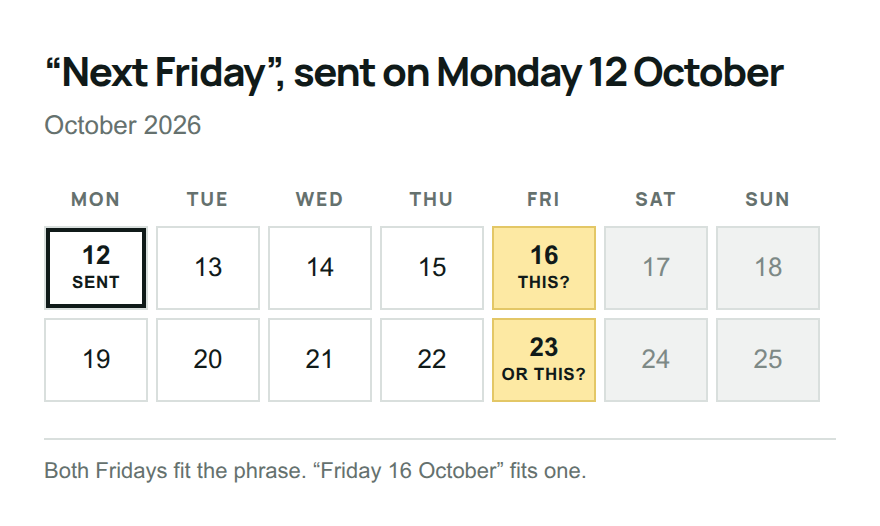
Sent on a Monday, this is Friday 16 October to some readers and Friday 23 October to others. The Oxford Learner’s Dictionary defines next Monday, week, etc. as the one “immediately following”, which gives the 16th. Plenty of speakers call that one “this Friday” and keep “next Friday” for the week after; the teacher who runs English Lessons Brighton describes both uses and thinks the second is the more common. You will not settle that argument in a meeting invite, so skip it.
Write: Let’s review the draft on Friday 16 October.
By Friday
Please send me your figures by Friday.
The day is not really in doubt. Cambridge gives by as “not later than; at or before”, so Friday counts. The hour is the problem. You may want the figures first thing on Friday so you can use them that day, while your colleague plans to send them at 11pm. If the reader is in another time zone, add whose Friday you mean.
Write: Please send me your figures by 10am UK time on Friday 16 October.
“By midnight on Friday” makes it worse. The GOV.UK style guide points out that a deadline of midnight on a named day can be read as the end of that day or the end of the day before, and tells its writers to consider 11:59pm. The US standards body NIST gives the same advice, and adds that 12 a.m. and 12 p.m. are ambiguous too.
Until the 19th, through the 19th
I’m on leave until 19 October.
Either you are back at your desk on the 19th, or the 19th is your last day away. Cambridge defines until as “up to (the time that)”, which does not say whether the named day is in or out. American writers have through for this, labelled US by Cambridge and defined as “including the first and last thing or person mentioned”. Cambridge gives the British equivalents as “to” and “through to”, and “to” on its own brings the same doubt back. Say the first day and the last day, or the day you return.
Write: I’m on leave from Monday 12 to Friday 16 October and back at work on Monday 19 October.
The same goes for offers and closures. “The discount runs until 31 October” becomes “The last day to order at the discounted price is Saturday 31 October”.
Within 5 days
We’ll reply within 5 days.
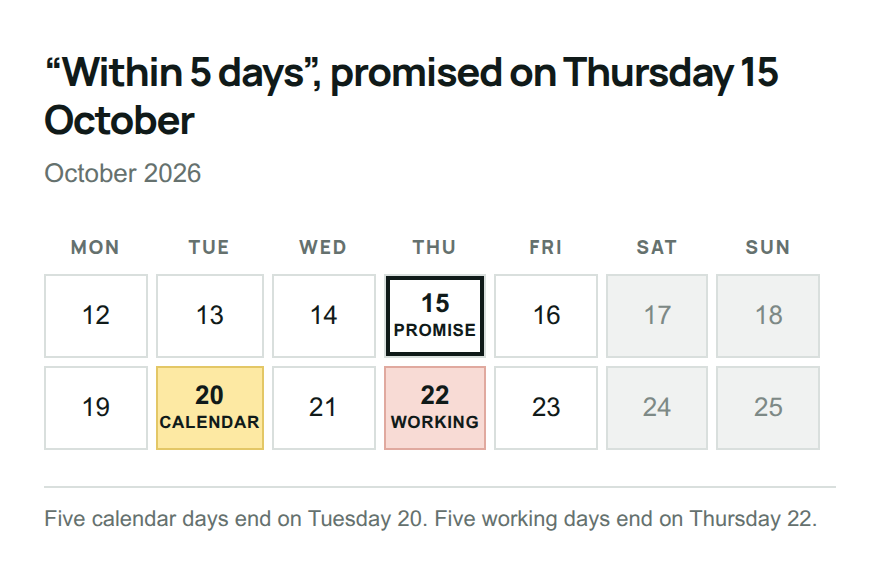
If that promise is made on Thursday 15 October, five calendar days ends on Tuesday 20 October and five working days ends on Thursday 22 October. Nothing in the sentence tells the customer which. Even formal rulebooks switch between the two: the Civil Procedure Rules for England and Wales (rule 2.8) leave out Saturdays, Sundays and bank holidays when a period is five days or less, and count them when it is longer.
Write: We’ll reply by Thursday 22 October. If you can’t give a date, write “within 5 working days”.
Biweekly, bimonthly, biannual
The project team will meet biweekly.
That is two meetings a month or eight. Cambridge defines biweekly as “happening or appearing every two weeks or twice a week”, and bimonthly as “every two months or twice a month”. Its entry for biannual gives “twice a year” and then notes that some people use it for once every two years. The American Heritage Dictionary’s usage note on bi- says these words are confused so often that “every two months” or “twice a month” is the better choice.
Write: The project team will meet every second Tuesday, starting on 13 October. Or: The project team will meet twice a week, on Tuesdays and Thursdays.
Decisions, blame and who did what
Sanction
The opening example covers the verb. The noun has the same split, with “approval or permission” in one Cambridge sense and a punishment in another, so “the move went ahead without sanction” has the same problem. Use approve and approval for one meaning and penalise and penalty for the other. Keep sanctions, plural, for the trade and legal kind, where nobody misreads it.
Oversight
The delay was the result of management oversight.
Management was supervising too closely, or management missed something. Cambridge has both: oversight is “a mistake made because of a failure to notice something” and also “responsibility for a job or activity and for making sure it is being done correctly”. In a report that assigns responsibility, that is the one sentence you can’t leave open.
Write: The delay happened because managers did not notice the missing permit. Or: The delay was caused by the extra review step that management added.
“Has oversight of” is safe, because only the supervision sense fits it. So is “an oversight”, which can only be a mistake. The risk is the noun with nothing in front of it, or after “the” or “due to”.
Rent and lease
We leased the second floor in March.
This doesn’t say whether you are the tenant or the landlord. Cambridge defines rent as “to pay or receive a fixed amount of money” for the use of something, and its business entry for lease lists paying and being paid as separate senses. A preposition fixes it.
Write: We leased the second floor from the building’s owner in March. Or: We leased the second floor to a tenant in March.
Moot point
Whether we renew the contract is a moot point.
Cambridge’s entry for moot has “often discussed or argued about but having no fixed or certain answer” and, directly under it, “not important or not relevant, therefore not worth discussing”. The first reading keeps the question on the agenda. The second closes it.
Write: We haven’t decided whether to renew the contract. Or: The supplier has withdrawn, so renewal no longer needs a decision.
British and American readers in the same meeting
Inside one country, readers share the meaning of these two. The trouble starts on a call or an email thread that includes both. Spelling is the other thing that changes for the same readers, and British and American spelling differences covers it.
Table
We agreed to table the pricing proposal.
This is the nearest thing to a true opposite on the page. Cambridge gives the verb table a UK sense, “to suggest the formal discussion of something”, and a US sense, “to delay the formal discussion of a subject until later”. The British attendee prepares to discuss pricing at the next meeting. The American one takes it off their list.
Write: We agreed to put the pricing proposal on the agenda for 20 October. Or: We agreed to postpone the pricing proposal until the new year.
Quite
The first draft is quite good.
Cambridge labels one sense of quite as UK, “a little or a lot but not completely”, and notes that American English usually says “fairly” or “pretty” for it. Its American dictionary gives “to a large degree”. Cambridge’s grammar guide glosses “quite good” as “moderately good but not outstanding”. So a British manager who writes this may be asking for another round of work, and an American writer who reads it may hear praise and stop. Replacing “quite” with another adverb doesn’t help much. Say what happens next.
Write: The first draft is ready to send. Or: The first draft needs more work on sections 2 and 4 before it goes out.
Instructions and notices
Momentarily
The booking system will be offline momentarily.
Cambridge’s first definition of momentarily is “for a very short time”. The second, labelled US, is “very soon”. The notice either warns of a brief interruption or announces that an outage of unknown length is about to start. An American reader has both meanings to choose from, and a British reader has only the first.
Write: The booking system will go offline at 2pm for about five minutes.
Should
You should back up your files before Friday’s upgrade.
Some staff will read a requirement and some will read a suggestion. The authorities don’t agree either. The US National Archives’ drafting guide says should “infers obligation, but not absolute necessity”. The internet standards document RFC 2119 defines SHOULD for engineers as a recommendation that can be set aside where there are valid reasons. If skipping the step has a consequence, say so with “must” and name the consequence.
Write: You must back up your files before 5pm on Thursday. Files that are not backed up will be lost. Or: We recommend backing up your files first. The upgrade is not expected to affect them.
May
Managers may approve overtime in December.
Cambridge’s grammar guide lists two main uses of may: giving permission and expressing a weak possibility. So this either grants managers the authority, or it predicts that some of them might say yes.
Write: Managers are allowed to approve overtime in December. Or: Your manager might approve overtime in December, so ask before you plan on it.
For a word that isn’t on this page
Read your sentence once with each meaning you can think of. If it makes sense both ways, the reader has to guess, so swap the word. Where a date is involved, give the day of the week and the date together: if the two don’t match, the reader will ask, which is better than turning up on the wrong day.
Corrected on 8 October 2026: this page said that table, quite, momentarily and moot point cause no trouble inside one country. That holds for table and quite. Momentarily has both meanings in American use, and the two meanings of moot carry no country label, so those two entries have moved. The page also gave “an oversight” as open to two readings. With “an” in front, it can only mean a mistake.