What an Out-of-Office Message Needs to Say


Thank you for your email. I am out of the office until the 16th with limited access to email. I will respond on my return.
Someone who gets this reply on a Wednesday has to decide whether to wait for you or find another person. The message doesn’t help them decide. It could mean you are back on the 16th, or that the 16th is your last day away. “Limited access” could mean you will see their email tonight or not at all. And nobody else is named, so if the matter is urgent they are stuck.
An auto-reply is read by a person with a problem, and they need four facts from it:
- The day you are back at work.
- Whether you will read their message before then.
- Who to contact if it can’t wait, and how.
- What that person can deal with, if it is not everything.
The reason you are away is not on the list. Mention it if you like, but the sender can act without it.
Unless one says otherwise, the examples on this page describe the same made-up absence: away from Monday 9 November 2026 to Friday 13 November, back at work on Monday 16 November.
Date wording that leaves the sender guessing
- “away until the 16th” Back on the 16th, or back on the 17th? Write: back at work on Monday 16 November.
- “out through Friday” Clear to American readers, unfamiliar to many others. Write: my last day away is Friday 13 November.
- “back next week” Which week? The sender doesn’t know when you wrote it. Write: back at work on Monday 16 November.
- “returning Monday” Which Monday? Write the date with it.
- “back on 7/12” 7 December, or July 12? Write: back at work on Monday 7 December.
- “limited access to email” Should they expect any answer before you return? Write: I won’t be reading email, or I’ll check it once a day.
Until and through
The dictionaries don’t settle “until”. Cambridge defines it as “up to (the time that)” and the Oxford Advanced Learner’s Dictionary as “up to the point in time or the event mentioned”. Neither says whether the named day is inside the period or outside it, so “away until the 16th” can be read as away up to the moment the 16th begins, or up to the end of it.
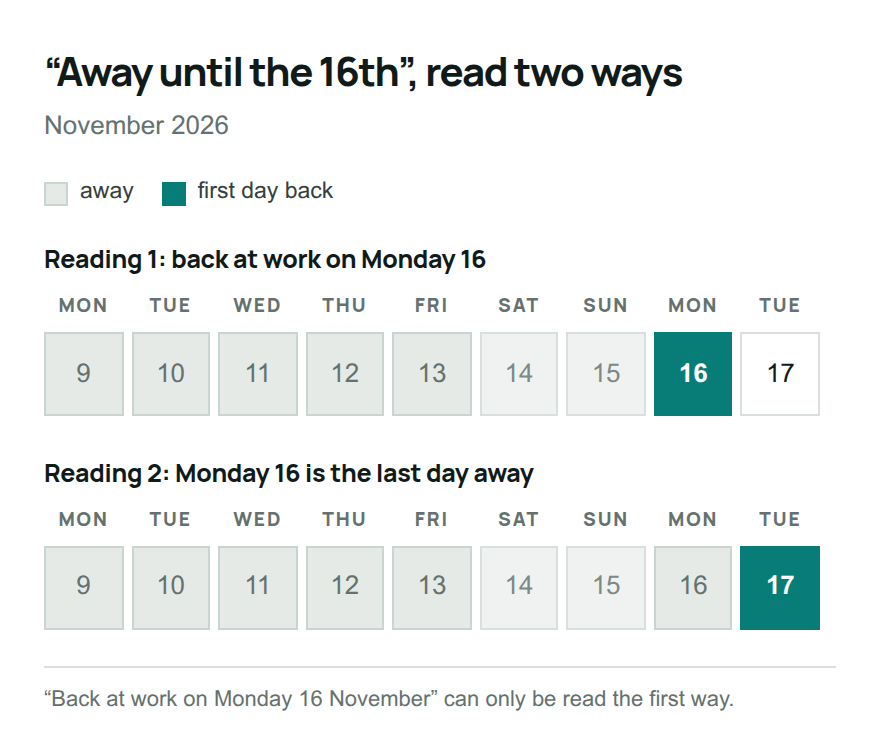
American English has “through”, which does include the last day: Oxford labels that sense North American and defines it as “until, and including”. So “out through Friday” is precise if every reader is American, and some readers elsewhere will take it for “until”. The first day you are working again is safe with both groups.
Next week, Monday, 7/12
You write an auto-reply once and people read it on every day of your absence. “Next week” and “Monday” are measured from the day you typed them, which the sender can’t see. A date fixes that, but not a date in numbers: Cambridge’s grammar guide notes that British English puts the day first and American English puts the month first, so 7/12 is two different days. Write the month as a word and put the weekday in front of it.
The same doubts turn up in deadlines and notices. Words your reader can take two ways covers “by Friday” and “within 5 days” alongside “until” and “through”.
Three more replies, and what each leaves out
The one that points at nobody
Before
I’m on annual leave and back next week. For anything urgent, please contact a colleague.
The sender doesn’t know which colleague, or whether that colleague handles their kind of question. A customer with a late delivery and a supplier chasing an invoice may need different people.
After
I’m away from Monday 9 November and back at work on Monday 16 November. I won’t be reading email while I’m away. If it can’t wait and it’s about orders or invoices, contact Dana Reyes (dana@example.com). Anything else will get a reply from me in the week I’m back.
The one with half the facts
Before
I will be out of the office through Friday, returning Monday. For urgent matters, contact Dana.
This has a return day with no date and a name with no address. Someone outside your company has no way to find Dana. If the reply is still switched on the following week, “Friday” and “Monday” point at the wrong days.
After
I’m away from Monday 9 November. My last day away is Friday 13 November and I’m back at work on Monday 16 November. I won’t be reading email. If it can’t wait, contact Dana Reyes at dana@example.com.
The joke
Before
I’m on a beach and not thinking about work, sorry! I’ll get to your email when I’m back.
It contains none of the four facts. I like a joke in an auto-reply, and the joke isn’t the problem. A message can be friendly and still say when you return, so keep the first line if it suits your workplace and add the facts under it.
After
I’m on a beach and not thinking about work. I’m back at my desk on Monday 16 November and I won’t see email before then. If it can’t wait, contact Dana Reyes (dana@example.com).
Build yours
The form below writes the message from your dates and the name of whoever is covering. It turns each date into a weekday, day and month, so you can’t end up with “until” or “next week”.
Build your out-of-office message
Runs in your browser. Nothing you type is sent anywhere.
With 9 November as the first day away, 16 November as the first day back, “No” for reading email, and Dana Reyes covering orders and invoices, it produces this:
Thanks for your email. I’m away from Monday 9 November and back at work on Monday 16 November.
I won’t be reading email while I’m away. I’ll reply after I’m back.
If it can’t wait and it’s about orders and invoices, contact Dana Reyes (dana@example.com).
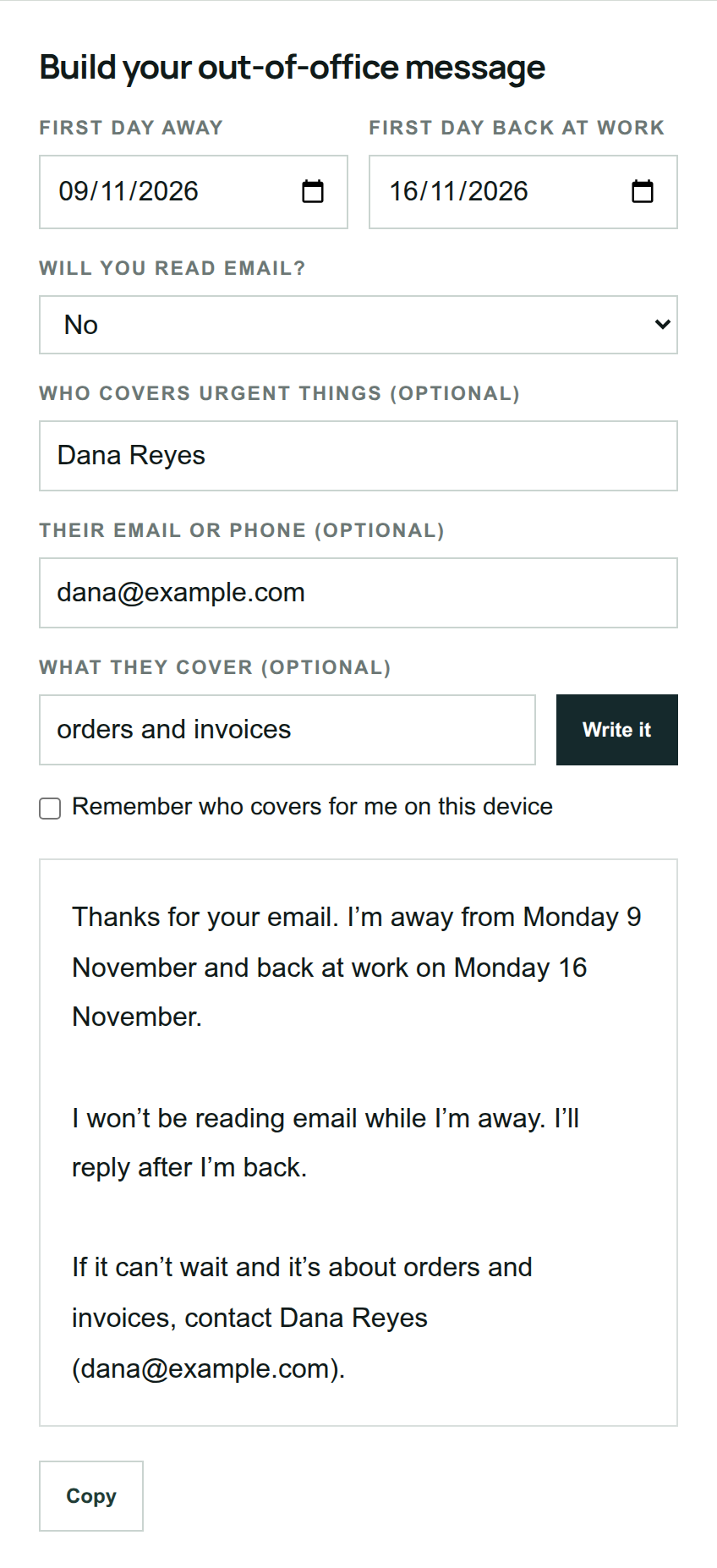
Leave the cover boxes empty and the last paragraph becomes “Nobody is covering my inbox while I’m away. I’ll reply in the week I’m back, starting Monday 16 November.” The form leaves out the year, and it writes dates day first, so American writers may want to swap “9 November” to “November 9” after copying. Edit the result as much as you like. Nothing you type is sent anywhere.
The form asks for your first day back. Your email program may ask for something else. Gmail’s vacation responder takes a start date and an end date, and Google’s help page says the reply “ends at 11:59 PM on the end date”. So the end date there is your last day away (Friday 13 November in our example), not the day you return.
The awkward cases
You’d rather not name a colleague
Maybe nobody is covering, or you don’t want to send every sender to one person’s inbox. Use a shared address or a team name if there is one. The form accepts “the support desk” as the name and a shared address or phone number as the contact. If there is nobody, say so plainly, which is what the form does when you leave the name and contact boxes empty. That is still an answer to the third fact:
I’m back at work on Monday 16 November and I won’t be reading email before then. Nobody is covering my inbox, so I’ll reply in the week I return.
You don’t know when you’ll be back
Illness and family leave often have no end date, and the form above can’t help, because it asks for one. Don’t guess a date to fill the gap. People plan around a return day, so a wrong one does more harm than none. The sender needs the other facts more than usual: say that you have no date yet, say that you are not reading email, and name someone who can deal with everything, because “it can wait for me” is no longer an answer you can give.
I’m away from work and don’t have a return date yet. I’m not reading email. Dana Reyes (dana@example.com) is looking after my work until I’m back, so please write to Dana.
You work part-time and are not in today
This is a standing message, so dates are the wrong tool and the form above doesn’t fit. Give your working days and say when a message sent on the other days gets read.
I work Monday to Wednesday. Emails sent on a Thursday or Friday are read the following Monday. If it can’t wait until then, contact the office at office@example.com.
You are leaving the job
The four facts change. There is no return day, so the sender needs your last day, the fact that the mailbox will not be read after it, and the name of whoever is taking over. Don’t promise that messages will be forwarded unless you know they will be.
I left Northgate Supplies on Friday 13 November 2026 and this mailbox is no longer read. For orders and invoices, contact Dana Reyes (dana@example.com). For anything else, contact office@example.com.
This one does need the year, because it may stay switched on for months.
Colleagues and outsiders get different messages
If your work account is on Outlook with Microsoft 365 or Exchange, you can write two replies: Microsoft’s instructions describe separate tabs for “Inside My Organization” and “Outside My Organization”. The same page warns that a reply to everyone outside goes to newsletters, advertisers and possibly junk senders too, and recommends limiting it to your contacts.
That warning tells you what belongs in each version. The outside one should carry the four facts and nothing you wouldn’t want a stranger to have: no mobile number, no detail about where you are, and a shared address in place of a named person if you prefer.
Thanks for your email. I’m back at work on Monday 16 November and I won’t be reading email before then. If it can’t wait, contact office@example.com.
The inside one can be more useful because your colleagues know the work. Split the cover by subject so nobody has to ask around.
I’m away from Monday 9 November and back on Monday 16 November, not reading email. Dana Reyes has the Whitby order and supplier invoices. Tomas Okoro has the holiday bookings. Anything else can wait for me.
Gmail’s vacation responder has one message for everyone, with a tick box to send it to your contacts only. If you can only have one version, write the outside one.