How to Tell Customers Your Prices Are Going Up

A price notice has two jobs: give the new price and give the date. This page starts with wording you can copy, at four sizes: a door sign, an invoice line, a text and an email. After that comes a letter built from the stock phrases of three published templates, taken apart phrase by phrase, so you can see what each one costs you.
What the customer needs from you
Four things, with the price and the date first.
- How much. The old price and the new one, in money. A percentage alone leaves the customer to work out their own bill.
- From when. The day of the week and the full date. Then say what the date applies to. “From 1 February” can mean work booked from then or work done from then, and a customer with a booking in the diary needs to know which.
- What stays the same. Prices that aren’t moving, and anything else they might worry is changing with it.
- What they can do. Book before the date, if you’re allowing that, and how to reach you.
A reason is optional and goes after those. So do thanks, as a sign-off.
The same notice at four sizes
All four are for the same invented shop and the same rise. Swap in your own figures and dates. In these versions the shop honours today’s price for anything booked by the Saturday before the rise. If you won’t be doing that, replace that sentence with “These prices apply to all work done from Monday 1 February.”
A sign for the door or counter
Service prices from Monday 1 February 2027
Standard service £60 (now £55)
Full service £105 (now £95)
Puncture repair stays at £12Book by Saturday 30 January and you pay today’s price, whenever the work is done.
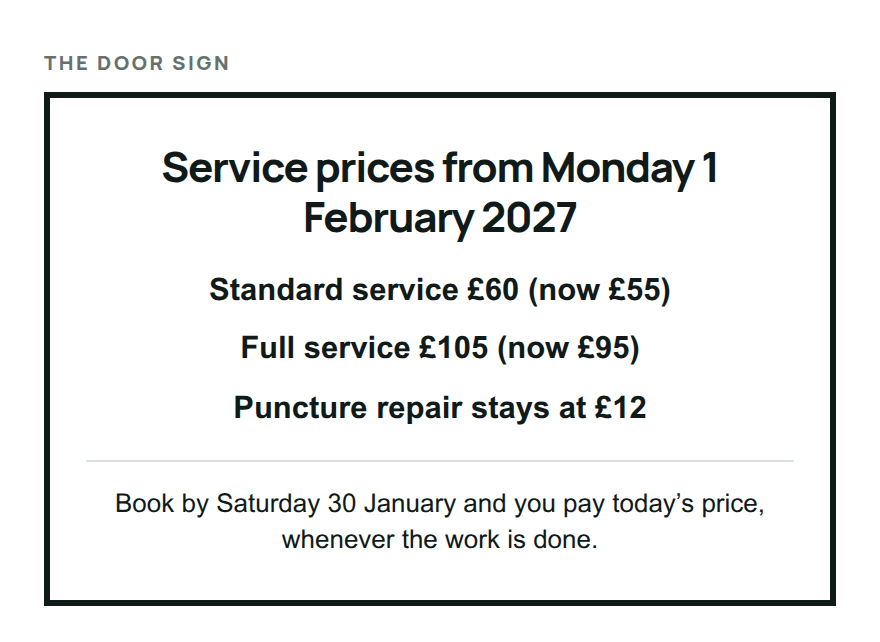
No greeting, no reason and no thanks. Someone reading a sign while holding a bike wants the lines they can act on. If they want to know why, they’re standing at your counter and can ask. On 1 February, take the sign down or reprint it without the “now” prices and the last line.
A line on an invoice or a quote
On an invoice, under the total:
From Monday 1 February 2027 a standard service will be £60 (currently £55) and a full service £105 (currently £95). Other prices are not changing.
On a quote, the customer’s question is whether the figure in front of them will hold:
This quote is at our current prices and holds if you book by Saturday 30 January 2027. For bookings made from Monday 1 February the price for this job will be £105.
An invoice line works as a first notice for regular customers because they read it at the moment they’re thinking about what you charge. It shouldn’t be the only notice for a large rise, since plenty of invoices are paid without being read to the bottom.
A text or chat message
Hi Maya, it’s Sam at Harbour Cycles. From Mon 1 Feb a standard service is £60 (now £55) and a full service £105 (now £95). Book by Sat 30 Jan to pay today’s price. Reply here or call 01632 960123.
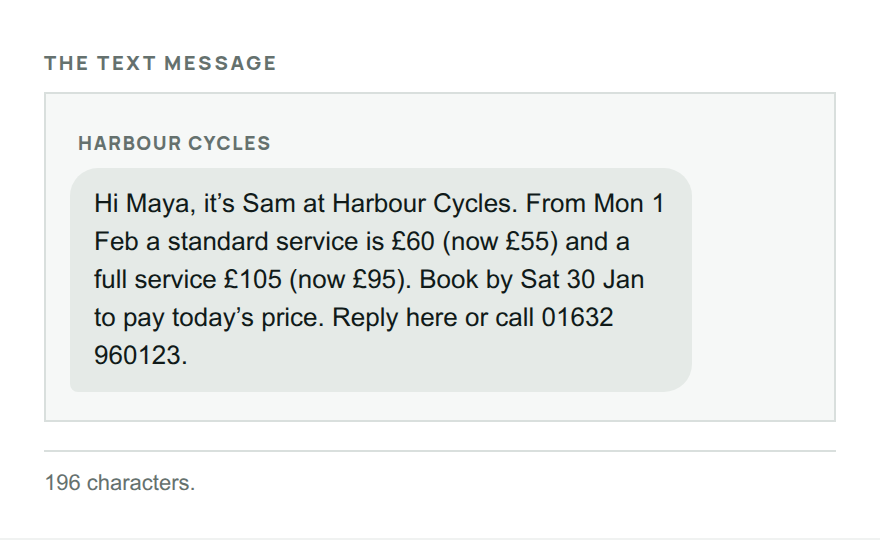
That’s 196 characters. The name and “it’s Sam” do the work that a paragraph of thanks does in a letter: they show a person wrote it to a person. If you send the same text to your whole list, drop “Hi Maya” and start with the shop’s name.
An email
Subject: Harbour Cycles service prices from 1 February
Hi Maya,
From Monday 1 February 2027 our two service prices go up:
Standard service: £60 (now £55)
Full service: £105 (now £95)Nothing else is changing. Puncture repairs stay at £12, and you still get a free safety check a month after any service.
If you book by Saturday 30 January you’ll pay today’s price, even if the work is done in February. To book, reply to this email or call 01632 960123.
The rise covers what we now pay for parts, which is the cost that has gone up most for us this year.
Thanks,
Sam
Harbour Cycles
It’s 108 words, against 157 for the standard letter taken apart further down this page, and it carries more: what isn’t changing, what a booking before the date gets you, a phone number and a named person. The prices sit on their own lines so they can be found again when the customer opens the email a second time in late January. The reason is one sentence and names one cost. If your real reason is that you haven’t raised prices in three years, say that. As a customer it is the reason I’d most like to read: it is short, and it is true of your shop and nobody else’s.
An email has room for one more paragraph, and it’s tempting to spend it on gratitude. Spend it on a customer-specific fact if you have one: “Your service plan renews on 14 March, so your first payment at the new price will be then.”
A letter made of the stock phrases
We wrote this one ourselves, for the same invented bike shop, out of phrases in three letter templates that rank for this search. It is a composite and not a quotation from any one site, and it is worse than any one of them, because it puts all the habits in one place.
Subject: Important update regarding our pricing
Dear Valued Customer,
Thank you for your continued support of Harbour Cycles. Since we opened in 2019 it has been a pleasure looking after you and your bikes, and your loyalty means everything to us.
As you may be aware, the past year has brought significant challenges for small businesses like ours. Due to rising costs, and after a great deal of consideration, we have made the difficult decision to make a small adjustment to our pricing structure. In order to continue providing the high level of service you have come to expect, the price of a standard service will increase from £55 to £60 and a full service from £95 to £105, effective 01/02/27.
We have done everything in our power to keep this increase to a minimum.
If you have any questions, please do not hesitate to contact us. We appreciate your understanding.
Kind regards,
The Harbour Cycles Team
The parts come from templates we read while writing this page. Invoicefly’s has the subject line “Important Update: Pricing Changes”, opens “Thank you for being a valued customer” and closes “We appreciate your understanding”. Simply Business’s formal version has “After a lot of consideration”, “a small increase”, “This unavoidable increase” and “We’ve done everything in our power to minimise the increased cost”. Housecall Pro’s has “To continue providing the level of service you expect”. None of the three apologises, and Simply Business says on the same page that you don’t need to. Its template also does two things ours leaves out on purpose: it tells you to name the cost behind the rise, and it has a line for your phone number.
Where the price is
The first figure a customer cares about, £55 to £60, arrives after 108 words of a 157-word notice, counting from the subject line. The date is the very last thing in that sentence. Everything before it is about the shop: its gratitude, its year, its costs, its difficult decision.
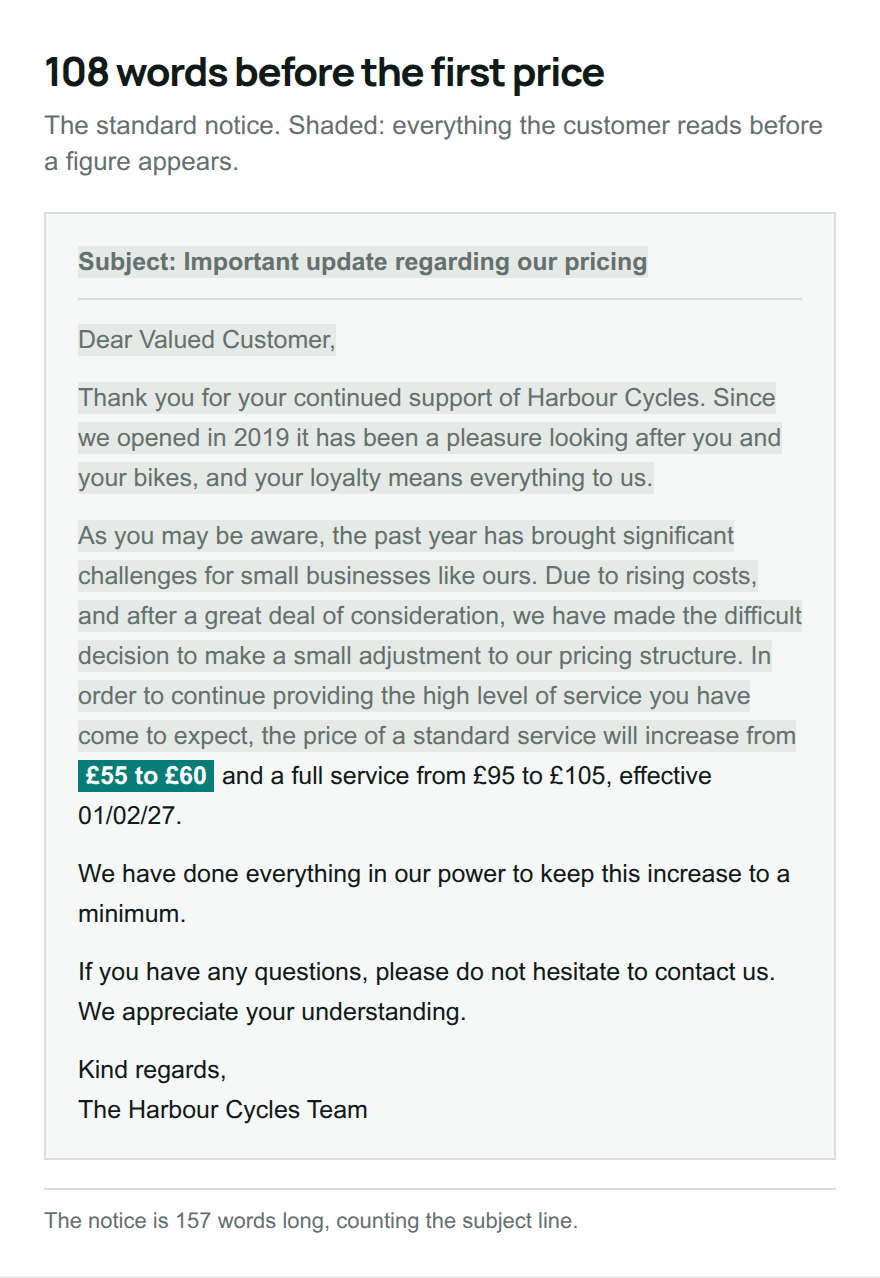
A customer who opens this is looking for two things, a price and a date. The subject line could have held both and holds neither. “Important update” tells them only that something is coming, and the two paragraphs that follow make them wait for it. By the time the numbers appear, a £5 rise has had the build-up of bad news.
The phrases, one at a time
- “Important update regarding our pricing”. Says there is news without giving it. Put the news in the subject: “Service prices from 1 February”.
- “Dear Valued Customer”. If they were valued you would know their name. Use the name, or on a notice to everyone, no greeting at all.
- “As you may be aware, the past year has brought significant challenges”. It asks the customer to think about your year before they know what you want from them. Cut it.
- “Due to rising costs”. It names no cost. It would be equally true of any business in any year, so it explains nothing about yours. Name the one cost, after the price: “what we pay for parts”. Or give no reason.
- “after a great deal of consideration, the difficult decision”. This is about how you felt. The customer can’t check it and didn’t ask. Cut it.
- “a small adjustment to our pricing structure”. “Adjustment” could go either way and “structure” suggests something complicated. “Small” is the customer’s call to make, and the figures follow anyway. “Our prices go up.” Then the figures.
- “In order to continue providing the high level of service you have come to expect”. Read literally, it says the service would get worse if they didn’t pay more. It also praises you in the sentence that asks for money. Cut it. Say what stays the same instead.
- “effective 01/02/27”. In the UK that is 1 February. In the US it is 2 January: Cambridge’s grammar guide notes that American English puts the month first. “From Monday 1 February 2027”.
- “We have done everything in our power to keep this increase to a minimum”. An unprovable claim, placed where the customer was hoping for information. Cut it.
- “please do not hesitate to contact us”. No number, no address, no name. “Reply to this email or call 01632 960123.”
- “We appreciate your understanding”. It thanks the customer for agreeing before they have. “Thanks”, and your name.
- “The Harbour Cycles Team”. A small shop signing as a team reads like a call centre. Sign it with a person’s name.
Two of those need more room.
The reason. Every template we read tells you to explain why, and a reason is fine. The trouble is where it goes and how much room it takes. Put before the price, a reason reads as a defence prepared in advance, and the more of it there is, the more the customer wonders what’s coming. Put after the price, in one sentence, it reads as an answer to a fair question. “Unavoidable” is worth dropping wherever it sits, because it invites the reader to think of ways you could have avoided it.
The soft words. Simply Business’s page tells readers to “avoid euphemisms like ‘price update’ or ‘adjustment’”, which is right. Its own casual template then says the rate “will be increasing slightly” and calls the rise “a small tweak”. That shows how hard the habit is to break. The plain verbs are go up, rise and increase, and you don’t need an adverb with them. If the rise is small, £55 to £60 says so.
If your customers are on a contract
For anyone on a contract, a subscription or a fixed-term plan, check your own contract or terms before you send anything. They may set how much notice you have to give and in what form, and the wording above doesn’t change that.