Words That Sound Smarter Until You Put Them in a Sentence


Please accept our fulsome apology for the delay to your order.
The writer wanted a bigger word than “full”. The Oxford Learner’s Dictionary marks fulsome as disapproving and defines it as “too generous in praising or thanking somebody, or in saying sorry, so that you do not sound sincere”. One of its example phrases is “a fulsome apology”. So the customer who knows the word has just been told the apology is overdone and insincere.
That is the pattern on this page: a word picked because it sounds more formal or more educated than the plain one, in a sentence where it says something else or breaks the grammar it was meant to polish. The sentences are made up. The verdicts are not: each one comes from a dictionary or a style guide, named where it is quoted, and several come from the American Heritage Dictionary’s Usage Panel, a group of writers and scholars the dictionary surveyed on disputed points. The percentages are theirs. Where the authorities disagree with each other I say which way I’d go, and you are free to go the other.
The word means something else
These are the costly ones, because the reader gets a different message from the one you sent.
Fulsome
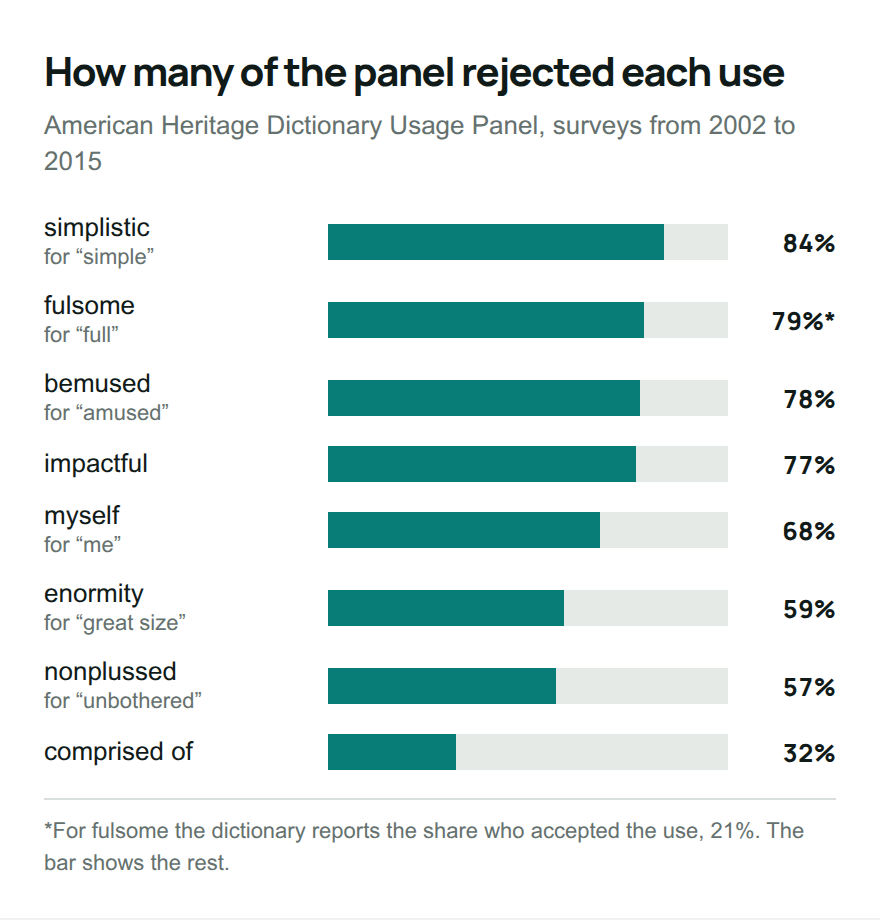
The opening example. The older sense of “abundant” does exist, but the American Heritage usage note on fulsome reports that only 21 percent of its panel accepted “a more detailed and fulsome discussion” in 2012, and advises keeping the word for praise that is clearly excessive. The Guardian’s style guide is blunter: “Not a fancy word for full”.
Write: Please accept our full apology for the delay to your order. Or better, “We’re sorry your order was late.”
Penultimate
We believe this is the penultimate stock-control system for small warehouses.
Penultimate means “immediately before the last one”. It is not a stronger “ultimate”. The University of Richmond’s writing centre notes that the word “gets employed to mean ‘the best of the best'” and calls that incorrect. A buyer who knows the word reads the sentence as “second to last”, which is no kind of boast.
Write: We built this stock-control system for small warehouses. Then say what it does better.
Simplistic
We’ve kept the new expenses form simplistic so that claims take two minutes.
Simplistic is a criticism. Cambridge defines simplistic as “making something complicated seem simple by ignoring important parts of it”. The sentence tells staff the form leaves out things it should ask. Using it for “simple” was rejected by 84 percent of the American Heritage panel in 2011.
Write: We’ve kept the new expenses form simple so that claims take two minutes.
Enormity
The board would like to recognise the enormity of what the support team achieved this year.
This one is disputed, so here are both sides. The Oxford Learner’s Dictionary accepts size as a meaning and gives “the enormity of the task” as an example. The Guardian’s style guide says enormity “refers to something monstrous or wicked” and “is not just another word for ‘big'”. The American Heritage panel split 59 to 41 against the size sense in 2002, and its note adds that even if you allow it, the word’s sense of monstrousness “may give rise to unintended smirks” when the subject is good news. Praise is exactly where that happens. I’d leave the word out of anything meant kindly. The dictionary may be on your side, but a thank-you is a bad place to find out which side your reader is on.
Write: The board would like to recognise how much the support team achieved this year.
Nonplussed
I walked the finance director through the overspend and she was nonplussed, so we can go ahead.
The writer means she wasn’t bothered. Oxford Learner’s defines nonplussed as “surprised and confused so that you do not know what to do or say”, and Cambridge agrees. Read that way, the finance director was thrown by the overspend and “so we can go ahead” makes no sense. The “unbothered” sense is real and spreading: Dictionary.com lists “not dismayed; indifferent or unexcited; calm” as a second meaning, while noting that many writers “consider it nonstandard and avoid it as potentially confusing”. American Heritage found 57 percent of its panel rejecting it in 2013. A word with two opposite readings is a bad choice for reporting someone’s reaction, whichever reading you think is right. We have a separate page on words your reader can take two ways.
Write: She wasn’t concerned about the overspend, so we can go ahead.
Bemused
The client was bemused by the mascot concepts and has asked to see more.
Bemused sounds like a refined “amused”. Cambridge defines bemused as “slightly confused”. Some dictionaries now record the newer use: Dictionary.com gives “mildly amused, especially in a detached way” as a third sense. But 78 percent of the American Heritage panel rejected it for “amused” in 2005, and a colleague who reads the sentence the standard way will think the client didn’t understand the concepts.
Write: The client liked the mascot concepts and has asked to see more.
i.e.
Please bring photo ID on your first day, i.e. a passport.
Both abbreviations look scholarly and they are not interchangeable. Cambridge says i.e. comes before information “that makes the meaning of something clearer or shows its true meaning”, and that e.g. means “for example”. So the sentence above says photo ID means a passport, and the new starter with only a driving licence has a problem. The GOV.UK style guide tells its writers to avoid both, because “ie” is “not always well understood”.
Write: Please bring photo ID on your first day, for example a passport or driving licence.
Seven that are not wrong, only heavier
None of these is an error, and the reader understands you. They also notice that you chose the long word. The style guides are short about them: the whole of the GOV.UK entry for one is “utilise, use ‘use'”, and the Guardian’s for another is “the word you want is ‘before'”.
- Utilize: use. American Heritage keeps a narrower meaning for it, “to put to use, especially to make profitable or effective use of”, so a timetable can utilize the two quiet hours after lunch. Nobody utilizes a side entrance.
- Leverage: use, unless something is being turned into something bigger. American Heritage’s example is people who “leveraged their personal contacts to find new investors”. A spreadsheet that tracks orders is just being used.
- Prior to: before.
- In order to: to. GOV.UK’s guide says “usually not needed”.
- Whilst: while. Cambridge labels whilst “UK formal” and American Heritage marks it “chiefly British”, so an American customer will read it as British as well as stiff. The Guardian, a British paper, rules “while not whilst”.
- Methodology: method, and often neither. In American Heritage’s definition a methodology is “a body of practices, procedures, and rules used by those who work in a discipline”. A survey has one. Booking a meeting room in the shared calendar does not.
- Impactful: the word is in dictionaries and many readers dislike it anyway. 77 percent of the American Heritage panel found it unacceptable in 2015. Swapping in “effective” doesn’t fix the sentence, because the real gap is that it never says what the impact was. “Four teams have already changed their checklists because of the workshop” does.
The grammar has been corrected into an error
In each of these, “me” or “who” was right and the writer reached past it for the form that sounds more correct. Linguists call that hypercorrection. American Heritage mentions it as one explanation for “between you and I”, while adding that it “cannot be the whole story”.
Myself
Please send your comments to Nadia or myself by Thursday.
American Heritage’s note on myself is fair to both sides: this use has “been common in the writing of reputable authors for several centuries”, and 68 percent of its panel still rejected “The boss asked John and myself to give a brief presentation” in 2009. The test is to remove the other person. Nobody writes “send your comments to myself”.
Write: Please send your comments to Nadia or me by Thursday.
“And I” where “and me” belongs
Thank you for inviting Priya and I to the launch.
Same test: “thank you for inviting I”. After a verb or a preposition the pronoun is “me”, however many people share the slot. American Heritage points out that “between you and I” is in Shakespeare, so it is not a modern invention, and then says it is “widely regarded as a mark of ignorance and is best avoided in formal contexts”.
Write: Thank you for inviting Priya and me to the launch.
Whomever
Please forward this to whomever is handling the Brennan account.
“To” seems to call for “whom”. But the word is the subject of “is handling”, and the whole clause is what follows “to”. American Heritage’s note on who covers exactly this structure and calls whom “an error” in it. The Guardian’s advice for anyone unsure is that it is “much better to use ‘who’ when ‘whom’ would traditionally have been required than to use ‘whom’ incorrectly for ‘who'”. The one place whom is still expected is directly after a preposition: “the client for whom we built it”.
Write: Please forward this to whoever is handling the Brennan account.
Two you may be corrected on although the dictionaries are on your side
Comprised of
The project team is comprised of four engineers and a designer.
The traditional rule is that the whole comprises the parts, so “is comprised of” is wrong and it should be “The team comprises four engineers and a designer”. Lists of misused words still say so. The dictionaries have moved. Oxford Learner’s gives “be comprised of” as a standard form with the same meaning. American Heritage records the share of its panel objecting falling from 53 percent in the 1960s to 32 percent in 2011. That still leaves about a third of careful readers who will mark it. The form Oxford does call incorrect is the active “comprises of”.
Write: The project team is four engineers and a designer. Or “is made up of”, which nobody objects to. That is what I’d write, and I’d keep the argument for something that matters more.
A myriad of
We offer a myriad of services to small businesses.
You may have been told that myriad is only an adjective (“myriad services”) and that “a myriad of” is a mistake. American Heritage’s note on myriad says the noun came first, the adjective arrived through poetry in the 1800s, and “both uses are acceptable today”. The trouble with the sentence is different. Myriad tells the customer there are a lot of services and none of what they are.
Write: We do bookkeeping, payroll and VAT returns for small businesses.