Log In or Login? The Same Rule Settles Set Up, Back Up and Sign Up


If it’s something you do, write two words: log in, set up, back up. If it’s a thing, or it describes a thing, write one word or a hyphenated one: a login, the setup, a backup copy, a follow-up email.
Please log in to set up your account.
Your login is your email address, and the setup takes five minutes.
A quick test when you’re unsure: put the word in the past. If the sentence still works with logged in or backed up, you have a verb and it needs the space. Nobody writes “I loginned yesterday”.
The same rule covers every pair on this page, and the checker below applies it to your own text.
Check your own text
Paste a message below, or press “Try the example”. Nothing you paste leaves your browser.
One word or two? Check your text
Runs in your browser. Your text is not sent anywhere or stored.
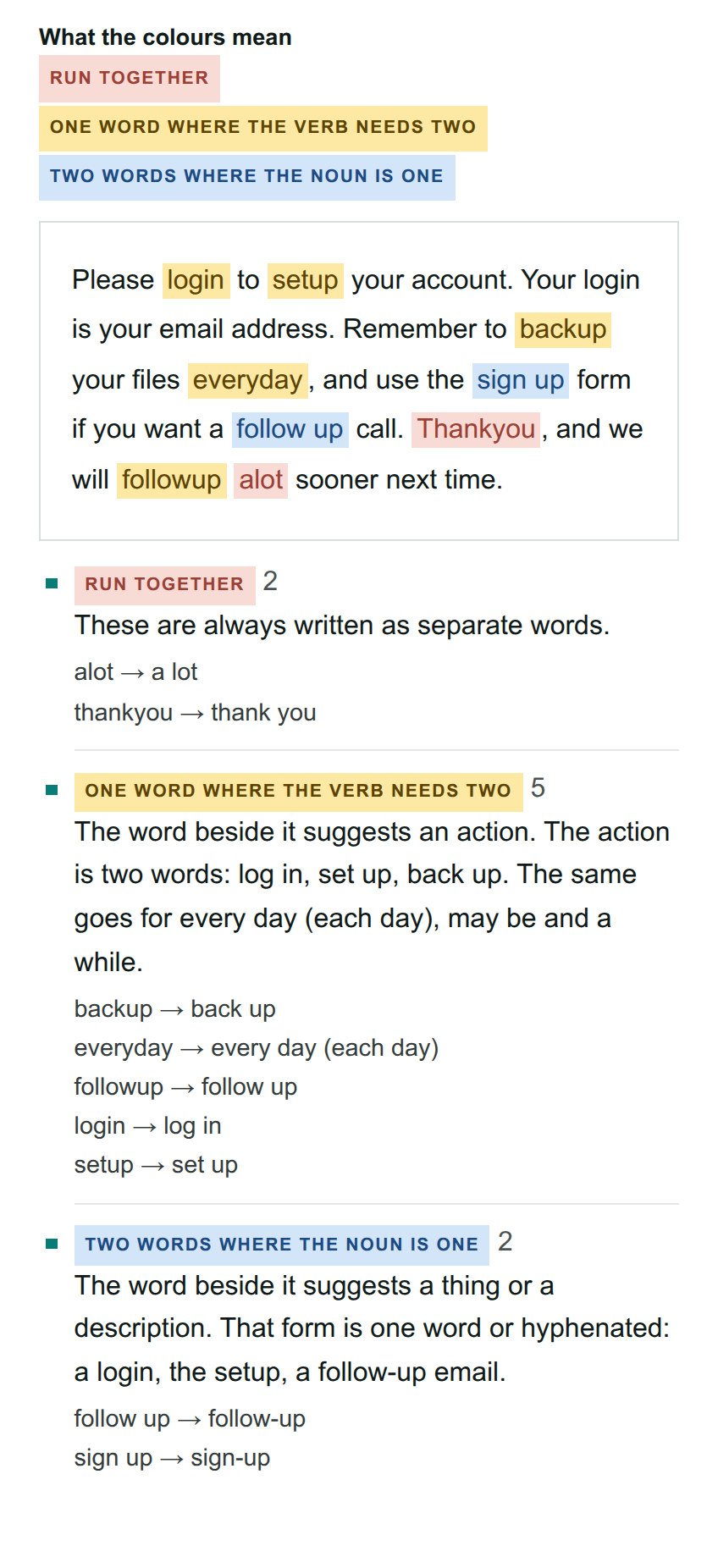
The example has nine mistakes. A spellchecker catches two or three of them: Hunspell’s American dictionary flags Thankyou and alot, and the British one those two and followup. The checker marks all nine and leaves the correct login in the second sentence alone:
- Red, run together: Thankyou and alot. This group is 27 forms that are never one word, each shown with its fix.
- Yellow, one word where the verb needs two: login, setup, backup, followup and everyday.
- Blue, two words where the noun is one: sign up (form) and follow up (call), with sign-up and follow-up given as the fix.
It knows 19 verb pairs: the 13 in the table below plus log on, log out, sign in, check in, shut down and print out. It also knows the four pairs listed under that table. It reads the word next to each form and does not understand the sentence, so the last section of this page says how it decides and what it got wrong when we tested it.
The pairs
| The verb | The noun or adjective |
|---|---|
| log in | login |
| set up | setup (US), set-up (UK) |
| back up | backup |
| check out | checkout |
| sign up | sign-up |
| follow up | follow-up |
| hand over | handover |
| roll out | rollout (UK also roll-out) |
| break down | breakdown |
| work out | workout |
| start up | start-up (US also startup) |
| clean up | clean-up (UK), cleanup (US) |
| kick off | kick-off (UK), kickoff (US) |
We checked every row in Cambridge Dictionary, Oxford Learner’s Dictionaries and the American Heritage Dictionary. In all three the two-word form is the verb and the joined or hyphenated form is a noun or adjective. None of them lists login, setup or backup as a verb.
Where they disagree is the hyphen, and it mostly follows the Atlantic. American Heritage has setup. Oxford Learner’s has only set-up, and a search there for “setup” returns “Word not found”. Cambridge gives set-up in its British entry and setup in its American one, and marks cleanup and kickoff as the American spellings of its hyphenated British entries. Start-up is hyphenated in Cambridge and Oxford Learner’s, while American Heritage puts startup first and gives “follow-up or followup”. Signup as one word is in none of the three, so keep that hyphen.
If you write for both markets, the forms with no variation are the safe ones: login, backup, checkout, handover, breakdown, workout. For the rest, pick one spelling per document. If you asked me to pick, I’d take the hyphen every time: set-up, sign-up, follow-up. A hyphenated form can’t be mistaken for the verb, and Hunspell accepted every one we tried, with both dictionaries. Our British and American spelling page has a checker for mixed spellings generally.
Four more pairs that split the same way
- every day, everyday. Every day means each day. Everyday is an adjective meaning ordinary, and Oxford Learner’s marks it “only before noun”: we deal with everyday problems every day.
- may be, maybe. Maybe means perhaps. May be is a verb: it may be late. Cambridge has a short grammar note on the pair.
- a while, awhile. Both exist, but after for or in only a while is right, according to the usage note in American Heritage.
- any time, anytime. All three dictionaries list anytime as an adverb only (call me anytime), and Oxford Learner’s makes any time the main British form. After at you need the noun, so write at any time.
A lot has no one-word form. Alot is in none of the three dictionaries.
What a spellchecker does with them
We ran the one-word forms through Hunspell 1.7.2, which is the spellchecker in LibreOffice, Firefox and Chrome, with its American dictionary (Ubuntu package hunspell-en-us 2020.12.07) and its British one (hunspell-en-gb 24.2.1). The command was hunspell -d en_US -l, then the same with en_GB. It lists the words the dictionary doesn’t recognise.
Of the 13 joined forms in the table (login, setup, backup, checkout, signup, followup, handover, rollout, breakdown, workout, startup, cleanup, kickoff), the American dictionary flagged two, signup and rollout, and the British one four: signup, followup, cleanup and kickoff. Neither flagged everyday, maybe, awhile or anytime. Both flagged every one of 27 run-together errors: alot, aswell, incase, infact, upto, atleast, thankyou, eachother, everytime, nevermind, ofcourse, inspite, infront, noone, abit, alittle, eventhough, inorder, ontop, afterall, aslong, nomatter, atall, ontime, incharge, highschool and anyother.
So the two kinds of mistake behave in opposite ways. Alot and aswell are not words, and the spellchecker underlines them every time. Login, setup, backup, checkout, handover, breakdown, workout and startup are real nouns, so they pass in both dictionaries wherever you put them. A spellchecker asks whether a word exists, not whether it’s in the right job.
The flags it does raise are about spelling variety, not grammar. The British dictionary rejects followup, cleanup and kickoff because it wants the hyphen. The American one rejects rollout, which American Heritage accepts, so that flag is a gap in the word list.
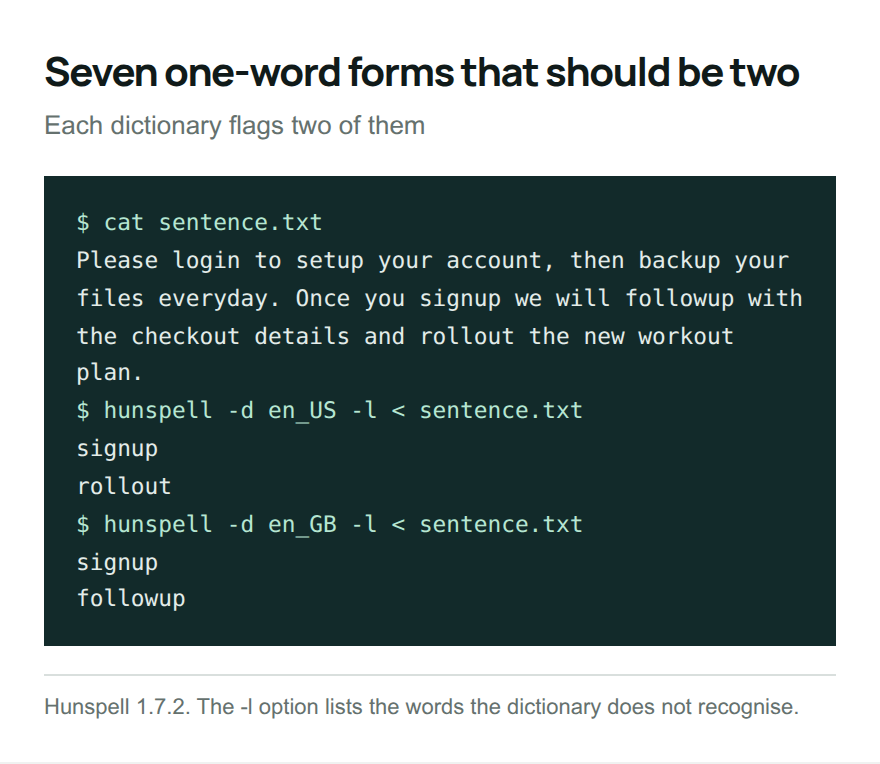
As a sentence test we gave both dictionaries this, which has seven mistakes, six verbs written as one word and everyday for every day:
Please login to setup your account, then backup your files everyday. Once you signup we will followup with the checkout details and rollout the new workout plan.
The American dictionary flagged signup and rollout. The British one flagged signup and followup. Each caught two of the seven. Hyphenated forms always pass, because Hunspell checks each half separately: log-in, set-up and sign-up went through in both. Our longer spellcheck test covers the other kinds of error that get through.
How the checker decides, and where it goes wrong
Login after please, to, can, will, you or we is treated as a verb and flagged. Log in after a, the or your is treated as a noun and flagged. A joined form followed by a noun (login page, backup copy) is left alone, and so is to after words such as go, proceed and prior, because “proceed to checkout” is correct.
We tested it on five texts written for the purpose, 688 words in all, with 48 planted mistakes. Four were run first and the rules were adjusted afterwards, so their final scores flatter the checker. The fifth was written after the rules were fixed and run once. The final results:
- A 178-word text that uses about 30 of these forms, all correctly: nothing flagged. On the first run it wrongly flagged “prior to checkout the customer”, which we fixed.
- The three other texts the rules were adjusted on: 36 of 38 mistakes found, and 2 correct uses flagged.
- The fifth text, 157 words with 10 mistakes: all 10 found and nothing flagged wrongly. That is the only clean test of the five, and it is a small one.
The two it missed:
- “Everyone needs to login before Friday and setup two-step verification.” The first verb is caught. The second has no cue word in front of it, only and.
- “You can login support staff yourself.” It sees a noun after login and assumes “login support”, as in “we offer login support”.
The two it flagged wrongly:
- “Your user login to the old system stops working.” Login followed by to usually is the verb. Here it’s a noun.
- “Signup for the event closes on Friday.” The same problem at the start of a sentence. (The dictionaries would want sign-up there, but the checker’s suggestion, sign up, is wrong.)
So a highlight means “look here”, and an empty result means only that none of its cues matched. If your text contains login, setup or backup joined to another verb with and or or, check that one yourself with the past-tense test from the top of the page.
Corrected on 7 October 2026: the sentence given to the spellcheckers was described as having seven verbs written as one word. Six of its mistakes are verbs. The seventh is everyday where every day is meant.