How to Refuse a Refund Without Starting an Argument


I think most arguments over a refused refund are started by the wording and not by the decision. I can’t prove it, and I know of nobody who has counted. But read a stock refusal as the customer would and notice what you want to write back about. It isn’t the “no”. It is the paragraph of thanks before it, the policy quoted back at you, and the apology for “any inconvenience” at the end.
Below are five refusals built from those stock phrases, each followed by a rewrite and the reasons for every change. The five businesses and their customers are made up.
Check first that you’re allowed to refuse. This article is about wording and assumes you’ve already done that. Often the law requires a refund whatever your policy says. In the UK, GOV.UK’s guidance for businesses says you “must offer a full refund if an item is faulty, not as described or does not do what it’s supposed to”, and that online, mail and telephone order customers can cancel if they tell you within 14 days of receiving the item. In the EU, the Your Europe page on returns says that for the purchases it covers “you can cancel the contract within 14 days without providing any justification”, and lists the exceptions. In the US, the FTC’s Cooling-Off Rule gives buyers “three days to cancel certain sales made at your home, workplace, or dormitory, or at a seller’s temporary location”, and the same page notes that some state laws give more rights. Whether a refusal is allowed in the situations below depends on where you and your customer are. Read the page for your country before you send anything.
The standard refusal, taken apart
A shoe shop. The customer bought walking boots in the shop on 2 June and emails on 20 August: the left heel rubs and she wants her money back. The shop takes returns for 30 days if the boots are unworn.
Before
Dear Ms Okafor,
Thank you for contacting Hartley’s Footwear. We value your custom and appreciate you taking the time to get in touch.
Unfortunately, due to company policy, we are unable to process your refund request at this time. As stated in our returns policy, items must be returned within 30 days of purchase in unworn condition. As your purchase was made on 2 June and the boots have been worn, your request does not meet these requirements.
We apologise for any inconvenience this may cause and hope to see you in store again soon.
After
Dear Ms Okafor,
I can’t refund the walking boots, and I’d like to explain why.
We take returns for 30 days as long as the boots haven’t been worn outside, because after that we can’t sell them as new. You bought yours on 2 June and have been walking in them since, so they’re past the point where we can take them back.
You mentioned the left heel rubs. That’s often a fit problem we can fix. Bring them in and we’ll fit a heel grip and re-lace them, free, in about ten minutes. If it turns out the rubbing comes from a fault in the boot, that’s a different matter and we’ll treat it as a faulty pair.
Dan Hartley
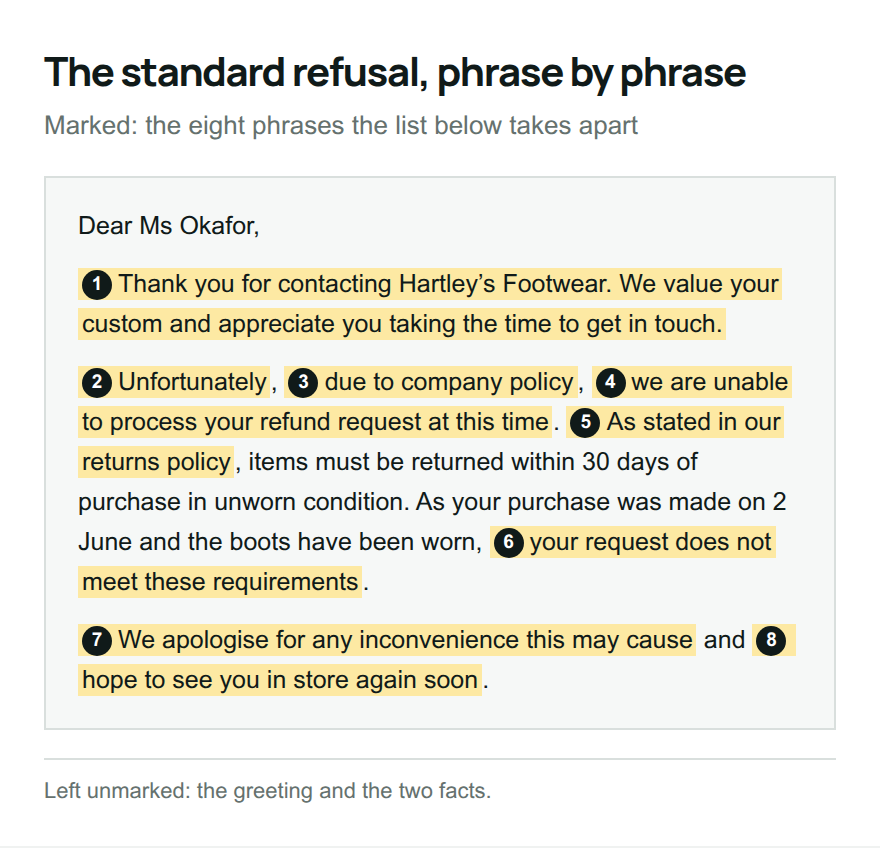
- “Thank you for contacting… We value your custom…” She asked a yes-or-no question. Two sentences of warm-up before the answer tell her it’s no and that you’d rather not say so. In the rewrite the answer is the first sentence.
- “Unfortunately” makes the refusal sound like bad luck that happened to both of you. Somebody decided this. The rewrite drops the word.
- “due to company policy”. The policy is the rule. It isn’t the reason for the rule. And in a shop with four staff, “the company” is the person writing. The rewrite gives the reason: “because after that we can’t sell them as new”.
- “we are unable to process your refund request at this time”. No person and no boots appear in this sentence. Her money has become a “request” to be “processed”. “At this time” suggests the answer might change, which invites a second email. The rewrite says “I can’t refund the walking boots”.
- “As stated in our returns policy” reads as “You should have read it.” The rewrite gives the rule as something the shop does: “We take returns for 30 days”.
- “your request does not meet these requirements”. She has been marked like a form. The rewrite gives the two facts, with the date.
- “We apologise for any inconvenience this may cause”. “Any” and “may” apologise for something you won’t name and aren’t sure happened. The rewrite has no apology for the decision. It has an offer that deals with the rubbing heel.
- “hope to see you in store again soon”. A cheerful sign-off straight after a refusal reads as not having listened. The rewrite ends on what happens if the boot is faulty.
On “I can’t”: use it when the next sentence says what stops you. If the honest position is that nothing stops you except your own rule, “we don’t” is more accurate, as in “we don’t refund missed classes”. Either is better than “we are unable to”, which is “can’t” with the person taken out.
When the mistake was the customer’s
This is where blame gets in. A customer ordered an engraved chopping board online as a birthday present and typed the name as “Cathrine”. It should have been “Catherine”.
Before
Unfortunately we are unable to offer a refund on this occasion. As per our terms and conditions, which you agreed to at checkout, personalised items are non-refundable. You failed to check the spelling before submitting your order, and we are not responsible for errors made by the customer.
After
Hi Robin,
I can’t refund the board. It’s engraved, so I can’t sell it to anyone else.
I’ve checked the order, and the engraving matches what was entered in the name box: Cathrine.
What I can do is make a second board with the right spelling for £18, which is what it costs me, instead of £34. If you confirm the spelling by 3pm tomorrow it will go in Thursday’s post and arrive before the 12th.
“As per”, “which you agreed to” and “you failed to” all make the customer the subject of an accusation. The facts haven’t changed in the rewrite, but the subject of the sentence has: “the engraving matches what was entered”. Robin can see whose typing it was without being told. “We are not responsible for errors made by the customer” is cut altogether, because the sentence before it already says so.
The reason is also specific to this product. “Personalised items are non-refundable” states a category. “I can’t sell it to anyone else” states the problem, and it’s one the customer can picture.
When the reason is “it’s digital”
A knitting-pattern designer sells PDFs. A buyer downloaded a cardigan pattern, found it too hard and asked for her money back.
Before
Thank you for reaching out. Unfortunately, as digital products are non-refundable, we are unable to process a refund for your order. This is clearly stated on the product page. We apologise for any inconvenience caused.
After
Hi Jo,
I don’t refund patterns once they’ve been downloaded, because there’s no way to hand a PDF back.
I don’t want you stuck with a pattern you can’t use, though. Tell me which row you stopped at and I’ll write those steps out in more detail. Or if you’d rather start with something easier, I’ll send you the beginner version of the same cardigan at no charge.
Check the law before you lean on that reason, because a download is not automatically outside the right to cancel. In the EU, the Your Europe page lists digital content among the exceptions only where the buyer started the download “after you expressly agreed to lose your right of withdrawal”. If your checkout doesn’t ask for that agreement, “there’s no way to hand a PDF back” does not settle it. GOV.UK tells British sellers that “there are different rules for downloads and streaming services”, so read those before you refuse.
“Clearly stated” does the most damage in the original. “Clearly” says that anyone paying attention would have seen it. If you need to mention where the rule is written, leave the adverb out, and consider whether you need to mention it at all. The customer isn’t asking where the rule is. She’s asking you to make an exception.
The offer is written so that she can take it by replying with one line. “Please let us know if we can help in any other way” isn’t an offer, since it leaves her to work out what help exists.
When you have nothing to offer
A home baker took a £40 deposit for a birthday cake. Two days before collection the customer cancels and asks for the deposit back.
Before
We regret to inform you that deposits are strictly non-refundable as per our terms and conditions. Unfortunately we are therefore unable to return your deposit. We apologise for any inconvenience and thank you for your understanding.
After
Hi Leila,
I’m sorry the party’s off. I can’t return the £40 deposit. It paid for the ingredients and the cake topper I ordered for you on Monday, and those are already bought.
I’ve cancelled the remaining £55, so there’s nothing more to pay.
The rewrite is three short lines and stops. There’s no voucher, because a discount on a cake she no longer needs would be an offer made for the sake of having one. The deposit is explained by what it was spent on, which “strictly non-refundable” never does. The only extra line gives her a fact she’d otherwise have to ask about.
“Thank you for your understanding” goes too. It thanks her for agreeing before she has.
One refusal in three channels
A pottery studio runs Saturday wheel classes at £45, with a 48-hour cancellation cut-off. Marek was ill and missed his.
Before
Unfortunately we are unable to issue refunds for missed classes. As stated in our booking terms, cancellations must be made at least 48 hours in advance. As you did not cancel within this period, your booking is non-refundable. We apologise for any inconvenience.
Hi Marek,
I’m sorry you were ill on Saturday. I can’t refund the class. There are eight wheels, and inside 48 hours I can’t offer an empty one to anyone else, which is why the cut-off is where it is.
I do have a place free on Saturday 14 November and on Saturday 28 November. Tell me which suits you and I’ll move your booking across at no charge.
Email has room for one sentence about him before the answer. It has to be about him, though, and not about how much you value his custom. The “no” still lands in the second sentence.
Live chat
Marek: Hi, I was ill and missed the wheel class on Saturday. Can I get my £45 back?
Studio: Hi Marek, sorry you were ill. I can’t refund it. Inside 48 hours we can’t give the wheel to anyone else.
Studio: I can move you to another Saturday for free, though. There’s a place on 14 or 28 November. Would either work?
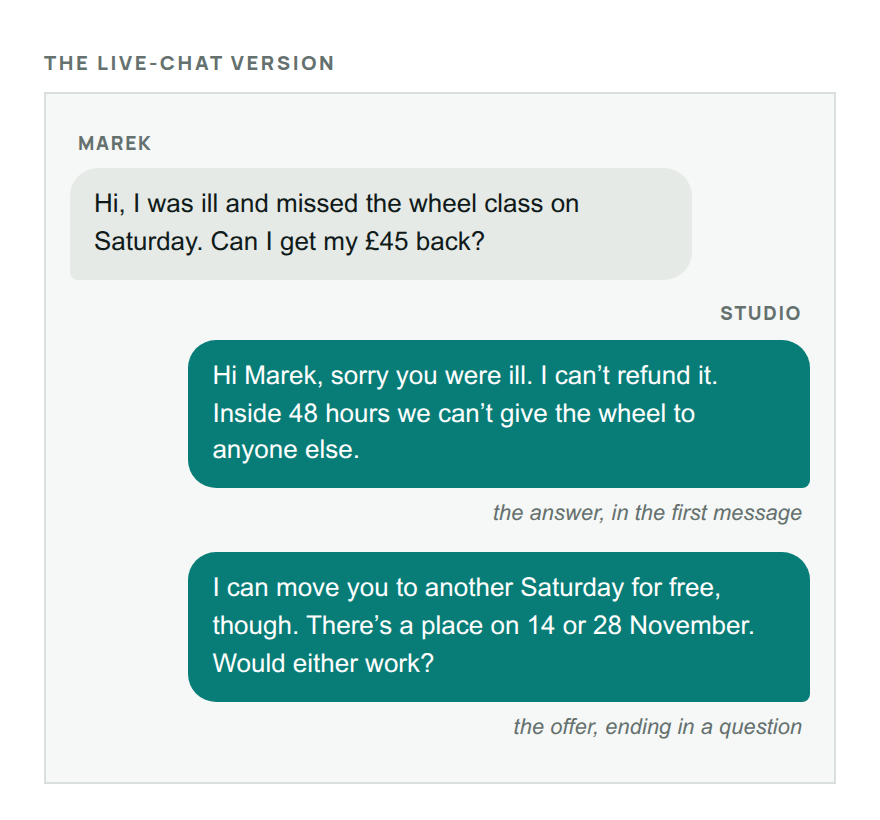
In chat he’s waiting on the other end, so the answer goes in the first message and the offer in the second, sent straight after. The reason shrinks to one sentence. The offer ends in a question he can answer with a date. Don’t open with “Let me look into that for you” if you already know the answer.
Public reply to a review
Suppose Marek never emailed and posted this instead: “Booked a class, was ill on the day, they kept my £45. Avoid.”
Marek, I’m sorry you were ill and missed the class. We don’t refund places cancelled less than 48 hours before, because by then we can’t offer the wheel to anyone else, and that’s the same for everyone who books. We’d be glad to move your booking to another Saturday at no charge. Email us and we’ll sort it out.
A public reply has a second reader: the person deciding whether to book. So the rule and its reason are given once, in a form a stranger can follow, and “we don’t” replaces “I can’t” because you’re describing how the studio works. The reply doesn’t dispute his account or answer “Avoid”. It adds no detail about him that he didn’t post himself. It ends with the offer, which shows the next customer what would happen to them.