One in 34 Emails With a Weekday and a Date Gets One of Them Wrong

Write “Friday, June 6th” in an email and you have named the day twice, once as a word and once as a number. If the two disagree, your reader cannot tell which one you meant, and somebody has to write back before anything can be booked. We wanted to know how often that happens, so we checked every weekday written beside a date in 85,123 real work emails against the calendar.
1,154 of the emails had at least one. In 34 of them a weekday and its date do not match. That is about 3%, or one email in 34. We read all 34.
Three ways the pair goes wrong
“Friday, June 6th” is one of them. It was in an invitation sent on Tuesday 3 July 2001, asking for an answer “by this Friday”. The sixth of June that year was a Wednesday. The sixth of July was the Friday.
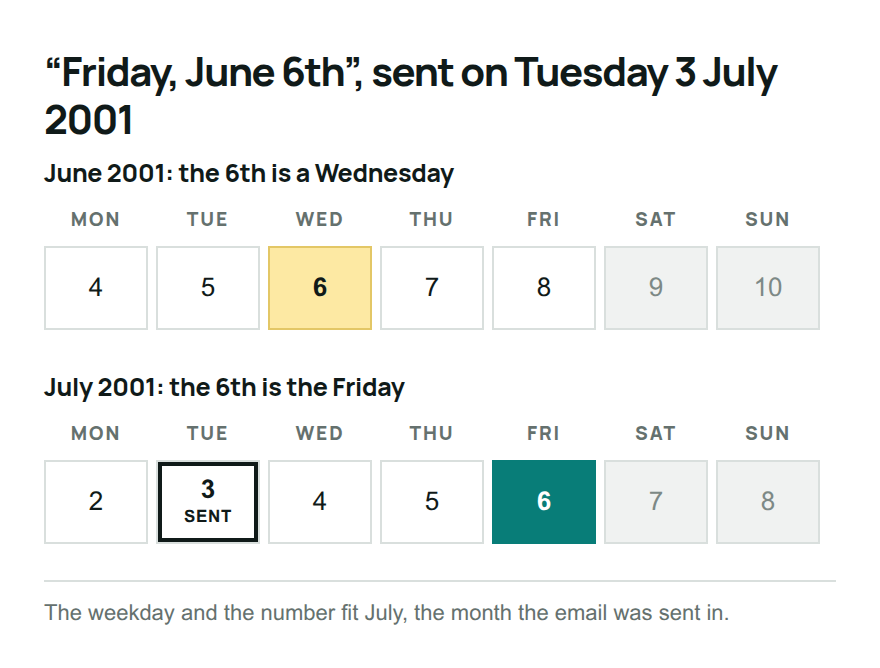
Ten of the 34 emails go wrong in this way: the weekday and the day number are right for the month the email was sent in, and the month that was written is another one. A staff meeting “on Tuesday Mar. 3” in an email of 1 April, when 3 April was the Tuesday. A conference call “scheduled for Tuesday, March 15, 2001”, announced on 14 May, the day before Tuesday 15 May. A deadline of “Friday, June 27” set on 19 April, eight days before Friday 27 April. In digits the slip is a single key: a digest of the press sent on Tuesday 7/10 dates its headlines “Tues, 5/10” and “Mon, 5/9”, 28 times in all.
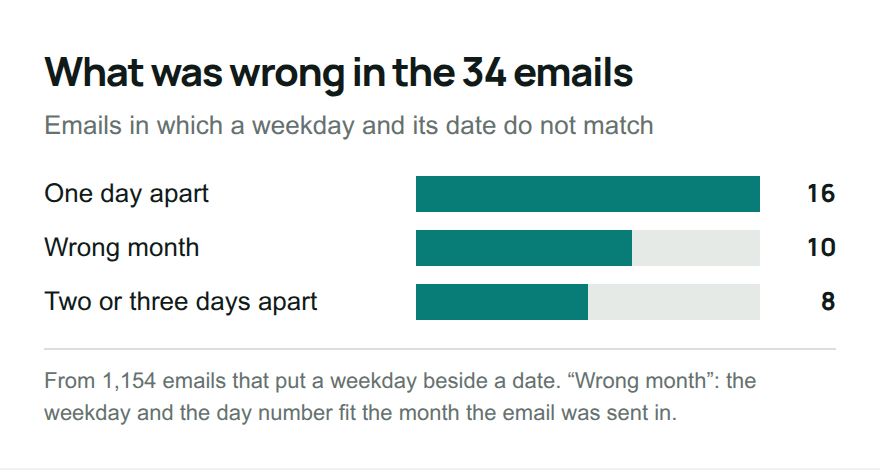
Sixteen are a single day out, and for the reader these are the hardest, because both days are believable. A conference call is moved to “Thursday, Oct. 20” in an email sent on Thursday 19 October: today, or tomorrow, which is the 20th and a Friday? Something is due “by next Wednesday, Feb. 5”, and the fifth is a Tuesday. One email lists four days of leave, “Tuesday April 2”, “Wed, April 3”, “Thurs, April 4” and “Friday, April 5”, in a year when 2 April fell on a Monday, so every line is a day out.
The other eight are two or three days apart. “Please RSVP by Friday, January 31”, when the 31st was a Monday. Leave from “Wed Dec 26” to “Fri Dec 30 (3 days)”, when three days from that Wednesday end on Friday the 28th. A meeting “set for Monday, October 12th” in an email sent on Friday 12 October, where the number is that day’s own date.
That makes 16 emails a day apart, 10 with the wrong month, 8 further apart.
Two of the 34 were not written by the person who made the mistake. They are the reply to it. One says that the other person’s notes ask for baseball tickets for “Wed., April 10th”, and that Monday is the 10th and Wednesday the 12th. The other says a meeting is “shown as Friday, August 28” and that the 28th falls on a Tuesday. Neither writer could know which half to believe, so each wrote back to say so.
Where we can tell, it is the date that is wrong
In twelve of the 34 the email itself shows which half was the slip. In the ten with the wrong month, the weekday and the number both fit the month the sender was writing in. The meeting “set for Monday, October 12th” on Friday the 12th carries the number of the day it was typed. The leave that ends on “Fri Dec 30” is counted as three days in the same line. All twelve times the weekday was right and the date was wrong. In the other 22 there is no telling.
My guess at the reason is that the weekday is the part people agree on. A meeting is fixed as “Tuesday” when it is arranged, and the number is added afterwards, from memory or from a glance at a calendar. So if I had to act on a mismatch before I could ask, I would go by the weekday, knowing that twelve emails are thin evidence. You could avoid the clash altogether by leaving the weekday out. I wouldn’t. Without “Friday”, the invitation above asks for an answer by June 6th, a date nearly four weeks in the past, and nothing in it tells the reader that the date is wrong. The weekday is what makes the mistake visible.
Before you send a date
Write both the weekday and the date, then check the pair once against a calendar. Check the month separately from the day: a calendar open at this month will agree with a weekday and a number that are right for this month, whatever month you typed.
Give the month even when it seems obvious. 105 of the weekdays in these emails stood beside a bare day number, as in “Wed the 22nd”, and eight of those fit neither the month of sending nor the month before or after it. Most look like plans two or three months ahead: one, written in October, is about a football game at New Year. The reader is left to work the month out.
If you receive a pair that does not match, ask. If you cannot, the weekday is the better guess.
Our Before you send page does the calendar check on a message you paste into it. It marks a weekday that does not match its date, in words or in digits, and gives the nearest date that does. It is the check that produced this count, and it runs in your browser.
What a grammar checker catches
Part of it. LanguageTool, the open-source checker, has a rule for this. Version 6.6, run on our own server, caught a wrong weekday when a comma followed it (“Tuesday, March 9”, “Tuesday, 9 March”, “Tue, Mar 9”) and when the date was written out with its year (“Monday 9 March 2027”). It passed the same mistake without the comma (“Tuesday 9 March”, “Tuesday March 9”), with the date in digits (“Tuesday, 3/9”) and with the date before the day (“March 9 (Tuesday)”). Where no year is written it judges the date by the current year alone, so late in the year it calls a date in the coming January wrong: “Friday, January 8” was marked, although the next 8 January is a Friday. We did not test the checkers built into mail programs.
How the count was made
The emails are the sent messages in the Enron email dataset distributed by Carnegie Mellon University: 148 mailboxes of one American energy company, almost all from 1999 to 2002. We took the part of each message that its sender typed, by the rule described in How Long Is a Normal Work Email?. That article counts each text once. Here every sending counts, because a date check needs the day a message was sent, so the total is 85,123 and not 79,569.
A pair is a weekday next to a day and a month, with the month in words or in digits: “Friday, June 6th”, “Fri 6 June”, “Friday 6/6”, “June 6 (Friday)”. Where no year is written we took the nearest such date to the day of sending. Three pairs were wrong for the nearest such date and right for the same date a year later, among them an October email saying that Easter “next year is Sunday April 15”, which it was. Those three are not in the 34. The senders are American, so 5/10 was read as 10 May.
The check read 1,685 pairs and found 1,594 right and 91 wrong. Fifty-six of the 91 are the one press digest, which repeats its wrong dates 28 times and was sent twice. We read every one of the 34 emails, and in each the weekday and the date disagree on the calendar of the year it was sent. One of them would be right if its sender meant the year before. Getting there took three rounds. Nearly half of what the first version of the check marked was its own mistake: it did not know that in “Monday and Tuesday, June 18 and 19” the date belongs to the Monday, or that a schedule reading “August 15 – Tuesday” puts each weekday after its date.
What the count leaves out: a pair in which the day and the date are wrong together looks right to any calendar. A weekday beside a bare day number has no month to check, so none of those is among the 34. Pairs written in a way the check does not read are missed, which makes 34 a floor. And this is one company, more than twenty years ago.
We quote only the dates and the few words around them, and give no names.