Before You Publish a Returns Policy Template, Answer These Six Questions


“If you are approved, then your refund will be processed, and a credit will automatically be applied to your credit card or original method of payment, within a certain amount of days.”
That sentence is in the refund page that WooCommerce puts, as an unpublished draft, into every new shop it is installed on. Somebody was meant to replace “a certain amount” with a number. A template is a list of decisions with the answers left out. The ones marked with a bracket are easy to find, and the rest are not marked at all. This page says what each of 20 published templates leaves for you to decide, so that you can look up the one you used, and it ends with a paragraph that answers everything a customer will ask.
What a customer asks, parcel in hand
- How many days do I have?
- Counted from which day: the day I ordered, or the day it arrived?
- What has to happen by the last day? Do I have to ask by then, post it by then, or have it reach you by then?
- Who pays the postage back?
- When do I get my money?
- Do I get the first delivery charge back as well?
A template can answer a question, leave you a marked blank for it, or say nothing. The third case is the one to look for, because nothing on the page tells you that a decision is missing.
Find the template you used
These are return and refund policy templates in the order web searches brought them up on 10 October 2026, at most two from one page, and only those that can be read without an account: 20 templates from 17 publishers. Each entry says what that text left open on the day it was read. Publishers rewrite their templates, so check yours against the six questions and not only against this list.
The one that may already be in your shop
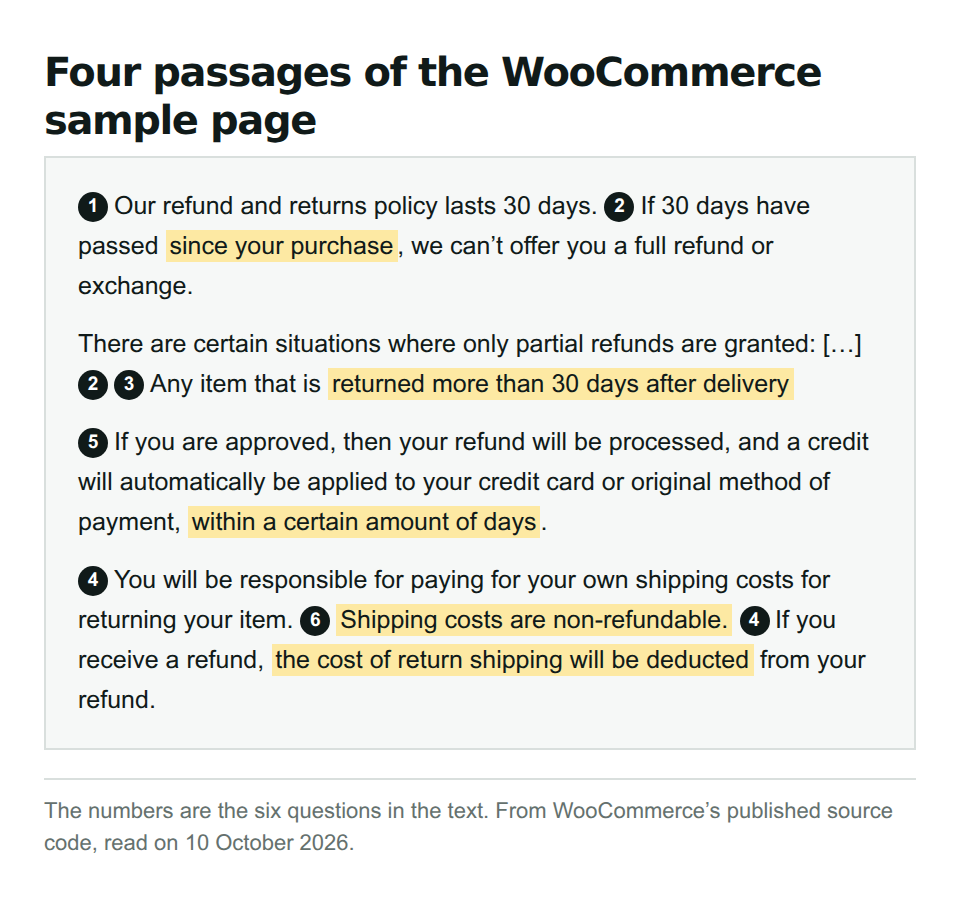
WooCommerce sample page. It gives 30 days and counts them twice: “If 30 days have passed since your purchase, we can’t offer you a full refund or exchange”, and further down a partial refund for “Any item that is returned more than 30 days after delivery”. A parcel that took a week to arrive is inside one clock and outside the other. It does not say whether “returned” means asked for, posted or arrived. On postage it says you pay, and two sentences later that the cost “will be deducted from your refund”, which leaves a customer who has paid at the post office wondering what is left to deduct. “Shipping costs are non-refundable” stands in a paragraph about posting things back and can be read as either journey. The refund comes “within a certain amount of days”.
Its first line is “This is a sample page.” It has five blanks in curly brackets for an email address and a postal address. And whatever you sell, it tells your customers that newspapers and magazines cannot be returned and that an opened “CD, DVD, VHS tape, software, video game, cassette tape, or vinyl record” earns only a partial refund. None of this is a criticism of WooCommerce: the page says it is a sample and stays a draft until its owner publishes it.
Generators
Termly. Blanks for the number of days and for the refund time, and four sentences to choose from on postage. It counts from the purchase date and is clear about the act: returns “must be postmarked” by then. Nothing on the first delivery charge. It carries a line crediting its own generator.
Shiprocket. Thirty days “after receiving your item to request a return”, and a refund within 10 business days. It promises a return label without saying who pays for it, and says nothing about the first delivery charge. It has two lines addressed to you, one on how to add the page to your site and one crediting Shiprocket, and a section on EU law that is wrong (see the note further down).
Synctrack. Thirty days from the day the goods were received, and a refund within 14 days of their coming back. Nothing on postage or the delivery charge. With its form left empty, the preview also carried a section saying that all sales are final, so read what your own answers produce.
Templates printed in advice articles
Shopify’s article on return policies. “Free returns within 30 days of purchase”, with a prepaid label. It does not say what has to happen within the 30 days. The refund time, any fees and what happens to a lost parcel are a list of things “you may want to include”, and one instruction to you sits among the customer’s steps.
Ringly, short and full. Both count from delivery and say what the customer has to do by then (“start a return”, “request a return”). The days, the postage on a refund and the refund time are brackets. Neither mentions the first delivery charge.
Gorgias. The only one of the 19 that answers all six: 14 days from delivery to say you are returning, 14 more to send, free returns on orders over $40, the money within 14 days, and the delivery charge refunded unless the customer chose express. They are an example shop’s answers, though, written as if they were yours, with two notes to you in square brackets inside the text.
Homebase. Blanks for the days and the refund time. It counts from the purchase date, has the customer “initiate” the return by then, and makes the customer pay the postage unless the mistake was the shop’s. Nothing on the first delivery charge.
Saara. One paragraph in which every answer is a bracket, including whether the days run from delivery or from purchase. The first delivery charge is the one thing it does not raise.
Zoho Commerce. Blanks as rows of underscores. Days from delivery, to “raise” the request. The parcel is collected by a courier and the template does not say at whose cost. Nothing on the delivery charge, and the line “Replace ___ by the required values” is printed twice in the text.
Shippo. Blanks in angle brackets, with “30 days” and “two weeks” offered as values. The request has to reach the shop within that time of the customer receiving the item. The customer pays the postage, deducted from the refund. Nothing on the first delivery charge.
ShipBob. Every answer is a choice in brackets, and it is the only template that asks you about the first delivery charge: it “[are/are not] refundable”. It counts from the order date and does not say what “make a return” within those days means.
Claimlane, standard and store credit. Thirty days, or 21, from delivery, with the postage and the refund time stated. Neither says what has to happen within that time, and neither mentions the first delivery charge.
Desku, general and small business. A blank for the days, counted from delivery. “Shipping fees are non-refundable”, without saying which, and no word on who pays to send the parcel back.
Forms from template libraries
Jotform. A filled-in example, not a set of blanks: 14 days, counted from nothing, a return address at 123 Maple Street, Anytown, a list of goods that begins with trading cards, and a table of refund times by payment method. The shop pays the postage. Nothing on the first delivery charge.
PlatoForms. A form with “e.g. 30 days” in a table and a starting day for one row only. Postage is set out case by case, and the first delivery charge is “non-refundable unless the return is due to our error”. Its “Overview” is a paragraph of Lorem ipsum, and the page carries a sample phone number and member ID.
The twentieth is a policy of no refunds at all, from iubenda, so the six questions do not apply to it.
What the 19 have in common
Every one deals with the number of days: eight give a number and 11 leave a blank for yours. After that they thin out. Ten count from delivery, four from the day of purchase or order, two do both in one text, two never say and one leaves you the choice. Nine do not say what has to happen by the last day. Five say nothing about who pays the postage back. Only six give a time for the refund. And 16 leave the first delivery charge open: 13 never mention it and three call shipping “non-refundable” without saying which shipping.
Eight of the 20 also carry sentences that were written for you and will go out to your customer if you paste them: an instruction, a credit to the publisher, sample details. A bracket is easy to spot. These are not, because they are ordinary sentences. I meant to count how many live shops have published them. I searched for the sentences, and the search engine I used does not return exact matches reliably enough to count anything, so I make no claim about how often it happens.
One template gets the law wrong. The text of Shiprocket’s generator has a section headed “European Union 3-Day Cooling Off Period”, which gives a customer in the EU 3 days to cancel. The EU’s own Your Europe page on returns gives anyone who buys online 14 days to change their mind, and says that “for goods this means 14 days from the date of delivery”. The same page bears on the postage question: the buyer pays to send goods back, with “the only exceptions: if the seller offers to pay, or if the seller fails to inform you about those costs before you buy”. That is as far as this page goes into law. The rules differ from country to country, so check the ones for the places you sell to.
The paragraph I would publish
This is how I would write it: one sentence for each question, in the order a customer meets them. The details belong to an invented shop. Yours will differ. What matters is that each one is stated.
You can return any item within 30 days of the day it was delivered. To start, email returns@example.com with your order number, and we will reply within two working days with the address to send it to. Post the parcel within 14 days of our reply.
The item must be unused and in its original packaging. You pay the postage back, unless the item is faulty or we sent the wrong one, and then we pay.
We refund the price of the item and the standard delivery charge to the card you paid with, within five working days of the parcel reaching us. We cannot take back personalised items or opened food. Nothing here limits the rights the law gives you.
I did not arrive at that paragraph straight off. I began with one of the shortest templates in the list, Desku’s for a small business, filled in its two blanks and read it as a customer would:
We accept returns and exchanges within 30 days of delivery. Items must be in new, unused condition with all original packaging. Refunds will be issued in the original form of payment. Shipping fees are non-refundable. We will process your return within 5 business days of receipt.
From that text alone I could answer two of the six questions: how many days, and counted from which day. I could not say what has to happen by day 30, who pays the postage back, when the money arrives, or whether the first delivery charge comes back. Three changes took it from two answers to six.
First, the day and the act went into separate sentences. “Within 30 days of the day it was delivered” says when the clock starts, and “post the parcel within 14 days of our reply” says what has to be done and by when. While both sat behind the single word “within”, I could not tell a customer what to do by day 30.
Second, I named each journey. “Shipping fees are non-refundable” could be the parcel going out or the parcel coming back, so the new text says “the postage back” and “the standard delivery charge” and never “shipping” on its own. That answered two questions at once.
Third, the refund got a number counted from something the customer can see, the parcel reaching us. “Process your return within 5 business days” left open whether that was the money or only the inspection.
When your own policy is filled in, read it once as the customer and answer the six questions from the text alone. Then search the page for a square bracket, a curly bracket, a row of underscores, the word “sample”, and the name of the company the template came from. If a customer has already been told no, the wording for that is in our guide to refusing a refund.