What to Check After AI Rewrites Your Work Email


Your message says, “Questions to me before Friday.” You ask an AI to make the email more professional. It comes back with: “If you have any questions or concerns, please reach out to me by end of day Friday.”
The sentence sounds more polished. It also gives people Friday to ask their questions, when your version did not. Reading the new email on its own would not reveal that change. You need the old one beside it.
That pair comes from a test of 30 short work emails we composed, each with details a rewrite should preserve: names, amounts, dates, conditions or promises. We sent each to Gemini 3.5 Flash with three requests: “Make this email more professional”, “Shorten this email” and “Make this email sound friendlier”. The 90 replies show why checking the numbers is only part of checking a rewrite.
“More professional” can add decisions
In the same maintenance email, the original told staff not to use the back staircase on Saturday. The professional version added:
Please use the main stairs or elevator instead.
We had said nothing about another staircase or a lift. It is plausible office wording, but it assumes a route exists and is available. Restoring the original instruction is better than trying to make the invented route more precise.
Another original gave the helpdesk number and its hours, “between 9 and 5”. The rewritten version supplied “Monday to Friday”. So did the shorter version and the friendlier one. The phone number survived all three; the operating days were new.
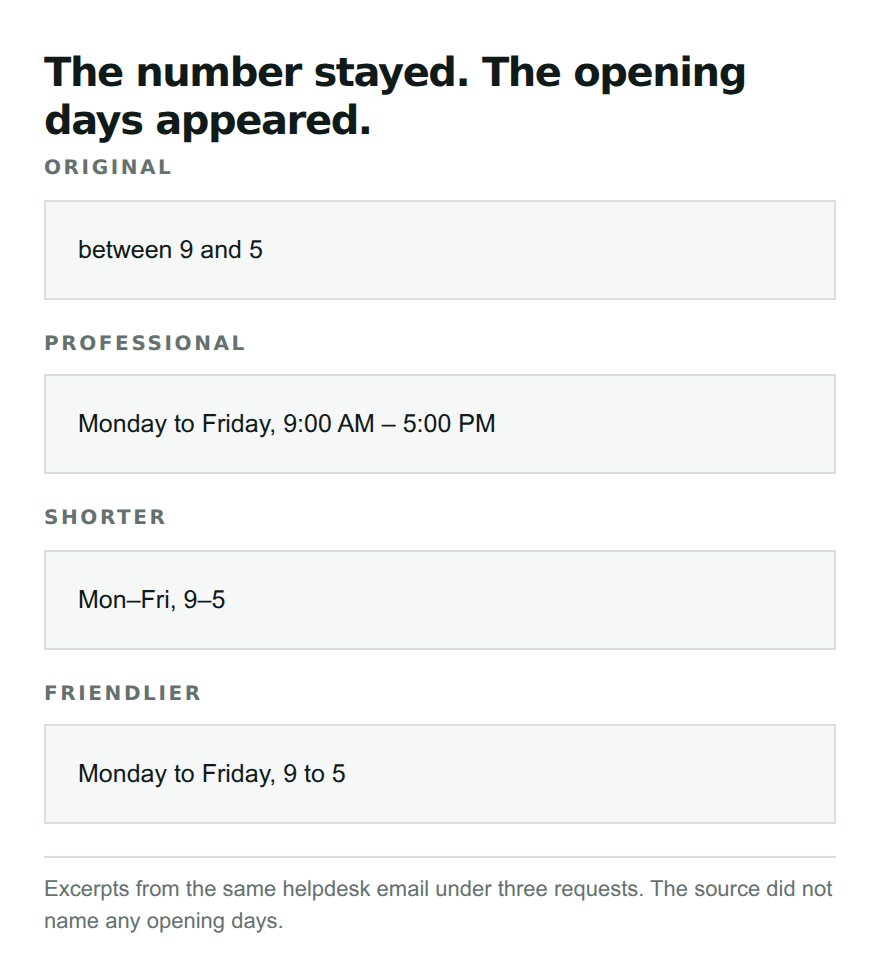
Read a professional rewrite for claims that sound routine enough to slip through: opening days, reasons for a decision, someone else’s agreement, a service you offer. A sentence can be grammatical, reassuring and unsupported at the same time.
Also compare the force of the verbs. “We will” commits you to something. “We expect to” leaves room for it not to happen. In the delayed-order email, “We will post your parcel on Monday 19 October” became “we now expect to dispatch your order on Monday, 19 October”. The date stayed; the commitment weakened. Decide which you mean before choosing either.
“Shorter” can remove the condition
Our release update said:
New date: Tuesday 27 October, if the fix passes on Monday.
The shorter version said:
Due to this, Friday’s release is postponed to Tuesday, October 27, pending Monday’s re-test.
“Pending” may suggest that the result matters. But the original explicitly required a pass, while the rewrite merely names the retest. There is no reason to trade the clearer condition for an inference. A short version that preserves it is: “Release: Tuesday 27 October, only if Monday’s retest passes.” That is our edit, not another model answer.
Elsewhere, “Kofi can only stay for the first half” became “Kofi is leaving early”. Both explain why the budget comes first, but only the original tells the chair when Kofi stops being available. If that timing matters, keep it. If it does not, the deletion may be a useful cut. Shortening calls for that decision; it cannot preserve every detail and remove every word.
Pay particular attention to “if”, “unless”, “only”, “before”, “after” and “not”. Compare the whole clause around them. A rewrite that keeps every figure can still change who must act or what must happen first. Some of these small changes create the two readings that cause trouble in work writing.
“Friendlier” can promise more
The delayed-order email offered a full refund if the customer preferred to cancel. Its friendlier rewrite added two pieces of good news:
we’ll be able to post your parcel out first thing on Monday, October 19th
I’ll be happy to issue a full refund of £36.50 right away.
The amount and the dispatch day match the original. “First thing” and “right away” do not. They make service promises that were never supplied. The friendly tone is not the problem; the new timings are.
In the meeting email, friendliness worked the other way. “It will last 45 minutes” became “We’ll need about 45 minutes”, and a link promised an hour before became a link sent “about an hour before”. Approximation may suit a casual catch-up. It may not suit a tightly scheduled call. Keep the warmth, then put back the degree of certainty you actually intended.
I would leave a decision about a deadline, a refund or someone else’s availability in my own wording until I had checked every changed clause. Those are the parts a recipient can act on. I am happier letting a tool suggest a greeting or remove a clumsy repetition: if I dislike the result, the consequence is usually just a sentence I would not have written.
What these examples establish
The run was made on 12 October 2026 through Google’s API, using Gemini 3.5 Flash at its default temperature, with minimal thinking and no system instruction. Each instruction was followed by the same original email. We kept one answer per request and examined the first draft it supplied. All source emails, names and situations were made up for this test.
A script compared written figures and source names; the assistant also read the drafts against their originals. Its review flags include optional additions and debatable omissions, so we do not turn them into an error percentage. These examples identify changes to inspect, not the probability that your next rewrite will be wrong. The experiment did not test the rewriting products of Grammarly, Wordtune or Microsoft, and repeating it may give different replies.
Compare the action before the style
Keep the original open and make the comparison in this order:
- The instruction. Is the same person being asked to do the same thing? Has “delete the spreadsheet” become “delete the email”, or a request become an offer?
- The condition and deadline. Read the clause that says when, or only if, the action happens. Look beyond the date itself.
- The promise. Find every new “will”, “can”, “immediately”, “usually” or “about”. Keep it only if it describes what you can actually do.
- The details. Compare names, figures, addresses, file references and phone numbers with the original, including anything the rewrite left out.
- The tone. Once the meaning is settled, choose the greeting, the level of formality and how much explanation the reader needs.
A spelling pass can follow. It cannot tell you that Friday used to be excluded, or that you never promised a refund immediately. If you cannot account for a change by pointing to your original or a fact you know, remove it before sending.