The Mistakes People Send a Second Email to Fix and How to Catch Them First

Checklists for email start with spelling. The emails people have to send a second time start with the attachment, and after that with the address line.
We read 176 real second emails, each sent to put right something its writer had sent a little earlier, to see what people get wrong and how they word the repair.
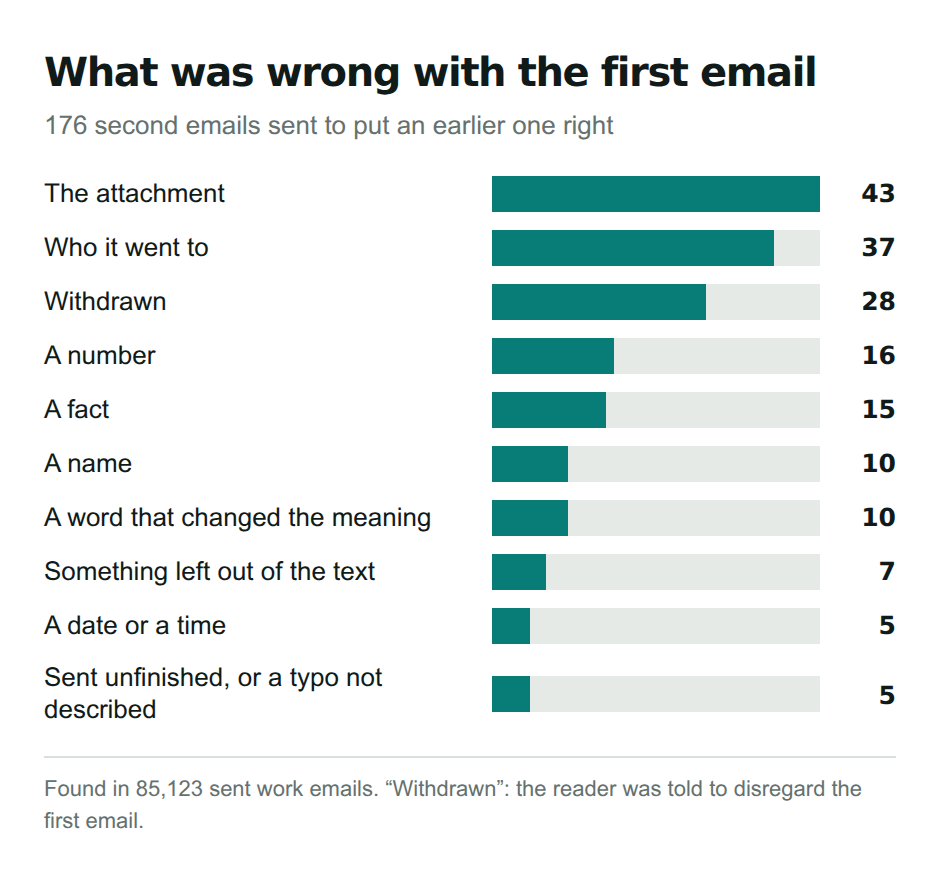
What the second emails were about
- The attachment, 43 times. It was left off 16 times. Sixteen times it was the wrong file, or the right file with a mistake inside it. Eleven times the sender had moved on to a newer version and asked the reader to throw the earlier one away.
- Who it went to, 37 times. Seventeen went to an address that was wrong or mistyped and never arrived. Ten reached a person they were not meant for, twice because two people had similar names. Ten left off somebody who should have had a copy.
- A detail in the text, 56 times. A number 16 times, a fact 15, a name 10, a single word that turned the sentence round 10, and a date or a time 5.
- Taken back whole, 28 times. Thirteen said the first email was no longer needed, because the thing had turned up or plans had changed. Fifteen gave no reason.
- The rest, 12 times. Seven added something the first email had left out, such as a link or an address. Two said it had gone before it was finished, and three mentioned a typo without saying what it was.
Where the 176 come from
They are in the sent folders of the Enron email dataset, 85,123 sent emails from the years around 2000. A search for the words people use when they correct themselves (“disregard”, “forgot to attach”, “I meant”, “oops”, “correction”, “resend”, “the wrong”) found 710 emails. Each was then read against written rules. In 176 the sender was putting right an earlier email of their own. In 484 it was something else: a request to somebody else to resend, a correction to a contract or an invoice, an apology for a late reply. Fifty could not be decided, most of them one line with an “oops” and little more.
A correction that uses none of those words was never found, so 176 is a floor, and the figures above are shares of what was found, not rates. Nothing on this page is quoted from the emails. The examples further down were written for it.
Catch them before you send, in this order
Going by those figures, this is the order I would check in. It is not the order most checklists use, because most checklists start with spelling.
First I would open the attachment from the draft itself, not from the folder it was saved in. That one action answers the three questions behind 43 of the second emails: is there a file, is it the right file, is it the version I meant. Gmail and Outlook can warn you when a message mentions an attachment and carries none. That covers 16 of the 43. Nothing warns you about the other 27.
I would fill in the address line last. An email with no address cannot go out unfinished or to the wrong person, and when the address is the last thing typed it is the only thing on your mind. Then read each address, ask who else should have a copy, and look twice wherever the program completed a name for you.
After that the numbers, one at a time, against the place they came from, and phone numbers digit by digit. Five of the 16 wrong numbers were phone or fax numbers and five were reference numbers, one of them with two digits swapped. Then the names, where the usual slip was the wrong person or company and not a misspelling. Then the one word that can reverse a sentence: a “not”, a “can” for “can’t”.
Spelling comes last. At most three of the 176 could have been about a plain typo. Every other second email was about something the reader would have acted on.
When the first one has gone
Fifteen of the 176 said little more than “Please disregard my last email.” The reader of that has two emails, no idea what was wrong with the first, and no way of telling whether any of it still stands.
The corrections of a detail are often not much fuller. Of the 56, 36 give the right version and nothing else: the new day, the new figure, the new name, sometimes in three words. Only 19 also say what it replaces, and one gives no right version at all. All five corrections of a date or a time were of the short kind.
The short kind works if the reader has the first email open beside it and reads the two in order. A reader who opens the correction first, or finds it a week later, has a day of the week and no idea which meeting it belongs to. These three were written for this page. Each is shown as it tends to be sent, and then as I would send it.
In place of “I meant Tuesday.”:
Correction to my email of 10:14 this morning: the review is on Tuesday 20 October, not Thursday 22 October. The time and the room are unchanged.
In place of “Please disregard my last email.”:
Please ignore my email of 3:40 pm about order 4471. It was meant for another customer, and nothing in it applies to you.
In place of “Sorry, wrong figure. Correct one below.”:
One figure in my email below was wrong: the deposit is £450, not £540. The rest of the quote stands.
A correction that can be read on its own does three things, usually in two sentences. It says which email it corrects. It gives the right version beside the wrong one, in the form “Tuesday, not Thursday”, so that the reader can see what changed without comparing two messages. And it says what still stands, because a reader who has been told one thing was wrong starts to doubt the rest.
I would also send it as a reply to my own first email, so that the two stay together in the reader’s inbox, and to everyone who got the first. A missing attachment is the one case where a short second email is all it needs.
The mistakes nobody comes back to fix
Five corrected dates is a small number, and I do not think it is small because dates are rarely wrong. An earlier count on these same emails compared each weekday that stands next to a date with the calendar, and found 34 emails in which the two disagree. It is reported in One in 34 Emails With a Weekday and a Date Gets One of Them Wrong. Two of the 34 were a reader writing back to ask which was meant.
My reading is that a second email fixes what its sender finds out about. A bad address bounces within seconds. A reader answers that nothing was attached. A colleague asks why they were not copied. A wrong date or a wrong figure sits in the text looking fine, and the person who wrote it is the last to know.
I have my own evidence for that. This site keeps a list of its corrections. As I write this it has fourteen entries, and ten of them put right a number or a count: a median, a tally of examples, how many words an extract changed. None of the ten was caught on the day it was written. Each turned up later, when the page was read again against its own figures. So I do not trust my eye on a number I have just typed. For any email with a figure in it, the check I would add is the dull one: go back to where the number came from and read the two side by side.