How to Write Numbers and Dates for Readers in Other Countries

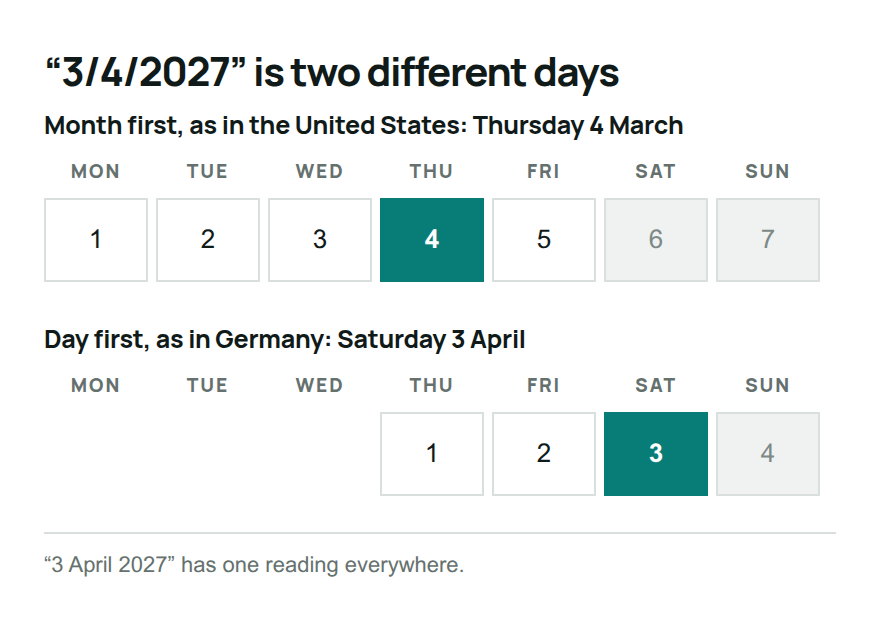
Write “the price is 1.500” to a customer in Germany and they read fifteen hundred. Send the same line to a customer in the United States and they read one and a half. Write “delivery on 3/4/2027” and the German reader expects Saturday 3 April while the American expects Thursday 4 March. Neither of them asks, because to each of them the line looked normal.
Type one of your own numbers and a date here to see how thirteen countries write them.
See how your number and date are written elsewhere
The formats come from your browser's own regional data. Nothing you enter is sent anywhere.
The tool takes a number typed with a dot for the decimals and a date from a date picker, and prints one row for each of thirteen countries. It formats and does not parse: you can’t paste “1.500” from an email and ask what the sender meant. It also uses the regional data built into your own browser, so a row can differ slightly from the table below, or from a colleague’s screen, if the browsers carry different versions of that data.
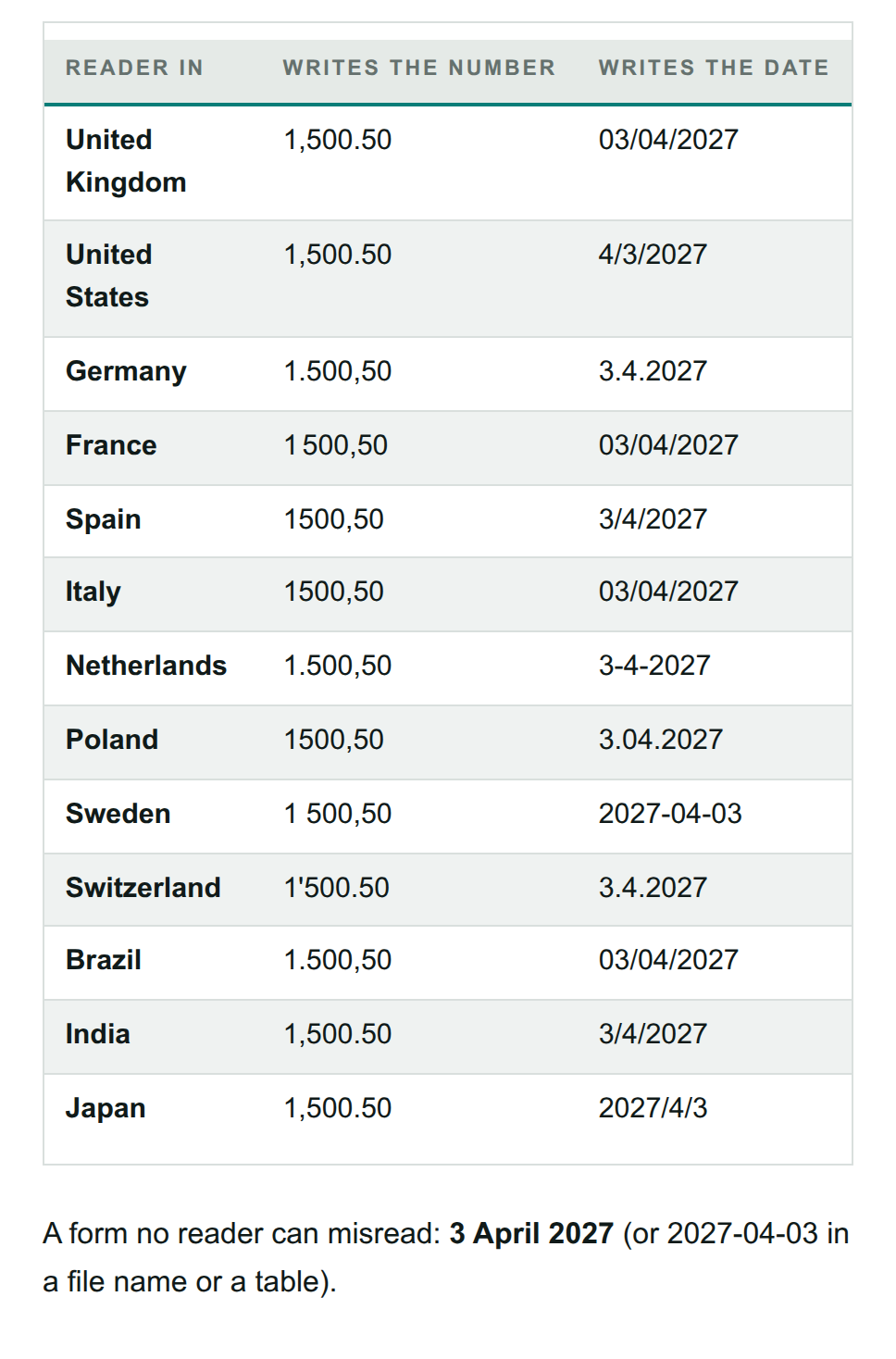
The same values in thirteen countries
The last column is 3 April 2027 written all in digits. This table was generated with the Intl formatting functions in Node.js 18.19.1, which carries ICU 74.2 and version 44.1 of the Unicode Common Locale Data Repository (CLDR). CLDR is the regional data that, in its own words, “is incorporated into all modern operating systems and browsers”. It is what your phone uses to decide how to show a date. Each cell is the default form for that country’s main locale, so it shows what software there prints. People also write other forms by hand.
| Country | 1500.5 | 1234567.89 | Date |
|---|---|---|---|
| UK | 1,500.50 | 1,234,567.89 | 03/04/2027 |
| US | 1,500.50 | 1,234,567.89 | 4/3/2027 |
| Germany | 1.500,50 | 1.234.567,89 | 3.4.2027 |
| France | 1 500,50 | 1 234 567,89 | 03/04/2027 |
| Spain | 1500,50 | 1.234.567,89 | 3/4/2027 |
| Italy | 1.500,50 | 1.234.567,89 | 03/04/2027 |
| Netherlands | 1.500,50 | 1.234.567,89 | 3-4-2027 |
| Poland | 1500,50 | 1 234 567,89 | 3.04.2027 |
| Sweden | 1 500,50 | 1 234 567,89 | 2027-04-03 |
| Switzerland | 1’500.50 | 1’234’567.89 | 3.4.2027 |
| Brazil | 1.500,50 | 1.234.567,89 | 03/04/2027 |
| India | 1,500.50 | 12,34,567.89 | 3/4/2027 |
| Japan | 1,500.50 | 1,234,567.89 | 2027/4/3 |
What came out of it:
- The decimal mark is a comma in eight of the thirteen countries and a point in five (UK, US, Switzerland, India, Japan).
- Thousands are separated by a comma in four, a point in five, a space in three and an apostrophe in one. Spain and Poland leave a four-digit number unseparated and only start grouping at five digits. The Chromium we captured the tool in carries newer data, in which Italy does the same. That is the 1500,50 in the picture above.
- India groups in twos after the first thousand, so 12,34,567.89 is a correctly written number and not a typing slip.
- The all-digit date puts the day first in ten countries, the month first in one (the United States) and the year first in two (Sweden and Japan). 3 April comes out in eight different written forms.
Albania, where I live, is not one of the thirteen, so we ran it as well. The same data gives 1500,50, 1 234 567,89 and 3.4.2027: Poland’s way with numbers and Germany’s way with the date. If your country is missing too, remember that the tool above knows only these thirteen, and the nearest row may not be the one you expect.
Which written forms have two readings
We then ran the test the other way round: took twelve ways of writing fifteen hundred, or fifteen hundred and a half, or one and a half, and checked each against every country’s own separators from the same data. This is a mechanical check of what fits each convention. It is not a survey of readers.
- 1.500 fits as fifteen hundred in Germany, Spain, Italy, the Netherlands and Brazil, and as one and a half in the UK, the US, Switzerland, India and Japan.
- 1,500 fits as fifteen hundred in the UK, the US, India and Japan, and as one and a half in Germany, France, Spain, Italy, the Netherlands, Poland, Sweden and Brazil.
Those were the only two with two readings. The other ten (1500, 1 500, 1.5, 1,5, 1,500.50, 1.500,50, 1500.50, 1500,50, 1 500.50, 1 500,50) each had one possible value. Several of them look foreign in most of the thirteen countries, but a reader who stops to work one out can only arrive at one number. So the risk sits in one place: a single separator followed by exactly three digits. The rules for numbers below all follow from that.
The forms to write
Dates in a sentence: the month as a word, the year in four digits
Every day-first, month-first and year-first reader gets the same date from “3 April 2027”. Adding the weekday gives the reader a way to catch your mistake if you typed the wrong number.
We will deliver on Thursday 4 March 2027.
Keep the four-digit year. The short date style in the same data gives 03.04.27 in Germany and 4/3/27 in the United States, and a two-digit year adds a third number that could be a day.
Dates in file names and tables: year-month-day
The form 2027-04-03 is the one from the ISO 8601 standard. The internet’s own date specification, RFC 3339, is a profile of that standard and defines a full date as four-digit year, two-digit month, two-digit day, joined by hyphens. Nobody writes year-day-month, so a date that starts with the year has one reading, and a list of files named this way sorts in date order. It is also what Sweden’s row in the table shows. In a sentence it reads stiffly, so keep it for file names, tables and reference numbers.
Attached: quote-2027-04-03.pdf
All-digit dates are ambiguous only when the day is 12 or under
13/4/2027 can’t be misread, because there is no thirteenth month. We counted the days of 2027: 132 of the 365 can be swapped into a different real date (eleven in every month), 12 read the same either way (1/1, 2/2 and so on), and 221 have a day above 12. My guess is that this is why the habit survives: roughly two times in three nothing goes wrong, and the writer concludes the format is fine. If you receive a date like 3/4 from someone abroad, ask which month before you act on it.
Whole numbers: no separator up to four digits, a space above that
“1500” was the only form in the test that fits all thirteen conventions. For longer numbers, the General Conference on Weights and Measures, which keeps the metric system, says that digits may be grouped in threes and that “neither dots nor commas are ever inserted in the spaces between groups”. A space is not the local habit in most of the countries above, but it has only one reading.
The order is for 1500 units now and 12 500 by the end of the year.
Decimals: never leave three digits after the mark
The same resolution accepts both the point and the comma as the decimal mark, so no standard will pick a side for you. In English text, use the point. What protects the reader is the digit count: “1.5 kg” and “2.75 m” have one reading, while “1.500 kg” could be a tonne and a half. If you need three decimals, change the unit.
Each carton weighs 1500 g. (Not: 1.500 kg.)
Money: three-letter code, and always the two decimals
With the cents written, both “1,500.50” and “1.500,50” came out of the test with one reading. Without them, “1,500” is the ambiguous form again. So write the cents even when they are zero.
For the currency, use the three-letter code from ISO 4217, the list kept up to date by SIX, the standard’s maintenance agency: EUR, USD, GBP, CHF, JPY. The list has 22 currencies with “dollar” in their name, from AUD to XCD, so “$” on its own doesn’t say which. The regional data agrees. Asked to print 1500.50 US dollars, it adds letters to the dollar sign for eight of the thirteen countries: US$1,500.50 for the United Kingdom, 1 500,50 $US for France, 1.500,50 USD for Italy. Only the United States, Germany, Switzerland, India and Japan get a bare “$”. For euros it puts the symbol before the amount in seven countries and after it in six, which is one more thing a code spares you from deciding.
The price is EUR 1500.00 per unit, excluding VAT.
Times: 24-hour clock, the city, and the UTC offset
Eleven of the thirteen countries print 15:30. Only the United States and India default to the 12-hour form, and 15:30 needs no “am” or “pm” to be complete. The harder part is the zone. Name the city whose clock you mean and give its offset from UTC, because the offset between two cities isn’t fixed. Under the rules in the IANA time zone database shipped with the same Node version, New York is six hours behind Berlin on 8 March 2027, five hours behind on 15 and 22 March, and six again on 29 March. The two places change their clocks on different weekends.
The call is on Thursday 18 March 2027 at 15:30 Berlin time (UTC+1). That is 10:30 in New York.
Billion, lakh and crore
In English today a billion is a thousand million. The older British meaning, a million million, is still recorded by Oxford and Cambridge, both marked old-fashioned. The trouble for an international reader comes from their own language. The same data names 1,000,000,000 as 1 Milliarde in German, 1 milliard in French, 1 miliardo in Italian, 1 miljard in Dutch and Swedish, 1 miliard in Polish and 1 mil millones in Spanish. German also has the word Billion, and Duden defines it as “eine Million Millionen”, a thousand times larger than the English word that looks the same. The first time a billion appears, give it in millions as well.
Group revenue was EUR 2.4 billion (2400 million).
Lakh and crore are Indian English. Oxford defines a lakh as “a hundred thousand” and a crore as “ten million; one hundred lakh”. They match the grouping in India’s row of the table: 12,34,567 is twelve lakh, thirty-four thousand, five hundred and sixty-seven. If you write from India to readers elsewhere, add the figure in millions. If you receive “Rs 15 lakh” and don’t know the word, it is 1.5 million rupees.
When a number arrives and you can’t tell
The table also works in reverse. A price of “2.350” from a supplier in Italy is almost certainly two thousand three hundred and fifty, and a date of “4/6” from an office in the United States is 6 April. But “almost certainly” is not what you want on an order, so reply with the unambiguous form and let them confirm it: “To confirm, that is EUR 2350.00 per pallet, delivered by Tuesday 6 April 2027?”
Dates and deadlines also go wrong in words, with “next Friday”, “by Friday” and “within 5 days”. Those are covered in Words Your Reader Can Take Two Ways.