What a Customer Apology Has to Contain


An apology can contain up to six things. This is the checklist, in the order one piece of research found they matter, beside a count of how many of 26 published customer apology templates contain each one.
- Acknowledgment of responsibility (ranked first): says the mistake was yours. In 20 of the 26 templates.
- Offer of repair (second): says what you’re doing to put it right. In 24.
- Expression of regret (third, about level with the next two): says you’re sorry, and for what. In all 26.
- Explanation of what went wrong (third): says how it happened. In 16.
- Declaration of repentance (third): says it won’t happen again, or what you’ve changed. In 13.
- Request for forgiveness (last): asks the customer to forgive you. In none.
What 26 templates contain
Search for a customer apology template and you get customer-service software blogs. On 4 October 2026 we read four of them and scored every template they offer: Pipedrive (5 templates), Mailrelay (4), Indy (3) and HeroThemes (14). One person did the coding, and more than half of the 26 come from one page, so treat the figures as one careful reading of four pages and not as a survey.
The coding rules
Each template was marked as containing a component or not. A blank such as “[brief explanation]” counted as the component it asks for. Regret: any words of apology, however hedged. Explanation: says how the mistake came about. Responsibility: says the fault was the business’s, or makes the business the subject of the failure (“we let you down”, “I gave you the wrong price”). Passive or agentless wording did not count. Repentance: says it won’t happen again or what has been changed. Repair: says what is being done for this customer. Forgiveness: asks to be forgiven. “Please accept our apologies” was scored as regret. The score for each template is available on request.
All 26 say sorry and 24 offer a repair. None asks for forgiveness, which on the research ranking is the right one to leave out. Half never say what will change. Six contain all of the first five components.
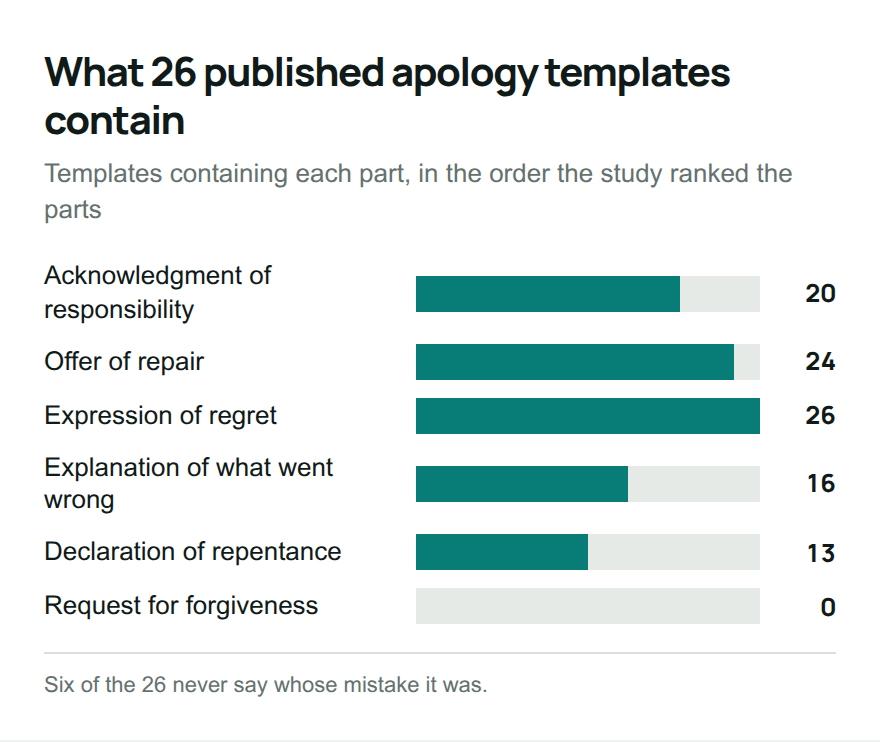
The gap that matters is in the first item on the list. Six templates never say whose mistake it was: three of Pipedrive’s five, one of Mailrelay’s and two of HeroThemes’s. They lose it through grammar. Pipedrive’s billing template opens “I noticed you were [overcharged/charged incorrectly]”. Its delay template says the order “is running [X days/X weeks] behind schedule”. Its outage template says “We experienced a [service outage/technical issue/system glitch]”, as though the outage happened to the company. Nobody in those sentences did anything. Fill in the blanks and you get a tidy message with a refund in it and no “we got this wrong”.
Pipedrive and Indy both warn against apologising for “the inconvenience”. Mailrelay’s templates still do it, twice, as “Sorry for any inconvenience this may have caused”. The construction survives elsewhere with the noun swapped: Pipedrive has “any confusion this may have caused” and HeroThemes has “any trouble it may have caused you”.
Where the six come from
The list is from Roy Lewicki, Beth Polin and Robert Lount, “An Exploration of the Structure of Effective Apologies”, published in Negotiation and Conflict Management Research in 2016. The full paper is behind the publisher’s paywall and we have not read it. What follows comes from the abstract and from Ohio State University’s account of the study, which quotes Lewicki. So we can report the design and the ranking but not how large the differences were, and the one-line descriptions in the list at the top are ours, not the paper’s definitions.
There were two experiments with 755 people in total. In the first, 333 adults recruited online imagined they managed an accounting department and were hiring. The candidate had, in a previous job, filed a tax return that understated a client’s income, and had apologised when confronted. Participants were told the apology contained one, three or all six components, and rated how effective, credible and adequate it would be on a scale of 1 to 5. In the second, 422 undergraduates got the same scenario but read an actual apology made of one to six statements.
In both experiments, the more components an apology had, the better it was rated. Acknowledgment of responsibility mattered most and the offer of repair came second. Regret, explanation and repentance were roughly level. The request for forgiveness mattered least, and Lewicki’s comment on it is “That’s the one you can leave out if you have to.” Apologies were also accepted less readily when the candidate had filed the return wrongly on purpose than when he hadn’t known the rules.
The study did not test customers, shops or emails: the scenario was a job interview. The raters were not the injured party. They were judging someone who had wronged a third person. They gave a score, so nothing here shows whether a customer comes back. And they read the words, where Lewicki notes that a spoken apology may work differently.
The university also says the two experiments were very similar but not identical in the order they produced. Use the checklist as a tested list of what an apology can contain, with a fair indication of which parts carry the weight.
How to score a message
Take the draft one sentence at a time and ask which of the six it supplies. Here is the stock reply to a lost restaurant booking. We made it up from the usual phrases, and nobody was sent it.
- “Thank you for your feedback.” Supplies nothing.
- “We apologise if you were disappointed with your recent visit.” Regret.
- “Unfortunately we were unable to locate your reservation on the evening in question.” Nothing.
- “We apologise for any inconvenience this may have caused and hope to welcome you back soon.” Regret again.
One component of six, supplied twice. Two of the four sentences supply nothing.
“we apologise if”. The apology is conditional, and the condition is the customer’s reaction: “if you were disappointed”. The problem has moved from your booking system to their feelings. HeroThemes’s page makes the same point about “I’m sorry if mistakes were made”, which adds a passive so that nobody made them.
“we were unable to locate your reservation”. The customer knows. It happened to them at the door. This retells the event from your side. An explanation would say why the booking wasn’t there, and an acknowledgment would say “we lost it”.
“any inconvenience”. “Any” means “whatever there was, if there was some”, so you can write it without finding out what happened. “Inconvenience” then chooses the size of the harm on the customer’s behalf, and chooses small. A birthday dinner for eight with no table is not an inconvenience.
“this may have caused”. “This” points at a noun that was never written. “May have” doubts whether anything was caused, in a reply to someone who wrote to tell you it was.
The test for responsibility is to look for “we” or “I” as the subject of the mistake. “We charged you twice” is an acknowledgment. “You were charged twice” says only that it happened.
The same message with all six
The restaurant took a phone booking for eight for Saturday 13 March 2027, with a £40 deposit, and had no table when the family arrived.
Dear Ms Rahman,
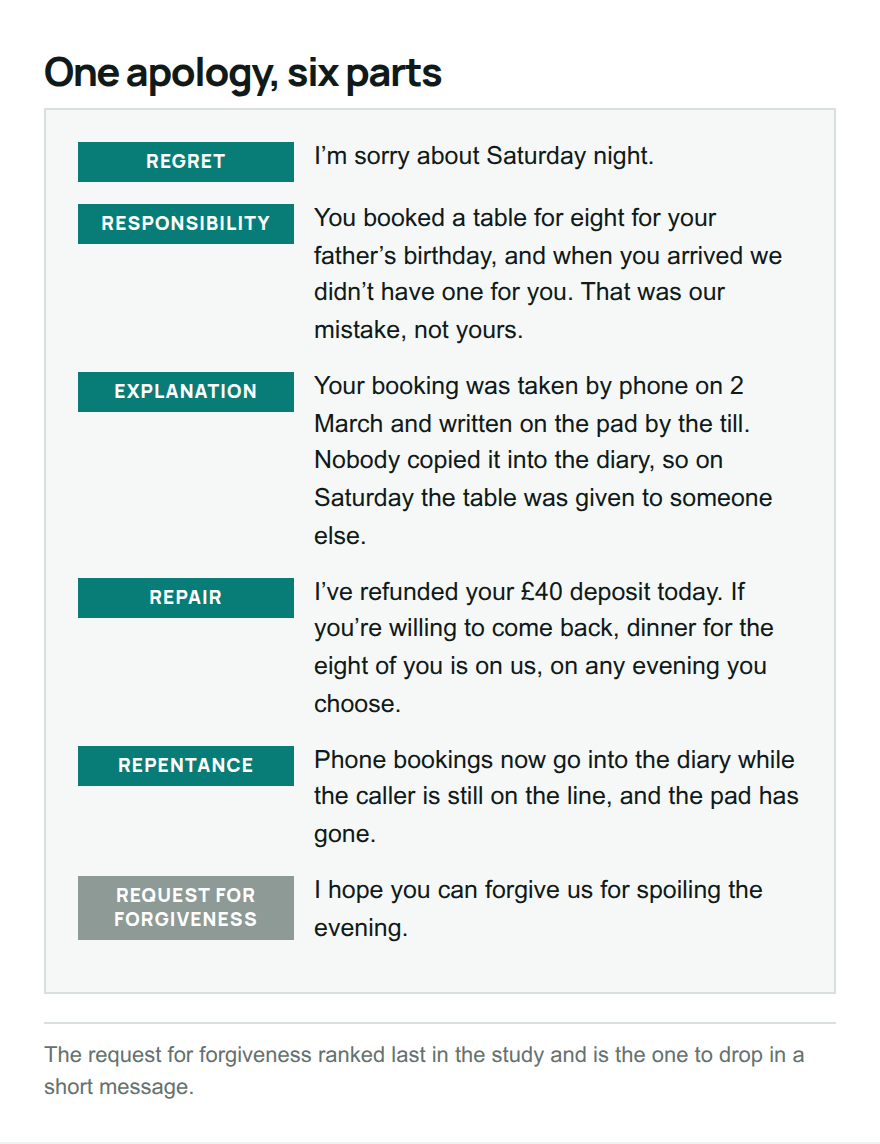
I’m sorry about Saturday night. You booked a table for eight for your father’s birthday, and when you arrived we didn’t have one for you. That was our mistake, not yours.
Your booking was taken by phone on 2 March and written on the pad by the till. Nobody copied it into the diary, so on Saturday the table was given to someone else.
I’ve refunded your £40 deposit today. If you’re willing to come back, dinner for the eight of you is on us, on any evening you choose. Phone bookings now go into the diary while the caller is still on the line, and the pad has gone.
I hope you can forgive us for spoiling the evening.
Tomas Vale, owner
In order: regret, responsibility, explanation, repair, repentance, request for forgiveness. The regret names the night. The explanation is fact, with no “unfortunately”. The repentance describes a change already made: “it won’t happen again” is a promise you may not keep, and “the pad has gone” is something done.
An apology can have legal weight, and the rules differ from place to place. In England and Wales, section 2 of the Compensation Act 2006 says an apology “shall not of itself amount to an admission of negligence or breach of statutory duty”. If the mistake is serious, such as an injury or a large loss, check what applies where you are before you admit liability in writing.
What you can drop in a text or a chat reply
The study’s ranking gives the first cut and the last two to keep. The advice on the middle three is my judgment, since the study found them about level.
- Request for forgiveness: drop it. It ranked last in both experiments. I would drop it from most emails as well. It asks the customer to do something for you at the moment you owe them.
- Repentance: drop it unless you’ve changed something and can say what in a few words.
- Explanation: cut it to a clause, or drop it. In chat the customer can ask.
- Regret: keep it. It costs two words, and without it the message reads as a status update.
- Responsibility and repair: these can’t go. They ranked first and second, and responsibility is the one the templates lose.
Ms Rahman, this is Tomas at Vale’s. We lost your booking on Saturday and that was our mistake. I’m sorry. I’ve refunded your £40 deposit, and dinner for your eight is on us whenever you’d like to come back.
If you can’t write the repair sentence because the customer wants a refund and the answer is no, that is a different message. See how to refuse a refund without starting an argument.