How to Write Opening Hours Without Leaving Customers Guessing


Set an opening and a closing time for each day, or tick Closed, add a break if you close for one, and the form below writes your hours out twice: once with am and pm, once with the 24-hour clock. Copy whichever suits the door, the website footer or a printed notice.
Write your opening hours
For a day you never close, enter 00:00 as both the opening and the closing time. Runs in your browser; nothing you enter is sent anywhere.
What the builder writes
We ran the builder’s code on 24 sets of hours to see what comes out. It follows the rules the rest of this page argues for.
- Days are written in full, starting on Monday, and days next to each other with the same hours share a line: “Monday to Friday: 9am to 5:30pm”, “Saturday and Sunday: closed”. When all seven days match, the line starts “Every day”.
- Every range uses the word “to”. The builder never writes a dash.
- 12:00 becomes “12 noon”. A closing time of 00:00 becomes “midnight”, and so does an opening time of 00:00 in the version with am and pm. It never writes 12am or 12pm.
- A closing time after midnight gets “the next morning”: “Friday: 6pm to 2am the next morning”.
- A break gives two sessions joined with “and”: “Monday to Friday: 9am to 12:30pm and 1:30pm to 5:30pm”.
- 00:00 in both boxes means open 24 hours.
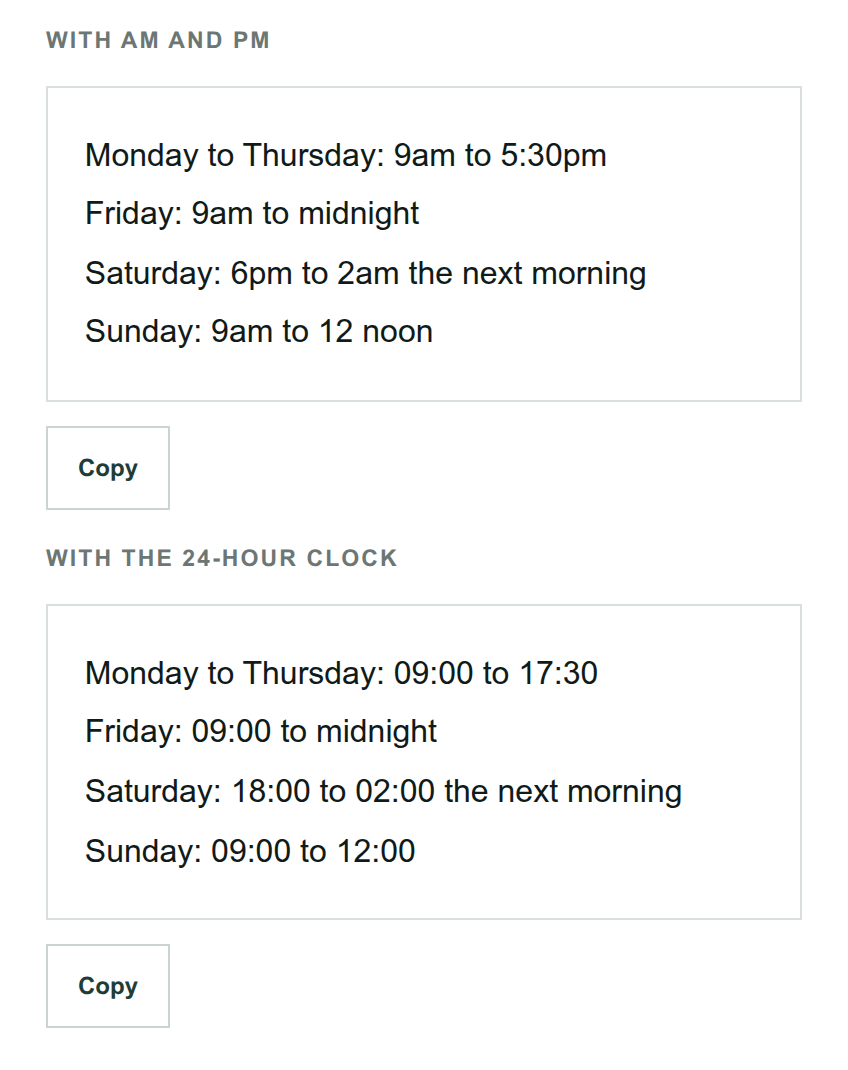
One thing to check before you copy. A closing time earlier than the opening time is always written as an overnight opening, so if you swap the two boxes by mistake you get “5:30pm to 9am the next morning”. When the closing time is after 06:00 a note above the result asks you to check the two times. At 06:00 or earlier there is no note.
What it can’t write, and how to write it yourself
The form takes regular weekly hours, with one break a day at most. Anything else you add by hand.
- Public holidays. “Closed on public holidays.” Before each one, add a dated line: “Friday 24 December 2027: 9am to 1pm”.
- Seasonal hours. Give dates: “1 April to 30 September: 9am to 7pm”, then “1 October to 31 March: 9am to 5pm”. “Summer hours” leaves the customer to work out whether mid-September counts.
- Appointments only. “Saturday: by appointment only. Phone or email to book.”
- A cut-off before closing time. “Monday to Sunday: 10am to 5pm. Last entry 4pm.”
- A narrow space. “Mon to Fri: 9am to 5:30pm”. Shorten the days, keep “to” and keep am and pm.
- A list that starts on Sunday. Move the Sunday line to the top. If the builder gave you “Saturday and Sunday”, split it into two lines first.
A notice for the days you are closed
A closure needs its own notice, and it goes wrong in one place: “closed until the 16th” does not say whether the 16th is the last day shut or the first day open. Give the form the first day you are closed and the first day you are open again. It writes the notice at four sizes, for the door, the website, a text message and an automatic reply, and each one names the day you reopen.
Write a notice that you are closed
Runs in your browser. Nothing you type is sent anywhere.
Forms that get misread
- 12am, 12pm. Which one is midnight? Write “midnight”, and “12 noon” or “midday”.
- 6-2, 7-7, 10-6. Which number is morning and which is evening? Write “6am to 2pm”.
- Open until midnight Friday. The start of Friday or the end of it? Write “Friday: 5pm to midnight”.
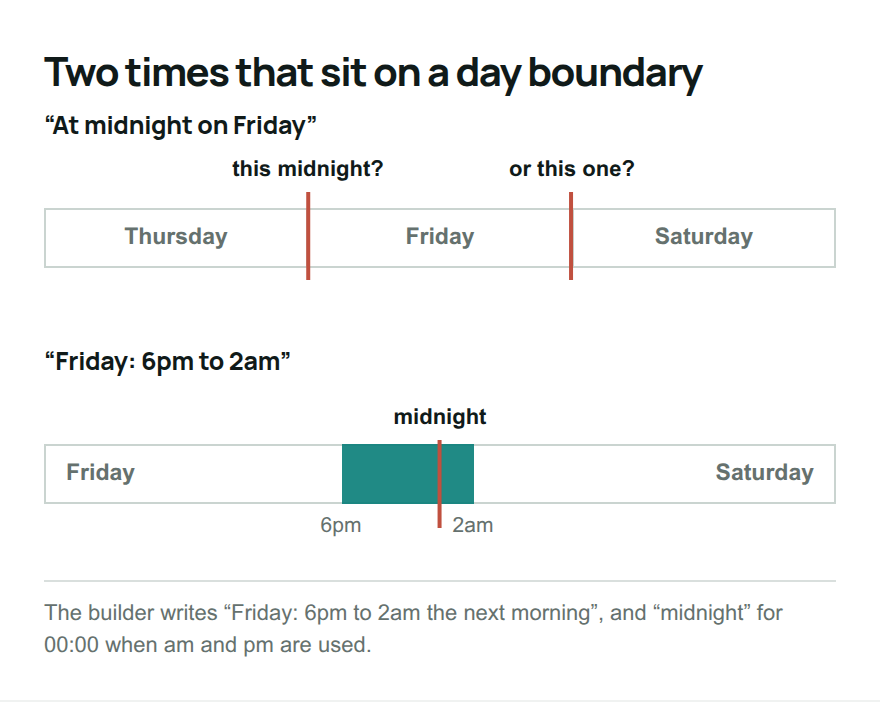
- Friday: 6pm to 2am. Does 2am belong to Friday or to Saturday morning? Write “Friday: 6pm to 2am the next morning”.
- Until late. When should a customer stop expecting to be let in? Give a time. If it varies, give the earliest you ever close: “to at least 11pm”.
- Last orders 9pm, last entry 4pm. Is that also when you close? Give both times, each labelled.
- Closed until Monday. Open on Monday, or shut on Monday too? “Until” does not say whether the named day is included. Name the day you open again and the time: “We reopen on Monday 1 March at 9am”.
- New hours: open till 6. From which day? A notice about new hours is read both before and after the change, so it needs the first day they apply, with the weekday and the year: “From Monday 1 March 2027: 9am to 6pm”. Take the notice down once that day has passed.
- 24/7. Does that include public holidays? Write “Open 24 hours, every day of the year”, or name the days you close.
- 9am to 5pm, for customers in other countries. Whose 9am? Name the place the hours belong to. GOV.UK’s example is “Monday to Friday, 8am to 5pm UK time”.
Four of these need more than a line.
12am and 12pm
The letters stand for ante meridiem and post meridiem, Latin for “before noon” and “after noon”, and that is the whole problem. The US standards institute, NIST, explains it in its Times of Day FAQ: “Since noon is neither before noon nor after noon, a designation of either a.m. or p.m. is incorrect”, and midnight is twelve hours from the noon on either side of it. Its conclusion is that “12 a.m. and 12 p.m. are ambiguous and should not be used”, and its example is business hours: “8 a.m. to noon” and “3:30 p.m. until midnight”.
The GOV.UK style guide avoids both as well, and it is stricter about what to write in their place. Its entry reads “midday (not 12 noon, noon or 12pm)”. The builder writes “12 noon” all the same. That was my decision and I’d make it again: in a column of opening times, “9am to 12 noon” keeps a number where the eye is looking for one. If you follow GOV.UK, change it to “midday”. Either is clear. “12pm” is the one that isn’t.
Midnight on which day
NIST points out that “at midnight on Friday” can mean the midnight that starts Friday or the one that ends it. In opening hours the opening time settles it: “Friday: 5pm to midnight” can only be the midnight at the end of Friday. The problem comes back when midnight stands alone, as in “open until midnight Friday” or a deadline. For a single time, GOV.UK suggests 11:59pm.
Bare numbers
“Mon-Fri 9-5” is safe because nine to five is a set phrase. A bakery that writes “6-2” and a bar that writes “6-2” mean opposite halves of the day, and the customer has to know which kind of business they are looking at. Adding am and pm costs four characters.
The dash
We found no evidence that customers misread “Mon-Fri” as stopping at Thursday, so we won’t claim it. The case for “to” is that it reads the same everywhere a dash might not: in a line like “Mon-Fri 9-5” the dash is doing two jobs, and a hyphen, an en dash and a minus sign are easy to mix up when you type the hours in several places. GOV.UK’s rule for times is “use ‘to’ in time ranges, not hyphens, en rules or em dashes”.
Google Business Profile
You don’t paste text into a Google Business Profile. You pick times in its own form, and Google’s help pages show how to enter each case: two entries for the same day for a break, a 24 hours option, and special hours for holidays, where Google says it is “a good idea to confirm your hours for official holidays, even if they’re the same as your regular hours”. Whatever you enter there should match the door.
Corrected on 7 October 2026: a line in the diagram of the two midnights said the builder writes “midnight” only as the end of an opening. With am and pm it writes “midnight” for an opening time of 00:00 as well, as the list under “What the builder writes” says. The diagram was redrawn.