How Long Is a Normal Work Email?

Half of the work emails we counted were 23 words or shorter. Three quarters were under 50 words, and nine in ten were under 100. If your draft runs past 150 words it is longer than 95% of them, and past 356 it is longer than 99%.
Those figures come from 79,569 emails that employees of one American company sent, mostly in 2000 and 2001. They describe what people sent. They say nothing about which emails got read or answered, and the company and the period are a real limit, set out below. Paste your own email here to see where it falls.
How long is your email?
Runs in your browser. Your text is not sent anywhere or stored.
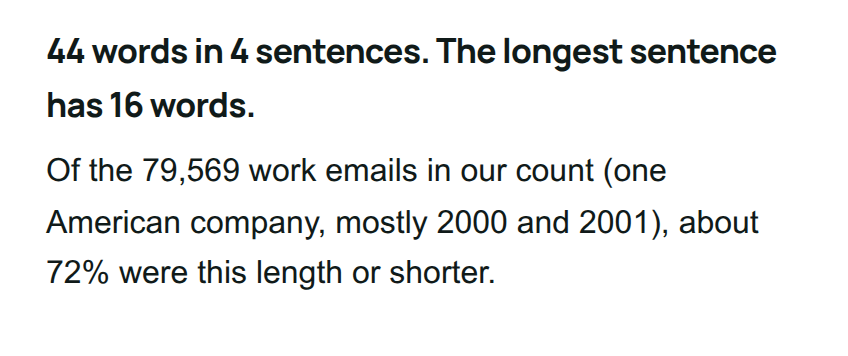
Paste only what you wrote, without the message you are replying to, since that is how the emails were counted. The example comes out at 44 words in 4 sentences, with about 72% of the counted emails that length or shorter. Above 356 words the tool says only “more than 99%”, because that is where our figures stop being worth splitting.
The count
In full: 10% of the emails were no longer than 5 words, 25% no longer than 11, half no longer than 23, 75% no longer than 49, 90% no longer than 94, 95% no longer than 143 and 99% no longer than 356.
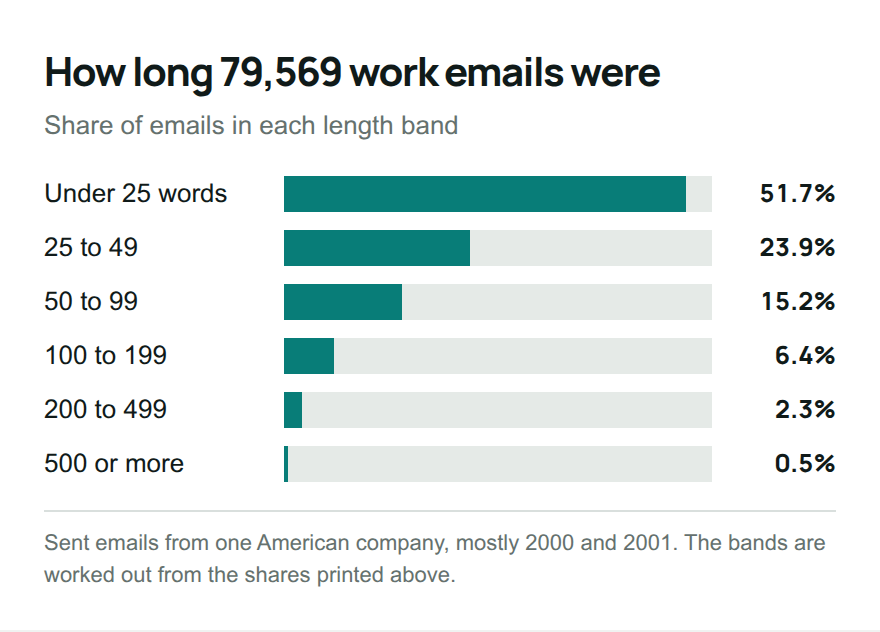
Counted the other way round, 51.7% were under 25 words, 75.6% under 50, 90.8% under 100, 97.2% under 200 and 99.5% under 500.
The average is 49.1 words, about twice the median, and it is the wrong number to use. A small number of very long messages pull it up: the longest 1% of emails contain 22% of all the words. 426 emails ran over 500 words, 122 over 1,000 and 27 over 2,000.
We read the start and the middle of the 30 longest to see what they were. Three were long messages the sender had written. Twenty were pasted press articles, notices or web pages, usually under a line or two from the sender. Three were pasted documents: two drafts of a contract and the text of a brochure. Four were data tables, a software export or a list of addresses. So the top of the range is mostly not writing at all, and the percentiles above 95 overstate how much people typed.
It is not a few heavy senders
The emails come from 148 mailboxes, and the ten largest hold 38% of them, so we checked whether a few people set the result. They don’t. In 122 of the 148 mailboxes the median is between 15 and 40 words, and with the ten largest mailboxes removed, the median of the remaining 49,684 emails is 23 words, the same as with them.
Sentences
Join lines that are separated by a single line break, then count only stretches of text that end in a full stop, question mark or exclamation mark. By that rule the median email has 2 sentences, a quarter have 4 or more, and 7% have none at all. The median sentence is 9 words long. A quarter are 16 words or longer, and 7.6% are over 25 words. Abbreviations with a full stop split a sentence in two under this rule, so real sentences are slightly longer than that. The tool at the top of the page is looser: it also ends a sentence at every line break, so “Thanks” and your name each count as one, and by its rule the median email has 4 sentences.
How it was counted, and the limits
The source is the Enron email dataset distributed by Carnegie Mellon University, in the version dated 7 May 2015. The CMU page describes it as data from about 150 users, “mostly senior management of Enron”, about half a million messages, made public by the US Federal Energy Regulatory Commission during its investigation of the company. It contains no attachments, and some messages were removed at the request of employees.
From that archive we took only the messages in each mailbox’s own sent folders (the folders named sent, sent_items and _sent_mail): 125,683 files. From each one we kept the text above the first quoted reply or forwarded message, using a rule that looks for the usual markers (an “Original Message” or “Forwarded by” line, a block of From and To headers, lines starting with >, and the name and date that the company’s mail program, Lotus Notes, put above a quoted message). 16,186 messages had no words left after that, for example a forward with nothing typed above it, and were dropped. 29,928 exact duplicates were dropped as well, because the same message is often filed in more than one folder. That leaves 79,569 emails from 148 mailboxes. A word is an unbroken run of letters and digits, with an apostrophe or hyphen allowed inside it. Percentiles are nearest-rank.
What this cannot tell you:
- It is one company, an American energy company, and the mailboxes are weighted towards senior staff. A support desk or a law firm may write differently.
- It is old. The dates on the sent messages run from 1998 to 2002, and 92% are from 2000 and 2001. Much of what was a one-line email then is a chat message now, so today’s emails may well be longer on average. We have no public data of this size to check that with.
- Repeats are left out, which makes the figures run slightly long. We removed duplicates by their text alone. Of the 29,928 removed, 24,360 were one message filed twice. The other 5,568 were the same words sent on another day or by another person, and most of those are one-line replies: 4,266 are five words or shorter. Counting them puts the median at 22 words, not 23, and the share under 25 words at 54.6%.
- Signatures, pasted documents and automatic footers are still in the text and are counted as words.
- The cutting rule knows the usual marks of a quoted message and can still miss an unusual one. Every miss adds another person’s words to the count, at the long end most of all.
- About 1.4% of the emails contain leftover encoding marks that add stray “words”. Removing them moves the 75th percentile from 49 to 48 and the 99th from 356 to 355, and leaves the others where they are.
- There are no attachments, so an email that says “see attached” is counted as two words even if a ten-page report went with it.
Where “50 to 125 words” comes from
Search for this question and you will meet a range: 50 to 125 words. It comes from a blog post Boomerang published on 12 February 2016, a company that sells an email add-on which reminds you when a message has had no reply. We read the post. This is what it says.
Boomerang’s customers had asked for a reminder on “over 40 million emails” in the past year, and the post draws its findings from those. On length: emails of 50 to 125 words “yielded response rates above 50%”; the rate “declined slowly from 50% for 125-word messages to about 44% for 500-word messages”, stayed flat to about 2,000 words, and fell below 35% above 2,500. A 25-word email had “only a 44% chance of getting a response”. In the comments under the post, Boomerang’s reply to a reader says a response means a reply to the message, not an open or a click.
Three things follow from reading it rather than the retellings.
- The effect is small. Between the best range and a 500-word email the reported difference is about six percentage points. The post itself says “you shouldn’t worry too much if you need a few extra” and to “include everything you need for the message to be complete”.
- The emails are not ordinary emails. They are messages a sender marked because a reply mattered, sent by users of one product. The post does not say how many of the 40 million were analysed, how words were counted, or what kinds of message they were.
- It is a correlation. Short emails and long emails are different kinds of message sent to different people, and the post does not separate length from that. A note added at the top says the post led to a Boomerang feature that scores your draft as you write.
Retellings drift. One of the ranking pages we opened reports the figure as a click-through rate of just over 50%. The original measured replies, and has nothing to say about clicks.
Set against our count, the range looks odd as a rule for everyone: 76% of the emails here were under 50 words, and only 18% were between 50 and 125. Most work email is a short answer to something, and it is short because the answer is short.
What to do with this
What I take from the count is permission, not a target. If the answer is twelve words long, twelve words is a normal email, and padding it out to look thorough makes it less normal, not more.
The count tells you whether your email is unusually long. It does not tell you whether it is too long, because nothing here measures what happened after the email was sent. A 300-word email that a reader needs is fine. It is also rare, so the reader will not be expecting it.
The rest of this section is my advice, not a finding. If the email has to be long, put what you want from the reader in the first two lines: the decision, the date, the question. Someone who reads no further should still be able to act. Then give the detail underneath for the reader who needs it. If the length comes from softening rather than from content, sorting the softeners that carry politeness from the ones that hide the request will shorten it more usefully than a word limit will.
Corrected on 8 October 2026: the page said duplicates were dropped because the same message is often filed in more than one folder. That accounts for most of them. The rest were the same words sent on another day or by another person, mostly one-line replies, and the limits now say what counting them does to the median.
Corrected on 9 October 2026: every figure on this page was counted again. The rule that cuts an email off above the message it replies to had left two lines of that message, the other person’s name and a date, in about 15% of the emails, and they were counted as words the sender had typed. With them removed the median is 23 words, not 25; 75% of the emails are no longer than 49 words, not 50; 99% are no longer than 356, not 382; and the count is of 79,569 emails, not 80,338. The tool and both pictures use the new figures.