Menu Descriptions That Tell the Customer What They’re Getting

Here is one line from a menu, written the way a lot of cafe menus are written, and the same dish rewritten.
Before
Pan-Fried Sea Bass
Fresh fillet of sea bass pan-fried to perfection, served on a bed of crushed new potatoes with a medley of seasonal vegetables and drizzled with lemon butter.
After
Sea bass
Pan-fried fillet, crushed new potatoes, leeks, lemon butter
Contains: fish, milk
The first version is 27 words and the second is 8, plus an allergen line. The second also says more: it names the vegetable and tells a customer with a milk allergy what “butter” left them to work out.
The rest of this page does the same to a whole menu. The cafe doesn’t exist: we made up twelve dishes, wrote them the way a lot of cafe menus are written, and then rewrote every one by the method set out between the two versions.
The menu before
Our Famous Homemade Granola
A delicious medley of toasted oats, nuts and seeds, nestled on a bed of creamy Greek yoghurt and drizzled with local honey.Farm Fresh Eggs Benedict
Perfectly poached free-range eggs served with succulent ham on a toasted muffin, smothered in our signature hollandaise sauce.Smashed Avocado Delight
Fresh, ripe avocado lovingly smashed and served on artisan sourdough with a sprinkling of chilli flakes and a zesty squeeze of lime.Homemade Soup of the Day
A hearty, warming bowl of our chef’s freshly prepared soup, made with love and the best produce. Ask your server for today’s delicious choice!Classic Caesar Salad
Crisp cos lettuce tossed in our authentic Caesar dressing with crunchy croutons, shavings of parmesan and tender chargrilled chicken breast.Gourmet Fish Finger Sandwich
Golden, hand-battered fish goujons nestled in thick-cut bloomer bread with lashings of tangy homemade tartare sauce.Croque Monsieur
A French classic! Simply the best sandwich in town.Pan-Fried Sea Bass
Fresh fillet of sea bass pan-fried to perfection, served on a bed of crushed new potatoes with a medley of seasonal vegetables and drizzled with lemon butter.Confit de Canard
Melt-in-the-mouth duck, slow-cooked the traditional way and nestled on a bed of Puy lentils, finished with a piquant mustard dressing.Wild Mushroom Risotto
A creamy, indulgent risotto of the finest wild mushrooms, finished with a drizzle of truffle oil. Simply delicious!Decadent Chocolate Brownie
A rich, gooey, indulgent homemade brownie served warm with a scoop of luxury vanilla ice cream and drizzled with chocolate sauce.Affogato
The perfect end to any meal.
That is 223 words of description. Count the dish names as well and “fresh” or “freshly” appears four times, “homemade” four times and “delicious” three. Four dishes involve a drizzle and three are nestled. The granola doesn’t say which nuts, the sea bass doesn’t say which vegetables, and the affogato doesn’t say what an affogato is.
The order for each description
Every rewritten item answers four questions, in this order.
- What is the dish? This is the name line. Use the plain name a customer would say when ordering: “Sea bass”, not “Pan-Fried Sea Bass”.
- What is the main ingredient, exactly? Haddock, not “fish”. Hazelnuts, not “nuts”. Chestnut and oyster mushrooms, not “wild mushrooms”.
- How is it cooked? One word usually does it: poached, chargrilled, battered. The avocado isn’t cooked, so its line has no method.
- What is the one detail that sets it apart? For the Caesar salad it is the anchovy dressing. For the brownie it is the walnuts. If you can’t find one, the description is finished without it.
Then stop. What comes with the dish goes in as plain nouns separated by commas.
If you only have time for one of the four, I’d make it the second. I think naming the ingredient exactly did more for this menu than any other change: haddock, hazelnuts and leeks are three words, and each one answers a question a customer would otherwise have to ask at the counter.
A length limit
We set two limits for this menu: 30 characters for the name, not counting the dietary mark, and 70 characters, spaces included, for the description. Seventy characters is about a dozen words. It is nobody’s rule. It is what fitted one line of our card, so to find yours, type your longest description into the menu template at print size and see whether it stays on one line.
A limit forces the choice in step 4: in 70 characters you can’t keep “tender”, “crisp” and “crunchy” and also name the dressing. We checked every rewritten description with a short script: the longest are the Caesar salad and the duck, both exactly 70 characters, and the twelve descriptions total 125 words against 223 before.
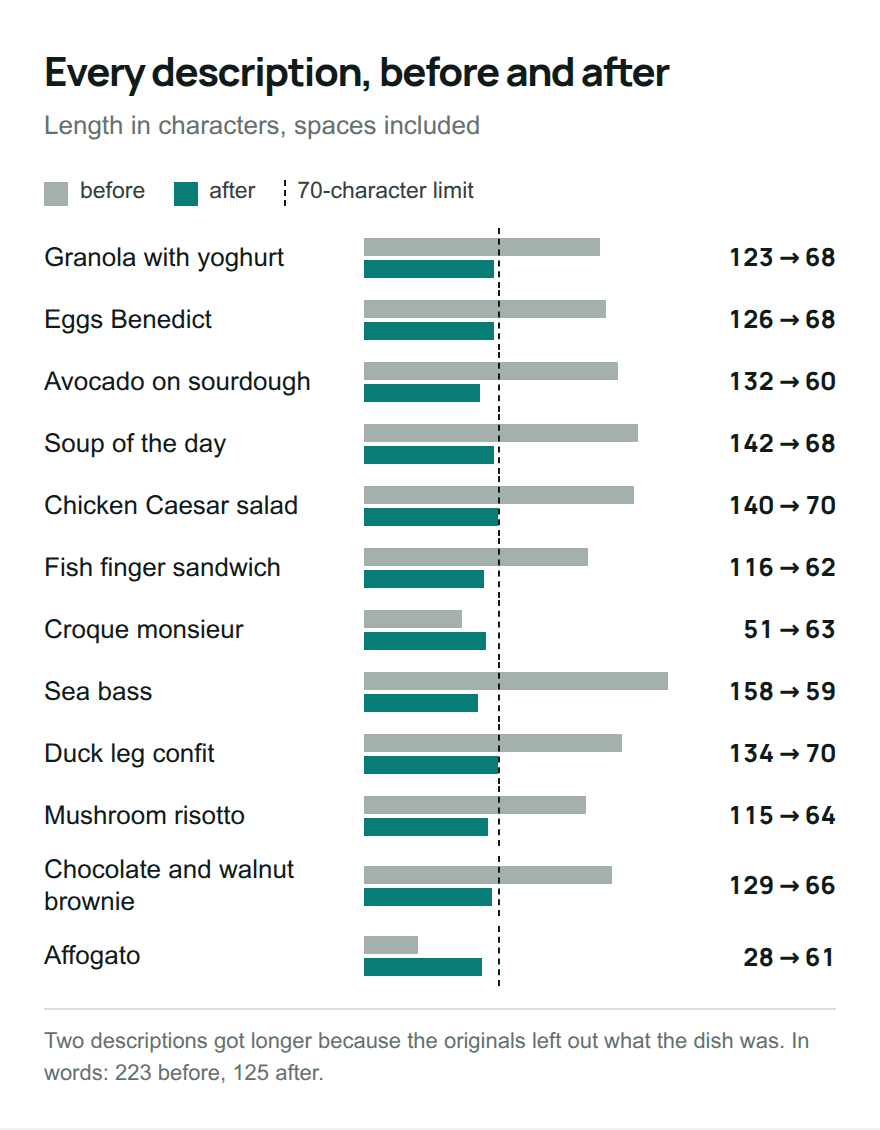
Two of them got longer. “A French classic!” and “The perfect end to any meal” were short and told the customer nothing, so the rewrite had to add the information that was never there. The limit is a ceiling, not an instruction to cut.
Words that carry no information
The test is whether the customer knows something after reading the word that they didn’t know before. The words that fail it come in five kinds.
- Praise: delicious, tasty, succulent, tender, melt-in-the-mouth, indulgent, decadent, “to perfection”. This is the kitchen’s opinion of its own food, given before anyone has tasted it. Cut it and leave the method alone: “pan-fried”, “poached”. Words for how a thing is prepared can stay: “crushed”, “battered”.
- Labels nobody can check: our famous, signature, classic, gourmet, artisan. Cut them, or give the fact behind the label: the bakery’s name, the cheese, the cut.
- Plating words: drizzled, nestled, on a bed of, smothered in, lashings of, served with, accompanied by. They say where the food sits on the plate, and everything on the line is served. “With”, “on”, “in” or a comma does the same work.
- Words that hide a list: a medley of, a selection of, seasonal vegetables. The customer wanted the list: “leeks”, “carrots and kale”.
- “Fresh” and “homemade”: no customer assumes the food is stale, so keep “fresh” only where it separates two things you could have served, such as fresh pasta against dried. “Homemade” is a claim about where the food was made and vague about which part. If it’s true, say what is made on the premises: “Baked here”, “Made here each morning”.
None of this bans adjectives. “Toasted”, “chargrilled” and “warm” all tell the customer something, which is why the brownie in the rewritten menu is still “served warm”. Keep the words that describe the food and cut the ones that praise it.
When a foreign or kitchen term needs a gloss
Ask whether a customer who doesn’t know the word can still tell what will arrive. There are three cases.
- The term is the dish’s name and there is no plain name. Keep it and make the description do the explaining. “Croque monsieur” stays, followed by “Toasted ham and Gruyère sandwich, baked with white sauce on top”. “Affogato” stays, followed by what it is.
- A plain word exists and means the same. Use it. “Goujons” became “strips”. “Confit de Canard” became “Duck leg confit”, with the description saying what confit means.
- The term is ordinary on menus like yours. Leave it alone. We left “hollandaise”, “espresso” and “sourdough” unglossed. That is a judgment about your customers, not a rule.
I should say where I stand on the first case, because not everyone agrees with it. I come to this as a translator, and my bias is to leave a dish its own name. “Croque monsieur” is what the thing is called. “Toasted ham and cheese sandwich” is only what it is made of. So the name stays and the line under it does the explaining.
Where allergens and dietary marks go
The same place on every item. In the rewrite, the dietary mark follows the name and the allergens get their own line under the description, starting with the word “Contains”.
Keep allergens out of the descriptive sentence. A customer may or may not connect “parmesan” with milk. “Contains: milk” leaves nothing to connect.
The law depends on where you trade, so check your own country’s rules. For England, Wales and Northern Ireland, the Food Standards Agency says that if you sell non-prepacked food you must supply allergen information for every item that contains any of 14 listed allergens, either in writing on a menu, chalkboard or information pack, or verbally with a written notice saying how to get it. Its separate best practice guidance for non-prepacked food, which is voluntary, gives the format we used here. Its example is “Chicken Salad (Contains: milk, egg, mustard)”. It also says that when allergens are given in words, the specific nut or cereal should be named, which is why our lines say “hazelnuts”, “walnuts” and “wheat” and not “nuts” or “gluten”. If you use symbols, the same guidance says each needs the allergen’s name as part of it or a key on the menu.
Dietary marks shouldn’t stand in for the allergen line. Print their key on every page of the menu. “V” and “VG” differ by one character, so if there’s room, spell out “vegan” in full.
The “Contains” lines below are examples written for an invented menu, based only on the ingredients named in each description. A real allergen line has to come from your own recipes and the labels of the products you buy in.
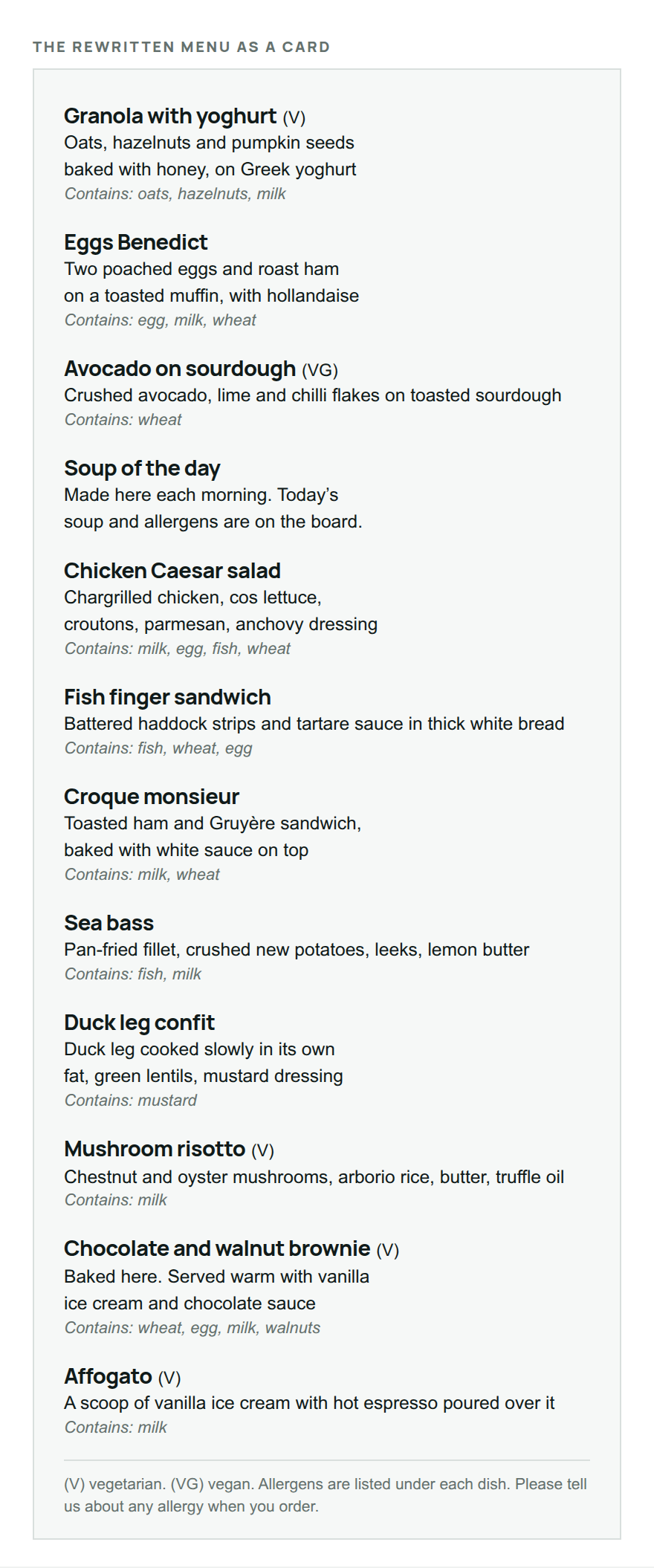
The menu after
Granola with yoghurt (V)
Oats, hazelnuts and pumpkin seeds baked with honey, on Greek yoghurt
Contains: oats, hazelnuts, milkEggs Benedict
Two poached eggs and roast ham on a toasted muffin, with hollandaise
Contains: egg, milk, wheatAvocado on sourdough (VG)
Crushed avocado, lime and chilli flakes on toasted sourdough
Contains: wheatSoup of the day
Made here each morning. Today’s soup and allergens are on the board.Chicken Caesar salad
Chargrilled chicken, cos lettuce, croutons, parmesan, anchovy dressing
Contains: milk, egg, fish, wheatFish finger sandwich
Battered haddock strips and tartare sauce in thick white bread
Contains: fish, wheat, eggCroque monsieur
Toasted ham and Gruyère sandwich, baked with white sauce on top
Contains: milk, wheatSea bass
Pan-fried fillet, crushed new potatoes, leeks, lemon butter
Contains: fish, milkDuck leg confit
Duck leg cooked slowly in its own fat, green lentils, mustard dressing
Contains: mustardMushroom risotto (V)
Chestnut and oyster mushrooms, arborio rice, butter, truffle oil
Contains: milkChocolate and walnut brownie (V)
Baked here. Served warm with vanilla ice cream and chocolate sauce
Contains: wheat, egg, milk, walnutsAffogato (V)
A scoop of vanilla ice cream with hot espresso poured over it
Contains: milk(V) vegetarian. (VG) vegan. Allergens are listed under each dish. Please tell us about any allergy when you order.
Three changes you can’t see from the two menus
Soup of the day. A printed menu can’t know today’s soup, so the line says only what stays true and sends the allergen question to the board, where the answer changes with the soup.
Caesar salad. The anchovies were always in the dressing. “Authentic” was sitting where they should have been named, and a customer who doesn’t eat fish had no way to tell.
Brownie. The walnuts were in the recipe and nowhere in the old description. They went into the name, which is the part every customer reads.
Will the plainer menu sell more?
We don’t know. We haven’t tested it. The aim here is narrower: a customer can tell what will arrive, and someone with an allergy can find what they need.
Many guides to menu writing say that longer, more evocative descriptions raise sales. One paper commonly cited for this is “Descriptive Menu Labels’ Effect on Sales” by Wansink, Painter and van Ittersum, published in the Cornell Hotel and Restaurant Administration Quarterly in 2001. When we checked, neither its Crossref record nor the Retraction Watch database showed a retraction or correction for it. But a 2005 paper by the same three authors, on how descriptive food names affect what diners say they taste, was corrected in 2017, and in 2018 the JAMA journals retracted six other papers by Wansink after Cornell told the editors it could not assure them the results were valid. The 2001 paper stands unretracted. I still wouldn’t plan a menu around it.
Corrected on 8 October 2026: the count of dishes described as “nestled” in the first menu was given as two. It is three: the granola, the fish finger sandwich and the duck. The counts of “fresh” and “homemade” include the dish names, which the article now says.